Direct test
• DirectAssessment refers to any method of collecting data that
requires students to demonstrate a knowledge, skill, or behavior.
• A test item is direct if it asks candidates to perform the
communicative skill which is being tested.
Indirect test
• refers to any method of collecting data that requires reflection on
student learning, skills, or behaviors, rather than a demonstration of
it.
• try to measure a student's knowledge and ability by getting at what
lies beneath their receptive and productive skills.
3.
• In manyproficiency tests where students sit a number of different
papers, there is a mixture of direct and indirect, discrete-point and
integrative testing. Test designers find that this combination gives a
good overall picture of student ability. Placement tests often use
discrete-point testing to measure students against an existing
language syllabus, but may then compare this with more direct and
integrative tasks to get a fuller picture.
4.
• Indirect testitem types
Although there is a wide range of indirect test possibilities, certain
types are in common use:
• Multiple choice questions (MCQs): a traditional vocabulary multiple
choice question looks like this:
The journalist was ___ by enemy fire as he tried to send a story by
radio.
A wronged B wounded C injured D damaged
For many years MCQs were considered to be ideal test instruments for
measuring students' knowledge of grammar and vocabulary. Above all
this was because they were easy to mark, and since the advent of
computers the answer books for these tests can be read by machines,
not people, thereby cutting out the possibility of scorer error.
5.
Cloze procedures:
• clozeprocedures seem to offer us the ideal indirect but integrative
testing item. They can be prepared quickly and if the claims made for
them are true, they are an extremely cost-effective way of finding out
about a testee's overall knowledge.
• Cloze, in its purest form, is the deletion of every nth word in a text
(somewhere between every fifth or tenth word). Because the
procedure is random, it avoids test designer failings. It produces test
items like this:
They sat on a bench attached 1 _____ a picnic table. Below them they
2_____ see the river gurgling between overgrown 3______ . The sky
was diamond blue, with 4_____ white clouds dancing in the freshening
5______ . They could hear the call of 6_____ and the buzzing of
countless insects. 7_____ were completely alone.
6.
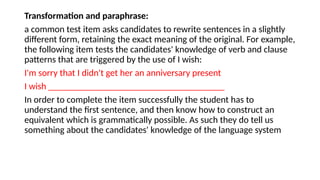
Transformation and paraphrase:
acommon test item asks candidates to rewrite sentences in a slightly
different form, retaining the exact meaning of the original. For example,
the following item tests the candidates' knowledge of verb and clause
patterns that are triggered by the use of I wish:
I'm sorry that I didn't get her an anniversary present
I wish ______________________________________
In order to complete the item successfully the student has to
understand the first sentence, and then know how to construct an
equivalent which is grammatically possible. As such they do tell us
something about the candidates' knowledge of the language system
7.
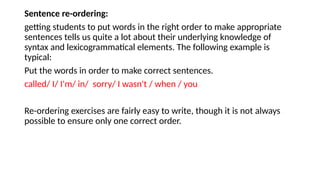
Sentence re-ordering:
getting studentsto put words in the right order to make appropriate
sentences tells us quite a lot about their underlying knowledge of
syntax and lexicogrammatical elements. The following example is
typical:
Put the words in order to make correct sentences.
called/ I/ I'm/ in/ sorry/ I wasn't / when / you
Re-ordering exercises are fairly easy to write, though it is not always
possible to ensure only one correct order.
8.
Direct test itemtypes
• Replicate real-life interaction: in real life when people speak or write
they generally do so with some real purpose. Yet traditional writing
tests have often been based exclusively on general essay questions,
and speaking tests often included hypothetical questions about what
candidates might say if they happened to be in a certain situation.
More modem test writers now include tasks which attempt to
replicate features of real life (Weir 1993: 167). They will often look
similar to the kind of speaking activities described in Chapter 19. Tests
of reading and listening should also, as far as possible, reflect real life.
This means that texts should be as realistic as possible, even where
they are not authentic