Hector Del Castillo
AIPMM
linkd.in/hdelcastillo
What We Will Discuss
1.   What is cloud security
2.   Current situation
3.   Dimensions of cloud security
4.   Security risks
5.   Critical areas
6.   Approaches to reduce risk
7.   Key takeaways
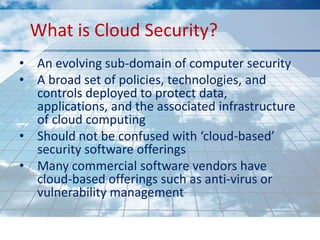
What is Cloud Security?
• An evolving sub-domain of computer security
• A broad set of policies, technologies, and
  controls deployed to protect data,
  applications, and the associated infrastructure
  of cloud computing
• Should not be confused with ‘cloud-based’
  security software offerings
• Many commercial software vendors have
  cloud-based offerings such as anti-virus or
  vulnerability management
Current Situation
• Analysts estimate that cloud computing
  adoption will continue to rapidly increase
• A single, massive cloud data center contains
  more computers than were on the entire
  internet just a few years ago
• Security experts agree that the number of
  attacks and their level of sophistication will
  continue to grow
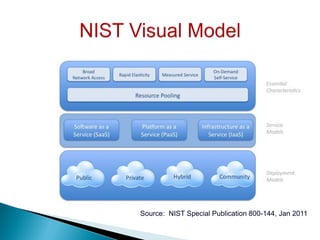
Source: NIST Special Publication 800-144, Jan 2011
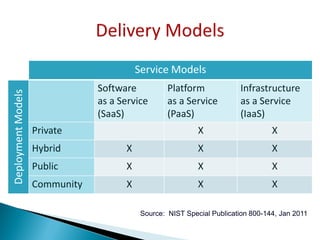
Service Models
                                Software           Platform             Infrastructure
Deployment Models


                                as a Service       as a Service         as a Service
                                (SaaS)             (PaaS)               (IaaS)
                    Private                                 X                     X
                    Hybrid            X                     X                     X
                    Public            X                     X                     X
                    Community         X                     X                     X

                                           Source: NIST Special Publication 800-144, Jan 2011
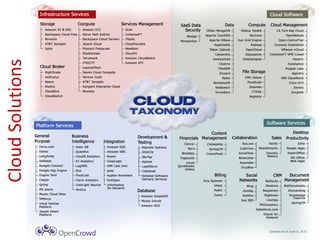
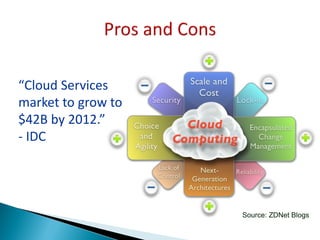
Cloud Solutions
“Cloud Services
market to grow to
$42B by 2012.”
- IDC


                    Source: ZDNet Blogs
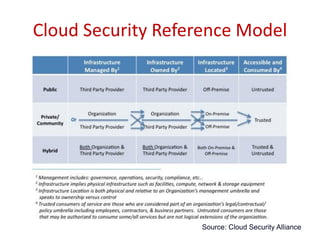
Cloud Security Reference Model


                   Source: Cloud Security Alliance
Dimensions of Cloud Security
• Security and Privacy
  – Data protection
  – Identity management
  – Physical and personnel security
  – Availability
  – Application security
  – Privacy

            Source: "Cloud Security Front and Center,” Forrester Research, 2009.
Dimensions of Cloud Security
• Compliance
  – Business continuity and data recovery
  – Logs and audit trails
  – Unique compliance requirements


            Source: "Cloud Security Front and Center,” Forrester Research, 2009.
Dimensions of Cloud Security
• Legal or Contractual Issues
  – Public records


            Source: "Cloud Security Front and Center,” Forrester Research, 2009.
Security Risks
1.   Privileged user access
2.   Regulatory compliance
3.   Data location
4.   Data segregation
5.   Recovery
6.   Investigative support
7.   Long-term viability
          Source: “Assessing the Security Risks of Cloud Computing,” Gartner, 2008.
Critical Areas
• Cloud Architecture
     – Cloud Computing Architectural Framework


Source: "Security Guidance for Critical Areas of Focus in Cloud Computing V2.1,” CSA, 2009.
Critical Areas
• Governing in the Cloud
     –   Governance and Enterprise Risk Management
     –   Legal and Electronic Discovery
     –   Compliance and Audit
     –   Information Lifecycle Management
     –   Portability and Interoperability


Source: "Security Guidance for Critical Areas of Focus in Cloud Computing V2.1,” CSA, 2009.
Critical Areas
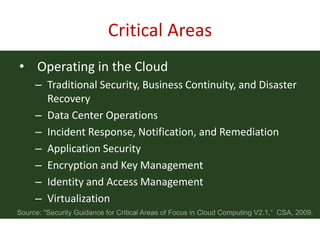
• Operating in the Cloud
     – Traditional Security, Business Continuity, and Disaster
       Recovery
     – Data Center Operations
     – Incident Response, Notification, and Remediation
     – Application Security
     – Encryption and Key Management
     – Identity and Access Management
     – Virtualization
Source: "Security Guidance for Critical Areas of Focus in Cloud Computing V2.1,” CSA, 2009.
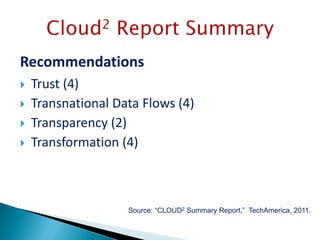
Recommendations
   Trust (4)
   Transnational Data Flows (4)
   Transparency (2)
   Transformation (4)


                    Source: “CLOUD2 Summary Report,” TechAmerica, 2011.
Approaches to Reduce Risk
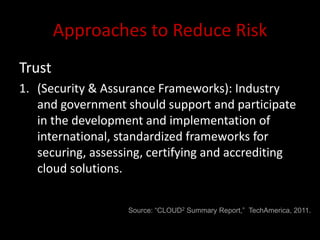
Trust
1. (Security & Assurance Frameworks): Industry
   and government should support and participate
   in the development and implementation of
   international, standardized frameworks for
   securing, assessing, certifying and accrediting
   cloud solutions.


                   Source: “CLOUD2 Summary Report,” TechAmerica, 2011.
Approaches to Reduce Risk
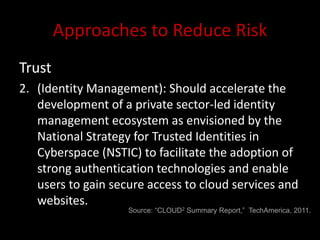
Trust
2. (Identity Management): Should accelerate the
   development of a private sector-led identity
   management ecosystem as envisioned by the
   National Strategy for Trusted Identities in
   Cyberspace (NSTIC) to facilitate the adoption of
   strong authentication technologies and enable
   users to gain secure access to cloud services and
   websites.
                    Source: “CLOUD2 Summary Report,” TechAmerica, 2011.
Approaches to Reduce Risk
Trust
3. (Responses to Data Breaches): Government
   should enact a national data breach law to
   clarify breach notification responsibilities and
   commitments of companies to their customers,
   and also update and strengthen criminal laws
   against those who attack computer systems and
   networks, including cloud computing services.
                    Source: “CLOUD2 Summary Report,” TechAmerica, 2011.
Approaches to Reduce Risk
Trust
4. (Research): Government, industry, and
   academia should develop and execute a joint
   cloud computing research agenda.


                  Source: “CLOUD2 Summary Report,” TechAmerica, 2011.
Approaches to Reduce Risk
Transnational Data Flows
5. (Privacy): The U.S. government and industry
   should promote a comprehensive,
   technology-neutral privacy framework,
   consistent with commonly accepted privacy
   and data protection principles-based
   frameworks such as the OECD principles
   and/or APEC privacy frameworks.
                  Source: “CLOUD2 Summary Report,” TechAmerica, 2011.
Approaches to Reduce Risk
Transnational Data Flows
6. (Government/Law Enforcement Access to
   Data): The U.S. government should
   demonstrate leadership in identifying and
   implementing mechanisms for lawful access
   by law enforcement or government to data
   stored in the cloud.

                 Source: “CLOUD2 Summary Report,” TechAmerica, 2011.
Approaches to Reduce Risk
Transnational Data Flows
7. (E-Discovery and Forensics): Government
   and industry should enable effective
   practices for collecting information from the
   cloud to meet forensic or e-discovery needs
   in ways that fully support legal due process
   while minimizing impact on cloud provider
   operations.
                   Source: “CLOUD2 Summary Report,” TechAmerica, 2011.
Approaches to Reduce Risk
Transnational Data Flows
8. (Lead by Example): The U.S. government
   should demonstrate its willingness to trust
   cloud computing environments in other
   countries for appropriate government
   workloads.


                  Source: “CLOUD2 Summary Report,” TechAmerica, 2011.
Approaches to Reduce Risk
Transparency
9. (Transparency): Industry should publicly
   disclose information about relevant
   operational aspects of their cloud services,
   including portability, interoperability,
   security, certifications, performance and
   reliability.

                   Source: “CLOUD2 Summary Report,” TechAmerica, 2011.
Approaches to Reduce Risk
Transparency
10. (Data Portability): Cloud providers should
    enable portability of user data through
    documents, tools, and support for agreed-
    upon industry standards and best practices.


                  Source: “CLOUD2 Summary Report,” TechAmerica, 2011.
Approaches to Reduce Risk
Transformation
11. (Federal Acquisition and Budgeting):
    Agencies should demonstrate flexibility in
    adapting existing procurement models to
    facilitate acquisition of cloud services and
    solutions. Congress and OMB should
    demonstrate flexibility in changing budget
    models to help agencies acquire cloud
    services and solutions.
                   Source: “CLOUD2 Summary Report,” TechAmerica, 2011.
Approaches to Reduce Risk
Transformation
12. (Incentives): Government should establish
    policies and processes for providing fiscal
    incentives, rewards and support for agencies
    as they take steps towards implementing
    cloud deployments.


                  Source: “CLOUD2 Summary Report,” TechAmerica, 2011.
Approaches to Reduce Risk
Transformation
13. (Improve Infrastructure): Government and
    industry should embrace the modernization
    of broadband infrastructure and the current
    move to IPv6 to improve the bandwidth and
    reliable connectivity necessary for the
    growth of cloud services.

                  Source: “CLOUD2 Summary Report,” TechAmerica, 2011.
Approaches to Reduce Risk
Transformation
14. (Education/Training): Government, industry,
    and academia should develop and
    disseminate resources for major stakeholder
    communities to be educated on the
    technical, business, and policy issues around
    acquisition, deployment and operation of
    cloud services.
                   Source: “CLOUD2 Summary Report,” TechAmerica, 2011.
Key Takeaways
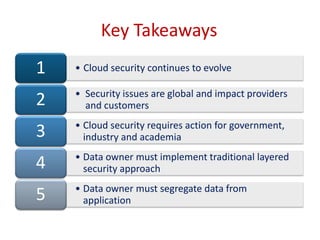
1   • Cloud security continues to evolve

    • Security issues are global and impact providers
2     and customers
    • Cloud security requires action for government,
3     industry and academia
    • Data owner must implement traditional layered
4     security approach
    • Data owner must segregate data from
5     application
Recommended AFCOM Sessions
1. "DCM18: Securing the Virtualized Environment,”
   Robert Klotz, Akibia, 2011.
2. "DCP10: How Social Media and the Cloud Impact
   Data Center Security,” James Danburg, SA2, 2011.
3. "Cloud07: Managing the Transition Cloud,” Brent
   Eubanks, Latisys, 2011.
4. "Cloud04: The Ins and Outs of Virtual Private
   Clouds,” Sundar Raghavan, Skytap, 2011.
Recommended Reading
1. “Assessing the Security Risks of Cloud Computing,”
   Gartner, 3 June 2008.
2. "Cloud Security Front and Center,” Forrester Research,
   18 Nov 2009.
3. "Security Guidance for Critical Areas of Focus in Cloud
   Computing V2.1,” Cloud Security Alliance, 2009.
4. “Guidelines on Security and Privacy in Public Cloud
   Computing, NIST Special Publication 800-144, Jan 2011.
5. “Summary Report of the Commission on the Leadership
   Opportunity in U.S. Deployment of the Cloud,”
   TechAmerica Foundation, July 2011.
Join My Professional Network!


Hector Del Castillo, PMP, CPM, CPMM
         linkd.in/hdelcastillo
      hmdelcastillo@aipmm.com

Cloud01: Best Practices for Virtual Cloud Security - H. Del Castillo, AIPMM

  • 1.
  • 2.
    What We WillDiscuss 1. What is cloud security 2. Current situation 3. Dimensions of cloud security 4. Security risks 5. Critical areas 6. Approaches to reduce risk 7. Key takeaways
  • 3.
    What is CloudSecurity? • An evolving sub-domain of computer security • A broad set of policies, technologies, and controls deployed to protect data, applications, and the associated infrastructure of cloud computing • Should not be confused with ‘cloud-based’ security software offerings • Many commercial software vendors have cloud-based offerings such as anti-virus or vulnerability management
  • 4.
    Current Situation • Analystsestimate that cloud computing adoption will continue to rapidly increase • A single, massive cloud data center contains more computers than were on the entire internet just a few years ago • Security experts agree that the number of attacks and their level of sophistication will continue to grow
  • 5.
    Source: NIST SpecialPublication 800-144, Jan 2011
  • 6.
    Service Models Software Platform Infrastructure Deployment Models as a Service as a Service as a Service (SaaS) (PaaS) (IaaS) Private X X Hybrid X X X Public X X X Community X X X Source: NIST Special Publication 800-144, Jan 2011
  • 7.
  • 8.
    “Cloud Services market togrow to $42B by 2012.” - IDC Source: ZDNet Blogs
  • 9.
    Cloud Security ReferenceModel Source: Cloud Security Alliance
  • 10.
    Dimensions of CloudSecurity • Security and Privacy – Data protection – Identity management – Physical and personnel security – Availability – Application security – Privacy Source: "Cloud Security Front and Center,” Forrester Research, 2009.
  • 11.
    Dimensions of CloudSecurity • Compliance – Business continuity and data recovery – Logs and audit trails – Unique compliance requirements Source: "Cloud Security Front and Center,” Forrester Research, 2009.
  • 12.
    Dimensions of CloudSecurity • Legal or Contractual Issues – Public records Source: "Cloud Security Front and Center,” Forrester Research, 2009.
  • 13.
    Security Risks 1. Privileged user access 2. Regulatory compliance 3. Data location 4. Data segregation 5. Recovery 6. Investigative support 7. Long-term viability Source: “Assessing the Security Risks of Cloud Computing,” Gartner, 2008.
  • 14.
    Critical Areas • CloudArchitecture – Cloud Computing Architectural Framework Source: "Security Guidance for Critical Areas of Focus in Cloud Computing V2.1,” CSA, 2009.
  • 15.
    Critical Areas • Governingin the Cloud – Governance and Enterprise Risk Management – Legal and Electronic Discovery – Compliance and Audit – Information Lifecycle Management – Portability and Interoperability Source: "Security Guidance for Critical Areas of Focus in Cloud Computing V2.1,” CSA, 2009.
  • 16.
    Critical Areas • Operatingin the Cloud – Traditional Security, Business Continuity, and Disaster Recovery – Data Center Operations – Incident Response, Notification, and Remediation – Application Security – Encryption and Key Management – Identity and Access Management – Virtualization Source: "Security Guidance for Critical Areas of Focus in Cloud Computing V2.1,” CSA, 2009.
  • 17.
    Recommendations  Trust (4)  Transnational Data Flows (4)  Transparency (2)  Transformation (4) Source: “CLOUD2 Summary Report,” TechAmerica, 2011.
  • 18.
    Approaches to ReduceRisk Trust 1. (Security & Assurance Frameworks): Industry and government should support and participate in the development and implementation of international, standardized frameworks for securing, assessing, certifying and accrediting cloud solutions. Source: “CLOUD2 Summary Report,” TechAmerica, 2011.
  • 19.
    Approaches to ReduceRisk Trust 2. (Identity Management): Should accelerate the development of a private sector-led identity management ecosystem as envisioned by the National Strategy for Trusted Identities in Cyberspace (NSTIC) to facilitate the adoption of strong authentication technologies and enable users to gain secure access to cloud services and websites. Source: “CLOUD2 Summary Report,” TechAmerica, 2011.
  • 20.
    Approaches to ReduceRisk Trust 3. (Responses to Data Breaches): Government should enact a national data breach law to clarify breach notification responsibilities and commitments of companies to their customers, and also update and strengthen criminal laws against those who attack computer systems and networks, including cloud computing services. Source: “CLOUD2 Summary Report,” TechAmerica, 2011.
  • 21.
    Approaches to ReduceRisk Trust 4. (Research): Government, industry, and academia should develop and execute a joint cloud computing research agenda. Source: “CLOUD2 Summary Report,” TechAmerica, 2011.
  • 22.
    Approaches to ReduceRisk Transnational Data Flows 5. (Privacy): The U.S. government and industry should promote a comprehensive, technology-neutral privacy framework, consistent with commonly accepted privacy and data protection principles-based frameworks such as the OECD principles and/or APEC privacy frameworks. Source: “CLOUD2 Summary Report,” TechAmerica, 2011.
  • 23.
    Approaches to ReduceRisk Transnational Data Flows 6. (Government/Law Enforcement Access to Data): The U.S. government should demonstrate leadership in identifying and implementing mechanisms for lawful access by law enforcement or government to data stored in the cloud. Source: “CLOUD2 Summary Report,” TechAmerica, 2011.
  • 24.
    Approaches to ReduceRisk Transnational Data Flows 7. (E-Discovery and Forensics): Government and industry should enable effective practices for collecting information from the cloud to meet forensic or e-discovery needs in ways that fully support legal due process while minimizing impact on cloud provider operations. Source: “CLOUD2 Summary Report,” TechAmerica, 2011.
  • 25.
    Approaches to ReduceRisk Transnational Data Flows 8. (Lead by Example): The U.S. government should demonstrate its willingness to trust cloud computing environments in other countries for appropriate government workloads. Source: “CLOUD2 Summary Report,” TechAmerica, 2011.
  • 26.
    Approaches to ReduceRisk Transparency 9. (Transparency): Industry should publicly disclose information about relevant operational aspects of their cloud services, including portability, interoperability, security, certifications, performance and reliability. Source: “CLOUD2 Summary Report,” TechAmerica, 2011.
  • 27.
    Approaches to ReduceRisk Transparency 10. (Data Portability): Cloud providers should enable portability of user data through documents, tools, and support for agreed- upon industry standards and best practices. Source: “CLOUD2 Summary Report,” TechAmerica, 2011.
  • 28.
    Approaches to ReduceRisk Transformation 11. (Federal Acquisition and Budgeting): Agencies should demonstrate flexibility in adapting existing procurement models to facilitate acquisition of cloud services and solutions. Congress and OMB should demonstrate flexibility in changing budget models to help agencies acquire cloud services and solutions. Source: “CLOUD2 Summary Report,” TechAmerica, 2011.
  • 29.
    Approaches to ReduceRisk Transformation 12. (Incentives): Government should establish policies and processes for providing fiscal incentives, rewards and support for agencies as they take steps towards implementing cloud deployments. Source: “CLOUD2 Summary Report,” TechAmerica, 2011.
  • 30.
    Approaches to ReduceRisk Transformation 13. (Improve Infrastructure): Government and industry should embrace the modernization of broadband infrastructure and the current move to IPv6 to improve the bandwidth and reliable connectivity necessary for the growth of cloud services. Source: “CLOUD2 Summary Report,” TechAmerica, 2011.
  • 31.
    Approaches to ReduceRisk Transformation 14. (Education/Training): Government, industry, and academia should develop and disseminate resources for major stakeholder communities to be educated on the technical, business, and policy issues around acquisition, deployment and operation of cloud services. Source: “CLOUD2 Summary Report,” TechAmerica, 2011.
  • 32.
    Key Takeaways 1 • Cloud security continues to evolve • Security issues are global and impact providers 2 and customers • Cloud security requires action for government, 3 industry and academia • Data owner must implement traditional layered 4 security approach • Data owner must segregate data from 5 application
  • 33.
    Recommended AFCOM Sessions 1."DCM18: Securing the Virtualized Environment,” Robert Klotz, Akibia, 2011. 2. "DCP10: How Social Media and the Cloud Impact Data Center Security,” James Danburg, SA2, 2011. 3. "Cloud07: Managing the Transition Cloud,” Brent Eubanks, Latisys, 2011. 4. "Cloud04: The Ins and Outs of Virtual Private Clouds,” Sundar Raghavan, Skytap, 2011.
  • 34.
    Recommended Reading 1. “Assessingthe Security Risks of Cloud Computing,” Gartner, 3 June 2008. 2. "Cloud Security Front and Center,” Forrester Research, 18 Nov 2009. 3. "Security Guidance for Critical Areas of Focus in Cloud Computing V2.1,” Cloud Security Alliance, 2009. 4. “Guidelines on Security and Privacy in Public Cloud Computing, NIST Special Publication 800-144, Jan 2011. 5. “Summary Report of the Commission on the Leadership Opportunity in U.S. Deployment of the Cloud,” TechAmerica Foundation, July 2011.
  • 35.
    Join My ProfessionalNetwork! Hector Del Castillo, PMP, CPM, CPMM linkd.in/hdelcastillo hmdelcastillo@aipmm.com