Extending Security in the Cloud
       Steven Wolford                      Chad Walter
Director, Information Security   Director, Channel Development
            6fusion                     Network Box USA
Today’s Agenda


•   Introduction
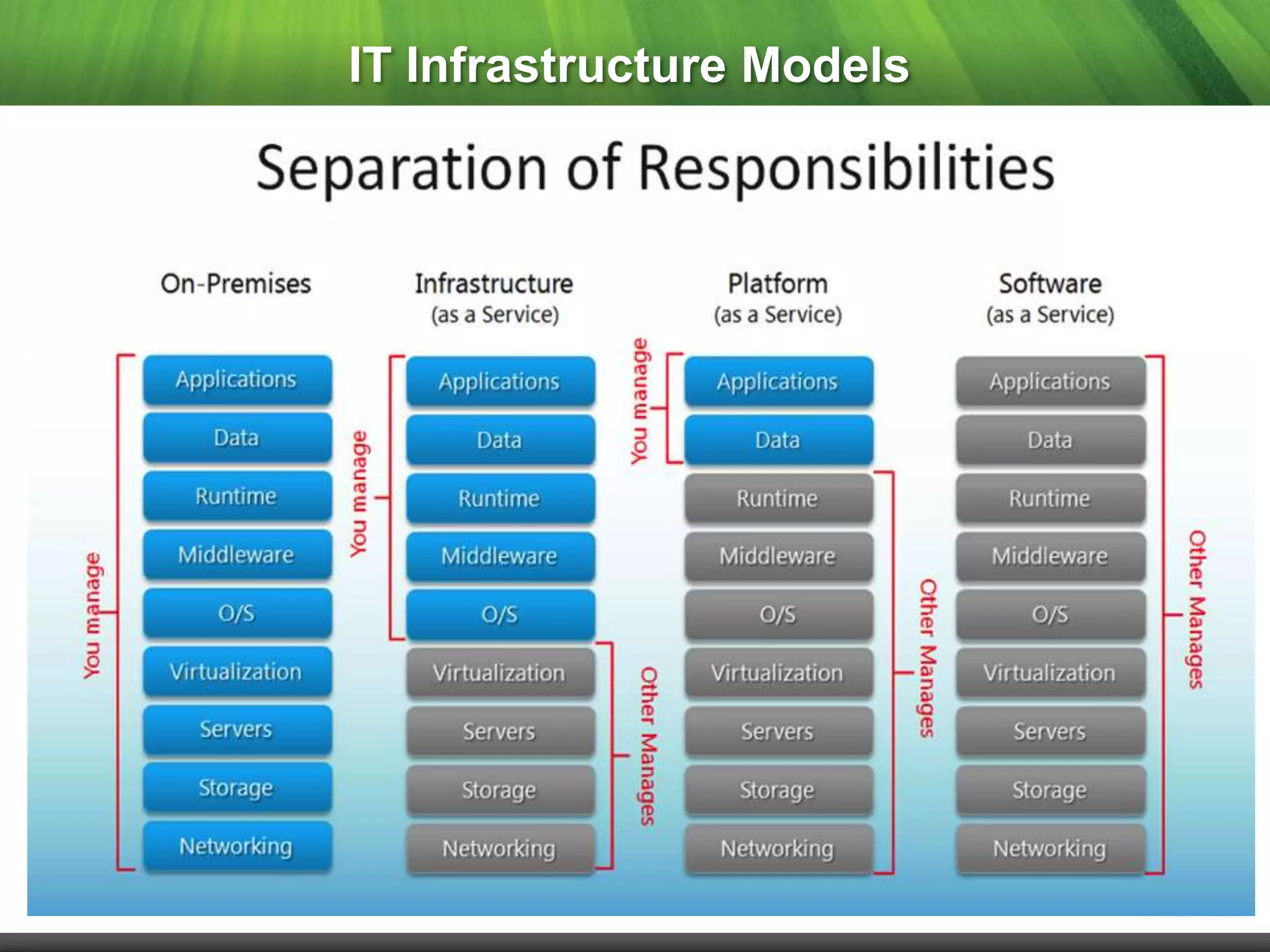
•   IT Infrastructure Models
•   Common Cloud Security Myths
•   Cloud Security Basics
•   Cloud Security Challenges
    •   Access
    •   Protection
    •   Segregation
    •   Recovery
• Cloud Security Best Practices
Who We Are

                  6fusion                                    Network Box USA
6fusion provides a utility-metered cloud             Network Box USA provides
platform that enables global workload                comprehensive, fully managed perimeter
distribution by turning public, private and          internet security solutions. The Network Box
hybrid clouds into pay-per-use billable utilities.   Unified Threat Management (UTM) solution
The unique metering algorithm, Workload              combines numerous applications such as
Allocation Cube (WAC), creates a commercial          firewall, intrusion prevention and
standard to quantify supply and demand for           detection, anti-virus, content filtering, anti-
compute resources.                                   span, anti-phishing, anti-spyware and VPN into
                                                     one single, sophisticated mix of hardware and
                                                     software. Network Box USA enables
                                                     businesses of all sizes to secure their networks
                                                     easily and cost effectively.


  This is the first in a series of webinars on cloud security. We will let you
     shape the content of the next webinar at the end of this webinar.
IT Infrastructure Models
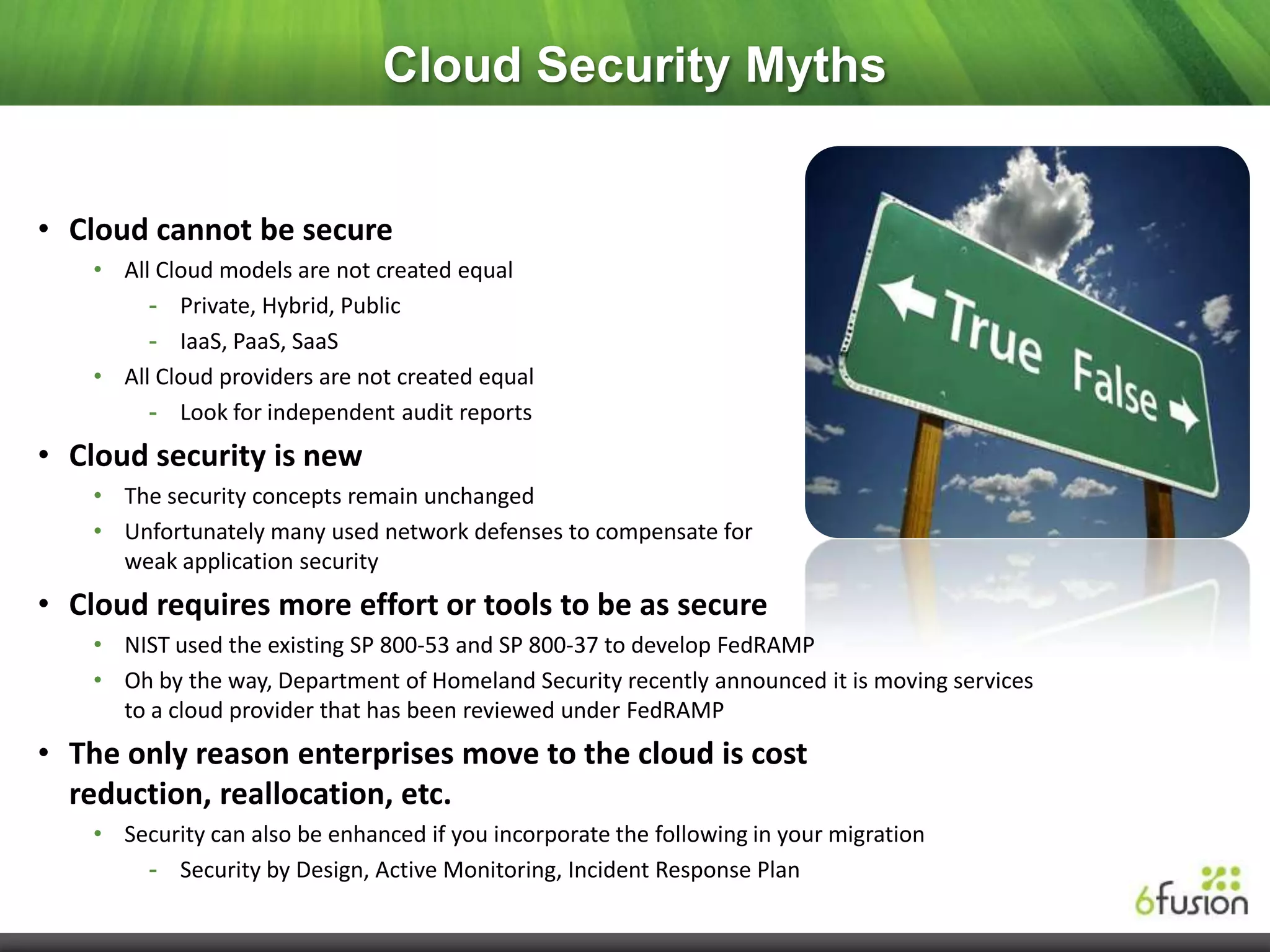
Cloud Security Myths


• Cloud cannot be secure
    • All Cloud models are not created equal
         - Private, Hybrid, Public
         - IaaS, PaaS, SaaS
    • All Cloud providers are not created equal
         - Look for independent audit reports
• Cloud security is new
    • The security concepts remain unchanged
    • Unfortunately many used network defenses to compensate for
      weak application security
• Cloud requires more effort or tools to be as secure
    • NIST used the existing SP 800-53 and SP 800-37 to develop FedRAMP
    • Oh by the way, Department of Homeland Security recently announced it is moving services
      to a cloud provider that has been reviewed under FedRAMP
• The only reason enterprises move to the cloud is cost
  reduction, reallocation, etc.
    • Security can also be enhanced if you incorporate the following in your migration
        - Security by Design, Active Monitoring, Incident Response Plan
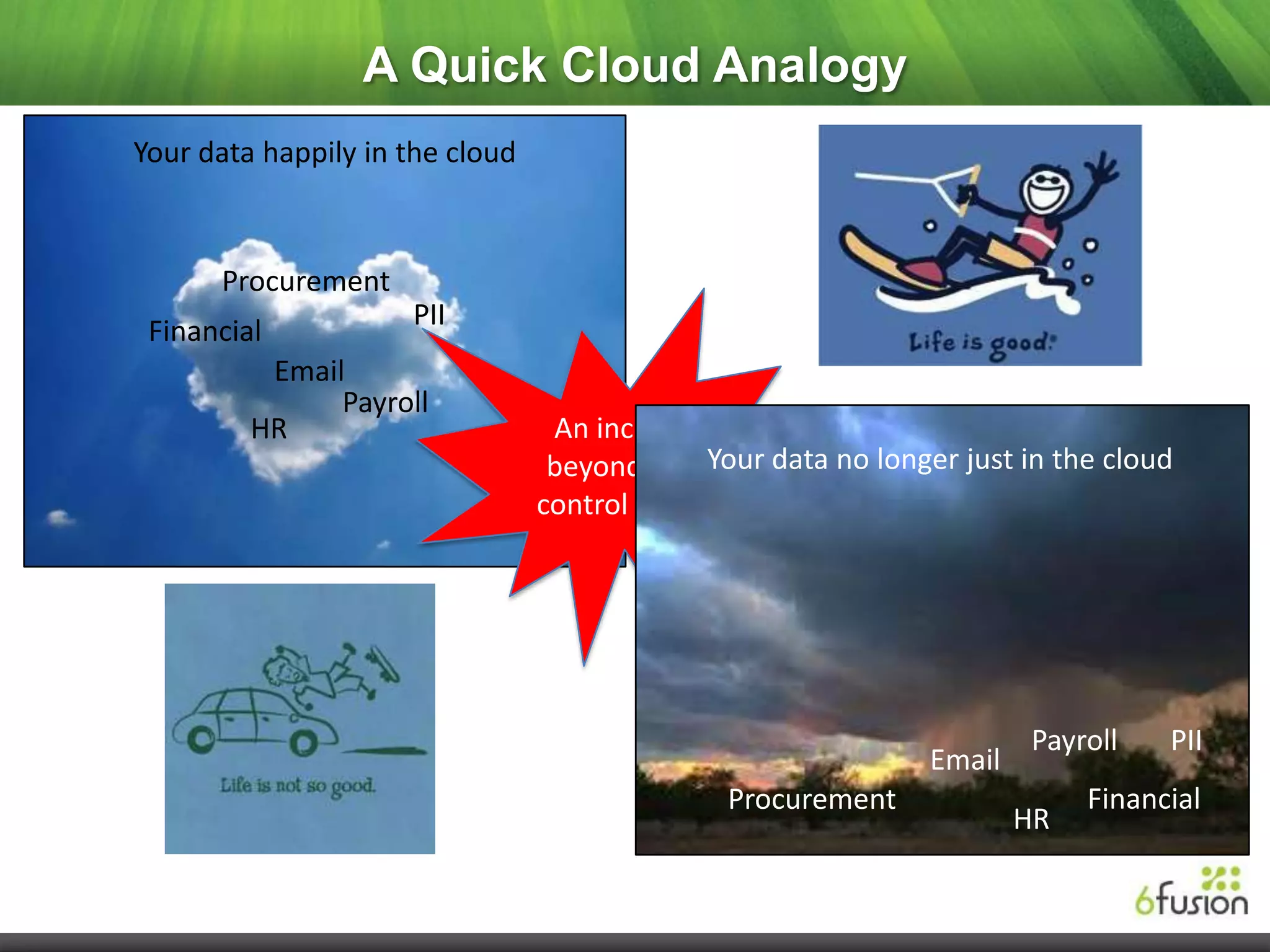
A Quick Cloud Analogy
Your data happily in the cloud


      Procurement
                     PII
 Financial
          Email
               Payroll
         HR                       An incident
                                  beyond yourYour data no longer just in the cloud
                                 control occurs


                                                                       Payroll    PII
                                                               Email
                                               Procurement                  Financial
                                                                       HR
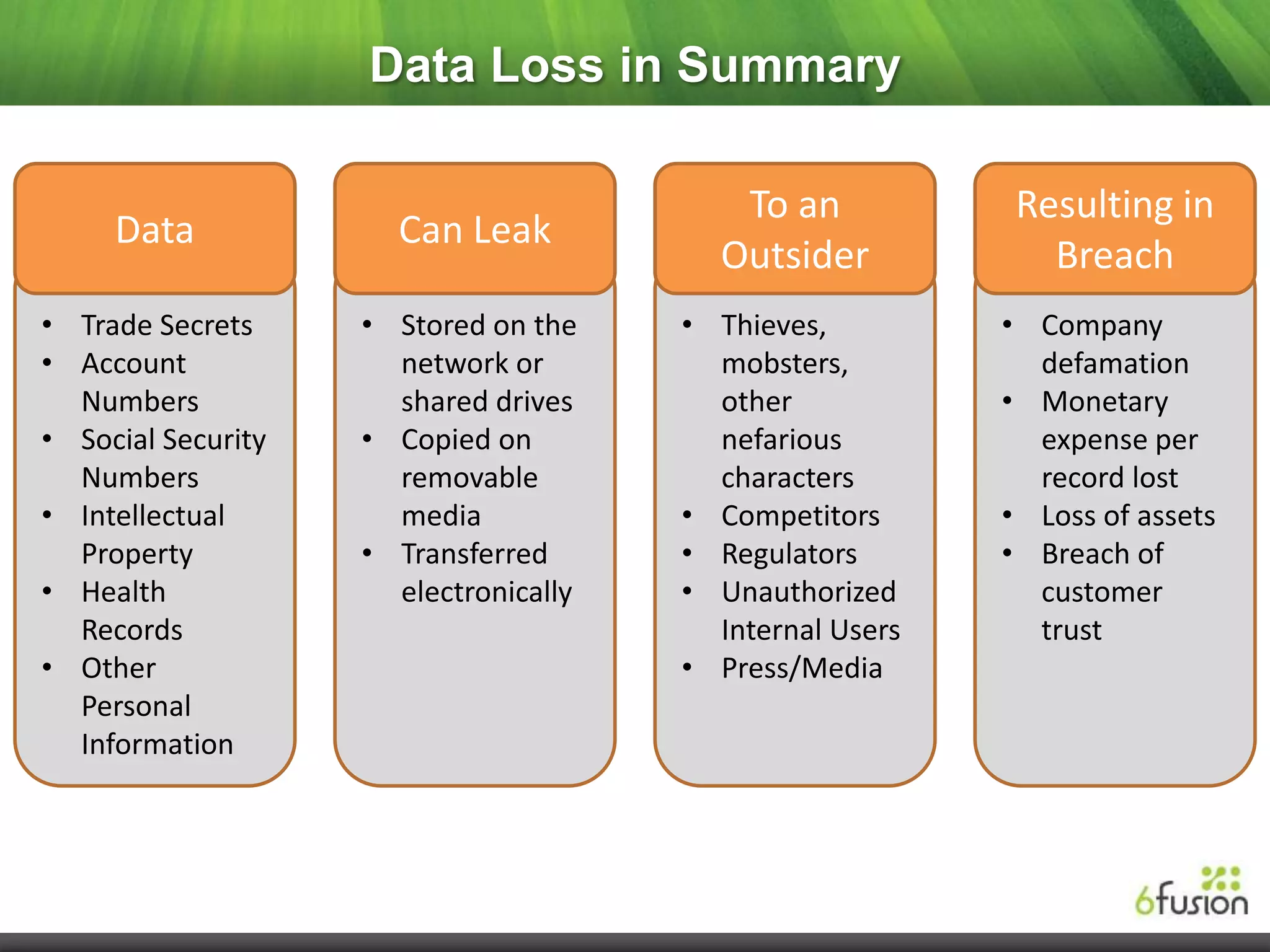
Data Loss in Summary

                                          To an            Resulting in
     Data             Can Leak
                                         Outsider            Breach
• Trade Secrets     • Stored on the    • Thieves,         • Company
• Account             network or         mobsters,          defamation
  Numbers             shared drives      other            • Monetary
• Social Security   • Copied on          nefarious          expense per
  Numbers             removable          characters         record lost
• Intellectual        media            • Competitors      • Loss of assets
  Property          • Transferred      • Regulators       • Breach of
• Health              electronically   • Unauthorized       customer
  Records                                Internal Users     trust
• Other                                • Press/Media
  Personal
  Information
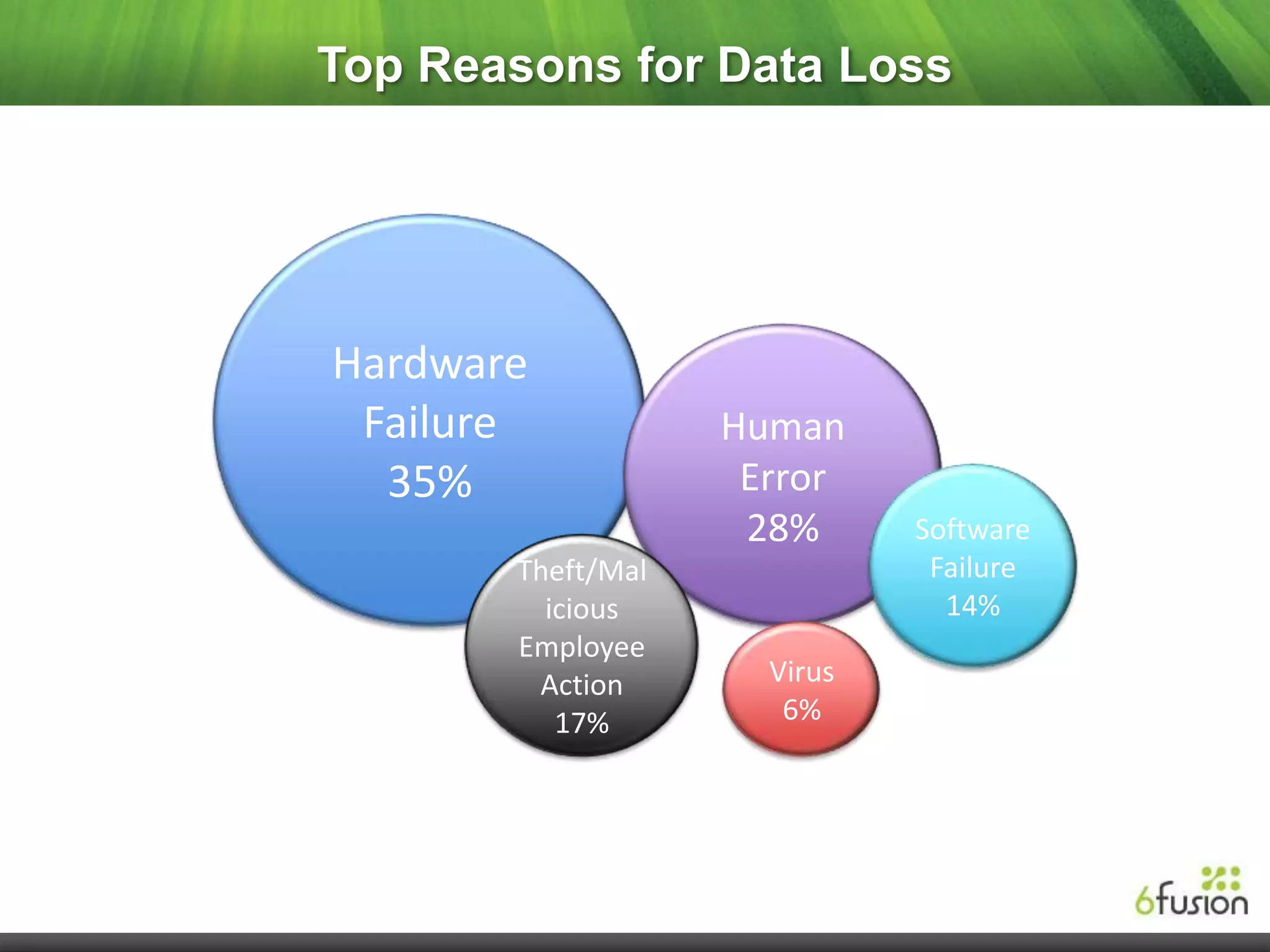
Top Reasons for Data Loss


Hardware
 Failure           Human
  35%               Error
                    28%      Software
       Theft/Mal              Failure
         icious                14%
       Employee
        Action       Virus
          17%         6%
Cloud Security Challenges
        There are a number of security issues associated with cloud
         computing, but data security is arguably the biggest issue.

Main areas of concern specific to data security include:


   Access           Protection          Segregation            Recovery
Access
 Data placed in the cloud are accessed and managed by persons other
       than privileged users within the customer’s organization.


                • What type and level of security checks are
Access            enforced on those individuals?
                • How are those checks enforced?
                • What policies are in place to ensure roles and
                  privileges are enforced?
Protection
     The nature of cloud computing means data can be stored at any
                geographical location at any given time.


                 •   Apart from some cloud service providers such as
                     Amazon who offers their customers the option of
Protection           choosing between different zones in which to store
                     their data, it is uncommon to see a cloud computing
                     service contract where the customer is guaranteed that
                     their data would not be transferred outside a specified
                     region.

                 •   Customers need to be aware that local laws may apply
                     to data held on servers within the cloud, and that it is
                     their responsibility to comply with data protection laws
                     under various jurisdictions worldwide where their data
                     is held.
Segregation
   Data in the cloud is typically stored in a shared environment whereby
    one customer’s data is stored alongside another customer’s data.


                  • While it is difficult to assure data
                    segregation, customers should review the cloud
Segregation         vendor’s architecture to ensure proper data
                    segregation is available and that data leak
                    prevention (DLP) measures are in place.
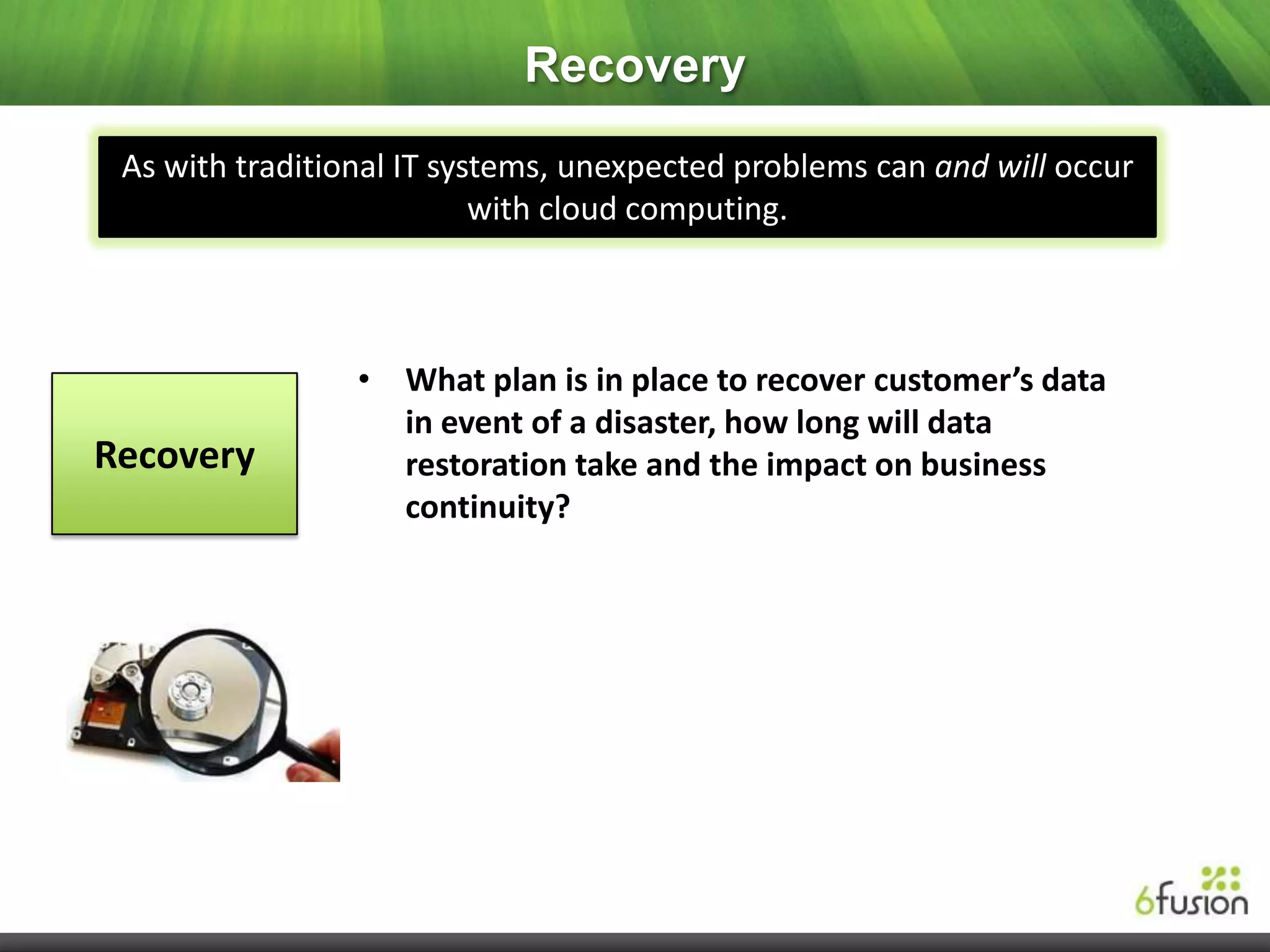
Recovery
 As with traditional IT systems, unexpected problems can and will occur
                           with cloud computing.


                 • What plan is in place to recover customer’s data
                   in event of a disaster, how long will data
Recovery           restoration take and the impact on business
                   continuity?
Cloud Security Best Practices
•   Ask where data will be kept and enquire the details of data protection laws in
    the relevant jurisdictions.

•   Include clauses in the cloud service contract that your data always belong to
    you, that you can reclaim your data at any time and that your data shall not be
    disclosed to any third party.

•   Make it as hard as possible to gain access to your systems and then to your data
    by implementing two-factor user authentication.

•   Ensure that data is encrypted both ways across the Internet by using, for
    example, mutual SSL. Ensure that data is encrypted when at rest, as well as
    when in motion from one location to another. You, the customer, should have
    control of key materials used for encrypting and decrypting data.

•   Develop good password policies – how they’re created, changed and protected.

•   Seek an independent security audit of the cloud vendor.
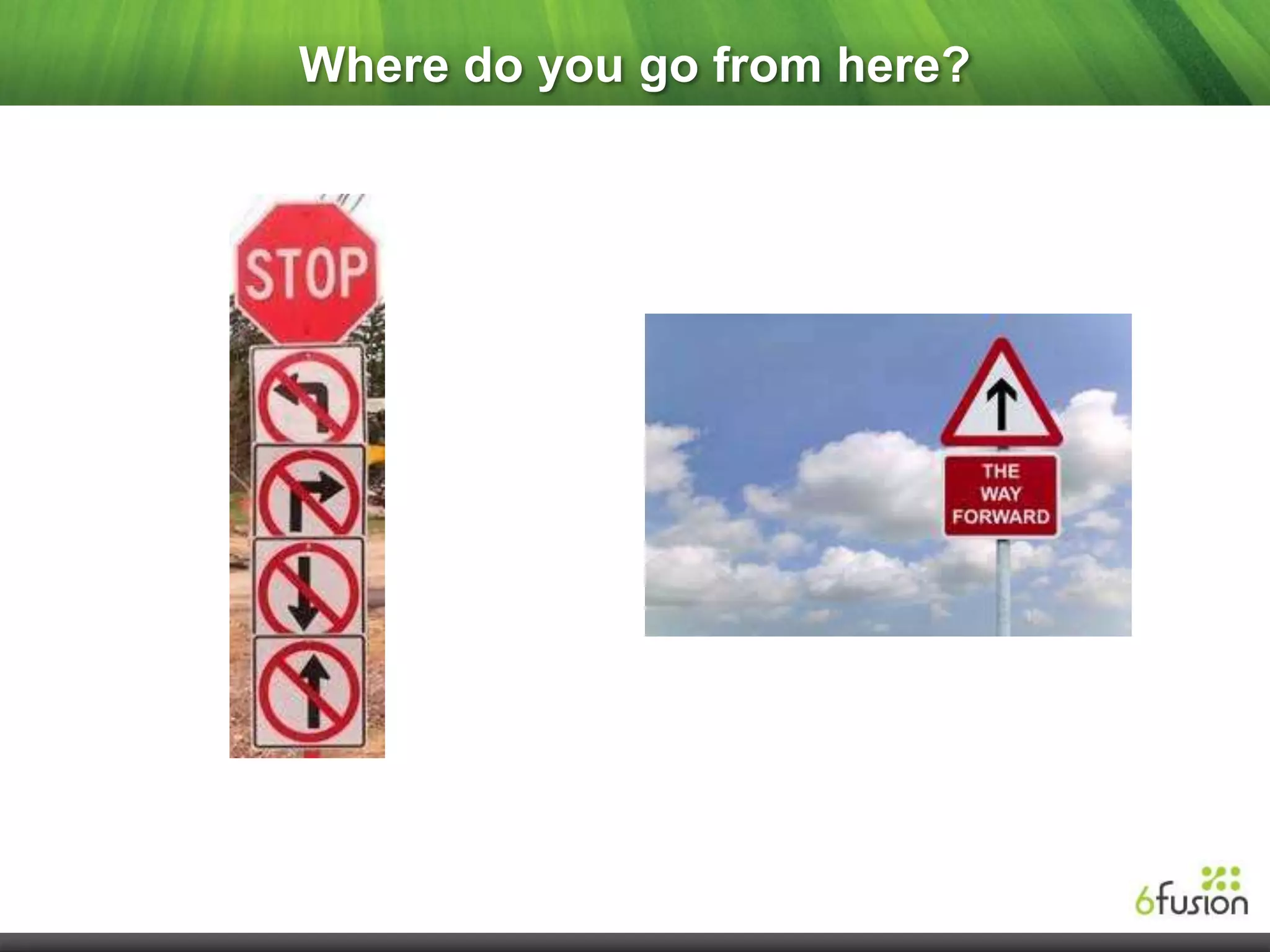
Where do you go from here?
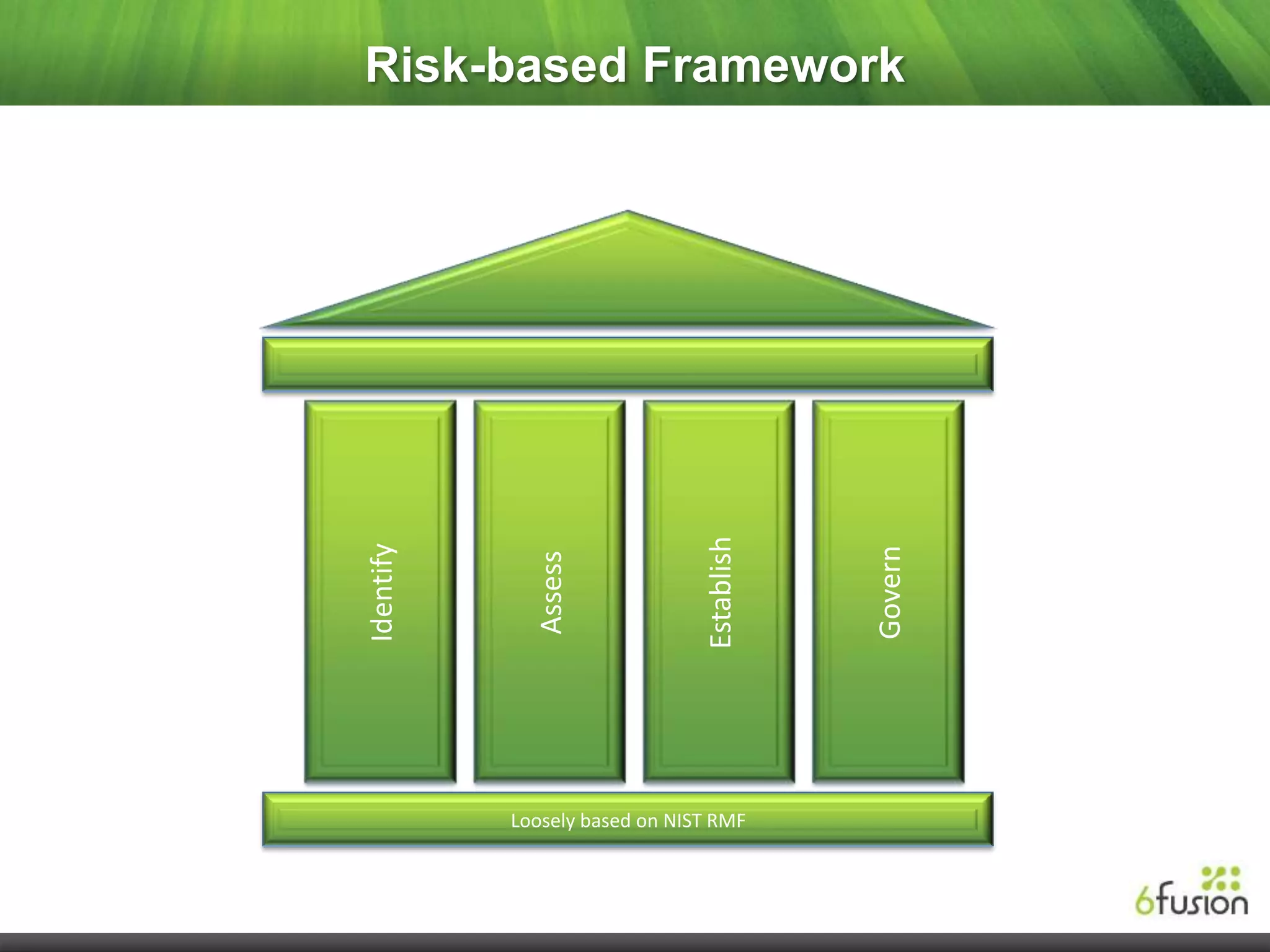
Risk-based Framework


                               Establish
Identify


                                           Govern
             Assess


           Loosely based on NIST RMF
Security by DESIGN

• Understand your
  security philosophy
• Know all of the
  components for
  each information
  system
• Implement the
  controls that bring
  risk down to the
  level acceptable to
  your organization
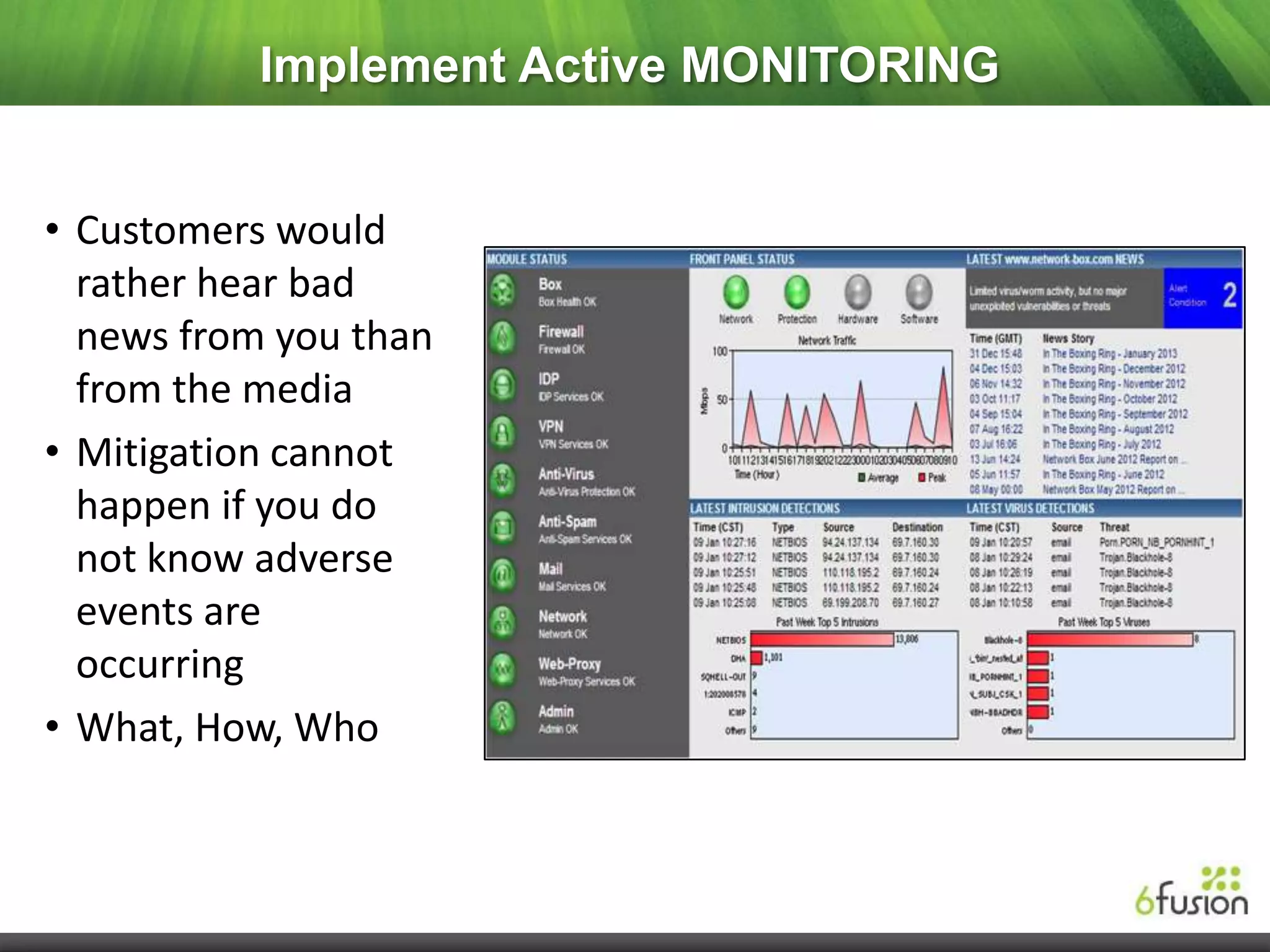
Implement Active MONITORING


• Customers would
  rather hear bad
  news from you than
  from the media
• Mitigation cannot
  happen if you do
  not know adverse
  events are
  occurring
• What, How, Who
Develop a RESPONSE Team and Plan

• Security is not a
  guarantee
• Most events can be
  categorized with
  operational, technic
  al, and legal
  responses planned
• Training and
  awareness are key
Questions?
Thank You!

               Resources                                 What’s next?

FedRAMP                                     2nd Webinar in the Series
   http://www.gsa.gov/portal/category/1
   02371                                    • Timing: Early March
                                            • Topic: How to advance your
Cloud Security Alliance
    https://cloudsecurityalliance.org/
                                                organizational security
                                            • Details: You tell us…
FFIEC (not really cloud but outsourced
    providers)
    http://ithandbook.ffiec.gov/it-           What do you want to hear about in
    booklets/outsourcing-technology-                        the next webinar?
    services/appendix-d-managed-security-
    service-providers.aspx

NIST (SP800-144)
                                             Email us at marketing@6fusion.com
   http://www.nist.gov/customcf/get_pdf.                         with your ideas!
   cfm?pub_id=909494

Extending security in the cloud network box - v4

  • 1.
    Extending Security inthe Cloud Steven Wolford Chad Walter Director, Information Security Director, Channel Development 6fusion Network Box USA
  • 2.
    Today’s Agenda • Introduction • IT Infrastructure Models • Common Cloud Security Myths • Cloud Security Basics • Cloud Security Challenges • Access • Protection • Segregation • Recovery • Cloud Security Best Practices
  • 3.
    Who We Are 6fusion Network Box USA 6fusion provides a utility-metered cloud Network Box USA provides platform that enables global workload comprehensive, fully managed perimeter distribution by turning public, private and internet security solutions. The Network Box hybrid clouds into pay-per-use billable utilities. Unified Threat Management (UTM) solution The unique metering algorithm, Workload combines numerous applications such as Allocation Cube (WAC), creates a commercial firewall, intrusion prevention and standard to quantify supply and demand for detection, anti-virus, content filtering, anti- compute resources. span, anti-phishing, anti-spyware and VPN into one single, sophisticated mix of hardware and software. Network Box USA enables businesses of all sizes to secure their networks easily and cost effectively. This is the first in a series of webinars on cloud security. We will let you shape the content of the next webinar at the end of this webinar.
  • 4.
  • 5.
    Cloud Security Myths •Cloud cannot be secure • All Cloud models are not created equal - Private, Hybrid, Public - IaaS, PaaS, SaaS • All Cloud providers are not created equal - Look for independent audit reports • Cloud security is new • The security concepts remain unchanged • Unfortunately many used network defenses to compensate for weak application security • Cloud requires more effort or tools to be as secure • NIST used the existing SP 800-53 and SP 800-37 to develop FedRAMP • Oh by the way, Department of Homeland Security recently announced it is moving services to a cloud provider that has been reviewed under FedRAMP • The only reason enterprises move to the cloud is cost reduction, reallocation, etc. • Security can also be enhanced if you incorporate the following in your migration - Security by Design, Active Monitoring, Incident Response Plan
  • 6.
    A Quick CloudAnalogy Your data happily in the cloud Procurement PII Financial Email Payroll HR An incident beyond yourYour data no longer just in the cloud control occurs Payroll PII Email Procurement Financial HR
  • 7.
    Data Loss inSummary To an Resulting in Data Can Leak Outsider Breach • Trade Secrets • Stored on the • Thieves, • Company • Account network or mobsters, defamation Numbers shared drives other • Monetary • Social Security • Copied on nefarious expense per Numbers removable characters record lost • Intellectual media • Competitors • Loss of assets Property • Transferred • Regulators • Breach of • Health electronically • Unauthorized customer Records Internal Users trust • Other • Press/Media Personal Information
  • 8.
    Top Reasons forData Loss Hardware Failure Human 35% Error 28% Software Theft/Mal Failure icious 14% Employee Action Virus 17% 6%
  • 9.
    Cloud Security Challenges There are a number of security issues associated with cloud computing, but data security is arguably the biggest issue. Main areas of concern specific to data security include: Access Protection Segregation Recovery
  • 10.
    Access Data placedin the cloud are accessed and managed by persons other than privileged users within the customer’s organization. • What type and level of security checks are Access enforced on those individuals? • How are those checks enforced? • What policies are in place to ensure roles and privileges are enforced?
  • 11.
    Protection The nature of cloud computing means data can be stored at any geographical location at any given time. • Apart from some cloud service providers such as Amazon who offers their customers the option of Protection choosing between different zones in which to store their data, it is uncommon to see a cloud computing service contract where the customer is guaranteed that their data would not be transferred outside a specified region. • Customers need to be aware that local laws may apply to data held on servers within the cloud, and that it is their responsibility to comply with data protection laws under various jurisdictions worldwide where their data is held.
  • 12.
    Segregation Data in the cloud is typically stored in a shared environment whereby one customer’s data is stored alongside another customer’s data. • While it is difficult to assure data segregation, customers should review the cloud Segregation vendor’s architecture to ensure proper data segregation is available and that data leak prevention (DLP) measures are in place.
  • 13.
    Recovery As withtraditional IT systems, unexpected problems can and will occur with cloud computing. • What plan is in place to recover customer’s data in event of a disaster, how long will data Recovery restoration take and the impact on business continuity?
  • 14.
    Cloud Security BestPractices • Ask where data will be kept and enquire the details of data protection laws in the relevant jurisdictions. • Include clauses in the cloud service contract that your data always belong to you, that you can reclaim your data at any time and that your data shall not be disclosed to any third party. • Make it as hard as possible to gain access to your systems and then to your data by implementing two-factor user authentication. • Ensure that data is encrypted both ways across the Internet by using, for example, mutual SSL. Ensure that data is encrypted when at rest, as well as when in motion from one location to another. You, the customer, should have control of key materials used for encrypting and decrypting data. • Develop good password policies – how they’re created, changed and protected. • Seek an independent security audit of the cloud vendor.
  • 15.
    Where do yougo from here?
  • 16.
    Risk-based Framework Establish Identify Govern Assess Loosely based on NIST RMF
  • 17.
    Security by DESIGN •Understand your security philosophy • Know all of the components for each information system • Implement the controls that bring risk down to the level acceptable to your organization
  • 18.
    Implement Active MONITORING •Customers would rather hear bad news from you than from the media • Mitigation cannot happen if you do not know adverse events are occurring • What, How, Who
  • 19.
    Develop a RESPONSETeam and Plan • Security is not a guarantee • Most events can be categorized with operational, technic al, and legal responses planned • Training and awareness are key
  • 20.
  • 21.
    Thank You! Resources What’s next? FedRAMP 2nd Webinar in the Series http://www.gsa.gov/portal/category/1 02371 • Timing: Early March • Topic: How to advance your Cloud Security Alliance https://cloudsecurityalliance.org/ organizational security • Details: You tell us… FFIEC (not really cloud but outsourced providers) http://ithandbook.ffiec.gov/it- What do you want to hear about in booklets/outsourcing-technology- the next webinar? services/appendix-d-managed-security- service-providers.aspx NIST (SP800-144) Email us at marketing@6fusion.com http://www.nist.gov/customcf/get_pdf. with your ideas! cfm?pub_id=909494

Editor's Notes

  • #6 Embrace a secure-by-design approach: IT organizations need to focus on identifying controls that address the lack of direct access to information. Taking an approach that is secure by design forms the foundation of the organizations strategy for entering the cloud and allows the organization to consistently approach security needs based on the workloads and granular data represented in their cloud efforts. This also facilitates the implementation of resiliency and audit capabilities in the cloud, allowing organizations to extend their security philosophy into the cloud.
  • #18 Embrace a secure-by-design approach: IT organizations need to focus on identifying controls that address the lack of direct access to information. Taking an approach that is secure by design forms the foundation of the organizations strategy for entering the cloud and allows the organization to consistently approach security needs based on the workloads and granular data represented in their cloud efforts. This also facilitates the implementation of resiliency and audit capabilities in the cloud, allowing organizations to extend their security philosophy into the cloud.
  • #19 Implement an active monitoring solution: For organizations to address availability or instability conditions they must implement an active monitoring solution, failure to do so relies on cues from users which could result in damages ranging from poor customer satisfaction, to loss of customers. Organizations need to make determinations as to the monitoring and intervals based on data content and should implement manual or automated procedures to respond to related events.
  • #20 Develop a plan and educate the response team: A large element of security is the response to threats and how rapidly an organization can respond to threats and adverse events. Organizations should document logical responses to event classes and implement education programs to facilitate response to said conditions.