Cloud Security and Privacy:
An Enterprise Perspective on Risks and Compliance


  Tim Mather
  Subra Kumaraswamy, Sun
  Shahed Latif, KPMG
© 2009 Tim Mather, Subra Kumaraswamy, Shahed Latif


     What We Do Not Discuss

• Existing aspects of information security
  which are not impacted by ‘cloud computing’

• Consumer aspects of cloud computing


                                                                          2
© 2009 Tim Mather, Subra Kumaraswamy, Shahed Latif


             What We Do Discuss
• Infrastructure Security
    •   Network-level
    •   Host-level
    •   Application-level
•   Data Security
•   Identity and Access Management (IAM)
•   Privacy Considerations
•   Audit & Compliance Considerations
•   Security-as-a- [Cloud] Service (SaaS)
•   Impact on the Role of Corporate IT
            Where Risk Has Changed: ±                                      3
© 2009 Tim Mather, Subra Kumaraswamy, Shahed Latif


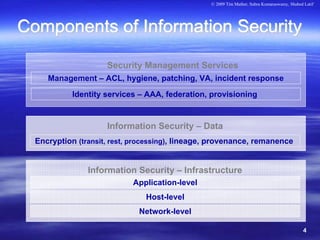
Components of Information Security

                     Security Management Services
     Management – ACL, hygiene, patching, VA, incident response

            Identity services – AAA, federation, provisioning


                     Information Security – Data
  Encryption (transit, rest, processing), lineage, provenance, remanence


                Information Security – Infrastructure
                            Application-level
                                Host-level
                              Network-level

                                                                                             4
© 2009 Tim Mather, Subra Kumaraswamy, Shahed Latif


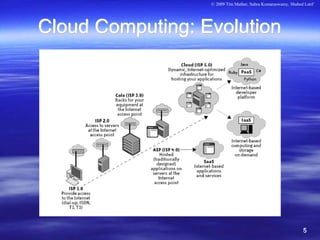
Cloud Computing: Evolution


                                                              5
© 2009 Tim Mather, Subra Kumaraswamy, Shahed Latif


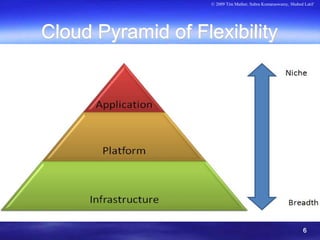
Cloud Pyramid of Flexibility


                                                                6
© 2009 Tim Mather, Subra Kumaraswamy, Shahed Latif


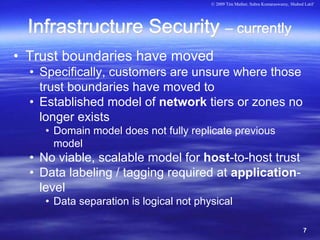
  Infrastructure Security – currently
• Trust boundaries have moved
  • Specifically, customers are unsure where those
    trust boundaries have moved to
  • Established model of network tiers or zones no
    longer exists
    • Domain model does not fully replicate previous
      model
  • No viable, scalable model for host-to-host trust
  • Data labeling / tagging required at application-
    level
    • Data separation is logical not physical

                                                                                    7
© 2009 Tim Mather, Subra Kumaraswamy, Shahed Latif


Infrastructure Security – going forward
• Need for greater transparency regarding
  which party (CSP or customer) provides
  which security capability

• Inter-relationships between systems,
  services, and people needs to be addressed
  by identity management


                                                                          8
© 2009 Tim Mather, Subra Kumaraswamy, Shahed Latif


            Data Security – currently
• Provider’s data collection efforts and
  monitoring of such (e.g., IPS, NBA)
• Use of encryption
    •   Point-to-multipoint data-in-transit an issue
    •   Data-at-rest possibly not encrypted
    •   Data being processed definitely not encrypted
    •   Key management is a significant issue
    •   Advocated alternative methods (e.g., obfuscation,
        redaction, truncation) are nonsense
•   Data lineage
•   Data provenance
•   Data remanence
                                                                                    9
© 2009 Tim Mather, Subra Kumaraswamy, Shahed Latif


        Data Security – going forward
Large-scale multi-entity key management
  • Must scale past multi-enterprise to inter-cloud
       • Not just hundreds of thousands of systems or even millions of
         virtual machine images, but billions of files or objects
  •   Must not only handle key management lifecycle (per NIST
      SP 800-57, Recommendation for Key Management), but also
       • Key recovery
       • Key archiving
       • Key hierarchies / chaining for legal entities


• Fully homomorphic encryption
  • Potentially huge boon to cloud computing
  • Will increase need for better key management
                                                                                          10
© 2009 Tim Mather, Subra Kumaraswamy, Shahed Latif


                IAM – currently
• Generally speaking, poor situation today:

  • Federated identity widely not available
  • Strong authentication available only through
    delegation
  • Provisioning of user access is proprietary to
    provider
  • User profiles are limited to “administrator” and
    “user”
  • Privilege management is coarse, not granular
                                                                               11
© 2009 Tim Mather, Subra Kumaraswamy, Shahed Latif


            IAM – going forward
• Emerging identity-as-a-service (IDaaS)
  needs to evolve beyond authentication

• SAML, SPML and XACML (especially) need
  to be more fully leveraged

• Increasing need for user-to-service and
  service-to-service authentication and
  authorization (OAuth)

                                                                          12
© 2009 Tim Mather, Subra Kumaraswamy, Shahed Latif


             Privacy – currently
• Transborder data issues may be exacerbated
  • Specifically, where are cloud computing activities
    occurring?


• Data governance is weak
  • Encryption is not pervasive
  • Data remanence receives inadequate attention
  • Cusps absolve themselves of privacy concerns:
    ‘We don’t look at your data’
                                                                              13
© 2009 Tim Mather, Subra Kumaraswamy, Shahed Latif


          Privacy – going forward
• Privacy laws are inconsistent across
  jurisdictions; need global standard

• Need specific requirements for auditing (e.g.,
 AICPA/CICA Generally Accepted Privacy Principles
 – GAPP)


                                                                           14
© 2009 Tim Mather, Subra Kumaraswamy, Shahed Latif


   Audit & Compliance – currently

• Effectiveness of current audit frameworks
  questionable (e.g., SAS 70 Type II)

• CSP users need to define:
  • their control requirements
  • understand their CSP’s internal control monitor-
    ing processes
  • analyze relevant external audit reports

• Issue is assurance of compliance
                                                                              15
© 2009 Tim Mather, Subra Kumaraswamy, Shahed Latif


 Audit & Compliance – going forward

• Inter-cloud (i.e., cross-CSP) solutions will
  demand unified compliance framework

• Volume, multi-tenancy of cloud computing,
  demand that CSP compliance programs be
  more real-time and have greater coverage
  than most traditional compliance programs


                                                                              16
© 2009 Tim Mather, Subra Kumaraswamy, Shahed Latif


  Security-as-a-Service – currently
• Some offerings mature
  • E-mail filtering, archiving
  • Web content filtering
• Some offerings still emerging
  •   (E-mail) eDiscovery
  •   Identity-as-a-Service (IDaaS)
  •   Encryption, key management
• Today’s security-as-a-service providers sell
  to CSP customers, not CSPs
• None of today’s CSPs offer security-as-a-
  service as integrated offering
                                                                                 17
© 2009 Tim Mather, Subra Kumaraswamy, Shahed Latif


Security-as-a-Service – going forward
• Horizontal integration
  • Pure play SaaS providers will broaden offerings
    beyond e-mail + Web content filtering
• Vertical integration
  • CSPs will offer SaaS as integrated offering
• IDaaS has to scale effectively for cloud
  computing to truly take off
• Complexity of key management screams for
  SaaS offering

                                                                              18
© 2009 Tim Mather, Subra Kumaraswamy, Shahed Latif


Impact on Role of Corporate IT – currently
• Governance issue as internal IT becomes
  “consultants” and business analysts to
  business units
• Delineation of responsibilities between
  providers and customers much more
  nebulous than between customers and
  outsourcers, collocation facilities, or ASPs
• Cloud computing likely to involve much more
  direct business unit interaction with CSPs
  than with other providers previously
                                                                         19
© 2009 Tim Mather, Subra Kumaraswamy, Shahed Latif


Impact on Role of Corporate IT – going forward
 • Relationship between business units and corporate
   IT departments vis-à-vis CSPs will shift greater
   power to business units from IT
 • Number of functions performed today by corporate
   IT departments will shift to CSPs, along with
   corresponding job positions
 • Functions performed by corporate IT departments
   will shift from those who do (i.e., practitioners who
   build or operate) to those who define and manage
 • IT itself will become more of a commodity as
   practices and skills are standardized and
   automated
                                                                                20
© 2009 Tim Mather, Subra Kumaraswamy, Shahed Latif


              Conclusions
• Part of customers’ infrastructure security
  moves beyond their control
• Provider’s infrastructure security may
  (enterprise) or may not (SMB) be less robust
  than customers’ expectations
• Data security becomes significantly more
  important – yet provider capabilities are
  inadequate (except for simple storage which
  can be encrypted, and processing of non-
  sensitive (unregulated and unclassified) data
                                                                          21
© 2009 Tim Mather, Subra Kumaraswamy, Shahed Latif


        Conclusions (continued)
• IAM is less than adequate for enterprises –
  weak authentication unless delegated back
  to customers or federated, weak authoriza-
  tion, proprietary provisioning

• Because of above, expect significant
  business unit pressure to desensitize or
  anonymize data; expect this to become a
  chokepoint
  • No established standards for obfuscation,
    redaction, or truncation
                                                                             22
© 2009 Tim Mather, Subra Kumaraswamy, Shahed Latif


    What’s Good about the Cloud?
• A lot! Both for enterprises and SMBs – for
  handling of non-sensitive (unregulated and
  unclassified) data

•   Cost
•   Flexibility
•   Scalability
•   Speed


                                                                         23
© 2009 Tim Mather, Subra Kumaraswamy, Shahed Latif


       Developments to Watch
• VMware’s vCloud API − submitted to DMTF
• Amazon’s Virtual Private Cloud − hybrid
  cloud that extends private cloud through
  “cloud bursting”
• Security-as-a-Service offered by CSPs (e.g.,
  Amazon’s Multi-Factor Authentication)
• Cloud Security Alliance v2 white paper
• Slow transparency and assurance from CSP
  (e.g., ISO 27002-based assurance)
• IT governance framework that blends ITIL,
  ISO 27002, CObIT                           24
© 2009 Tim Mather, Subra Kumaraswamy, Shahed Latif


    Cloud Security and Privacy:
An Enterprise Perspective on Risks and Compliance


  Continue the discussion on-line at: cloudsecurityandprivacy.com
                                                                                         25

Cloud Security And Privacy

  • 1.
    Cloud Security andPrivacy: An Enterprise Perspective on Risks and Compliance Tim Mather Subra Kumaraswamy, Sun Shahed Latif, KPMG
  • 2.
    © 2009 TimMather, Subra Kumaraswamy, Shahed Latif What We Do Not Discuss • Existing aspects of information security which are not impacted by ‘cloud computing’ • Consumer aspects of cloud computing 2
  • 3.
    © 2009 TimMather, Subra Kumaraswamy, Shahed Latif What We Do Discuss • Infrastructure Security • Network-level • Host-level • Application-level • Data Security • Identity and Access Management (IAM) • Privacy Considerations • Audit & Compliance Considerations • Security-as-a- [Cloud] Service (SaaS) • Impact on the Role of Corporate IT Where Risk Has Changed: ± 3
  • 4.
    © 2009 TimMather, Subra Kumaraswamy, Shahed Latif Components of Information Security Security Management Services Management – ACL, hygiene, patching, VA, incident response Identity services – AAA, federation, provisioning Information Security – Data Encryption (transit, rest, processing), lineage, provenance, remanence Information Security – Infrastructure Application-level Host-level Network-level 4
  • 5.
    © 2009 TimMather, Subra Kumaraswamy, Shahed Latif Cloud Computing: Evolution 5
  • 6.
    © 2009 TimMather, Subra Kumaraswamy, Shahed Latif Cloud Pyramid of Flexibility 6
  • 7.
    © 2009 TimMather, Subra Kumaraswamy, Shahed Latif Infrastructure Security – currently • Trust boundaries have moved • Specifically, customers are unsure where those trust boundaries have moved to • Established model of network tiers or zones no longer exists • Domain model does not fully replicate previous model • No viable, scalable model for host-to-host trust • Data labeling / tagging required at application- level • Data separation is logical not physical 7
  • 8.
    © 2009 TimMather, Subra Kumaraswamy, Shahed Latif Infrastructure Security – going forward • Need for greater transparency regarding which party (CSP or customer) provides which security capability • Inter-relationships between systems, services, and people needs to be addressed by identity management 8
  • 9.
    © 2009 TimMather, Subra Kumaraswamy, Shahed Latif Data Security – currently • Provider’s data collection efforts and monitoring of such (e.g., IPS, NBA) • Use of encryption • Point-to-multipoint data-in-transit an issue • Data-at-rest possibly not encrypted • Data being processed definitely not encrypted • Key management is a significant issue • Advocated alternative methods (e.g., obfuscation, redaction, truncation) are nonsense • Data lineage • Data provenance • Data remanence 9
  • 10.
    © 2009 TimMather, Subra Kumaraswamy, Shahed Latif Data Security – going forward Large-scale multi-entity key management • Must scale past multi-enterprise to inter-cloud • Not just hundreds of thousands of systems or even millions of virtual machine images, but billions of files or objects • Must not only handle key management lifecycle (per NIST SP 800-57, Recommendation for Key Management), but also • Key recovery • Key archiving • Key hierarchies / chaining for legal entities • Fully homomorphic encryption • Potentially huge boon to cloud computing • Will increase need for better key management 10
  • 11.
    © 2009 TimMather, Subra Kumaraswamy, Shahed Latif IAM – currently • Generally speaking, poor situation today: • Federated identity widely not available • Strong authentication available only through delegation • Provisioning of user access is proprietary to provider • User profiles are limited to “administrator” and “user” • Privilege management is coarse, not granular 11
  • 12.
    © 2009 TimMather, Subra Kumaraswamy, Shahed Latif IAM – going forward • Emerging identity-as-a-service (IDaaS) needs to evolve beyond authentication • SAML, SPML and XACML (especially) need to be more fully leveraged • Increasing need for user-to-service and service-to-service authentication and authorization (OAuth) 12
  • 13.
    © 2009 TimMather, Subra Kumaraswamy, Shahed Latif Privacy – currently • Transborder data issues may be exacerbated • Specifically, where are cloud computing activities occurring? • Data governance is weak • Encryption is not pervasive • Data remanence receives inadequate attention • Cusps absolve themselves of privacy concerns: ‘We don’t look at your data’ 13
  • 14.
    © 2009 TimMather, Subra Kumaraswamy, Shahed Latif Privacy – going forward • Privacy laws are inconsistent across jurisdictions; need global standard • Need specific requirements for auditing (e.g., AICPA/CICA Generally Accepted Privacy Principles – GAPP) 14
  • 15.
    © 2009 TimMather, Subra Kumaraswamy, Shahed Latif Audit & Compliance – currently • Effectiveness of current audit frameworks questionable (e.g., SAS 70 Type II) • CSP users need to define: • their control requirements • understand their CSP’s internal control monitor- ing processes • analyze relevant external audit reports • Issue is assurance of compliance 15
  • 16.
    © 2009 TimMather, Subra Kumaraswamy, Shahed Latif Audit & Compliance – going forward • Inter-cloud (i.e., cross-CSP) solutions will demand unified compliance framework • Volume, multi-tenancy of cloud computing, demand that CSP compliance programs be more real-time and have greater coverage than most traditional compliance programs 16
  • 17.
    © 2009 TimMather, Subra Kumaraswamy, Shahed Latif Security-as-a-Service – currently • Some offerings mature • E-mail filtering, archiving • Web content filtering • Some offerings still emerging • (E-mail) eDiscovery • Identity-as-a-Service (IDaaS) • Encryption, key management • Today’s security-as-a-service providers sell to CSP customers, not CSPs • None of today’s CSPs offer security-as-a- service as integrated offering 17
  • 18.
    © 2009 TimMather, Subra Kumaraswamy, Shahed Latif Security-as-a-Service – going forward • Horizontal integration • Pure play SaaS providers will broaden offerings beyond e-mail + Web content filtering • Vertical integration • CSPs will offer SaaS as integrated offering • IDaaS has to scale effectively for cloud computing to truly take off • Complexity of key management screams for SaaS offering 18
  • 19.
    © 2009 TimMather, Subra Kumaraswamy, Shahed Latif Impact on Role of Corporate IT – currently • Governance issue as internal IT becomes “consultants” and business analysts to business units • Delineation of responsibilities between providers and customers much more nebulous than between customers and outsourcers, collocation facilities, or ASPs • Cloud computing likely to involve much more direct business unit interaction with CSPs than with other providers previously 19
  • 20.
    © 2009 TimMather, Subra Kumaraswamy, Shahed Latif Impact on Role of Corporate IT – going forward • Relationship between business units and corporate IT departments vis-à-vis CSPs will shift greater power to business units from IT • Number of functions performed today by corporate IT departments will shift to CSPs, along with corresponding job positions • Functions performed by corporate IT departments will shift from those who do (i.e., practitioners who build or operate) to those who define and manage • IT itself will become more of a commodity as practices and skills are standardized and automated 20
  • 21.
    © 2009 TimMather, Subra Kumaraswamy, Shahed Latif Conclusions • Part of customers’ infrastructure security moves beyond their control • Provider’s infrastructure security may (enterprise) or may not (SMB) be less robust than customers’ expectations • Data security becomes significantly more important – yet provider capabilities are inadequate (except for simple storage which can be encrypted, and processing of non- sensitive (unregulated and unclassified) data 21
  • 22.
    © 2009 TimMather, Subra Kumaraswamy, Shahed Latif Conclusions (continued) • IAM is less than adequate for enterprises – weak authentication unless delegated back to customers or federated, weak authoriza- tion, proprietary provisioning • Because of above, expect significant business unit pressure to desensitize or anonymize data; expect this to become a chokepoint • No established standards for obfuscation, redaction, or truncation 22
  • 23.
    © 2009 TimMather, Subra Kumaraswamy, Shahed Latif What’s Good about the Cloud? • A lot! Both for enterprises and SMBs – for handling of non-sensitive (unregulated and unclassified) data • Cost • Flexibility • Scalability • Speed 23
  • 24.
    © 2009 TimMather, Subra Kumaraswamy, Shahed Latif Developments to Watch • VMware’s vCloud API − submitted to DMTF • Amazon’s Virtual Private Cloud − hybrid cloud that extends private cloud through “cloud bursting” • Security-as-a-Service offered by CSPs (e.g., Amazon’s Multi-Factor Authentication) • Cloud Security Alliance v2 white paper • Slow transparency and assurance from CSP (e.g., ISO 27002-based assurance) • IT governance framework that blends ITIL, ISO 27002, CObIT 24
  • 25.
    © 2009 TimMather, Subra Kumaraswamy, Shahed Latif Cloud Security and Privacy: An Enterprise Perspective on Risks and Compliance Continue the discussion on-line at: cloudsecurityandprivacy.com 25