

Cloud Predictions for 2016
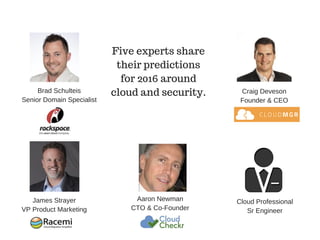
Created by
Connie Bensen
Aaron Newman
CTO & Co­Founder
Brad Schulteis
Senior Domain Specialist
James Strayer
VP Product Marketing
Craig Deveson
Founder & CEO
Cloud Professional
Sr Engineer
Five experts share
their predictions
for 2016 around
cloud and security.
"Stop treating cloud computing as
IT outsourcing or server colocation"   
Brad Schulteis, Rackspace
One of the biggest security challenges facing the cloud as we
head into 2016 is the failure to move beyond antiquated security
analysis frameworks. It is still far too common to be required to
document physical locations, IP addresses and hostnames as a
part of security assessments and audits. We need to collectively
stop treating cloudcomputing as IT outsourcing or server
colocation and fully embrace the ephemeral and dynamic nature.
Connect on LinkedIn:  Brad Schulteis
The discussion is no longer "if" ­ it is
now "what, when, and how?
James Strayer, Racemi
My prediction for 2016 is that this is the year of Enterprise IaaS
adoption. The discussion is no longer "if" ­ it is now "what, when,
and how?". Enterprises were testing the waters in 2014 and 2015
and have found that they like what IaaS has to offer, and the
market should see hundreds of thousands of enterprise
applications migrated to IaaS next year as a result. We also see
companies diversifying their cloud strategy and not relying on a
sole vendor for compute and storage services, which should also
help them with their Disaster Recovery planning as well.
Connect on LinkedIn: James Strayer
Cloud is the biggest change to security in a decade.
  Aaron Newman, CloudCheckr
The cloud has introduced the biggest change to security in a decade.
Fundamentally the same security principles apply. Organizations will
continue to need to properly implement network, operating system,
and database security. However, how these are implemented is
significantly different. The cloud has characteristics that make the old
methodologies and tools ineffective. The cloud is ephemeral, elastic,
and auto scaling. These defining characteristics make implementing
everything from intrusion detection to vulnerability management to
perimeter assessment very different.
Connect on LinkedIn: Aaron Newman
Get some freedom to build net new capabilities  
Brad Schulteis, Rackspace
The top types of business applications that will move to the cloud
in 2016 will be brand new, socially focused and collaborative
environments. IT will stop being asked to simply MIGRATE
existing capabilities into the cloud, and instead get some freedom
to build net new capabilities that truly take advantage of the
disruptive nature of cloud.
Installing and managing infrastructure has
been commoditized so that owning is no
longer the better option  
Aaron Newman, CloudCheckr
Over the past few years, we have already seen everything from
email to CRMs to ERPs move to the cloud. In 2016, we will see
the largest movement in Infrastructure as a Service (IaaS). The
underlying servers, databases, and networks that made up your
data center can be moved to the public cloud very effectively.
Installing and managing infrastructure has been commoditized to
the point that owning your own is rarely a better option. We have
even seen organizations such as the CIA adopting IaaS. 
CEOs and CFOs begin to reject any major 
cash outlays for IT infrastructure in favor
of cloud adoption  
Brad Schulteis, Rackspace
In 2016 "private cloud", "data center", and "hardware recap"
become dirty words for most organizations, if they aren't
already. CEOs and CFOs begin to categorically reject any
major cash outlays for IT infrastructure in favor of cloud
adoption.
Migrating just about every type of application
you can think of to the cloud  
James Strayer, Racemi
While historically companies have focused on moving CRM,
ERP, web applications, and custom developed applications to
IaaS, our customers now seem to be migrating just about every
type of application you can think of to the cloud. Or at least
components of them (for hybrid applications). As Enterprise
adoption picks up steam in 2016, we expect to see just about
everything under the sun re­hosted to IaaS, for better or for
worse. 
The discussion is no longer "if" ­ it is now
"what, when, and how?
Craig Deveson, Cloud Manager
Public Cloud will be focused around 2 vendors. AWS & Azure.
First moves are Rackspace reselling AWS and now HP selling
Azure. Most services providers will integrate both of these 2 or
both in 2016. This spells trouble for many data centers and junior
players.
Consolidation in the service provider industry will continue to
increase. Cloud focused service providers based on AWS &
Azure will continue to grow.
Connect on LinkedIn: Craig Deveson
Security means allowing users to
do what they need to  
Senior Engineer
The internal cloud will require making sure that permissions are
appropriate and don't allow users to do harmful things. In other
words, users need the permissions to be able to start and stop
their own instances, networks and storage but not be able to
impact others.
 
The competitive advantage of moving to the cloud  
Aaron Newman, CloudCheckr
In 2016 the cloud will continue to mature. Prices will continue to
be driven down. Even the traditional, old school organizations will
be unable to deny the competitive advantage of moving to the
cloud. The efficiency of the public cloud will help companies drive
increased profits. The discussion of "if" or even "when" to move
to the cloud will be done. The new discussion will be around what
to do with your existing infrastructure that is not in the cloud.
There is no question public cloud adoption is accelerating and shows
no signs of slowing down. The value proposition of operating in the
cloud is so compelling the movement to the cloud will indubitably
continue. Even the concerns around security and compliance have
been put to bed, and the accepted wisdom is that moving to the cloud
will provide BETTER security.                Aaron Newman, CloudCheckr
Public cloud adoption definitely continues to grow through 2016. A
major increase in acceleration seems unlikely due to resource
constraints and a widening skills gap, but the blistering pace we are
currently on at least remains the same.    Brad Schulteis, Rackspace
Our customer data shows that Enterprise customers are
accelerating their adoption of IaaS, so we expect to see
widespread adoption of IaaS by Enterprises over the
next 2­3 years, which should accelerate the market. We
expect migration technology to continue to be key
component of these company's cloud strategies as they
begin to execute more broadly.
James Strayer, Racemi
Is the Cloud on your roadmap for 2016?
How will you ensure that security is properly
managed for the new environment?
Contact the CloudCheckr team for
cost and security optimization.
https://cloudcheckr.com
@CloudCheckr

Cloud Predictions 2016