Ernest Mueller National Instruments theagileadmin.com
ernest.mueller@gmail.com @ernestmueller
(ISP -> colo) + virtualization + HPC
+ (AJAX + SOA -> REST APIs) = IaaS
IDE/4GLs + EAI + SaaS + IaaS = PaaS
((web site -> web app) -> ASP) +
virtualization + fast network + [RIA
browsers && mobile] = SaaS
[IaaS | PaaS | SaaS ] + [ devops |
open source | noSQL ] = cloud
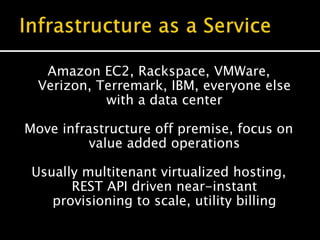
Amazon EC2, Rackspace, VMWare,
Verizon, Terremark, IBM, everyone else
with a data center
Move infrastructure off premise, focus on
value added operations
Usually multitenant virtualized hosting,
REST API driven near-instant
provisioning to scale, utility billing
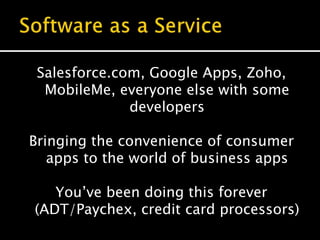
Salesforce.com, Google Apps, Zoho,
MobileMe, everyone else with some
developers
Bringing the convenience of consumer
apps to the world of business apps
You’ve been doing this forever
(ADT/Paychex, credit card processors)
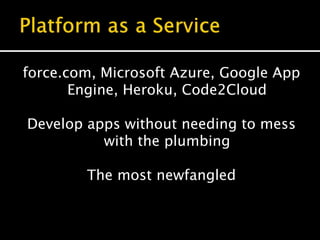
force.com, Microsoft Azure, Google App
Engine, Heroku, Code2Cloud
Develop apps without needing to mess
with the plumbing
The most newfangled
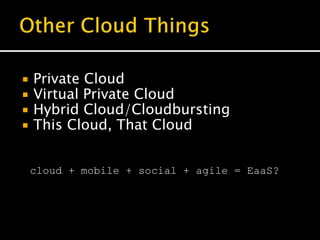
 Private Cloud
 Virtual Private Cloud
 Hybrid Cloud/Cloudbursting
 This Cloud, That Cloud
cloud + mobile + social + agile = EaaS?
“Cloud? I’ve been doing
that since 1988. It’s just
the same old thing with a
new name."
- Technohipster
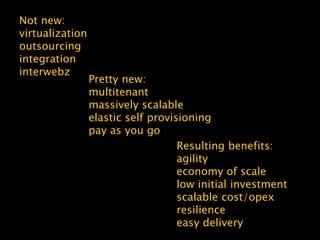
Pretty new:
multitenant
massively scalable
elastic self provisioning
pay as you go
Resulting benefits:
agility
economy of scale
low initial investment
scalable cost/opex
resilience
easy delivery
Not new:
virtualization
outsourcing
integration
interwebz
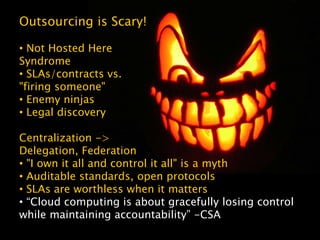
Centralization ->
Delegation, Federation
• "I own it all and control it all" is a myth
• Auditable standards, open protocols
• SLAs are worthless when it matters
• “Cloud computing is about gracefully losing control
while maintaining accountability” -CSA
Outsourcing is Scary!
• Not Hosted Here
Syndrome
• SLAs/contracts vs.
"firing someone"
• Enemy ninjas
• Legal discovery
“I'd rather trust someone
I've never met than the
guys in IT.”
- Developer
Are You This Guy?
Too bad!
Gartner reports that 39% of respondents worldwide are budgeting
money to spend on cloud
Cloud computing is already 10% of total IT services budgets
Cloud is the future of computing
If you make it into security “versus” business outcome – you lose!
Luckily, it doesn’t have to be that way
Sure, there’s security stuff to manage around the cloud, just like
anything
But here’s why the cloud can improve your security posture, and
how it can help you do your job!
 Globally distributed data centers with
multiple availability zones per region
 Data centers: unmarked separate
buildings, biometrics, access logging.
SAS 70 Type II, ISO 27001 in progress
 S3 Storage: highly redundant storage,
control over global distribution
 Disks are zeroed out post-use
 EC2 Instances: image based VMs
 Security Groups – like a software
firewall integrated down to the
hypervisor
 Amazon ops staff can’t see within
your VM or memory
 VPC for private only instances
 Key crypto for machine access
 Multifactor auth available
 “Bring your own key”
 Employee vetting procedures
 Big security department
 Other products - RDS, SNS, SimpleDB,
SQS, monitoring, CDN, etc.
 Via a console or API, you instantiate
instances from images, provision
storage and network, set access keys,
make copies, terminate assets
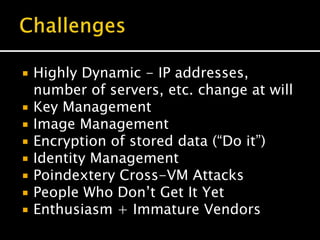
 Highly Dynamic - IP addresses,
number of servers, etc. change at will
 Key Management
 Image Management
 Encryption of stored data (“Do it”)
 Identity Management
 Poindextery Cross-VM Attacks
 People Who Don’t Get It Yet
 Enthusiasm + Immature Vendors
“But you said the cloud’s
more secure, man!”
- You
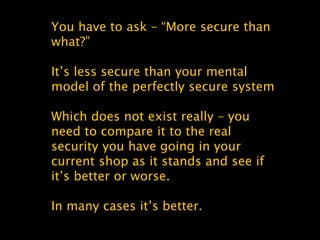
You have to ask – “More secure than
what?”
It’s less secure than your mental
model of the perfectly secure system
Which does not exist really – you
need to compare it to the real
security you have going in your
current shop as it stands and see if
it’s better or worse.
In many cases it’s better.
the proof is in the pudding
mmm… pudding
let’s see how the cloud and
one large IT shop compare
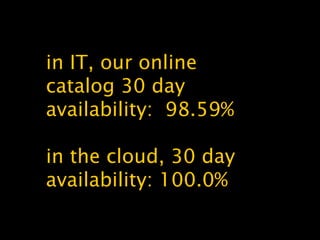
in IT, our online
catalog 30 day
availability: 98.59%
in the cloud, 30 day
availability: 100.0%
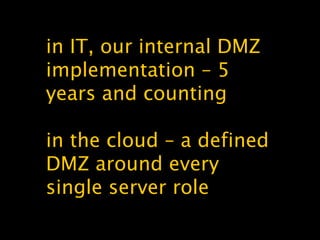
in IT, our internal DMZ
implementation – 5
years and counting
in the cloud – a defined
DMZ around every
single server role
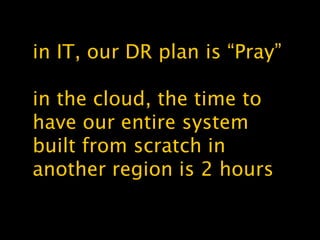
in IT, our DR plan is “Pray”
in the cloud, the time to
have our entire system
built from scratch in
another region is 2 hours
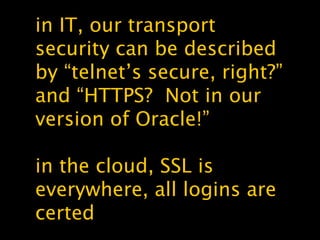
in IT, our transport
security can be described
by “telnet’s secure, right?”
and “HTTPS? Not in our
version of Oracle!”
in the cloud, SSL is
everywhere, all logins are
certed
in IT, we have to “scan”
to “discover” our assets
and their OS levels
in the cloud, we create
our systems from a
defined model
programmatically
in the cloud, we alert if
anyone logs into a
server, it’s so rare
in the cloud, if a box is
suspect we crumple it
up and throw it away
(you can make a copy)
is this an unfair comparison?
what is “fair?”
the only meaningful
question is “with my new
app, where objectively is it
better off?”
the cloud gives superpowers
to the little guy
intense resilience
cloud backup
near automatic DR
open standards
APIs and scale drive self service
many cloud providers have more
security staff than you do
you benefit from the security
requirements of all their other
customers
managed security service integration
is a compelling product
security is a differentiator in the
space and suppliers are chasing it
better architecture –
“sharing is the devil”
utility billing drives
sunsetting of old apps/systems
security SaaS products make
enterprise level security accessible
acknowledges reality – devices,
networks, data are everywhere
the cloud age
post "perimeter"
post "SLA"
post "server"
post "web page"
“You can run, but you’ll
just die tired.”
- Me
The Cloud Friendly Ghost
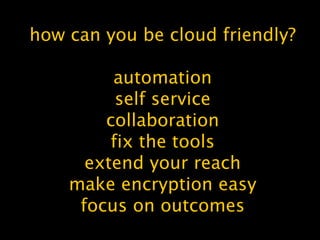
how can you be cloud friendly?
automation
self service
collaboration
fix the tools
extend your reach
make encryption easy
focus on outcomes
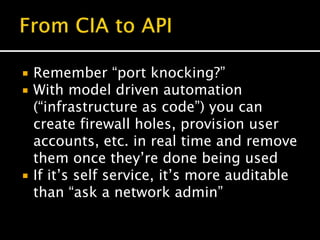
 Remember “port knocking?”
 With model driven automation
(“infrastructure as code”) you can
create firewall holes, provision user
accounts, etc. in real time and remove
them once they’re done being used
 If it’s self service, it’s more auditable
than “ask a network admin”
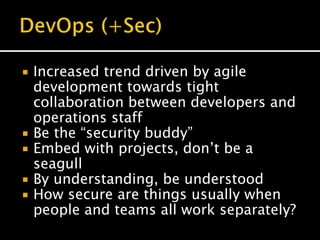
 Increased trend driven by agile
development towards tight
collaboration between developers and
operations staff
 Be the “security buddy”
 Embed with projects, don’t be a
seagull
 By understanding, be understood
 How secure are things usually when
people and teams all work separately?
 Dynamic nature of cloud poses
challenges for old tools
 Encryption is still stupid hard – check
out grendel, and maybe homomorphic
encryption will rescue us
 Note all the “Security as a Service”
offerings springing up- was spam
filtering and scanning, now it’s code
analysis (Veracode, Fortify), IAM
(PingIdentity), virus scan (McAfee), etc.
 Focus on real security
 Naturally it’ll take time for compliance
standards to get with the times – but
don’t assume it can’t be compliant –
some of your auditors have actually
heard of VMs and know what to do
 FUD doesn’t benefit anyone – figuring
out how to “make it happen” –
securely – benefits everyone.
try it –
you’ll like it
 Cloud Security Alliance
(cloudsecurityalliance.org)

 Security Guidance for Critical Areas in Cloud
Computing
(http://cloudsecurityalliance.org/guidance/cs
aguide.v2.1.pdf)
 ENISA Cloud Computing Risk Assessment
(http://www.enisa.europa.eu/act/rm/files/del
iverables/cloud-computing-risk-assessment )
 Book: Cloud Security and Privacy (Mather,
Kumraswamy, Latif) - Yay!
 Book: Cloud Security (Krutz, Vines) - Boo!
 Jericho Forum (jerichoforum.org)
 Amazon Security Center
(aws.amazon.com/security)
 Austin Cloud User Group (acug.cloudug.org)
Why the cloud is more secure than your existing systems

Why the cloud is more secure than your existing systems

  • 1.
    Ernest Mueller NationalInstruments theagileadmin.com ernest.mueller@gmail.com @ernestmueller
  • 3.
    (ISP -> colo)+ virtualization + HPC + (AJAX + SOA -> REST APIs) = IaaS IDE/4GLs + EAI + SaaS + IaaS = PaaS ((web site -> web app) -> ASP) + virtualization + fast network + [RIA browsers && mobile] = SaaS [IaaS | PaaS | SaaS ] + [ devops | open source | noSQL ] = cloud
  • 4.
    Amazon EC2, Rackspace,VMWare, Verizon, Terremark, IBM, everyone else with a data center Move infrastructure off premise, focus on value added operations Usually multitenant virtualized hosting, REST API driven near-instant provisioning to scale, utility billing
  • 5.
    Salesforce.com, Google Apps,Zoho, MobileMe, everyone else with some developers Bringing the convenience of consumer apps to the world of business apps You’ve been doing this forever (ADT/Paychex, credit card processors)
  • 6.
    force.com, Microsoft Azure,Google App Engine, Heroku, Code2Cloud Develop apps without needing to mess with the plumbing The most newfangled
  • 7.
     Private Cloud Virtual Private Cloud  Hybrid Cloud/Cloudbursting  This Cloud, That Cloud cloud + mobile + social + agile = EaaS?
  • 8.
    “Cloud? I’ve beendoing that since 1988. It’s just the same old thing with a new name." - Technohipster
  • 9.
    Pretty new: multitenant massively scalable elasticself provisioning pay as you go Resulting benefits: agility economy of scale low initial investment scalable cost/opex resilience easy delivery Not new: virtualization outsourcing integration interwebz
  • 10.
    Centralization -> Delegation, Federation •"I own it all and control it all" is a myth • Auditable standards, open protocols • SLAs are worthless when it matters • “Cloud computing is about gracefully losing control while maintaining accountability” -CSA Outsourcing is Scary! • Not Hosted Here Syndrome • SLAs/contracts vs. "firing someone" • Enemy ninjas • Legal discovery
  • 11.
    “I'd rather trustsomeone I've never met than the guys in IT.” - Developer
  • 12.
  • 13.
    Too bad! Gartner reportsthat 39% of respondents worldwide are budgeting money to spend on cloud Cloud computing is already 10% of total IT services budgets Cloud is the future of computing If you make it into security “versus” business outcome – you lose! Luckily, it doesn’t have to be that way Sure, there’s security stuff to manage around the cloud, just like anything But here’s why the cloud can improve your security posture, and how it can help you do your job!
  • 14.
     Globally distributeddata centers with multiple availability zones per region  Data centers: unmarked separate buildings, biometrics, access logging. SAS 70 Type II, ISO 27001 in progress  S3 Storage: highly redundant storage, control over global distribution  Disks are zeroed out post-use  EC2 Instances: image based VMs
  • 15.
     Security Groups– like a software firewall integrated down to the hypervisor  Amazon ops staff can’t see within your VM or memory  VPC for private only instances  Key crypto for machine access  Multifactor auth available  “Bring your own key”
  • 16.
     Employee vettingprocedures  Big security department  Other products - RDS, SNS, SimpleDB, SQS, monitoring, CDN, etc.  Via a console or API, you instantiate instances from images, provision storage and network, set access keys, make copies, terminate assets
  • 17.
     Highly Dynamic- IP addresses, number of servers, etc. change at will  Key Management  Image Management  Encryption of stored data (“Do it”)  Identity Management  Poindextery Cross-VM Attacks  People Who Don’t Get It Yet  Enthusiasm + Immature Vendors
  • 18.
    “But you saidthe cloud’s more secure, man!” - You
  • 19.
    You have toask – “More secure than what?” It’s less secure than your mental model of the perfectly secure system Which does not exist really – you need to compare it to the real security you have going in your current shop as it stands and see if it’s better or worse. In many cases it’s better.
  • 21.
    the proof isin the pudding mmm… pudding let’s see how the cloud and one large IT shop compare
  • 22.
    in IT, ouronline catalog 30 day availability: 98.59% in the cloud, 30 day availability: 100.0%
  • 23.
    in IT, ourinternal DMZ implementation – 5 years and counting in the cloud – a defined DMZ around every single server role
  • 24.
    in IT, ourDR plan is “Pray” in the cloud, the time to have our entire system built from scratch in another region is 2 hours
  • 25.
    in IT, ourtransport security can be described by “telnet’s secure, right?” and “HTTPS? Not in our version of Oracle!” in the cloud, SSL is everywhere, all logins are certed
  • 26.
    in IT, wehave to “scan” to “discover” our assets and their OS levels in the cloud, we create our systems from a defined model programmatically
  • 27.
    in the cloud,we alert if anyone logs into a server, it’s so rare in the cloud, if a box is suspect we crumple it up and throw it away (you can make a copy)
  • 29.
    is this anunfair comparison? what is “fair?” the only meaningful question is “with my new app, where objectively is it better off?”
  • 30.
    the cloud givessuperpowers to the little guy intense resilience cloud backup near automatic DR open standards APIs and scale drive self service
  • 31.
    many cloud providershave more security staff than you do you benefit from the security requirements of all their other customers managed security service integration is a compelling product security is a differentiator in the space and suppliers are chasing it
  • 32.
    better architecture – “sharingis the devil” utility billing drives sunsetting of old apps/systems security SaaS products make enterprise level security accessible acknowledges reality – devices, networks, data are everywhere
  • 33.
    the cloud age post"perimeter" post "SLA" post "server" post "web page"
  • 34.
    “You can run,but you’ll just die tired.” - Me
  • 35.
  • 36.
    how can yoube cloud friendly? automation self service collaboration fix the tools extend your reach make encryption easy focus on outcomes
  • 37.
     Remember “portknocking?”  With model driven automation (“infrastructure as code”) you can create firewall holes, provision user accounts, etc. in real time and remove them once they’re done being used  If it’s self service, it’s more auditable than “ask a network admin”
  • 38.
     Increased trenddriven by agile development towards tight collaboration between developers and operations staff  Be the “security buddy”  Embed with projects, don’t be a seagull  By understanding, be understood  How secure are things usually when people and teams all work separately?
  • 39.
     Dynamic natureof cloud poses challenges for old tools  Encryption is still stupid hard – check out grendel, and maybe homomorphic encryption will rescue us  Note all the “Security as a Service” offerings springing up- was spam filtering and scanning, now it’s code analysis (Veracode, Fortify), IAM (PingIdentity), virus scan (McAfee), etc.
  • 40.
     Focus onreal security  Naturally it’ll take time for compliance standards to get with the times – but don’t assume it can’t be compliant – some of your auditors have actually heard of VMs and know what to do  FUD doesn’t benefit anyone – figuring out how to “make it happen” – securely – benefits everyone.
  • 41.
  • 42.
     Cloud SecurityAlliance (cloudsecurityalliance.org)  Security Guidance for Critical Areas in Cloud Computing (http://cloudsecurityalliance.org/guidance/cs aguide.v2.1.pdf)  ENISA Cloud Computing Risk Assessment (http://www.enisa.europa.eu/act/rm/files/del iverables/cloud-computing-risk-assessment )
  • 43.
     Book: CloudSecurity and Privacy (Mather, Kumraswamy, Latif) - Yay!  Book: Cloud Security (Krutz, Vines) - Boo!  Jericho Forum (jerichoforum.org)  Amazon Security Center (aws.amazon.com/security)  Austin Cloud User Group (acug.cloudug.org)