

The Cloud Is Rockin’ & Rollin’ InKrishnan SubramanianAnalyst & Editor, CloudAve
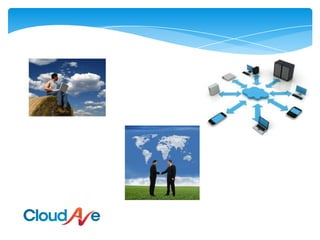
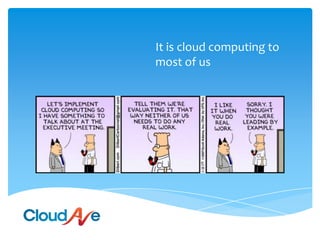
It is cloud computing to most of us
Cloud Computing – What, Why, How and Who?Potential Concerns & Best PracticesPredictions & ConclusionPlan of my talk
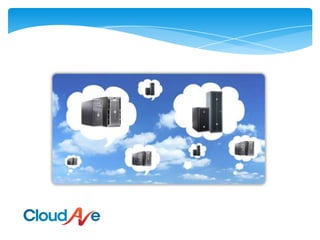
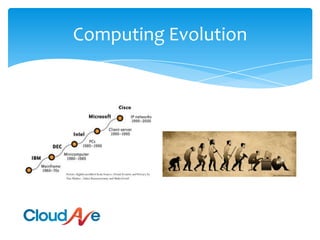
Computing Evolution
Cloud Computing - DefinitionOn-demand self-service internet infrastructure where you pay as you go and use only what you need, all managed by a browser, application or APIClouds will be the next transformation over the next several years, building off of the software models that virtualization enabled+ 100s more from experts, vendors and kids
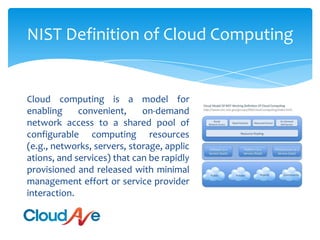
NIST Definition of Cloud ComputingCloud computing is a model for enabling convenient, on-demand network access to a shared pool of configurable computing resources (e.g., networks, servers, storage, applications, and services) that can be rapidly provisioned and released with minimal management effort or service provider interaction.
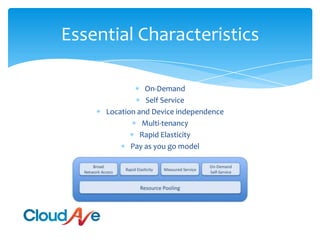
Essential CharacteristicsOn-DemandSelf ServiceLocation and Device independenceMulti-tenancyRapid ElasticityPay as you go model
On Demand
Self Service
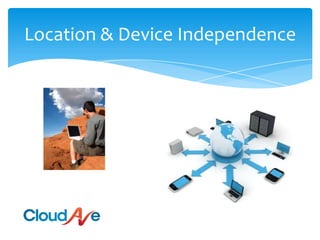
Location & Device Independence
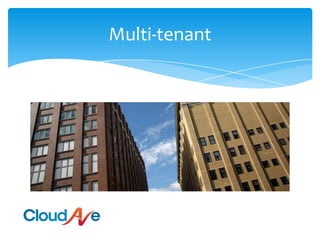
Multi-tenant
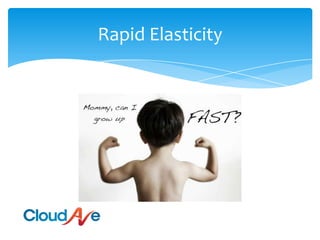
Rapid Elasticity
Pay Per Use
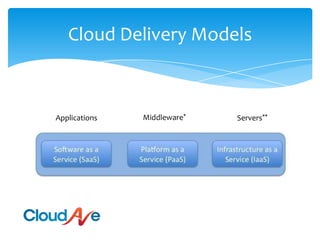
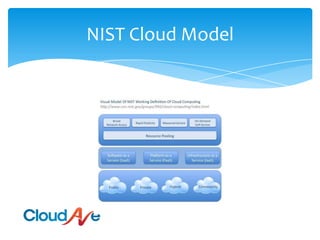
Cloud Delivery ModelsMiddleware*ApplicationsServers**
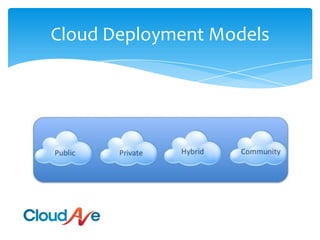
Cloud Deployment Models
NIST Cloud Model
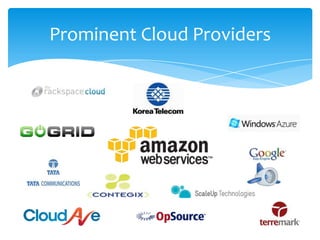
Prominent Cloud Providers
Amazon Web ServicesCompute – EC2, MapReduce, AutoscalingStorage – S3, EBSNetworking – Route 53, VPC, ELBDatabase – SimpleDB, RDSDeployment – Elastic Beanstalk, CloudformationMessaging – SQS, SNS, SESMonitoring – CloudwatchAnd moreAmazon is a pioneer in cloud computing with rapid innovation
Rackspace CloudCloud ServersCloud SitesCloud FilesOpenStackCloud Builders
GoGridCloud ServersCloud StorageLoad BalancingHybrid Hostingand more
Azure & App EngineThey are in the PaaS spaceTargeted at developersAzure supports .NET, Java, Ruby, etcGAE supports Python and Java
Business AdvantagesCost Savings – No Capex and Lower OpexAgility – Faster Business Response To Changing Conditions Focus on Core Business
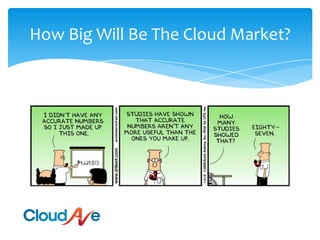
How Big Will Be The Cloud Market?
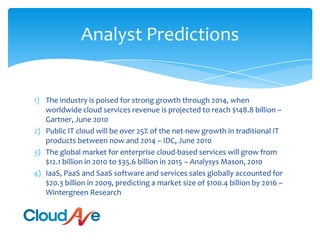
Analyst PredictionsThe industry is poised for strong growth through 2014, when worldwide cloud services revenue is projected to reach $148.8 billion – Gartner, June 2010Public IT cloud will be over 25% of the net-new growth in traditional IT products between now and 2014 – IDC, June 2010The global market for enterprise cloud-based services will grow from $12.1 billion in 2010 to $35.6 billion in 2015 –Analysys Mason, 2010IaaS, PaaS and SaaS software and services sales globally accounted for $20.3 billion in 2009, predicting a market size of $100.4 billion by 2016 – Wintergreen Research
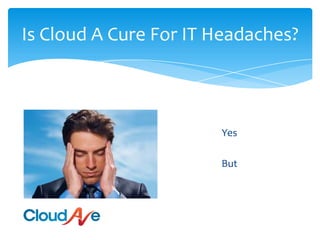
Is Cloud A Cure For IT Headaches?YesBut
Business ConcernsAvailability ConcernsSecurity ConcernsPrivacy ConcernsBut?
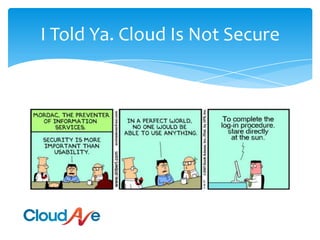
I Told Ya. Cloud Is Not Secure
Security & Privacy ConcernsCloud Provider’s Security PracticesRegulatory NeedsData OwnershipData Privacy
Mental ShiftLosing ControlTrust
In RealityCloud is neither more nor less secure than the traditional ITWith the loss of control, different kind of risks comes into focusIndustry best practices can help mitigate these risks. Check out Cloud Security Alliance (CSA)Bottom Line is balancing the risks to take advantage of the clouds
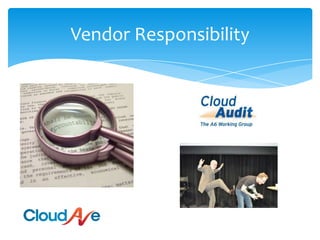
Vendor Responsibility
Future Of Cloud ComputingCloud adoption will be rapid. Security concerns will fade away with better education on the side of the users and more transparency on the side of the providersA federated cloud ecosystem will ensure competition empowering the usersPaaS is the future of cloud services – empowering the developers
ConclusionCloud is real and maturing fast. Businesses of all sizes and shapes are going to adopt it much sooner than many expectUsing Cloud Computing becomes a competitive advantageA big part of the security concerns are due to FUD but it is also critical to understand the risks and take steps to mitigate them, to take the full advantage of cloudsLeverage the cloud but control your destiny

The Cloud Is Rockin' and Rollin' In

  • 1.
    The Cloud IsRockin’ & Rollin’ InKrishnan SubramanianAnalyst & Editor, CloudAve
  • 4.
    It is cloudcomputing to most of us
  • 5.
    Cloud Computing –What, Why, How and Who?Potential Concerns & Best PracticesPredictions & ConclusionPlan of my talk
  • 6.
  • 7.
    Cloud Computing -DefinitionOn-demand self-service internet infrastructure where you pay as you go and use only what you need, all managed by a browser, application or APIClouds will be the next transformation over the next several years, building off of the software models that virtualization enabled+ 100s more from experts, vendors and kids
  • 8.
    NIST Definition ofCloud ComputingCloud computing is a model for enabling convenient, on-demand network access to a shared pool of configurable computing resources (e.g., networks, servers, storage, applications, and services) that can be rapidly provisioned and released with minimal management effort or service provider interaction.
  • 9.
    Essential CharacteristicsOn-DemandSelf ServiceLocationand Device independenceMulti-tenancyRapid ElasticityPay as you go model
  • 10.
  • 11.
  • 12.
    Location & DeviceIndependence
  • 13.
  • 14.
  • 15.
  • 16.
  • 17.
  • 18.
  • 19.
  • 20.
    Amazon Web ServicesCompute– EC2, MapReduce, AutoscalingStorage – S3, EBSNetworking – Route 53, VPC, ELBDatabase – SimpleDB, RDSDeployment – Elastic Beanstalk, CloudformationMessaging – SQS, SNS, SESMonitoring – CloudwatchAnd moreAmazon is a pioneer in cloud computing with rapid innovation
  • 21.
    Rackspace CloudCloud ServersCloudSitesCloud FilesOpenStackCloud Builders
  • 22.
    GoGridCloud ServersCloud StorageLoadBalancingHybrid Hostingand more
  • 23.
    Azure & AppEngineThey are in the PaaS spaceTargeted at developersAzure supports .NET, Java, Ruby, etcGAE supports Python and Java
  • 24.
    Business AdvantagesCost Savings– No Capex and Lower OpexAgility – Faster Business Response To Changing Conditions Focus on Core Business
  • 25.
    How Big WillBe The Cloud Market?
  • 26.
    Analyst PredictionsThe industryis poised for strong growth through 2014, when worldwide cloud services revenue is projected to reach $148.8 billion – Gartner, June 2010Public IT cloud will be over 25% of the net-new growth in traditional IT products between now and 2014 – IDC, June 2010The global market for enterprise cloud-based services will grow from $12.1 billion in 2010 to $35.6 billion in 2015 –Analysys Mason, 2010IaaS, PaaS and SaaS software and services sales globally accounted for $20.3 billion in 2009, predicting a market size of $100.4 billion by 2016 – Wintergreen Research
  • 27.
    Is Cloud ACure For IT Headaches?YesBut
  • 28.
  • 29.
    I Told Ya.Cloud Is Not Secure
  • 30.
    Security & PrivacyConcernsCloud Provider’s Security PracticesRegulatory NeedsData OwnershipData Privacy
  • 31.
  • 32.
    In RealityCloud isneither more nor less secure than the traditional ITWith the loss of control, different kind of risks comes into focusIndustry best practices can help mitigate these risks. Check out Cloud Security Alliance (CSA)Bottom Line is balancing the risks to take advantage of the clouds
  • 33.
  • 34.
    Future Of CloudComputingCloud adoption will be rapid. Security concerns will fade away with better education on the side of the users and more transparency on the side of the providersA federated cloud ecosystem will ensure competition empowering the usersPaaS is the future of cloud services – empowering the developers
  • 35.
    ConclusionCloud is realand maturing fast. Businesses of all sizes and shapes are going to adopt it much sooner than many expectUsing Cloud Computing becomes a competitive advantageA big part of the security concerns are due to FUD but it is also critical to understand the risks and take steps to mitigate them, to take the full advantage of cloudsLeverage the cloud but control your destiny