1. Zero Trust:Trust No One, Verify Everything
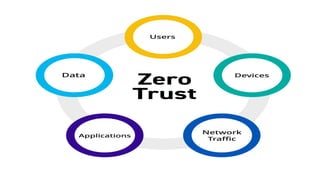
Zero Trust Model in Cloud Security
• Emergence of cloud adoption and remote work.
• Operates on "trust no one, verify everything" principle.
• Continuous user authentication based on device health, location, and
behavior.
• Ensures only legitimate users access sensitive data, even outside
corporate network.
4.
2. The AIand ML Revolution
• As cyber threats become more sophisticated, traditional security
measures may not suffice.
• Enter Artificial Intelligence (AI)-driven threat detection, which serves
as the watchful eye in the sky. AI algorithms continuously analyze
massive amounts of data to identify anomalies, potential breaches,
and suspicious activities.
• This proactive approach helps businesses detect and mitigate threats
before they can wreak havoc on the cloud infrastructure. AI-driven
threat detection remains one of the major cloud security trends.
5.
3. Identity andAccess Management (IAM)
Enhancements
Cloud Security Enhancements
• Importance of IAM in cloud security.
• Emergence of adaptive access controls based on user behavior,
context, and risk assessment.
• Real-time monitoring and detection of anomalous user behavior
through User and Entity Behavior Analytics (UEBA).
• These enhancements add additional protection and contribute to a
comprehensive security framework.
6.
4. Confidential Computing:Encrypting Data in
Use.
• Cloud security trends are not just about securing data at rest or in
transit; it also extends to protecting data while it’s being processed in
memory.
• Confidential Computing addresses this concern by encrypting data
while it is in use. This allows cloud providers to perform computations
on encrypted data without ever exposing the actual information.
• As a result, sensitive data remains shielded even from potential
insider threats or malicious actors targeting the cloud infrastructure.
7.
5. Multi-Factor Authentication(MFA): The
Golden Lock for Cloud Entry
• Passwords alone are no longer enough to ensure secure access to
cloud services.
• Multi-Factor Authentication (MFA) adds an extra layer of protection
by requiring users to provide multiple forms of identification before
gaining entry.
• This may include something they know (password), something they
have (smartphone), and something they are (biometric data).
• MFA significantly reduces the risk of unauthorized access, ensuring
the cloud remains a fortress of data security.
8.
6. DevSecOps: IntegratingSecurity into the
Cloud Pipeline
• In the past, security was often an afterthought in the development
and deployment of cloud applications.
• However, rising cloud security trends of DevSecOps has changed the
game. DevSecOps integrates security practices into the entire cloud
development pipeline, ensuring that security measures are not
compromised in the quest for faster deployments.
• This seamless collaboration between developers, IT operations, and
security teams enhances the overall security posture of cloud-based
applications.