Spending on public cloud services 
could be more than $180 billion by 
next year, says the IT research 
group Gartner as quoted in 
InformationWeek.
The cloud allows for quick 
scalability to meet demand. 
Companies can quickly scale cloud 
services and storage up or down 
as needed.
The public cloud will grow 45% 
annually over the next five 
years, while on-site computing 
will grow by just under 9%, 
according to Barron’s Tech 
Trader Daily and Piper Jaffray.
Cloud providers can efficiently, 
accurately and quickly manage 
upgrades, backup, disaster 
recovery, maintenance, security 
and more.
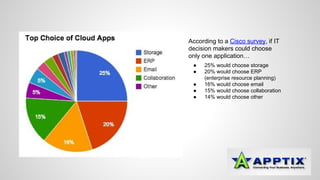
According to a Cisco survey, if IT 
decision makers could choose 
only one application… 
● 25% would choose storage 
● 20% would choose ERP 
(enterprise resource planning) 
● 16% would choose email 
● 15% would choose collaboration 
● 14% would choose other
Companies using the cloud can 
save on capital costs because 
they don’t have to buy any (or as 
many) servers, software, etc.
Companies concerned with being 
environmentally sound can 
choose green IT (data centers 
powered by renewable energy, 
like a wind farm for example.)
According to an NSK survey of 
3500 IT executives, more than 
80% saved money by moving 
company business to the cloud.
Nearly 15% of IT companies in the 
NSK survey downsized staff after 
moving to the cloud, thereby 
saving even more money.
Cloud computing allows IT costs 
to be more transparent and 
expenses can be divided among 
department budgets.
Almost all of those surveyed by 
RightScale, 94%, use cloud 
computing. Close to 60% of those 
use a combination (public and 
private) cloud solution, 30% use 
public cloud only and less than 
10% use private only.
Using the cloud helps small 
businesses and entrepreneurs 
access the latest, full-featured 
technology, quicker and at lower 
cost, than they could if they had to 
purchase the tech outright.
Versus 25% in 2012, by 2020, 
60% of storage capacity is 
expected to be in cloud apps, 
according to Seagate, the 
industry’s leading producer of data 
storage hardware.
Using cloud computing, 
companies can operate without a 
large IT team in-house.
An estimated 1 exabyte of data is 
currently in cloud storage, 
according to Seagate and 
SiliconAngle. One exabyte is 
equal to 1000 petabytes (PB), or 
1,000,000 terabytes, or 
1,000,000,000 gigabytes
A whopping 90% of IT 
professionals surveyed saw an 
improvement in either security, 
quality or efficiency after moving 
to the cloud, according to NSK.
The cloud allows businesses to be 
use remote workers. Employees 
can work from wherever they are 
and share information, documents 
and applications in the cloud.
Employees and freelance 
consultants can use their favorite 
devices (and multiple devices) to 
access the cloud data or apps.
According to Thales e-Security more 
than half of the 4000 businesses 
surveyed worldwide use the cloud for 
confidential information sharing and 
storage - and 60% of them believe that 
security is the responsibility of the cloud 
provider.
Small or large firms can save a 
significant amount fairly quickly on 
software and energy expenses by 
moving email to web mail and getting 
antivirus protection via cloud software.
About 60% of new spending on cloud 
computing is by North American 
businesses. Western European users 
account for about 25% and this trend is 
growing, according to Forbes and 
Gartner
By the end of 2014, businesses in the 
United States will spend more than $13 
billion on cloud computing and 
managed hosting services.
More than 60% of businesses use the 
cloud for IT operations. Approximately 
75% of businesses surveyed said 
service availability improved after 
moving to the cloud, according to 
Security Week
According to EMC, nearly 40% of all 
information in the digital universe will be 
touched in some way by cloud 
computing companies.
The number of cloud providers is huge: 
2200+ cloud services are being used by 
3 million people in major business 
sectors such as finance, health, 
technology, manufacturing, media, and 
services.
91% of users surveyed said the cloud 
makes it easier to meet government 
compliance requirements, according to 
Baseline.
More than 33% of survey respondents 
said that accessibility to cloud 
information with multiple devices was 
the main reason they adopted cloud 
computing, according to Ramco.
According to Baseline, 75% of 
companies surveyed experienced 
improvements in their network 
availability.
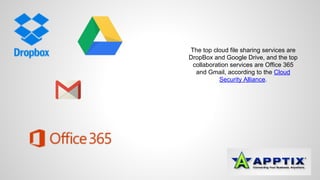
The top cloud file sharing services are 
DropBox and Google Drive, and the top 
collaboration services are Office 365 
and Gmail, according to the Cloud 
Security Alliance.
Survey respondents stated that the 
fastest areas of growth in cloud 
applications will be in the IT areas of 
big data, backup, help desk operations, 
mobile, system management and 
security, according to North Bridge 
Growth Equity Venture Partners and 
GigaOm Research.
GigaOM predicts the total world market 
for cloud computing will be 
approximately $160 billion by the end of 
2014, which is up about 125% from just 
3 years ago.
Businesses can add cloud services as 
needed, for instance, you might move 
email first, but keep your data files on a 
local server and use a cloud-based 
system for backup.
About 65% of companies surveyed said 
that switching to cloud solutions 
reduced waste and lowered energy 
consumption, according to Ramco.
Although data security and intellectual 
property rights are concerns when 
choosing a cloud provider, 94% of 
businesses found that IT security 
actually improved after switching to the 
cloud, according to Security Week 
quoting a ComScore survey.
CSC surveyed 3,500 IT decision 
makers. 80% of respondents said they 
saw improvements in IT performance 
within 6 months of switching to the 
cloud.
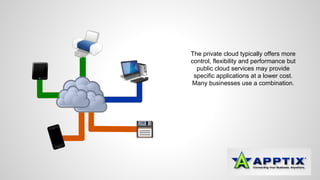
The private cloud typically offers more 
control, flexibility and performance but 
public cloud services may provide 
specific applications at a lower cost. 
Many businesses use a combination.
In 2013, 64% of cloud activity was 
related to banking, partly due to the 
introduction and adoption of mobile 
banking. This was closely followed by 
shopping at 63% of cloud activity, social 
media at nearly 60%, online gaming 
accounted for 45% of cloud activity. 
Nearly 30% of cloud activity was due to 
photo sharing and almost 20% due to 
file sharing, according to NSK Inc.
When evaluating a cloud provider, 
make sure you understand the details 
like the data storage location, how 
backups are done and how data is 
secured. Get details about the provider’ 
s disaster planning and also what 
service levels are guaranteed.
More than 60% of cloud users said their 
levels of privacy protection increased, 
according to Security Week quoting a 
Microsoft study.
The cloud allows companies to shift 
employees to other tasks like data 
analysis, strategic planning or sales.
SaaS (software as a service) is the 
most popular of cloud services, used by 
about 65% of companies surveyed by 
GigaOM and North Bridge.
Nearly 40% of respondents plan to 
increase their training investment to 
support the expansion of cloud 
computing in their business, according 
to GigaOM and North Bridge.
Cloud advertising is the largest 
segment of the cloud services market, 
making up almost 50% percent of the 
market in 2012, with $310 billion to be 
spent through 2016, according to 
Gartner.
Gartner predicts that, through 2016, the 
most widely used cloud services 
segment (after advertising) will be 
business process services (BPaaS, 
nearly 30% of total market), followed by 
application services (SaaS, software as 
a service at nearly 15%), cloud system 
infrastructure (infrastructure as a 
service, called IaaS, at about 6%), 
cloud management and security service 
(at about 3%), and application 
infrastructure services (PaaS, platform 
as a service at 1%).
By 2020, private and public clouds will 
be common and will exchange data 
seamlessly, according to EMC.
When surveyed by Citrix and Wakefield 
Research, consumers said the cloud 
would benefit the economy by lowering 
costs for businesses and lowering 
prices for them (35%), spurring small 
business growth (32%) and generating 
jobs (said 26% of Millennials and only 
19% of Baby Boomers).
More than 75% of survey respondents 
expect hybrid cloud solutions to be the 
core of their cloud strategies within five 
years, according to GigaOM.
Among those reluctant to use the cloud, 
the top reasons were cost (34%), 
security issues (32%) and privacy 
concerns (31%), according to GigaOM.
Despite all of the cloud usage, many 
members of the public don’t realize 
when they are using it. According to a 
survey by Citrix, 95% of consumers 
said they never use the cloud, but when 
asked, said they do engage in online 
shopping, social media, mobile banking 
and more.
According to Wakefield Research, a 
little over 50% of respondents, including 
a majority of Millennials (born in the 
1980s and 90s), think that stormy 
weather interferes with cloud 
computing.
Read the full article with links and resources on Apptix.com 
50 Things You Absolutely Need To Know About the Cloud

50 Things You Absolutely Need To Know About The Cloud

  • 2.
    Spending on publiccloud services could be more than $180 billion by next year, says the IT research group Gartner as quoted in InformationWeek.
  • 3.
    The cloud allowsfor quick scalability to meet demand. Companies can quickly scale cloud services and storage up or down as needed.
  • 4.
    The public cloudwill grow 45% annually over the next five years, while on-site computing will grow by just under 9%, according to Barron’s Tech Trader Daily and Piper Jaffray.
  • 5.
    Cloud providers canefficiently, accurately and quickly manage upgrades, backup, disaster recovery, maintenance, security and more.
  • 6.
    According to aCisco survey, if IT decision makers could choose only one application… ● 25% would choose storage ● 20% would choose ERP (enterprise resource planning) ● 16% would choose email ● 15% would choose collaboration ● 14% would choose other
  • 7.
    Companies using thecloud can save on capital costs because they don’t have to buy any (or as many) servers, software, etc.
  • 8.
    Companies concerned withbeing environmentally sound can choose green IT (data centers powered by renewable energy, like a wind farm for example.)
  • 9.
    According to anNSK survey of 3500 IT executives, more than 80% saved money by moving company business to the cloud.
  • 10.
    Nearly 15% ofIT companies in the NSK survey downsized staff after moving to the cloud, thereby saving even more money.
  • 11.
    Cloud computing allowsIT costs to be more transparent and expenses can be divided among department budgets.
  • 12.
    Almost all ofthose surveyed by RightScale, 94%, use cloud computing. Close to 60% of those use a combination (public and private) cloud solution, 30% use public cloud only and less than 10% use private only.
  • 13.
    Using the cloudhelps small businesses and entrepreneurs access the latest, full-featured technology, quicker and at lower cost, than they could if they had to purchase the tech outright.
  • 14.
    Versus 25% in2012, by 2020, 60% of storage capacity is expected to be in cloud apps, according to Seagate, the industry’s leading producer of data storage hardware.
  • 15.
    Using cloud computing, companies can operate without a large IT team in-house.
  • 16.
    An estimated 1exabyte of data is currently in cloud storage, according to Seagate and SiliconAngle. One exabyte is equal to 1000 petabytes (PB), or 1,000,000 terabytes, or 1,000,000,000 gigabytes
  • 17.
    A whopping 90%of IT professionals surveyed saw an improvement in either security, quality or efficiency after moving to the cloud, according to NSK.
  • 18.
    The cloud allowsbusinesses to be use remote workers. Employees can work from wherever they are and share information, documents and applications in the cloud.
  • 19.
    Employees and freelance consultants can use their favorite devices (and multiple devices) to access the cloud data or apps.
  • 20.
    According to Thalese-Security more than half of the 4000 businesses surveyed worldwide use the cloud for confidential information sharing and storage - and 60% of them believe that security is the responsibility of the cloud provider.
  • 21.
    Small or largefirms can save a significant amount fairly quickly on software and energy expenses by moving email to web mail and getting antivirus protection via cloud software.
  • 22.
    About 60% ofnew spending on cloud computing is by North American businesses. Western European users account for about 25% and this trend is growing, according to Forbes and Gartner
  • 23.
    By the endof 2014, businesses in the United States will spend more than $13 billion on cloud computing and managed hosting services.
  • 24.
    More than 60%of businesses use the cloud for IT operations. Approximately 75% of businesses surveyed said service availability improved after moving to the cloud, according to Security Week
  • 25.
    According to EMC,nearly 40% of all information in the digital universe will be touched in some way by cloud computing companies.
  • 26.
    The number ofcloud providers is huge: 2200+ cloud services are being used by 3 million people in major business sectors such as finance, health, technology, manufacturing, media, and services.
  • 27.
    91% of userssurveyed said the cloud makes it easier to meet government compliance requirements, according to Baseline.
  • 28.
    More than 33%of survey respondents said that accessibility to cloud information with multiple devices was the main reason they adopted cloud computing, according to Ramco.
  • 29.
    According to Baseline,75% of companies surveyed experienced improvements in their network availability.
  • 30.
    The top cloudfile sharing services are DropBox and Google Drive, and the top collaboration services are Office 365 and Gmail, according to the Cloud Security Alliance.
  • 31.
    Survey respondents statedthat the fastest areas of growth in cloud applications will be in the IT areas of big data, backup, help desk operations, mobile, system management and security, according to North Bridge Growth Equity Venture Partners and GigaOm Research.
  • 32.
    GigaOM predicts thetotal world market for cloud computing will be approximately $160 billion by the end of 2014, which is up about 125% from just 3 years ago.
  • 33.
    Businesses can addcloud services as needed, for instance, you might move email first, but keep your data files on a local server and use a cloud-based system for backup.
  • 34.
    About 65% ofcompanies surveyed said that switching to cloud solutions reduced waste and lowered energy consumption, according to Ramco.
  • 35.
    Although data securityand intellectual property rights are concerns when choosing a cloud provider, 94% of businesses found that IT security actually improved after switching to the cloud, according to Security Week quoting a ComScore survey.
  • 36.
    CSC surveyed 3,500IT decision makers. 80% of respondents said they saw improvements in IT performance within 6 months of switching to the cloud.
  • 37.
    The private cloudtypically offers more control, flexibility and performance but public cloud services may provide specific applications at a lower cost. Many businesses use a combination.
  • 38.
    In 2013, 64%of cloud activity was related to banking, partly due to the introduction and adoption of mobile banking. This was closely followed by shopping at 63% of cloud activity, social media at nearly 60%, online gaming accounted for 45% of cloud activity. Nearly 30% of cloud activity was due to photo sharing and almost 20% due to file sharing, according to NSK Inc.
  • 39.
    When evaluating acloud provider, make sure you understand the details like the data storage location, how backups are done and how data is secured. Get details about the provider’ s disaster planning and also what service levels are guaranteed.
  • 40.
    More than 60%of cloud users said their levels of privacy protection increased, according to Security Week quoting a Microsoft study.
  • 41.
    The cloud allowscompanies to shift employees to other tasks like data analysis, strategic planning or sales.
  • 42.
    SaaS (software asa service) is the most popular of cloud services, used by about 65% of companies surveyed by GigaOM and North Bridge.
  • 43.
    Nearly 40% ofrespondents plan to increase their training investment to support the expansion of cloud computing in their business, according to GigaOM and North Bridge.
  • 44.
    Cloud advertising isthe largest segment of the cloud services market, making up almost 50% percent of the market in 2012, with $310 billion to be spent through 2016, according to Gartner.
  • 45.
    Gartner predicts that,through 2016, the most widely used cloud services segment (after advertising) will be business process services (BPaaS, nearly 30% of total market), followed by application services (SaaS, software as a service at nearly 15%), cloud system infrastructure (infrastructure as a service, called IaaS, at about 6%), cloud management and security service (at about 3%), and application infrastructure services (PaaS, platform as a service at 1%).
  • 46.
    By 2020, privateand public clouds will be common and will exchange data seamlessly, according to EMC.
  • 47.
    When surveyed byCitrix and Wakefield Research, consumers said the cloud would benefit the economy by lowering costs for businesses and lowering prices for them (35%), spurring small business growth (32%) and generating jobs (said 26% of Millennials and only 19% of Baby Boomers).
  • 48.
    More than 75%of survey respondents expect hybrid cloud solutions to be the core of their cloud strategies within five years, according to GigaOM.
  • 49.
    Among those reluctantto use the cloud, the top reasons were cost (34%), security issues (32%) and privacy concerns (31%), according to GigaOM.
  • 50.
    Despite all ofthe cloud usage, many members of the public don’t realize when they are using it. According to a survey by Citrix, 95% of consumers said they never use the cloud, but when asked, said they do engage in online shopping, social media, mobile banking and more.
  • 51.
    According to WakefieldResearch, a little over 50% of respondents, including a majority of Millennials (born in the 1980s and 90s), think that stormy weather interferes with cloud computing.
  • 52.
    Read the fullarticle with links and resources on Apptix.com 50 Things You Absolutely Need To Know About the Cloud