By sadak pramodh 
Guided by
 Introduction 
 What is Cloud Operating System 
 Why Cloud OS? 
 Architecture 
 Applications 
 Live Demonstration 
 Cloud Storage 
 Advantages 
 Disadvantages 
 Conclusion
Introduction 
 With traditional desktop computing, we run copies of software programs on our 
own computer. The documents we create are stored on our own pc. 
 Although documents can be accessed from other computers on the network, they 
can’t be accessed by computers outside the network. This is PC-centric. 
 With cloud computing, the software programs one use aren’t run from one’s 
personal computer, but are rather stored on servers accessed via the Internet.
 If a computer crashes, the software is still available for others to use. Same goes for 
the documents one create; they’re stored on a collection of servers accessed via the 
Internet. 
 Anyone with permission can not only access the documents, but can also edit and 
collaborate on those documents in real time. 
 Unlike traditional computing, this cloud computing model isn’t PC-centric, it’s 
document-centric.
Examples of cloud operating systems 
 EyeOS 
 Joli OS 
 Easy Peasy 
 Google Chrome OS 
 Osw3 
 Own cloud
What is cloud operating System? 
 Cloud operating system that runs just a web browser, providing access to a variety 
of web-based applications that allow the user to perform many simple tasks 
without booting a full-scale operating system. Because of its simplicity, Cloud 
operating system can boot in just a few seconds. 
 The operating system is designed for Netbooks, Mobile Internet Devices, and PCs 
that are mainly used to browse the Internet. 
 From Cloud the user can quickly boot into the main OS, because Cloud continues 
booting the main OS in the background. 
 Combining a browser with a basic operating system allows the use of cloud 
computing, in which applications and data "live and run" on the Internet instead of 
the hard drive.
Why cloud OS? 
 For platform independence. 
 Faster and safer access. 
 Centralisized storage. 
 Huge data analysis. 
 Data sharing. 
 Better administration.
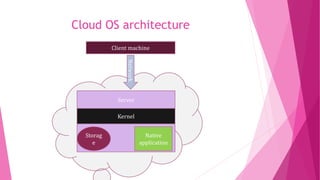
Cloud OS architecture 
Client machine 
Network 
Server 
Native 
application 
Kernel 
Storag 
e
 Individual users connect to the cloud from their own personal computers or 
portable devices, over the Internet. To these individual users, the cloud is seen as a 
single application, device, or document. 
 The hardware in the cloud (and the operating system that manages the hardware 
connections) is invisible. 
 Data and instuctions are sent to cloud system. Here all data is stored. 
 All insturctions passed over the network and information processed in the cloud 
only.
Applications 
 In company / organisation environment. 
 For research and development. 
 Social networking. 
 Remote Assistance. 
 Gamming.
Live Demonstration
Storage 
 Data is centralisized so we can easily analyse,arrange and sharing over the 
network. 
 We can use access the data even the clent system file system is different. 
 Can provide the better security to the data and also set restrictions to the users. 
 Multiple users can access the same data many times. 
 Common application format.
Advantages 
 Lower computer costs. 
 Improved performance. 
 Reduced software costs. 
 Instant software updates. 
 Improved document format compatibility. 
 Unlimited storage capacity. 
 Increased data reliability. 
 Universal document access. 
 Latest version availability. 
 Device independence.
Disadvantages 
 Requires a constant Internet connection. 
 Does not work well with low-speed connections. 
 Features might be limited. 
 Can be slow. 
 Stored data might not be secure without proper administartion. 
 Stored data can be lost by hardware failures.
Conclusion 
 Thus cloud operating system provide a super-computing power . 
 This cloud of computers extends beyond a single company or enterprise and also 
home PC’s. 
 The applications and data served by the cloud are available to broad group of 
users, cross-enterprise and cross-platform. 
 In future every home becomes a smart home by using the cloud service. 
 A revoluation can’t stop by anyone.
References 
 https://en.wikipedia.org/wiki/Cloud_(operating_system) 
 https://en.wikipedia.org/wiki/EyeOS 
 https://en.wikipedia.org/wiki/Google_Chrome_OS 
 https://en.wikipedia.org/wiki/User:Sadakpramodh
Thank you

Cloud operating system

  • 1.
    By sadak pramodh Guided by
  • 2.
     Introduction What is Cloud Operating System  Why Cloud OS?  Architecture  Applications  Live Demonstration  Cloud Storage  Advantages  Disadvantages  Conclusion
  • 3.
    Introduction  Withtraditional desktop computing, we run copies of software programs on our own computer. The documents we create are stored on our own pc.  Although documents can be accessed from other computers on the network, they can’t be accessed by computers outside the network. This is PC-centric.  With cloud computing, the software programs one use aren’t run from one’s personal computer, but are rather stored on servers accessed via the Internet.
  • 4.
     If acomputer crashes, the software is still available for others to use. Same goes for the documents one create; they’re stored on a collection of servers accessed via the Internet.  Anyone with permission can not only access the documents, but can also edit and collaborate on those documents in real time.  Unlike traditional computing, this cloud computing model isn’t PC-centric, it’s document-centric.
  • 5.
    Examples of cloudoperating systems  EyeOS  Joli OS  Easy Peasy  Google Chrome OS  Osw3  Own cloud
  • 6.
    What is cloudoperating System?  Cloud operating system that runs just a web browser, providing access to a variety of web-based applications that allow the user to perform many simple tasks without booting a full-scale operating system. Because of its simplicity, Cloud operating system can boot in just a few seconds.  The operating system is designed for Netbooks, Mobile Internet Devices, and PCs that are mainly used to browse the Internet.  From Cloud the user can quickly boot into the main OS, because Cloud continues booting the main OS in the background.  Combining a browser with a basic operating system allows the use of cloud computing, in which applications and data "live and run" on the Internet instead of the hard drive.
  • 7.
    Why cloud OS?  For platform independence.  Faster and safer access.  Centralisized storage.  Huge data analysis.  Data sharing.  Better administration.
  • 8.
    Cloud OS architecture Client machine Network Server Native application Kernel Storag e
  • 9.
     Individual usersconnect to the cloud from their own personal computers or portable devices, over the Internet. To these individual users, the cloud is seen as a single application, device, or document.  The hardware in the cloud (and the operating system that manages the hardware connections) is invisible.  Data and instuctions are sent to cloud system. Here all data is stored.  All insturctions passed over the network and information processed in the cloud only.
  • 10.
    Applications  Incompany / organisation environment.  For research and development.  Social networking.  Remote Assistance.  Gamming.
  • 11.
  • 12.
    Storage  Datais centralisized so we can easily analyse,arrange and sharing over the network.  We can use access the data even the clent system file system is different.  Can provide the better security to the data and also set restrictions to the users.  Multiple users can access the same data many times.  Common application format.
  • 13.
    Advantages  Lowercomputer costs.  Improved performance.  Reduced software costs.  Instant software updates.  Improved document format compatibility.  Unlimited storage capacity.  Increased data reliability.  Universal document access.  Latest version availability.  Device independence.
  • 14.
    Disadvantages  Requiresa constant Internet connection.  Does not work well with low-speed connections.  Features might be limited.  Can be slow.  Stored data might not be secure without proper administartion.  Stored data can be lost by hardware failures.
  • 15.
    Conclusion  Thuscloud operating system provide a super-computing power .  This cloud of computers extends beyond a single company or enterprise and also home PC’s.  The applications and data served by the cloud are available to broad group of users, cross-enterprise and cross-platform.  In future every home becomes a smart home by using the cloud service.  A revoluation can’t stop by anyone.
  • 16.
    References  https://en.wikipedia.org/wiki/Cloud_(operating_system)  https://en.wikipedia.org/wiki/EyeOS  https://en.wikipedia.org/wiki/Google_Chrome_OS  https://en.wikipedia.org/wiki/User:Sadakpramodh
  • 18.