Phase 2 Internationalwww.Phase2.comSoftware as a Service using the Web
IntroductionContentsIntroduction Definition of SaaSOpportunities of SaaSPoints of considerationRisks of SaaSPage ď‚§2
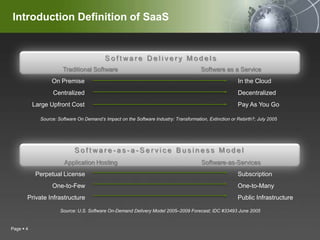
Introduction Definition of SaaSSoftware-as-a-Service (SaaS) has evolved from limited on-line software delivery of the 1990s to a fully matured “direct-sourcing” business model for enterprise applicationsSaaS is one of the fastest growing concepts: more than 10 million companies will be using SaaS in the next 5 - 10 years; more than 50% of all Fortune 500 companies are already using SaaSAccording to influential IT institutes, SaaS is the leading business model of choice for 2008/2009Virtually all big software/service vendors (IBM, Microsoft, Oracle, Cisco) are investing heavily in SaaSWith the continuously increasing bandwidth and reliability of the internet, using web services over the (public) internet has become a viable optionPage 3
Introduction Definition of SaaSSource: Software On Demand’s Impact on the Software Industry: Transformation, Extinction or Rebirth?; July 2005 Source: U.S. Software On-Demand Delivery Model 2005–2009 Forecast; IDC #33493 June 2005 Page 4
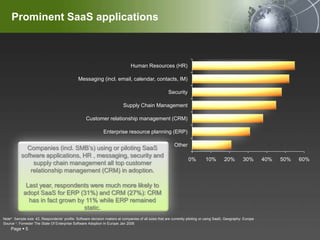
Prominent SaaS applicationsCompanies (incl. SMB’s) using or piloting SaaS software applications, HR , messaging, security and supply chain management all top customer relationship management (CRM) in adoption. Last year, respondents were much more likely to adopt SaaS for ERP (31%) and CRM (27%): CRM has in fact grown by 11% while ERP remained static.Note*: Sample size: 42, Respondents’ profile: Software decision makers at companies of all sizes that are currently piloting or using SaaS, Geography: EuropeSource 1: Forrester The State Of Enterprise Software Adoption In Europe Jan 2006 Page 5
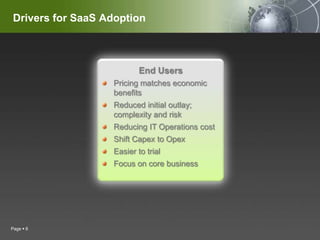
Drivers for SaaS AdoptionISVsEnd UsersTechnology & connectivity makes it possibleRecurring revenue streamSingle version for all customersStrong customer feedback loopEasier to trialReach broader target marketPricing matches economic benefitsReduced initial outlay; complexity and riskReducing IT Operations costShift Capex to OpexEasier to trialFocus on core businessPage ď‚§6
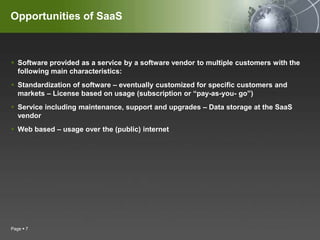
Opportunities of SaaSSoftware provided as a service by a software vendor to multiple customers with the following main characteristics:Standardization of software – eventually customized for specific customers and markets – License based on usage (subscription or “pay-as-you- go”)Service including maintenance, support and upgrades – Data storage at the SaaS vendorWeb based – usage over the (public) internetPage 7
Opportunities of SaaSSaaS offers potential for lowering the Total Cost of OwnershipLower operational costsNo large scale, costly, high risk implementations of applicationsFewer operational resources for application managementNo platform and hardware (maintenance) costs for application serversReduced operational complexity: software delivered as a transparent service through the webMinimized software development costs – No lengthy software development and testing cyclesLower costs for software useNo software license and annual maintenance feesNo expensive software upgradesLower application consultancy and support costsPage 8
SaaS allows corporations to focus on core business activities and responsibilitiesTransparent overview and usage of electronic data and informationAutomation of iterative, manual tasksFaster Time to Market – easy to scale softwareMore flexibility in changing and modifying application services for business needs – Full-scale integration of business processesControl over ITMinimized IT Service Management efforts mainly focused on availability – Well-defined SLAs between the corporation and the IT vendorMore predictable cash flow – easier licensing based on access/usage of softwareIncreased productivity and improved user satisfaction – Shorter implementation times for IT services and changes – Single point of entrance to business applications provided via the web – Automatic software upgrades with minimal outagePage 9Opportunities of SaaS
Considerations of SaaSDepreciation of existing software and software serversIntegration/alignment of existing Service Management processes and the processes of the SaaS vendor(s)Single or multi-vendor solutionsStandardized or customized servicesSeveral pricing models possibleIdentity & Access ManagementThe rate of “outsourcing”Logging and monitoringData confidentiality/integrityBy using SaaS, the business (critical) data is stored at remote location. It may well lead to extreme dependency on vendor’s integrity and expertisePage 10
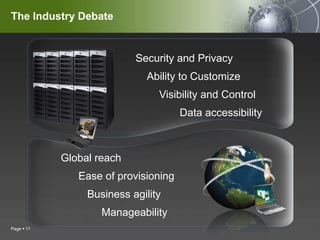
Security and Privacy    Ability to Customize        Visibility and Control               Data accessibility            Global reach      Ease of provisioning         Business agility	   ManageabilityThe Industry DebatePage ď‚§11
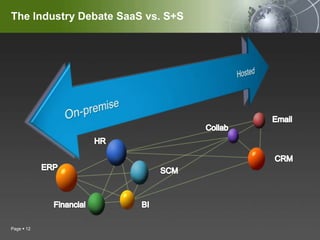
On-premise				         		HostedEmailCollabHRCRMERPSCMFinancialBIThe Industry Debate SaaS vs. S+SPage ď‚§12
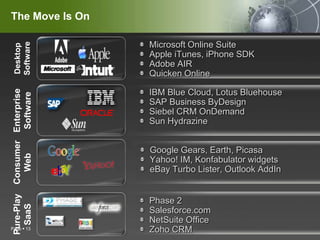
The Move Is OnMicrosoft Online SuiteApple iTunes, iPhone SDKAdobe AIRQuicken OnlineDesktop SoftwareIBM Blue Cloud, Lotus BluehouseSAP Business ByDesignSiebel CRM OnDemandSun HydrazineEnterprise SoftwareGoogle Gears, Earth, PicasaYahoo! IM, Konfabulator widgetseBay Turbo Lister, Outlook AddInConsumer WebPhase 2 Salesforce.comNetSuite OfficeZoho CRMPure-Play SaaSPage ď‚§13
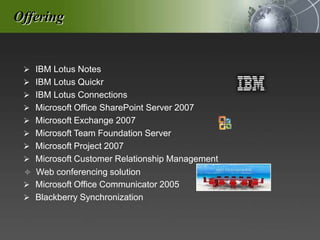
OfferingIBM Lotus Notes
IBM Lotus Quickr

Software As A Service Presentation

  • 1.
  • 2.
    IntroductionContentsIntroduction Definition ofSaaSOpportunities of SaaSPoints of considerationRisks of SaaSPage ď‚§2
  • 3.
    Introduction Definition ofSaaSSoftware-as-a-Service (SaaS) has evolved from limited on-line software delivery of the 1990s to a fully matured “direct-sourcing” business model for enterprise applicationsSaaS is one of the fastest growing concepts: more than 10 million companies will be using SaaS in the next 5 - 10 years; more than 50% of all Fortune 500 companies are already using SaaSAccording to influential IT institutes, SaaS is the leading business model of choice for 2008/2009Virtually all big software/service vendors (IBM, Microsoft, Oracle, Cisco) are investing heavily in SaaSWith the continuously increasing bandwidth and reliability of the internet, using web services over the (public) internet has become a viable optionPage 3
  • 4.
    Introduction Definition ofSaaSSource: Software On Demand’s Impact on the Software Industry: Transformation, Extinction or Rebirth?; July 2005 Source: U.S. Software On-Demand Delivery Model 2005–2009 Forecast; IDC #33493 June 2005 Page 4
  • 5.
    Prominent SaaS applicationsCompanies(incl. SMB’s) using or piloting SaaS software applications, HR , messaging, security and supply chain management all top customer relationship management (CRM) in adoption. Last year, respondents were much more likely to adopt SaaS for ERP (31%) and CRM (27%): CRM has in fact grown by 11% while ERP remained static.Note*: Sample size: 42, Respondents’ profile: Software decision makers at companies of all sizes that are currently piloting or using SaaS, Geography: EuropeSource 1: Forrester The State Of Enterprise Software Adoption In Europe Jan 2006 Page 5
  • 6.
    Drivers for SaaSAdoptionISVsEnd UsersTechnology & connectivity makes it possibleRecurring revenue streamSingle version for all customersStrong customer feedback loopEasier to trialReach broader target marketPricing matches economic benefitsReduced initial outlay; complexity and riskReducing IT Operations costShift Capex to OpexEasier to trialFocus on core businessPage ď‚§6
  • 7.
    Opportunities of SaaSSoftwareprovided as a service by a software vendor to multiple customers with the following main characteristics:Standardization of software – eventually customized for specific customers and markets – License based on usage (subscription or “pay-as-you- go”)Service including maintenance, support and upgrades – Data storage at the SaaS vendorWeb based – usage over the (public) internetPage 7
  • 8.
    Opportunities of SaaSSaaSoffers potential for lowering the Total Cost of OwnershipLower operational costsNo large scale, costly, high risk implementations of applicationsFewer operational resources for application managementNo platform and hardware (maintenance) costs for application serversReduced operational complexity: software delivered as a transparent service through the webMinimized software development costs – No lengthy software development and testing cyclesLower costs for software useNo software license and annual maintenance feesNo expensive software upgradesLower application consultancy and support costsPage 8
  • 9.
    SaaS allows corporationsto focus on core business activities and responsibilitiesTransparent overview and usage of electronic data and informationAutomation of iterative, manual tasksFaster Time to Market – easy to scale softwareMore flexibility in changing and modifying application services for business needs – Full-scale integration of business processesControl over ITMinimized IT Service Management efforts mainly focused on availability – Well-defined SLAs between the corporation and the IT vendorMore predictable cash flow – easier licensing based on access/usage of softwareIncreased productivity and improved user satisfaction – Shorter implementation times for IT services and changes – Single point of entrance to business applications provided via the web – Automatic software upgrades with minimal outagePage 9Opportunities of SaaS
  • 10.
    Considerations of SaaSDepreciationof existing software and software serversIntegration/alignment of existing Service Management processes and the processes of the SaaS vendor(s)Single or multi-vendor solutionsStandardized or customized servicesSeveral pricing models possibleIdentity & Access ManagementThe rate of “outsourcing”Logging and monitoringData confidentiality/integrityBy using SaaS, the business (critical) data is stored at remote location. It may well lead to extreme dependency on vendor’s integrity and expertisePage 10
  • 11.
    Security and Privacy Ability to Customize Visibility and Control Data accessibility Global reach Ease of provisioning Business agility ManageabilityThe Industry DebatePage ď‚§11
  • 12.
    On-premise HostedEmailCollabHRCRMERPSCMFinancialBIThe Industry Debate SaaS vs. S+SPage ď‚§12
  • 13.
    The Move IsOnMicrosoft Online SuiteApple iTunes, iPhone SDKAdobe AIRQuicken OnlineDesktop SoftwareIBM Blue Cloud, Lotus BluehouseSAP Business ByDesignSiebel CRM OnDemandSun HydrazineEnterprise SoftwareGoogle Gears, Earth, PicasaYahoo! IM, Konfabulator widgetseBay Turbo Lister, Outlook AddInConsumer WebPhase 2 Salesforce.comNetSuite OfficeZoho CRMPure-Play SaaSPage ď‚§13
  • 14.
  • 15.