Cloud Computing +
Internet of Things =
New Software
Requirements
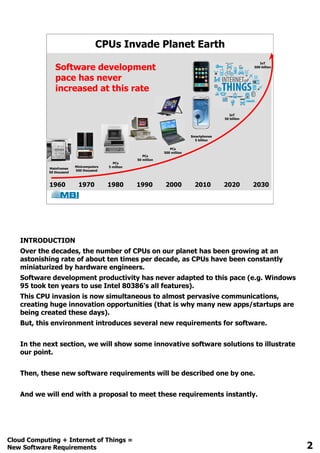
CPUs Invade Planet Earth
Mainframes
50 thousand
Minicomputers
500 thousand
PCs
5 million
PCs
50 million
PCs
500 million
Smartphones
5 billion
IoT
50 billion
1960 1970 1980 1990 2000 2010 2020 2030
IoT
500 billion
Software development
pace has never
increased at this rate
Some Innovative
Software Solutions
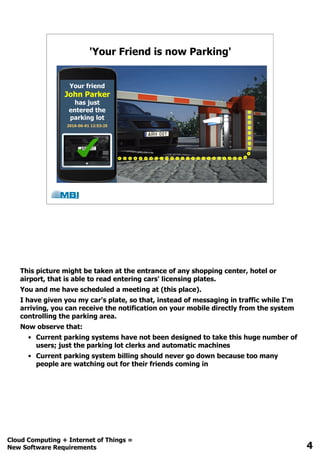
'Your Friend is now Parking'
Your friend
John
Parker
has just
entered the
parking lot
2016-06-01 12:53:25
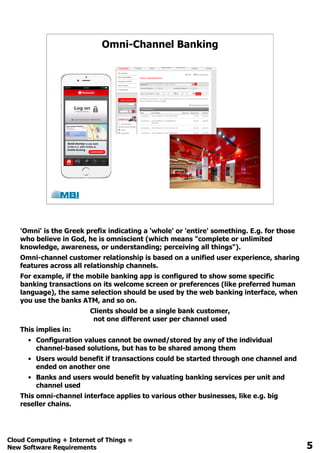
Omni-Channel Banking
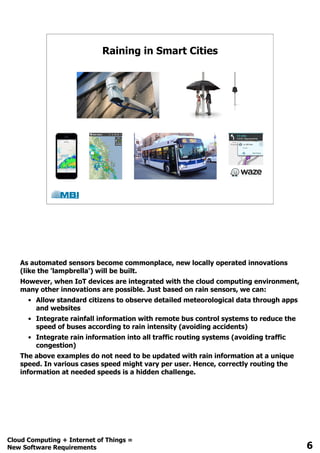
Raining in Smart Cities
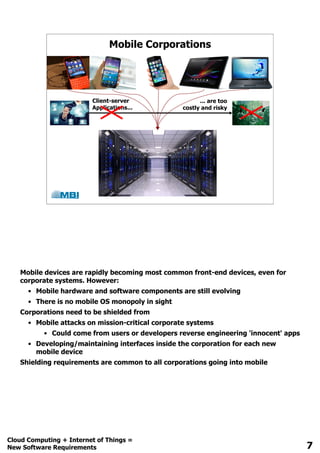
Mobile Corporations
Client-server
Applications...
... are too
costly and
risky
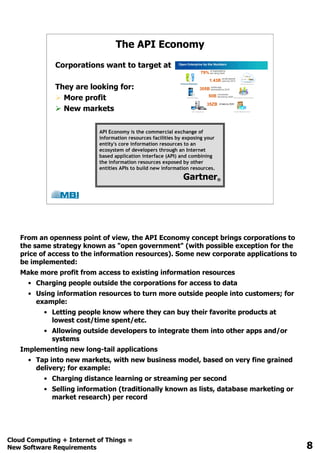
The API Economy
Corporations want to target at
They are looking for:
 More profit
 New markets
API Economy is the commercial exchange of
information resources facilities by exposing your
entity's core information resources to an ecosystem
of developers through an Internet based application
interface (API) and combining the information
resources exposed by other entities APIs to build
new information resources.
Gartner®
Some New Software
Requirements
Users and Servers Disappear
All Solutions become Global
• Every solution is or will
become global
– Developers have to adapt
to various human
cultural environments
I18N
Don't use local customization data!
A user is a user
A user is NOT a device
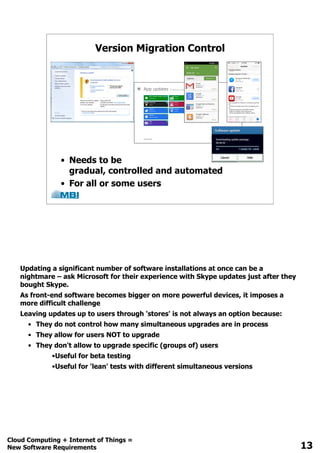
Version Migration Control
• Needs to be
gradual, controlled and automated
• For all or some users
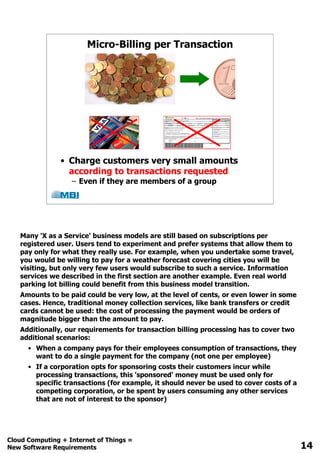
Micro-Billing per Transaction
• Charge customers very small amounts
according to transactions requested
– Even if they are members of a group
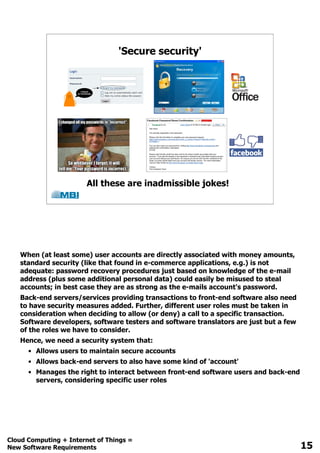
'Secure security'
All these are inadmissible jokes!
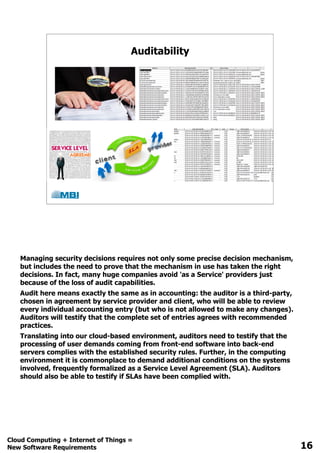
Auditability
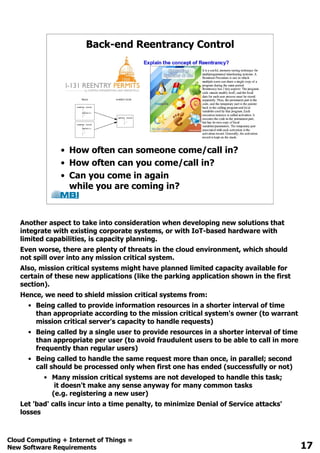
Back-end Reentrancy Control
• How often can someone come/call in?
• How often can you come/call in?
• Can you come in again
while you are coming in?
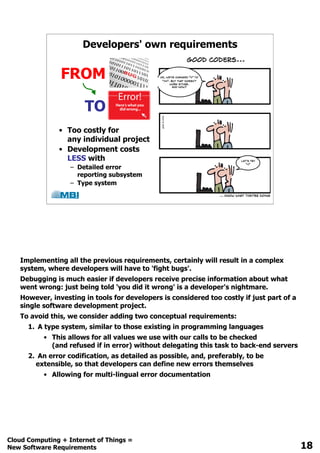
Developers' own requirements
• Too costly for
any individual project
• Development costs
LESS with
– Detailed error
reporting subsystem
– Type system
FROM
TO
New Software
Scenario
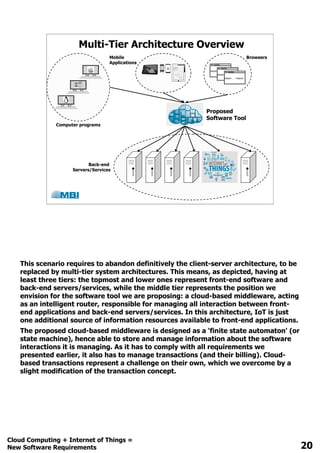
Back-end
Servers/Services
Multi-Tier Architecture Overview
Computer programs
Mobile
Applications www.
<html> ... </html>
www.
<html> ... </html>
www.
<html> ... </html>
Browsers
Proposed
Software Tool
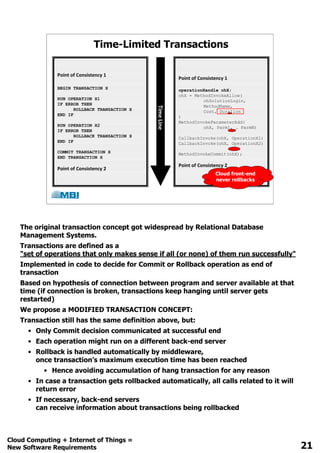
Time-Limited Transactions
Point of Consistency 1
BEGIN TRANSACTION X
RUN OPERATION X1
IF ERROR THEN
ROLLBACK TRANSACTION X
END IF
RUN OPERATION X2
IF ERROR THEN
ROLLBACK TRANSACTION X
END IF
COMMIT TRANSACTION X
END TRANSACTION X
Point of Consistency 2
Point of Consistency 1
operationHandle ohX;
ohX = MethodInvokeAllow(
ohSolutionLogin,
MethodName,
Cost, Duration
)
MethodInvokeParameterAdd(
ohX, Parm1, … ParmN)
CallbackInvoke(ohX, OperationX1)
CallbackInvoke(ohX, OperationX2)
MethodInvokeCommit(ohX);
Point of Consistency 2
TimeLine
Cloud front-end
never rollbacks
Cloud-Based Time-Limited Transaction
Manager
2014 2016Q1 Q2 Q3 Q4 Q1 2015 Q2 Q3 Q4 Q1 2016
Start of
Development
Nov 11
End of
Development
Dec 19
Unfruitful search for
ready-to-use products,
similar patents and/or
academic papers
Formal
Specification of
Requirements &
submission to
various
experienced
software
developers and
architects
First software implementation of a
cloud-based time-limited transaction
manager, including experimental front-
end interface to aid development, test
and debug implementation
United States
Provisional
Patent
Application
drafting,
attorney
review
and final
corrections
Public Beta
US PPA filed
Apr 5
Thanks!
www.mbi.com.br
www.versacloud.technology
rocmayer@mbi.com.br
rocmayer
+55 11 99216 9776
voip: +55 11 3230 6851
Questions?
Space for notes

Cloud iot-new-software-requirements

Editor's Notes

  • #2 ABSTRACT Cloud Computing and the Internet of Things have opened up a new space for innovation opportunities. By analyzing these new applications in detail, we not only find that they have many new requirements (in comparison with traditional software), but that many of these new requirements are common to many of them. Hence, development costs can be reduced by the introduction of new and appropriate software tools aimed specifically at this scenario.
  • #3 INTRODUCTION Over the decades, the number of CPUs on our planet has been growing at an astonishing rate of about ten times per decade, as CPUs have been constantly miniaturized by hardware engineers. Software development productivity has never adapted to this pace (e.g. Windows 95 took ten years to use Intel 80386&amp;apos;s all features). This CPU invasion is now simultaneous to almost pervasive communications, creating huge innovation opportunities (that is why many new apps/startups are being created these days). But, this environment introduces several new requirements for software. In the next section, we will show some innovative software solutions to illustrate our point. Then, these new software requirements will be described one by one. And we will end with a proposal to meet these requirements instantly.
  • #4 Let&amp;apos;s start by showcasing a significant variety of ideas any startup could pick up these days. While describing the ideas, we also comment on some challenges these solutions have to overcome.
  • #5 This picture might be taken at the entrance of any shopping center, hotel or airport, that is able to read entering cars&amp;apos; licensing plates. You and me have scheduled a meeting at (this place). I have given you my car&amp;apos;s plate, so that, instead of messaging in traffic while I&amp;apos;m arriving, you can receive the notification on your mobile directly from the system controlling the parking area. Now observe that: Current parking systems have not been designed to take this huge number of users; just the parking lot clerks and automatic machines Current parking system billing should never go down because too many people are watching out for their friends coming in
  • #6 &amp;apos;Omni&amp;apos; is the Greek prefix indicating a &amp;apos;whole&amp;apos; or &amp;apos;entire&amp;apos; something. E.g. for those who believe in God, he is omniscient (which means &amp;quot;complete or unlimited knowledge, awareness, or understanding; perceiving all things&amp;quot;). Omni-channel customer relationship is based on a unified user experience, sharing features across all relationship channels. For example, if the mobile banking app is configured to show some specific banking transactions on its welcome screen or preferences (like preferred human language), the same selection should be used by the web banking interface, when you use the banks ATM, and so on. Clients should be a single bank customer, not one different user per channel used This implies in: Configuration values cannot be owned/stored by any of the individual channel-based solutions, but has to be shared among them Users would benefit if transactions could be started through one channel and ended on another one Banks and users would benefit by valuating banking services per unit and channel used This omni-channel interface applies to various other businesses, like e.g. big reseller chains.
  • #7 As automated sensors become commonplace, new locally operated innovations (like the &amp;apos;lampbrella&amp;apos;) will be built. However, when IoT devices are integrated with the cloud computing environment, many other innovations are possible. Just based on rain sensors, we can: Allow standard citizens to observe detailed meteorological data through apps and websites Integrate rainfall information with remote bus control systems to reduce the speed of buses according to rain intensity (avoiding accidents) Integrate rain information into all traffic routing systems (avoiding traffic congestion) The above examples do not need to be updated with rain information at a unique speed. In various cases speed might vary per user. Hence, correctly routing the information at needed speeds is a hidden challenge.
  • #8 Mobile devices are rapidly becoming most common front-end devices, even for corporate systems. However: Mobile hardware and software components are still evolving There is no mobile OS monopoly in sight Corporations need to be shielded from Mobile attacks on mission-critical corporate systems Could come from users or developers reverse engineering &amp;apos;innocent&amp;apos; apps Developing/maintaining interfaces inside the corporation for each new mobile device Shielding requirements are common to all corporations going into mobile
  • #9 From an openness point of view, the API Economy concept brings corporations to the same strategy known as &amp;quot;open government&amp;quot; (with possible exception for the price of access to the information resources). Some new corporate applications to be implemented: Make more profit from access to existing information resources Charging people outside the corporations for access to data Using information resources to turn more outside people into customers; for example: Letting people know where they can buy their favorite products at lowest cost/time spent/etc. Allowing outside developers to integrate them into other apps and/or systems Implementing new long-tail applications Tap into new markets, with new business model, based on very fine grained delivery; for example: Charging distance learning or streaming per second Selling information (traditionally known as lists, database marketing or market research) per record
  • #10 All these new software applications have many new requirements. Many of these requirements are common to most of those applications. This section describes the most important of these requirements, one per slide.
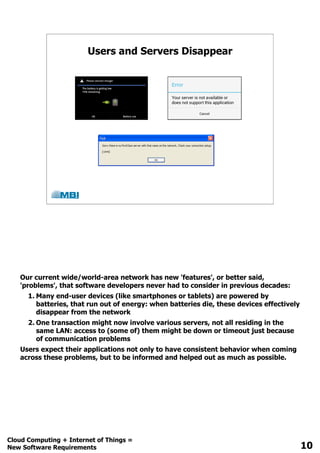
  • #11 Our current wide/world-area network has new &amp;apos;features&amp;apos;, or better said, &amp;apos;problems&amp;apos;, that software developers never had to consider in previous decades: Many end-user devices (like smartphones, tablets or credit card machines) are powered by batteries, that run out of energy: when batteries die, these devices effectively disappear from the network One transaction might now involve various servers, not all residing in the same LAN: access to (some of) them might be down or timeout just because of communication problems Users expect their applications not only to have consistent behavior when coming across these problems, but to be informed and helped out as much as possible.
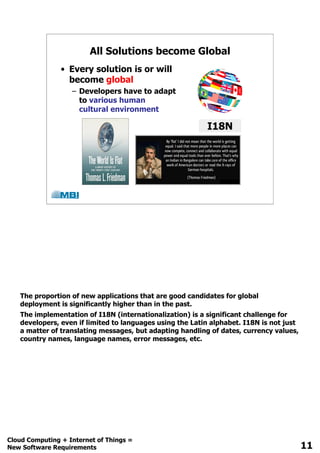
  • #12 The proportion of new applications that are good candidates for global deployment is significantly higher than in the past. Just think of the samples presented in the previous section. The implementation of I18N (internationalization) is a significant challenge for developers, even if limited to languages using the Latin alphabet. I18N is not just a matter of translating messages, but adapting handling of dates, currency values, country names, language names, error messages, etc.
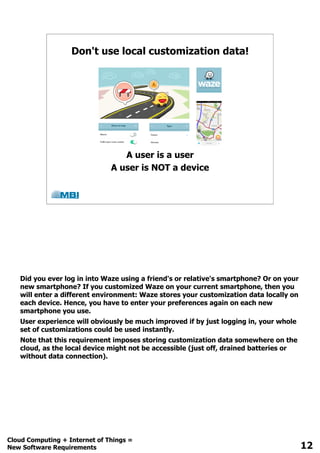
  • #13 Did you ever log in into Waze using a friend&amp;apos;s or relative&amp;apos;s smartphone? Or on your new smartphone? If you customized Waze on your current smartphone, then you will enter a different environment: Waze stores your customization data locally on each device. Hence, you have to enter your preferences again on each new smartphone you use. User experience will obviously be much improved if by just logging in, your whole set of customizations could be used instantly. Note that this requirement imposes storing customization data somewhere on the cloud, as the local device might not be accessible (just off, drained batteries or without data connection).
  • #14 Updating a significant number of software installations at once can be a nightmare – ask Microsoft for their experience with Skype updates just after they bought Skype. As front-end software becomes bigger on more powerful devices, it imposes a more difficult challenge Leaving updates up to users through &amp;apos;stores&amp;apos; is not always an option because: They do not control how many simultaneous upgrades are in process They allow for users NOT to upgrade They don&amp;apos;t allow to upgrade specific (groups of) users Useful for beta testing Useful for &amp;apos;lean&amp;apos; tests with different simultaneous versions
  • #15 Many &amp;apos;X as a Service&amp;apos; business models are still based on subscriptions per registered user. Users tend to experiment and prefer systems that allow them to pay only for what they really use. For example, when you undertake some travel, you would be willing to pay for a weather forecast covering cities you will be visiting, but only very few users would subscribe to such a service. Information services we described in the first section are another example. Even real world parking lot billing could benefit from this business model transition. Amounts to be paid could be very low, at the level of cents, or even lower in some cases. Hence, traditional money collection services, like bank transfers or credit cards cannot be used: the cost of processing the payment would be orders of magnitude bigger than the amount to pay. Additionally, our requirements for transaction billing processing has to cover two additional scenarios: When a company pays for their employees consumption of transactions, they want to do a single payment for the company (not one per employee) If a corporation opts for sponsoring costs their customers incur while processing transactions, this &amp;apos;sponsored&amp;apos; money must be used only for specific transactions (for example, it should never be used to cover costs of a competing corporation, or be spent by users consuming any other services that are not of interest to the sponsor)
  • #16 When (at least some) user accounts are directly associated with money amounts, standard security (like that found in e-commerce applications, e.g.) is not adequate: password recovery procedures just based on knowledge of the e-mail address (plus some additional personal data) could easily be misused to steal accounts; in best case they are as strong as the e-mails account&amp;apos;s password. Back-end servers/services providing transactions to front-end software also need to have security measures added. Further, different user roles must be taken in consideration when deciding to allow (or deny) a call to a specific transaction. Software developers, software testers and software translators are just but a few of the roles we have to consider. Hence, we need a security system that: Allows users to maintain secure accounts Allows back-end servers to also have some kind of &amp;apos;account&amp;apos; Manages the right to interact between front-end software users and back-end servers, considering specific user roles
  • #17 Managing security decisions requires not only some precise decision mechanism, but includes the need to prove that the mechanism in use has taken the right decisions. In fact, many huge companies avoid &amp;apos;as a Service&amp;apos; providers just because of the loss of audit capabilities (in comparison to traditional data processing environments). Audit here means exactly the same as in accounting: the auditor is a third-party, chosen in agreement by service provider and client, who will be able to review every individual accounting entry (but who is not allowed to make any changes). Auditors will testify that the complete set of entries agrees with recommended practices. Translating into our cloud-based environment, auditors need to testify that the processing of user demands coming from front-end software into back-end servers complies with the established security rules. Further, in the computing environment it is commonplace to demand additional conditions on the systems involved, frequently formalized as a Service Level Agreement (SLA). Auditors should also be able to testify if SLAs have been complied with.
  • #18 Another aspect to take into consideration when developing new solutions that integrate with existing corporate systems, or with IoT-based hardware with limited capabilities, is capacity planning. Even worse, there are plenty of threats in the cloud environment, which should not spill over into any mission critical system. Also, mission critical systems might have planned limited capacity available for certain of these new applications (like the parking application shown in the first section). Hence, we need to shield mission critical systems from: Being called to provide information resources in a shorter interval of time than appropriate according to the mission critical system&amp;apos;s owner (to warrant mission critical server&amp;apos;s capacity to handle requests) Being called by a single user to provide resources in a shorter interval of time than appropriate per user (to avoid fraudulent users to be able to call in more frequently than regular users) Being called to handle the same request more than once, in parallel; second call should be processed only when first one has ended (successfully or not) Many mission critical systems are not developed to handle this task Finally, we would let &amp;apos;bad&amp;apos; calls incur into a time penalty, to minimize Denial of Service attacks&amp;apos; losses
  • #19 Implementing all the previous requirements, certainly will result in a complex system, where developers will have to &amp;apos;fight bugs&amp;apos;. Debugging is much easier if developers receive precise information about what went wrong: just being told &amp;apos;you did it wrong&amp;apos; is a developer&amp;apos;s nightmare. However, investing in tools for developers is considered too costly if just part of a single software development project. To avoid this, we consider adding two conceptual requirements: A type system, similar to those existing in programming languages This allows for all values we use with our calls to be checked (and refused if in error) without delegating this task to back-end servers An error codification, as detailed as possible, and, preferably, to be extensible, so that developers can define new errors themselves Allowing for multi-lingual error documentation
  • #20 From an economic point of view, there is no reason why each new software development, like the ones described in the first section, should pay for the cost of developing these requirements again and again. It makes much more sense if all these requirements could be complied with through the use of a software tool that would bring them in as ready to use features to applications.
  • #21 This scenario requires to abandon definitively the client-server architecture, to be replaced by multi-tier system architectures. This means, as depicted, having at least three tiers: the topmost and lower ones represent front-end software and back-end servers/services, while the middle tier represents the position we envision for the software tool we are proposing: a cloud-based middleware, acting as an intelligent router, responsible for managing all interaction between front-end applications and back-end servers/services. In this architecture, IoT is just one additional source of information resources available to front-end applications. The proposed cloud-based middleware is designed as a &amp;apos;finite state automaton&amp;apos; (or state machine), hence able to store and manage information about the software interactions it is managing. As it has to comply with all requirements we presented earlier, it also has to manage transactions (and their billing). Cloud-based transactions represent a challenge on their own, which we overcome by a slight modification of the transaction concept.
  • #22 The original transaction concept got widespread by Relational Database Management Systems. Transactions are defined as a &amp;quot;set of operations that only makes sense if all (or none) of them run successfully&amp;quot; They are implemented in code to decide for Commit or Rollback operation as end of transaction Based on hypothesis of connection between program and server available at that time (if connection is broken, transactions keep hanging until server gets restarted) We propose a MODIFIED TRANSACTION CONCEPT: Transaction still has the same definition above, but: Only Commit decision communicated at successful end Each operation might run on a different back-end server Rollback is handled automatically by middleware, once transaction’s maximum execution time has been reached Hence avoiding accumulation of hang transaction for any reason In case a transaction gets rollbacked automatically, all calls related to it will return error If necessary, back-end servers can receive information about transactions being rollbacked
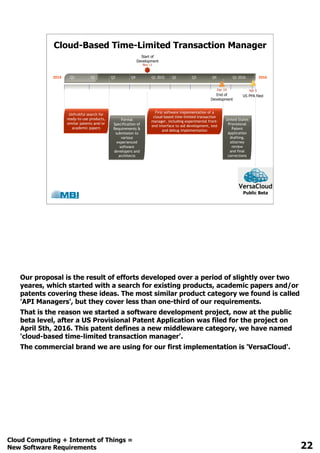
  • #23 Our proposal is the result of efforts developed over a period of slightly over two yeares, which started with a search for existing products, academic papers and/or patents covering these ideas. The most similar product category we found is called &amp;apos;API Managers&amp;apos;, but they cover less than one-third of our requirements. That is the reason we started a software development project, now at the public beta level, after a US Provisional Patent Application was filed for the project on April 5th, 2016. This patent defines a new middleware category, we have named &amp;apos;cloud-based time-limited transaction manager&amp;apos;. The commercial brand we are using for our first implementation is &amp;apos;VersaCloud&amp;apos;.