WELCOME
TO
SOFTWARE TECHNOLOGY
PARKS OF INDIA
Cloud services in near future
Introduction To Cloud
What is Cloud Computing?
 Cloud computing is a method for delivering information technology (IT)
services in which resources are retrieved from the Internet through web-
based tools and applications, as opposed to a direct connection to a
server. Rather than keeping files on a proprietary hard drive or local
storage device, cloud-based storage makes it possible to save them to a
remote database. As long as an electronic device has access to the web,
it has access to the data and the software programs to run it.
 It's called cloud computing because the information being accessed is
found in "the cloud" and does not require a user to be in a specific place
to gain access to it. This type of system allows employees to work
remotely. Companies providing cloud services enable users to store files
and applications on remote servers, and then access all the data via the
internet.
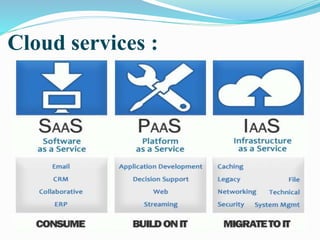
Cloud services :
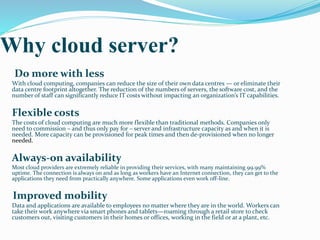
Why cloud server?
Do more with less
With cloud computing, companies can reduce the size of their own data centres — or eliminate their
data centre footprint altogether. The reduction of the numbers of servers, the software cost, and the
number of staff can significantly reduce IT costs without impacting an organization’s IT capabilities.
Flexible costs
The costs of cloud computing are much more flexible than traditional methods. Companies only
need to commission – and thus only pay for – server and infrastructure capacity as and when it is
needed. More capacity can be provisioned for peak times and then de-provisioned when no longer
needed.
Always-on availability
Most cloud providers are extremely reliable in providing their services, with many maintaining 99.99%
uptime. The connection is always on and as long as workers have an Internet connection, they can get to the
applications they need from practically anywhere. Some applications even work off-line.
Improved mobility
Data and applications are available to employees no matter where they are in the world. Workers can
take their work anywhere via smart phones and tablets—roaming through a retail store to check
customers out, visiting customers in their homes or offices, working in the field or at a plant, etc.
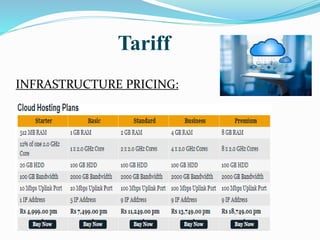
Tariff
INFRASTRUCTURE PRICING:
cloud computing tutorial

cloud computing tutorial

  • 1.
  • 2.
    Cloud services innear future
  • 3.
    Introduction To Cloud Whatis Cloud Computing?  Cloud computing is a method for delivering information technology (IT) services in which resources are retrieved from the Internet through web- based tools and applications, as opposed to a direct connection to a server. Rather than keeping files on a proprietary hard drive or local storage device, cloud-based storage makes it possible to save them to a remote database. As long as an electronic device has access to the web, it has access to the data and the software programs to run it.  It's called cloud computing because the information being accessed is found in "the cloud" and does not require a user to be in a specific place to gain access to it. This type of system allows employees to work remotely. Companies providing cloud services enable users to store files and applications on remote servers, and then access all the data via the internet.
  • 5.
  • 6.
    Why cloud server? Domore with less With cloud computing, companies can reduce the size of their own data centres — or eliminate their data centre footprint altogether. The reduction of the numbers of servers, the software cost, and the number of staff can significantly reduce IT costs without impacting an organization’s IT capabilities. Flexible costs The costs of cloud computing are much more flexible than traditional methods. Companies only need to commission – and thus only pay for – server and infrastructure capacity as and when it is needed. More capacity can be provisioned for peak times and then de-provisioned when no longer needed. Always-on availability Most cloud providers are extremely reliable in providing their services, with many maintaining 99.99% uptime. The connection is always on and as long as workers have an Internet connection, they can get to the applications they need from practically anywhere. Some applications even work off-line. Improved mobility Data and applications are available to employees no matter where they are in the world. Workers can take their work anywhere via smart phones and tablets—roaming through a retail store to check customers out, visiting customers in their homes or offices, working in the field or at a plant, etc.
  • 7.