The cloudy road aheadAnindya RoyCEOTech Newton
AgendaWhat is Cloud ComputingCharacteristicsPublic CloudPrivate Cloud
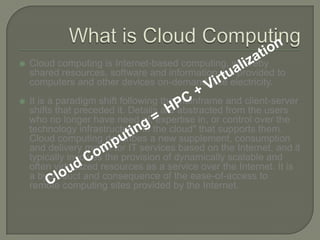
What is Cloud ComputingCloud computing is Internet-based computing, whereby shared resources, software and information are provided to computers and other devices on-demand, like electricity.It is a paradigm shift following the mainframe and client-server shifts that preceded it. Details are abstracted from the users who no longer have need of, expertise in, or control over the technology infrastructure "in the cloud" that supports them. Cloud computing describes a new supplement, consumption and delivery model for IT services based on the Internet, and it typically involves the provision of dynamically scalable and often virtualized resources as a service over the Internet. It is a byproduct and consequence of the ease-of-access to remote computing sites provided by the Internet.
What is Cloud ComputingCloud computing is Internet-based computing, whereby shared resources, software and information are provided to computers and other devices on-demand, like electricity.It is a paradigm shift following the mainframe and client-server shifts that preceded it. Details are abstracted from the users who no longer have need of, expertise in, or control over the technology infrastructure "in the cloud" that supports them. Cloud computing describes a new supplement, consumption and delivery model for IT services based on the Internet, and it typically involves the provision of dynamically scalable and often virtualized resources as a service over the Internet. It is a byproduct and consequence of the ease-of-access to remote computing sites provided by the Internet.Cloud Computing =  HPC + Virtualization
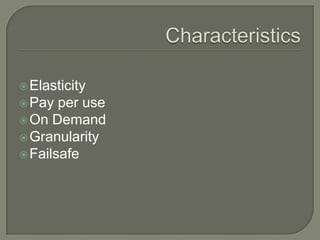
CharacteristicsElasticityPay per useOn DemandGranularity Failsafe
Public CloudPublic cloud or external cloud describes cloud computing in the traditional mainstream sense, whereby resources are dynamically provisioned on a fine-grained, self-service basis over the Internet, via web applications/web services, from an off-site third-party provider who shares resources and bills on a fine-grained utility computing basis
Private CloudPrivate cloud and internal cloud are buzzwords that some vendors have recently used to describe offerings that emulate cloud computing on private networks. These (typically virtualization automation) products claim to "deliver some benefits of cloud computing without the pitfalls", capitalizing on data security, corporate governance, and reliability concerns. They have been criticized on the basis that users "still have to buy, build, and manage them" and as such do not benefit from lower up-front capital costs and less hands-on management, essentially "[lacking] the economic model that makes cloud computing such an intriguing concept"
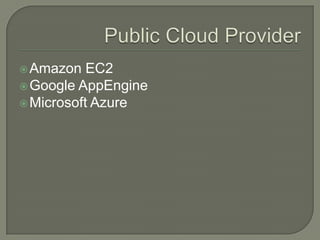
Public Cloud ProviderAmazon EC2Google AppEngineMicrosoft Azure
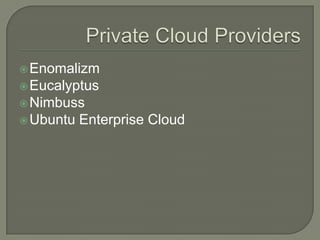
Private Cloud ProvidersEnomalizmEucalyptusNimbussUbuntu Enterprise Cloud
      Questions
Thanksanindyar.roy@gmail.comSkype: anindyaroy29Ph: 9811565558http://twitter.com/anindyar
Some Thoughts for Workshops and SeminarsWorkshops/SeminarCloud Computing HPC and Supercomputing		       Failsafe ComputingSAN ManagementEthical Hacking

Cloud Computing

  • 1.
    The cloudy roadaheadAnindya RoyCEOTech Newton
  • 2.
    AgendaWhat is CloudComputingCharacteristicsPublic CloudPrivate Cloud
  • 3.
    What is CloudComputingCloud computing is Internet-based computing, whereby shared resources, software and information are provided to computers and other devices on-demand, like electricity.It is a paradigm shift following the mainframe and client-server shifts that preceded it. Details are abstracted from the users who no longer have need of, expertise in, or control over the technology infrastructure "in the cloud" that supports them. Cloud computing describes a new supplement, consumption and delivery model for IT services based on the Internet, and it typically involves the provision of dynamically scalable and often virtualized resources as a service over the Internet. It is a byproduct and consequence of the ease-of-access to remote computing sites provided by the Internet.
  • 4.
    What is CloudComputingCloud computing is Internet-based computing, whereby shared resources, software and information are provided to computers and other devices on-demand, like electricity.It is a paradigm shift following the mainframe and client-server shifts that preceded it. Details are abstracted from the users who no longer have need of, expertise in, or control over the technology infrastructure "in the cloud" that supports them. Cloud computing describes a new supplement, consumption and delivery model for IT services based on the Internet, and it typically involves the provision of dynamically scalable and often virtualized resources as a service over the Internet. It is a byproduct and consequence of the ease-of-access to remote computing sites provided by the Internet.Cloud Computing = HPC + Virtualization
  • 5.
    CharacteristicsElasticityPay per useOnDemandGranularity Failsafe
  • 6.
    Public CloudPublic cloudor external cloud describes cloud computing in the traditional mainstream sense, whereby resources are dynamically provisioned on a fine-grained, self-service basis over the Internet, via web applications/web services, from an off-site third-party provider who shares resources and bills on a fine-grained utility computing basis
  • 7.
    Private CloudPrivate cloudand internal cloud are buzzwords that some vendors have recently used to describe offerings that emulate cloud computing on private networks. These (typically virtualization automation) products claim to "deliver some benefits of cloud computing without the pitfalls", capitalizing on data security, corporate governance, and reliability concerns. They have been criticized on the basis that users "still have to buy, build, and manage them" and as such do not benefit from lower up-front capital costs and less hands-on management, essentially "[lacking] the economic model that makes cloud computing such an intriguing concept"
  • 8.
    Public Cloud ProviderAmazonEC2Google AppEngineMicrosoft Azure
  • 9.
  • 10.
    Questions
  • 11.
  • 12.
    Some Thoughts forWorkshops and SeminarsWorkshops/SeminarCloud Computing HPC and Supercomputing Failsafe ComputingSAN ManagementEthical Hacking