• Just make you familiar with Cloud
Computing and its Services1
• Explore Cloud Computing and
how it can be used for providing
library services
2
Our effort is to:
What is Cloud Computing?
Distributed computing on internet Or
delivery of computing service over the
internet.
Eg: Yahoo!, GMail, Hotmail-
Instead of running an e-mail program on
your computer, you log in to a Web e-mail account
remotely. The software and storage for your account
doesn't exist on your computer -- it's on the
service's computer cloud.
History
 Concept evolved in 1950(IBM) called RJE
(Remote Job Entry Process).
 In 2006 Amazon provided First public cloud
AWS(Amazon Web Service).
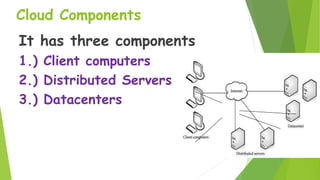
Cloud Components
It has three components
1.) Client computers
2.) Distributed Servers
3.) Datacenters
Clients
Clients are the device that the end user
interact with cloud.
three types of clients:
1.) Mobile
2.) Thick
3.) Thin (Most Popular)
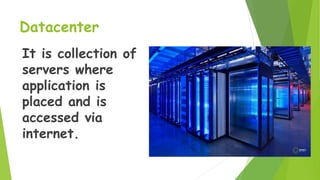
Datacenter
It is collection of
servers where
application is
placed and is
accessed via
internet.
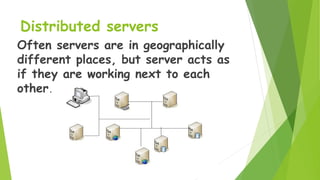
Distributed servers
Often servers are in geographically
different places, but server acts as
if they are working next to each
other.
Central Server
 It Administers the system such as monitoring
traffic, client demands to ensure everything
runs smoothly.
 It uses a special type of software called
Middleware.
Middleware allow computer to communicate
each other.
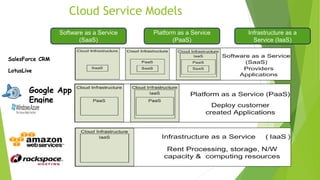
Service Models
SaaS(Software as a service): Required
software, Operating system & network is
provided.
PaaS(Platform as service): Operating
system and network is provided.
IaaS(Infrastructure as a service): just
Network is provided.
Deployment of Cloud
Service
Public Cloud
Private Cloud
Community Cloud
Hybrid Cloud(Combined Cloud)
Why cloud service is popular?
 Reduce the complexity of networks.
 Do not have to buy software licenses.
 Customization.
 Cloud providers that have specialized in a particular
area (such as e-mail) can bring advanced services
that a single company might not be able to afford
or develop.
 scalability, reliability, and efficiency.
 Info. at cloud are not easily lost.
Application
Social Networking sites.
E-mail sites.
Search Engines.
Many more services OVER THE INTERNET.
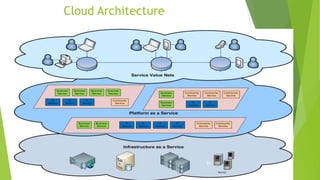
Cloud Architecture
14
6/23/2010Wipro Chennai 2011 15
Challenges
 Alignment with the needs of the business / user / non-computer specialists /
community and society
 Need to address the scalability issue: large scale data, high performance
computing, automation, response time, rapid prototyping, and rapid time to
production
 Need to effectively address (i) ever shortening cycle of obsolescence, (ii)
heterogeneity and (iii) rapid changes in requirements
 Transform data from diverse sources into intelligence and deliver intelligence to
right people/user/systems
 What about providing all this in a cost-effective manner?
16
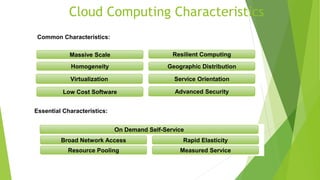
Cloud Computing Characteristics
Common Characteristics:
Low Cost Software
Virtualization Service Orientation
Advanced Security
Homogeneity
Massive Scale Resilient Computing
Geographic Distribution
Essential Characteristics:
Resource Pooling
Broad Network Access Rapid Elasticity
Measured Service
On Demand Self-Service
Adopted from: Effectively and Securely Using the Cloud Computing Paradigm by peter Mell, Tim Grance
17
Cloud Service Models
Software as a Service
(SaaS)
Platform as a Service
(PaaS)
Infrastructure as a
Service (IaaS)
Google App
Engine
SalesForce CRM
LotusLive
Adopted from: Effectively and Securely Using the Cloud Computing Paradigm by peter Mell, Tim Grance
What is the purpose and benefits?
 Cloud computing enables companies and applications, which are
system infrastructure dependent, to be infrastructure-less.
 By using the Cloud infrastructure on “pay as used and on
demand”, all of us can save in capital and operational
investment!
 Clients can:
 Put their data on the platform instead of on their own desktop PCs
and/or on their own servers.
 They can put their applications on the cloud and use the servers within
the cloud to do processing and data manipulations etc.
18
Some Commercial Cloud Offerings
19
Thank You
For Your Attention…

Cloudcomputing

  • 2.
    • Just makeyou familiar with Cloud Computing and its Services1 • Explore Cloud Computing and how it can be used for providing library services 2 Our effort is to:
  • 3.
    What is CloudComputing? Distributed computing on internet Or delivery of computing service over the internet. Eg: Yahoo!, GMail, Hotmail- Instead of running an e-mail program on your computer, you log in to a Web e-mail account remotely. The software and storage for your account doesn't exist on your computer -- it's on the service's computer cloud.
  • 4.
    History  Concept evolvedin 1950(IBM) called RJE (Remote Job Entry Process).  In 2006 Amazon provided First public cloud AWS(Amazon Web Service).
  • 5.
    Cloud Components It hasthree components 1.) Client computers 2.) Distributed Servers 3.) Datacenters
  • 6.
    Clients Clients are thedevice that the end user interact with cloud. three types of clients: 1.) Mobile 2.) Thick 3.) Thin (Most Popular)
  • 7.
    Datacenter It is collectionof servers where application is placed and is accessed via internet.
  • 8.
    Distributed servers Often serversare in geographically different places, but server acts as if they are working next to each other.
  • 9.
    Central Server  ItAdministers the system such as monitoring traffic, client demands to ensure everything runs smoothly.  It uses a special type of software called Middleware. Middleware allow computer to communicate each other.
  • 10.
    Service Models SaaS(Software asa service): Required software, Operating system & network is provided. PaaS(Platform as service): Operating system and network is provided. IaaS(Infrastructure as a service): just Network is provided.
  • 11.
    Deployment of Cloud Service PublicCloud Private Cloud Community Cloud Hybrid Cloud(Combined Cloud)
  • 12.
    Why cloud serviceis popular?  Reduce the complexity of networks.  Do not have to buy software licenses.  Customization.  Cloud providers that have specialized in a particular area (such as e-mail) can bring advanced services that a single company might not be able to afford or develop.  scalability, reliability, and efficiency.  Info. at cloud are not easily lost.
  • 13.
    Application Social Networking sites. E-mailsites. Search Engines. Many more services OVER THE INTERNET.
  • 14.
  • 15.
    6/23/2010Wipro Chennai 201115 Challenges  Alignment with the needs of the business / user / non-computer specialists / community and society  Need to address the scalability issue: large scale data, high performance computing, automation, response time, rapid prototyping, and rapid time to production  Need to effectively address (i) ever shortening cycle of obsolescence, (ii) heterogeneity and (iii) rapid changes in requirements  Transform data from diverse sources into intelligence and deliver intelligence to right people/user/systems  What about providing all this in a cost-effective manner?
  • 16.
    16 Cloud Computing Characteristics CommonCharacteristics: Low Cost Software Virtualization Service Orientation Advanced Security Homogeneity Massive Scale Resilient Computing Geographic Distribution Essential Characteristics: Resource Pooling Broad Network Access Rapid Elasticity Measured Service On Demand Self-Service Adopted from: Effectively and Securely Using the Cloud Computing Paradigm by peter Mell, Tim Grance
  • 17.
    17 Cloud Service Models Softwareas a Service (SaaS) Platform as a Service (PaaS) Infrastructure as a Service (IaaS) Google App Engine SalesForce CRM LotusLive Adopted from: Effectively and Securely Using the Cloud Computing Paradigm by peter Mell, Tim Grance
  • 18.
    What is thepurpose and benefits?  Cloud computing enables companies and applications, which are system infrastructure dependent, to be infrastructure-less.  By using the Cloud infrastructure on “pay as used and on demand”, all of us can save in capital and operational investment!  Clients can:  Put their data on the platform instead of on their own desktop PCs and/or on their own servers.  They can put their applications on the cloud and use the servers within the cloud to do processing and data manipulations etc. 18
  • 19.
  • 20.
    Thank You For YourAttention…