
Presented by David G. Fletcher November 2009 Governing In the Cloud An Update on Cloud Computing  Service Models
Be sure to ask and find answers to the important cloud questions.
The path to cloud computing  provides a unique opportunity;  take advantage of it!!
“ Cloud computing can help lower the cost of government operations while driving innovation.” US CTO Vivek Kundra Cloud Computing: A State’s Perspective
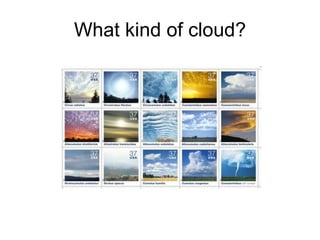
What kind of cloud?
 
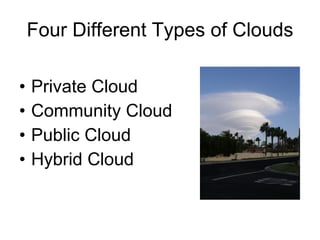
Four Different Types of Clouds Private Cloud Community Cloud Public Cloud Hybrid Cloud
Private Cloud Utah’s private cloud is an internal service-oriented environment optimized for performance and cost that is deployed inside the state’s datacenters. Cloud Computing: A State’s Perspective
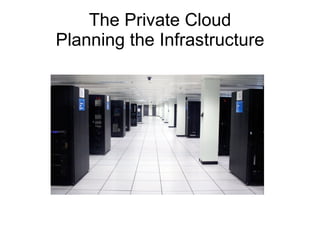
The Private Cloud Planning the Infrastructure
Building the Cloud Virtualization and automation Interchangeable resources: servers, storage, and network Management of these resources as a single fabric Elastic capacity: ability to scale (up or down) to respond to business requirements Focused on service to the business Cloud Computing: A State’s Perspective
Progress  Identified two primary datacenters 2005 – began virtualization testing, 45 servers virtualized to 3 2005 – Consolidation of all executive branch IT resources into one department 2006 - began pulling 38 datacenters into the two primary datacenters 2007 – Architecture Review Board created 2008 – Cloud strategy developed 2009 – CIO announced creation of Utah’s private cloud Cloud Computing: A State’s Perspective
Vision The State will develop a Cloud environment that leverages internally-hosted services with specialized access and security requirements with public services that add to or replaced existing state infrastructure services.  When the State of Utah Cloud services vision is realized, users will be able to: Cloud Computing: A State’s Perspective
Vision Use on-demand self-service and provision-computing capabilities such as hosting and network storage, as needed, without requiring human interaction with each service’s provider Cloud Computing: A State’s Perspective
Vision Access services over the network and through standard mechanisms that promote use by hetrogeneous thin or thick client platforms Use resource-pooling to serve multiple users using a multi-tenant shared model, with different physical and virtual resources dynamically assigned and reassigned according to consumer demand Cloud Computing: A State’s Perspective
Vision Use services with location-independence enabled Use service resources at more abstract levels such as storage, backup services, processing, memory, network bandwidth, and virtual machines Cloud Computing: A State’s Perspective
Vision Be able to leverage capabilities that can be rapidly and elastically provisioned to scale out and rapidly released to scale in Use capabilities for provisioning that often appear to be unlimited and can be purchased in any quantity at any time Cloud Computing: A State’s Perspective
Vision Report on resource-usage that is monitored, controlled, and reported, providing transparency for both the provider and user of the utilized service Use appropriate implementation of security and privacy to meet State and Federal requirements Cloud Computing: A State’s Perspective
Major Cloud Services Providers Amazon Microsoft Google IBM HP
Google will offer cloud-computing services designed specifically for U.S. government agencies starting next year.  The services will be hosted in Google’s existing datacenters, but on systems that are compliant with government regulations . - Infoworld Cloud Computing: A State’s Perspective
Internal Clouds Won’t Meet  All Your Needs Your internal cloud will be relatively small Performance testing is best done on rented resources An internal cloud is not for all applications  Some applications will need “cloud bursting” Others may work best in a hybrid cloud deployment Source: Forrester Research Cloud Computing: A State’s Perspective
Green Aspects of Cloud Fewer servers, less waste Lower energy consumption Opportunities to leverage renewable energy sources Cloud Computing: A State’s Perspective
 
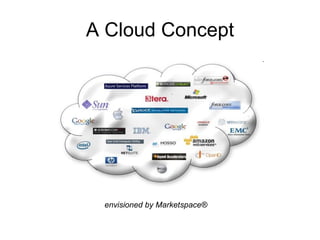
A Cloud Concept envisioned by Marketspace®
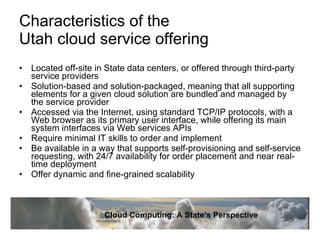
Characteristics of the  Utah cloud service offering  Located off-site in State data centers, or offered through third-party service providers  Solution-based and solution-packaged, meaning that all supporting elements for a given cloud solution are bundled and managed by the service provider  Accessed via the Internet, using standard TCP/IP protocols, with a Web browser as its primary user interface, while offering its main system interfaces via Web services APIs Require minimal IT skills to order and implement  Be available in a way that supports self-provisioning and self-service requesting, with 24/7 availability for order placement and near real-time deployment  Offer dynamic and fine-grained scalability  Cloud Computing: A State’s Perspective
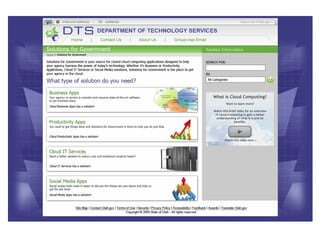
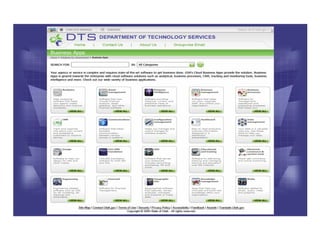
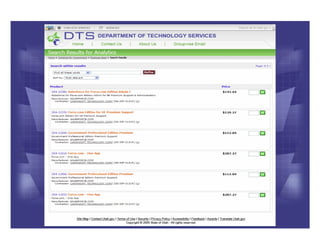
Provisioning Cloud Services


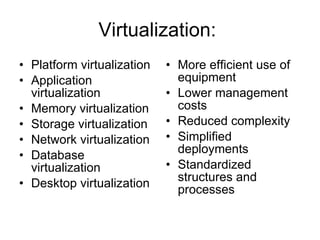
Virtualization:  Platform virtualization Application virtualization Memory virtualization Storage virtualization Network virtualization Database virtualization Desktop virtualization More efficient use of equipment Lower management costs Reduced complexity Simplified deployments Standardized structures and processes
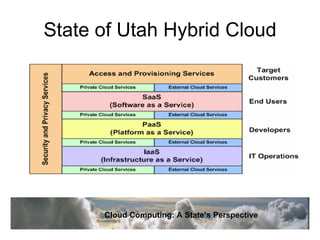
State of Utah Hybrid Cloud Cloud Computing: A State’s Perspective
 
Cloud Computing: A State’s Perspective

Cloud Computing in Government

  • 1.
    Presented by DavidG. Fletcher November 2009 Governing In the Cloud An Update on Cloud Computing Service Models
  • 2.
    Be sure toask and find answers to the important cloud questions.
  • 3.
    The path tocloud computing provides a unique opportunity; take advantage of it!!
  • 4.
    “ Cloud computingcan help lower the cost of government operations while driving innovation.” US CTO Vivek Kundra Cloud Computing: A State’s Perspective
  • 5.
  • 6.
  • 7.
    Four Different Typesof Clouds Private Cloud Community Cloud Public Cloud Hybrid Cloud
  • 8.
    Private Cloud Utah’sprivate cloud is an internal service-oriented environment optimized for performance and cost that is deployed inside the state’s datacenters. Cloud Computing: A State’s Perspective
  • 9.
    The Private CloudPlanning the Infrastructure
  • 10.
    Building the CloudVirtualization and automation Interchangeable resources: servers, storage, and network Management of these resources as a single fabric Elastic capacity: ability to scale (up or down) to respond to business requirements Focused on service to the business Cloud Computing: A State’s Perspective
  • 11.
    Progress Identifiedtwo primary datacenters 2005 – began virtualization testing, 45 servers virtualized to 3 2005 – Consolidation of all executive branch IT resources into one department 2006 - began pulling 38 datacenters into the two primary datacenters 2007 – Architecture Review Board created 2008 – Cloud strategy developed 2009 – CIO announced creation of Utah’s private cloud Cloud Computing: A State’s Perspective
  • 12.
    Vision The Statewill develop a Cloud environment that leverages internally-hosted services with specialized access and security requirements with public services that add to or replaced existing state infrastructure services. When the State of Utah Cloud services vision is realized, users will be able to: Cloud Computing: A State’s Perspective
  • 13.
    Vision Use on-demandself-service and provision-computing capabilities such as hosting and network storage, as needed, without requiring human interaction with each service’s provider Cloud Computing: A State’s Perspective
  • 14.
    Vision Access servicesover the network and through standard mechanisms that promote use by hetrogeneous thin or thick client platforms Use resource-pooling to serve multiple users using a multi-tenant shared model, with different physical and virtual resources dynamically assigned and reassigned according to consumer demand Cloud Computing: A State’s Perspective
  • 15.
    Vision Use serviceswith location-independence enabled Use service resources at more abstract levels such as storage, backup services, processing, memory, network bandwidth, and virtual machines Cloud Computing: A State’s Perspective
  • 16.
    Vision Be ableto leverage capabilities that can be rapidly and elastically provisioned to scale out and rapidly released to scale in Use capabilities for provisioning that often appear to be unlimited and can be purchased in any quantity at any time Cloud Computing: A State’s Perspective
  • 17.
    Vision Report onresource-usage that is monitored, controlled, and reported, providing transparency for both the provider and user of the utilized service Use appropriate implementation of security and privacy to meet State and Federal requirements Cloud Computing: A State’s Perspective
  • 18.
    Major Cloud ServicesProviders Amazon Microsoft Google IBM HP
  • 19.
    Google will offercloud-computing services designed specifically for U.S. government agencies starting next year. The services will be hosted in Google’s existing datacenters, but on systems that are compliant with government regulations . - Infoworld Cloud Computing: A State’s Perspective
  • 20.
    Internal Clouds Won’tMeet All Your Needs Your internal cloud will be relatively small Performance testing is best done on rented resources An internal cloud is not for all applications Some applications will need “cloud bursting” Others may work best in a hybrid cloud deployment Source: Forrester Research Cloud Computing: A State’s Perspective
  • 21.
    Green Aspects ofCloud Fewer servers, less waste Lower energy consumption Opportunities to leverage renewable energy sources Cloud Computing: A State’s Perspective
  • 22.
  • 23.
    A Cloud Conceptenvisioned by Marketspace®
  • 24.
    Characteristics of the Utah cloud service offering Located off-site in State data centers, or offered through third-party service providers Solution-based and solution-packaged, meaning that all supporting elements for a given cloud solution are bundled and managed by the service provider Accessed via the Internet, using standard TCP/IP protocols, with a Web browser as its primary user interface, while offering its main system interfaces via Web services APIs Require minimal IT skills to order and implement Be available in a way that supports self-provisioning and self-service requesting, with 24/7 availability for order placement and near real-time deployment Offer dynamic and fine-grained scalability Cloud Computing: A State’s Perspective
  • 25.
  • 26.
  • 27.
  • 28.
  • 29.
    Virtualization: Platformvirtualization Application virtualization Memory virtualization Storage virtualization Network virtualization Database virtualization Desktop virtualization More efficient use of equipment Lower management costs Reduced complexity Simplified deployments Standardized structures and processes
  • 30.
    State of UtahHybrid Cloud Cloud Computing: A State’s Perspective
  • 31.
  • 32.
    Cloud Computing: AState’s Perspective