
SUBMITTED BY
HANISH H MENON
MBA
JBS
Meaning
Distributed computing on internet Or delivery of computing
service over the internet.
An environment created in a user’s machine from an on-line
application stored on the cloud and run through a web browser.
Eg: Yahoo!, Gmail, Hotmail
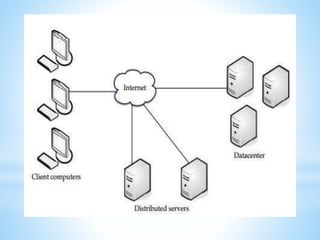
It has three components
1.) Client computers
2.) Distributed Servers
3.) Datacenters
*Client computers
Clients are the device that the end user interact
with cloud.
*Distributed Servers
Often servers are in geographically different
places, but server acts as if they are working next to each
other.
*Datacenters
It is collection of servers where application is
placed and is accessed via internet.
Service Models
Service Models are the reference models on
which the Cloud Computing is based. These can
be categorized into three basic service models
as listed below:
*SaaS(Software as a service): Required
software, Operating system & network is
provided.
*PaaS(Platform as service): Operating system
and network is provided.
*IaaS(Infrastructure as a service): just Network
is provided.
Software as a Service (SaaS)
*SaaS model allows to use software applications as a
service to end users.
*SaaS is a software delivery methodology that
provides licensed multi-tenant access to software and
its functions remotely as a Web-based service.
• Usually billed based on usage
• Usually multi tenant environment
• Highly scalable architecture
Platform as a Service (PaaS)
*PaaS provides the runtime environment for
applications, development & deployment tools, etc.
*PaaS provides all of the facilities required to support
the complete life cycle of building and delivering web
applications and services entirely from the Internet.
*Typically applications must be developed with a
particular platform in mind
• Multi tenant environments
• Highly scalable multi tier architecture
Infrastructure as a Service
(IaaS)
IaaS is the delivery of technology infrastructure as an on
demand scalable service.
IaaS provides access to fundamental resources such as
physical machines, virtual machines, virtual storage, etc.
*Usually billed based on usage
*Usually multi tenant virtualized environment
*Can be coupled with Managed Services for OS and
application support
Deployment Models
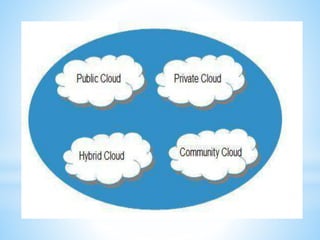
Deployment models define the type of
access to the cloud, i.e., how the cloud is
located? Cloud can have any of the four
types of access: Public, Private, Hybrid and
Community.
*PUBLIC CLOUD : The Public Cloud allows systems and
services to be easily accessible to the general public. Public cloud
may be less secure because of its openness, e.g., e-mail.
*PRIVATE CLOUD : The Private Cloud allows systems and
services to be accessible within an organization. It offers increased
security because of its private nature.
*COMMUNITY CLOUD : The Community Cloud allows
systems and services to be accessible by group of organizations.
*HYBRID CLOUD : The Hybrid Cloud is mixture of public
and private cloud. However, the critical activities are performed
using private cloud while the non-critical activities are performed
using public cloud.
*‘Big Data’ is similar to ‘small data’, but bigger in size
*but having data bigger it requires different approaches:
*Techniques, tools and architecture
*An aim to solve new problems or old problems in a better
way
*Big Data generates value from the storage and processing
of very large quantities of digital information that cannot
be analyzed with traditional computing techniques.
Why Big Data?
•Growth of Big Data is needed
–Increase of storage capacities
–Increase of processing power
–Availability of data(different data types)
–Every day we create 2.5 quintillion bytes of data; 90% of
the data in the world today has been created in the last two
years alone
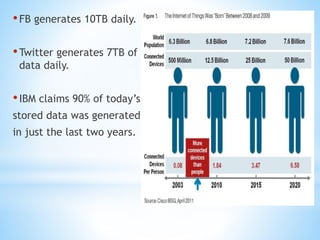
•FB generates 10TB daily.
•Twitter generates 7TB of
data daily.
•IBM claims 90% of today’s
stored data was generated
in just the last two years.
*Where processing is hosted?
*Distributed Servers / Cloud (e.g. Amazon EC2)
*Where data is stored?
*Distributed Storage (e.g. Amazon S3)
*What is the programming model?
*Distributed Processing (e.g. MapReduce)
*How data is stored & indexed?
*High-performance schema-free databases (e.g. MongoDB)
*What operations are performed on data?
*Analytic / Semantic Processing
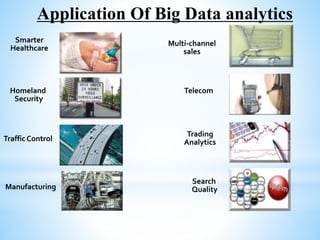
Application Of Big Data analytics
Homeland
Security
Smarter
Healthcare
Multi-channel
sales
Telecom
Manufacturing
Traffic Control
Trading
Analytics
Search
Quality
•Big data is a troublesome force presenting opportunities
with challenges to IT organizations.
By 2015 4.4 million IT jobs in Big Data ; 1.9 million is in
US itself
India will require a minimum of 1 lakh data scientists in
the next couple of years in addition to data analysts and
data managers to support the Big Data space.
How Big data impacts on IT
*$15 billion on software firms only specializing in data
management and analytics.
*This industry on its own is worth more than $100 billion
and growing at almost 10% a year which is roughly twice
as fast as the software business as a whole.
*In February 2012, the open source analyst firm Wikibon
released the first market forecast for Big Data , listing
$5.1B revenue in 2012 with growth to $53.4B in 2017
*The McKinsey Global Institute estimates that data volume
is growing 40% per year, and will grow 44x between 2009
and 2020.
Cloud computing and big data analytics

Cloud computing and big data analytics

  • 1.
    SUBMITTED BY HANISH HMENON MBA JBS
  • 2.
    Meaning Distributed computing oninternet Or delivery of computing service over the internet. An environment created in a user’s machine from an on-line application stored on the cloud and run through a web browser. Eg: Yahoo!, Gmail, Hotmail
  • 4.
    It has threecomponents 1.) Client computers 2.) Distributed Servers 3.) Datacenters
  • 5.
    *Client computers Clients arethe device that the end user interact with cloud. *Distributed Servers Often servers are in geographically different places, but server acts as if they are working next to each other. *Datacenters It is collection of servers where application is placed and is accessed via internet.
  • 6.
    Service Models Service Modelsare the reference models on which the Cloud Computing is based. These can be categorized into three basic service models as listed below: *SaaS(Software as a service): Required software, Operating system & network is provided. *PaaS(Platform as service): Operating system and network is provided. *IaaS(Infrastructure as a service): just Network is provided.
  • 7.
    Software as aService (SaaS) *SaaS model allows to use software applications as a service to end users. *SaaS is a software delivery methodology that provides licensed multi-tenant access to software and its functions remotely as a Web-based service. • Usually billed based on usage • Usually multi tenant environment • Highly scalable architecture
  • 8.
    Platform as aService (PaaS) *PaaS provides the runtime environment for applications, development & deployment tools, etc. *PaaS provides all of the facilities required to support the complete life cycle of building and delivering web applications and services entirely from the Internet. *Typically applications must be developed with a particular platform in mind • Multi tenant environments • Highly scalable multi tier architecture
  • 9.
    Infrastructure as aService (IaaS) IaaS is the delivery of technology infrastructure as an on demand scalable service. IaaS provides access to fundamental resources such as physical machines, virtual machines, virtual storage, etc. *Usually billed based on usage *Usually multi tenant virtualized environment *Can be coupled with Managed Services for OS and application support
  • 10.
    Deployment Models Deployment modelsdefine the type of access to the cloud, i.e., how the cloud is located? Cloud can have any of the four types of access: Public, Private, Hybrid and Community.
  • 12.
    *PUBLIC CLOUD :The Public Cloud allows systems and services to be easily accessible to the general public. Public cloud may be less secure because of its openness, e.g., e-mail. *PRIVATE CLOUD : The Private Cloud allows systems and services to be accessible within an organization. It offers increased security because of its private nature. *COMMUNITY CLOUD : The Community Cloud allows systems and services to be accessible by group of organizations. *HYBRID CLOUD : The Hybrid Cloud is mixture of public and private cloud. However, the critical activities are performed using private cloud while the non-critical activities are performed using public cloud.
  • 13.
    *‘Big Data’ issimilar to ‘small data’, but bigger in size *but having data bigger it requires different approaches: *Techniques, tools and architecture *An aim to solve new problems or old problems in a better way *Big Data generates value from the storage and processing of very large quantities of digital information that cannot be analyzed with traditional computing techniques.
  • 14.
    Why Big Data? •Growthof Big Data is needed –Increase of storage capacities –Increase of processing power –Availability of data(different data types) –Every day we create 2.5 quintillion bytes of data; 90% of the data in the world today has been created in the last two years alone
  • 15.
    •FB generates 10TBdaily. •Twitter generates 7TB of data daily. •IBM claims 90% of today’s stored data was generated in just the last two years.
  • 16.
    *Where processing ishosted? *Distributed Servers / Cloud (e.g. Amazon EC2) *Where data is stored? *Distributed Storage (e.g. Amazon S3) *What is the programming model? *Distributed Processing (e.g. MapReduce) *How data is stored & indexed? *High-performance schema-free databases (e.g. MongoDB) *What operations are performed on data? *Analytic / Semantic Processing
  • 17.
    Application Of BigData analytics Homeland Security Smarter Healthcare Multi-channel sales Telecom Manufacturing Traffic Control Trading Analytics Search Quality
  • 18.
    •Big data isa troublesome force presenting opportunities with challenges to IT organizations. By 2015 4.4 million IT jobs in Big Data ; 1.9 million is in US itself India will require a minimum of 1 lakh data scientists in the next couple of years in addition to data analysts and data managers to support the Big Data space. How Big data impacts on IT
  • 19.
    *$15 billion onsoftware firms only specializing in data management and analytics. *This industry on its own is worth more than $100 billion and growing at almost 10% a year which is roughly twice as fast as the software business as a whole. *In February 2012, the open source analyst firm Wikibon released the first market forecast for Big Data , listing $5.1B revenue in 2012 with growth to $53.4B in 2017 *The McKinsey Global Institute estimates that data volume is growing 40% per year, and will grow 44x between 2009 and 2020.

Editor's Notes

  • #18  Quote practical examples