A D V E N T O F C L O U D C O M P U T I N G :
C A S E S T U D Y O N
A M A Z O N W E B S E R V I C E S
AGENDA
โ€ข Concepts of Cloud Computing
โ€ข Advantages of Cloud Computing
โ€ข Amazon Web Services(AWS)
โ€ข Netflix Case
โ€ข Challenges of Cloud Computing
What is Cloud Computing?
โ€ข Cloud Computing means storing and accessing data and programs over the
Internet instead of your computer's hard drive.
โ€ข Basically a step on from Utility Computing (flexible/ customized service)
โ€ข Collection of integrated and networked hardware, software and Internet
infrastructure (called a platform).
โ€ข These platforms hide the complexity and details of the underlying infrastructure
from users and applications by providing very simple graphical interface or API
What is Cloud Computing?
โ€ข It is like grid computing where unused processing cycles of all computers in a
network are harnessed to solve problems too intensive for any stand-alone
machine.
โ€ข We use their service everyday. For example, Yahoo, Gmail etc.
โ€ข Instead of running an email program on your computer, You log in to a
Web email account remotely. The software and storage for your account
doesnโ€™t exist on your computer. It is on the service providerโ€™s cloud.
โ€ข Cloud Computing concept evolved in 1950 when IBM used a process called
Remote Job Entry(RJE) to receive and process requests from remote locations.
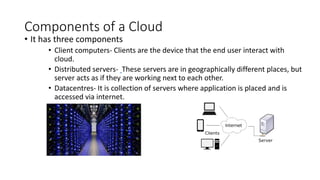
Components of a Cloud
โ€ข It has three components
โ€ข Client computers- Clients are the device that the end user interact with
cloud.
โ€ข Distributed servers- These servers are in geographically different places, but
server acts as if they are working next to each other.
โ€ข Datacentres- It is collection of servers where application is placed and is
accessed via internet.
Characteristics of a Cloud
โ€ข A number of characteristics define cloud data, applications services
and infrastructure:
โ€ข Remotely hosted: Services or data are hosted on remote
infrastructure.
โ€ข Ubiquitous: Services or data are available from anywhere.
โ€ข Commoditized: The result is a utility computing model similar to
traditional that of traditional utilities, like gas and electricity - you
pay for what you would want!
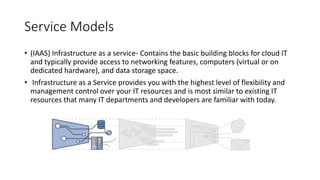
Service Models
โ€ข (IAAS) Infrastructure as a service- Contains the basic building blocks for cloud IT
and typically provide access to networking features, computers (virtual or on
dedicated hardware), and data storage space.
โ€ข Infrastructure as a Service provides you with the highest level of flexibility and
management control over your IT resources and is most similar to existing IT
resources that many IT departments and developers are familiar with today.
Service Models
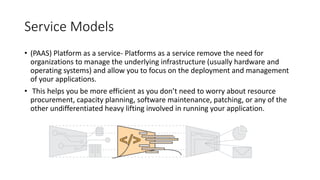
โ€ข (PAAS) Platform as a service- Platforms as a service remove the need for
organizations to manage the underlying infrastructure (usually hardware and
operating systems) and allow you to focus on the deployment and management
of your applications.
โ€ข This helps you be more efficient as you donโ€™t need to worry about resource
procurement, capacity planning, software maintenance, patching, or any of the
other undifferentiated heavy lifting involved in running your application.
Service Models
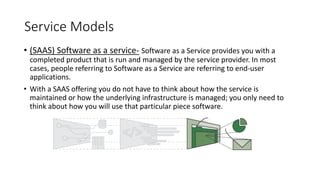
โ€ข (SAAS) Software as a service- Software as a Service provides you with a
completed product that is run and managed by the service provider. In most
cases, people referring to Software as a Service are referring to end-user
applications.
โ€ข With a SAAS offering you do not have to think about how the service is
maintained or how the underlying infrastructure is managed; you only need to
think about how you will use that particular piece software.
Deployment of Cloud Service
โ€ข Public Cloud-
โ€ข The public cloud is defined as a multi-tenant environment, where
you buy a โ€œserver sliceโ€ in a cloud computing environment that is
shared with a number of other clients or tenants.
โ€ข Private Cloud-
โ€ข Private cloud services are delivered from a business' data centre to
internal users. This model offers versatility and convenience, while
preserving management, control and security. Internal customers
may or may not be billed for services through.
Deployment of Cloud Service
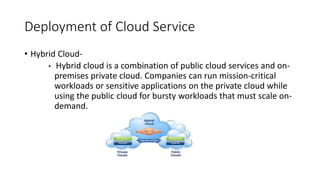
โ€ข Hybrid Cloud-
โ€ข Hybrid cloud is a combination of public cloud services and on-
premises private cloud. Companies can run mission-critical
workloads or sensitive applications on the private cloud while
using the public cloud for bursty workloads that must scale on-
demand.
Advantages of Cloud Computing
1. Trade capital expense for variable expense
โ€ข Instead of having to invest heavily in data centers and servers
before you know how youโ€™re going to use them, you can only
pay when you consume computing resources, and only pay for
how much you consume.
Advantages of Cloud Computing
2. Benefit from massive economies of scale
โ€ข By using cloud computing, you can achieve a lower variable
cost than you can get on your own. Because usage from
hundreds of thousands of customers are aggregated in the
cloud, providers such as Amazon Web Services can achieve
higher economies of scale which translates into lower pay as
you go prices.
Advantages of Cloud Computing
3. Stop guessing capacity
โ€ข Eliminate guessing on your infrastructure capacity needs. When
you make a capacity decision prior to deploying an application,
you often either end up sitting on expensive idle resources or
dealing with limited capacity. With Cloud Computing, these
problems go away. You can access as much or as little as you
need, and scale up and down as required with only a few
minutes notice.
Advantages of Cloud Computing
4. Increase speed and agility
โ€ข In a cloud computing environment, new IT resources are only
ever a click away, which means you reduce the time it takes to
make those resources available to your developers from weeks
to just minutes. This results in a dramatic increase in agility for
the organization, since the cost and time it takes to experiment
and develop is significantly lower.
Advantages of Cloud Computing
5. Stop spending money on running and maintaining data centers
โ€ข Focus on projects that differentiate your business, not the
infrastructure. Cloud computing lets you focus on your own
customers, rather than on the heavy lifting of racking, stacking
and powering servers.
Advantages of Cloud Computing
6. Go Global in minutes
โ€ข Easily deploy your application in multiple regions around the
world with just a few clicks. This means you can provide a lower
latency and better experience for your customers simply and at
minimal cost.
Amazon Web Services (AWS)
โ€ข In 2006, Amazon Web Services (AWS) began offering IT infrastructure
services to businesses in the form of web services, now commonly
known as cloud computing.
โ€ข Amazon Web Services (AWS), is a collection of remote computing
services, also called web services, that make up a cloud-computing
platform offered by Amazon.com.
Amazon Q1 Earnings
โ€ข $22.72 billion revenue, vs $22.39 billion expected.
โ€ข AWS revenue came in at $1.57 billion, or a run rate of a little over $6
billion a year. That's up 49% from last year's figure, and in line with
what most analysts were expecting.
โ€ข AWS profits of $265 million, up from $245 million a year
ago. Analysts had all kinds of expectations for AWS earnings, so this is
a surprise.
โ€ข If it sticks to this rate, that means AWS earns more than $1 billion in
profit a year.
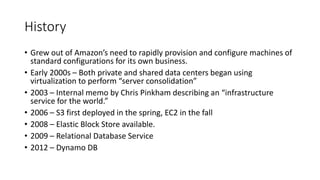
History
โ€ข Grew out of Amazonโ€™s need to rapidly provision and configure machines of
standard configurations for its own business.
โ€ข Early 2000s โ€“ Both private and shared data centers began using
virtualization to perform โ€œserver consolidationโ€
โ€ข 2003 โ€“ Internal memo by Chris Pinkham describing an โ€œinfrastructure
service for the world.โ€
โ€ข 2006 โ€“ S3 first deployed in the spring, EC2 in the fall
โ€ข 2008 โ€“ Elastic Block Store available.
โ€ข 2009 โ€“ Relational Database Service
โ€ข 2012 โ€“ Dynamo DB
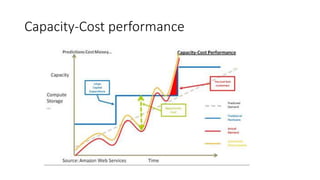
Capacity-Cost performance
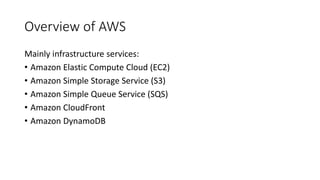
Overview of AWS
Mainly infrastructure services:
โ€ข Amazon Elastic Compute Cloud (EC2)
โ€ข Amazon Simple Storage Service (S3)
โ€ข Amazon Simple Queue Service (SQS)
โ€ข Amazon CloudFront
โ€ข Amazon DynamoDB
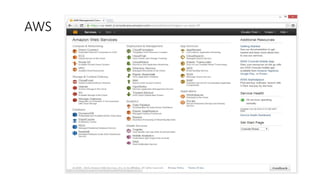
AWS
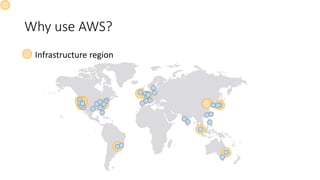
Why use AWS?
Infrastructure region
Amazon Elastic Compute Cloud (EC2)
โ€ข Amazon Elastic Compute Cloud (EC2) forms a central part of
Amazon.com's cloud-computing platform, by allowing users to rent
virtual computers on which to run their own computer applications.
โ€ข EC2 encourages scalable deployment of applications by providing a
web service through which a user can boot an Amazon Machine
Image to configure a virtual machine, which Amazon calls an
"instance", containing any software desired
Amazon Simple Storage Service (S3)
โ€ข Amazon S3 has a simple web services interface that you can use to
store and retrieve any amount of data, at any time, from anywhere on
the web.
โ€ข It gives any developer access to the same highly scalable, reliable,
fast, inexpensive data storage infrastructure that Amazon uses to run
its own global network of web sites.
โ€ข The service aims to maximize benefits of scale and to pass those
benefits on to developers.
Amazon Simple Storage Service (S3)
โ€ข A bucket is a container for objects and describes location, logging,
accounting, and access control. A bucket can hold any number of objects,
which are files of up to 5TB. A bucket has a name that must be globally
unique.
โ€ข Fundamental operations corresponding to HTTP actions:
โ€ข http://bucket.s3.amazonaws.com/object
โ€ข POST a new object or update an existing object.
โ€ข GET an existing object from a bucket.
โ€ข DELETE an object from the bucket
โ€ข LIST keys present in a bucket, with a filter.
โ€ข A bucket has a flat directory structure (despite the appearance given by
the interactive web interface.)
Pros and Cons
โ€ข Perhaps the biggest drawback of the S3 storage system is lack of
support for file systems. Also, S3 retrieval times can be slow when
compared to EBS and can vary between requests. S3 will, however,
support up to 5 TB of data in a single object and users can store as
many objects as they like.
โ€ข EBS volumes are limited to 1 TB and can be attached to only a single
EC2 instance. If you want to use the same EBS volume on multiple
EC2 instances, you will have to replicate the EBS volume and attach
the replicas to the other instances.
Amazon CloudFront
โ€ข Amazon CloudFront is a content delivery web service.
โ€ข Amazon CloudFront can be used to deliver your entire website,
including dynamic, static, streaming, and interactive content using a
global network of edge locations. Eg. Imdb,Youtube.
โ€ข Requests for your content are automatically routed to the nearest
edge location, so content is delivered with the best possible
performance
โ€ข It integrates with other Amazon Web Services products to give
developers and businesses an easy way to distribute content to end
users with low latency, high data transfer speeds, and no minimum
usage commitments.
Elastic Block Store (EBS)
โ€ข An EBS volume is a virtual disk of a fixed size with a block read/write
interface. It can be mounted as a file system on a running EC2
instance where it can be updated incrementally. Unlike an instance
store, an EBS volume is persistent.
Durability
โ€ข Amazon claims about S3:
โ€ข Amazon S3 is designed to sustain the concurrent loss of data in two facilities, e.g. 3+
copies across multiple available domains.
โ€ข 99.999999999% durability of objects over a given year.
โ€ข Amazon claims about EBS:
โ€ข Amazon EBS volume data is replicated across multiple servers in an Availability Zone
to prevent the loss of data from the failure of any single component.
โ€ข Amazon EBS volumes are designed for an annual failure rate (AFR) of between 0.1% -
0.2%, where failure refers to a complete or partial loss of the volume
โ€ข Commodity hard disks have an AFR of about 4%.
โ€ข Amazon claims about Glacier (for cold data) is the same as S3:
โ€ข Amazon S3 is designed to sustain the concurrent loss of data in two facilities, e.g. 3+
copies across multiple available domains PLUS periodic internal integrity checks.
โ€ข 99.999999999% durability of objects over a given year.
AWS Solutions
AWS can provide these solutions
โ€ข Web sites
โ€ข Back up and recovery
โ€ข Disaster recovery
โ€ข Development and testing
โ€ข Big data
โ€ข Media and entertainment
โ€ข Internet of things
โ€ข High performance computing
โ€ข Gaming
Success story
Netflix-
โ€ข Netflix Inc. is an international provider of on-demand Internet
streaming media available to viewers in all of North and South
America, Australia, New Zealand, Japan, and parts of Europe.
โ€ข As of October 2015, Netflix reported 69.17 million subscribers
worldwide, including more than 43 million in the U.S.
โ€ข Netflixโ€™s revenue is as high as US$5.50 billion (FY 2014)
Netflix Case
โ€ข Netflix has been on AWS since a devastating fire destroyed their own
datacentre in 2010.
โ€ข Netflix has turned to amazon to provide its infrastructure. Due to the
sheer volume and fluctuating usage patterns of its customer base,
Netflix relies on Amazonโ€™s infrastructure capabilities for rapid scaling,
server, and storage deployment.
โ€ข By 2015, their Cloud migration was complete and, thanks to AWS, the
scale they have achieved has been outstanding.
Challenges after 2010
โ€ข They needed to re-architect, which allowed them to question
everything, including whether to keep building out their own data
centre solution.
โ€ข Letting Amazon focus on datacentre infrastructure allows our
engineers to focus on building and improving our business.
โ€ข Netflix needed help with predicting their scaling and AWS had
expertise in this regard. It helped them concentrate on their products
and customer service.
Netflixโ€™s new motto
โ€ข Protect customer experience. This is crucial at Netflix and is the key
point of each operation.
โ€ข Make failures unique. This means making errors happen only once,
by identifying the real root of each problem and fixing it.
โ€ข Achieve constant improvement. This takes a lot of individual effort
and can be helped along by incident reviews and by
encouraging honest and open feedback.
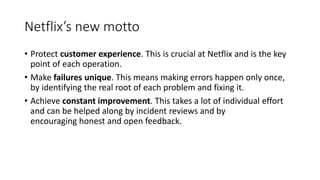
Some Clients of AWS
Warm up: Get Started with Amazon
โ€ข Skim through the AWS documentation.
โ€ข Sign up for AWS at http://aws.amazon.com
โ€ข (Skip the IAM management for now)
โ€ข Apply the service credit you received by email.
โ€ข Create and download a Key-Pair, save it in your home directory.
โ€ข Create a VM via the AWS Console
โ€ข Connect to your newly-created VM like this:
โ€ข ssh -i my-aws-keypair.pem ec2-user@ip-address-of-vm
โ€ข Create a bucket in S3 and upload/download some files.
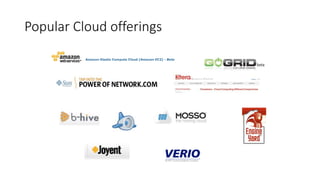
Popular Cloud offerings
Cloud Computing : Challenges
โ€ข Though there are benefits, In parallel there has been backlash against cloud computing:
โ€ข Use of cloud computing means dependence on others and that could possibly limit flexibility and
innovation:
โ€ข The others are likely become the bigger Internet companies like Google and IBM, who may
monopolise the market.
โ€ข Some argue that this use of supercomputers is a return to the time of mainframe computing
that the PC was a reaction against.
โ€ข Security could prove to be a big issue:
โ€ข It is still unclear how safe out-sourced data is and when using these services ownership of data is not
always clear.
โ€ข There are also issues relating to policy and access:
โ€ข If your data is stored abroad whose policy do you adhere to?
โ€ข What happens if the remote server goes down?
โ€ข How will you then access files?
โ€ข There have been cases of users being locked out of accounts and losing access to data.
Disadvantages of Cloud Computing
โ€ข Requires a constant Internet connection
โ€ข Does not work well with low-speed connections
โ€ข Features might be limited:
โ€ข For example, you can do a lot more with Microsoft PowerPoint than
with Google Presentation's web-based offering
โ€ข Even with a fast connection, web-based applications can sometimes
be slower than accessing a similar software program on your
desktop PC.
Disadvantages of Cloud Computing
โ€ข Stored data can be lost
โ€ข Theoretically, data stored in the cloud is safe, replicated across multiple
machines.
โ€ข But on the off chance that your data goes missing, you have no physical or
local backup.
โ€ข Put simply, relying on the cloud puts you at risk if the cloud lets you down.
By
โ€ข Rohith
โ€ข Chandramouli and
โ€ข Youssef
References
1. https://aws.amazon.com/?nc2=h_lg
2. http://www.smartdatacollective.com/connectriahosting/197171/who-are-some-heavy-users-
amazon-web-services-aws
3. http://www.theatlantic.com/technology/archive/2015/04/the-unbelievable-power-of-amazon-
web-services/391281/
4. Cloud Computing, University of Notre dame ( Thain,Douglas)
5. http://blogs.wsj.com/cio/2015/08/14/the-morning-download-netflix-leads-way-into-cloud-
closing-final-data-center/
6. Cloud computing, Lecture 15 (Baker, Mark )
7. http://www.tomsitpro.com/articles/cost-of-the-cloud-book,2-694-2.html
8. http://www.businessinsider.com/amazon-earnings-q1-2015-2015-4
THANK YOU

Cloud computing

  • 1.
    A D VE N T O F C L O U D C O M P U T I N G : C A S E S T U D Y O N A M A Z O N W E B S E R V I C E S
  • 2.
    AGENDA โ€ข Concepts ofCloud Computing โ€ข Advantages of Cloud Computing โ€ข Amazon Web Services(AWS) โ€ข Netflix Case โ€ข Challenges of Cloud Computing
  • 3.
    What is CloudComputing? โ€ข Cloud Computing means storing and accessing data and programs over the Internet instead of your computer's hard drive. โ€ข Basically a step on from Utility Computing (flexible/ customized service) โ€ข Collection of integrated and networked hardware, software and Internet infrastructure (called a platform). โ€ข These platforms hide the complexity and details of the underlying infrastructure from users and applications by providing very simple graphical interface or API
  • 4.
    What is CloudComputing? โ€ข It is like grid computing where unused processing cycles of all computers in a network are harnessed to solve problems too intensive for any stand-alone machine. โ€ข We use their service everyday. For example, Yahoo, Gmail etc. โ€ข Instead of running an email program on your computer, You log in to a Web email account remotely. The software and storage for your account doesnโ€™t exist on your computer. It is on the service providerโ€™s cloud. โ€ข Cloud Computing concept evolved in 1950 when IBM used a process called Remote Job Entry(RJE) to receive and process requests from remote locations.
  • 5.
    Components of aCloud โ€ข It has three components โ€ข Client computers- Clients are the device that the end user interact with cloud. โ€ข Distributed servers- These servers are in geographically different places, but server acts as if they are working next to each other. โ€ข Datacentres- It is collection of servers where application is placed and is accessed via internet.
  • 6.
    Characteristics of aCloud โ€ข A number of characteristics define cloud data, applications services and infrastructure: โ€ข Remotely hosted: Services or data are hosted on remote infrastructure. โ€ข Ubiquitous: Services or data are available from anywhere. โ€ข Commoditized: The result is a utility computing model similar to traditional that of traditional utilities, like gas and electricity - you pay for what you would want!
  • 7.
    Service Models โ€ข (IAAS)Infrastructure as a service- Contains the basic building blocks for cloud IT and typically provide access to networking features, computers (virtual or on dedicated hardware), and data storage space. โ€ข Infrastructure as a Service provides you with the highest level of flexibility and management control over your IT resources and is most similar to existing IT resources that many IT departments and developers are familiar with today.
  • 8.
    Service Models โ€ข (PAAS)Platform as a service- Platforms as a service remove the need for organizations to manage the underlying infrastructure (usually hardware and operating systems) and allow you to focus on the deployment and management of your applications. โ€ข This helps you be more efficient as you donโ€™t need to worry about resource procurement, capacity planning, software maintenance, patching, or any of the other undifferentiated heavy lifting involved in running your application.
  • 9.
    Service Models โ€ข (SAAS)Software as a service- Software as a Service provides you with a completed product that is run and managed by the service provider. In most cases, people referring to Software as a Service are referring to end-user applications. โ€ข With a SAAS offering you do not have to think about how the service is maintained or how the underlying infrastructure is managed; you only need to think about how you will use that particular piece software.
  • 10.
    Deployment of CloudService โ€ข Public Cloud- โ€ข The public cloud is defined as a multi-tenant environment, where you buy a โ€œserver sliceโ€ in a cloud computing environment that is shared with a number of other clients or tenants. โ€ข Private Cloud- โ€ข Private cloud services are delivered from a business' data centre to internal users. This model offers versatility and convenience, while preserving management, control and security. Internal customers may or may not be billed for services through.
  • 11.
    Deployment of CloudService โ€ข Hybrid Cloud- โ€ข Hybrid cloud is a combination of public cloud services and on- premises private cloud. Companies can run mission-critical workloads or sensitive applications on the private cloud while using the public cloud for bursty workloads that must scale on- demand.
  • 12.
    Advantages of CloudComputing 1. Trade capital expense for variable expense โ€ข Instead of having to invest heavily in data centers and servers before you know how youโ€™re going to use them, you can only pay when you consume computing resources, and only pay for how much you consume.
  • 13.
    Advantages of CloudComputing 2. Benefit from massive economies of scale โ€ข By using cloud computing, you can achieve a lower variable cost than you can get on your own. Because usage from hundreds of thousands of customers are aggregated in the cloud, providers such as Amazon Web Services can achieve higher economies of scale which translates into lower pay as you go prices.
  • 14.
    Advantages of CloudComputing 3. Stop guessing capacity โ€ข Eliminate guessing on your infrastructure capacity needs. When you make a capacity decision prior to deploying an application, you often either end up sitting on expensive idle resources or dealing with limited capacity. With Cloud Computing, these problems go away. You can access as much or as little as you need, and scale up and down as required with only a few minutes notice.
  • 15.
    Advantages of CloudComputing 4. Increase speed and agility โ€ข In a cloud computing environment, new IT resources are only ever a click away, which means you reduce the time it takes to make those resources available to your developers from weeks to just minutes. This results in a dramatic increase in agility for the organization, since the cost and time it takes to experiment and develop is significantly lower.
  • 16.
    Advantages of CloudComputing 5. Stop spending money on running and maintaining data centers โ€ข Focus on projects that differentiate your business, not the infrastructure. Cloud computing lets you focus on your own customers, rather than on the heavy lifting of racking, stacking and powering servers.
  • 17.
    Advantages of CloudComputing 6. Go Global in minutes โ€ข Easily deploy your application in multiple regions around the world with just a few clicks. This means you can provide a lower latency and better experience for your customers simply and at minimal cost.
  • 18.
    Amazon Web Services(AWS) โ€ข In 2006, Amazon Web Services (AWS) began offering IT infrastructure services to businesses in the form of web services, now commonly known as cloud computing. โ€ข Amazon Web Services (AWS), is a collection of remote computing services, also called web services, that make up a cloud-computing platform offered by Amazon.com.
  • 19.
    Amazon Q1 Earnings โ€ข$22.72 billion revenue, vs $22.39 billion expected. โ€ข AWS revenue came in at $1.57 billion, or a run rate of a little over $6 billion a year. That's up 49% from last year's figure, and in line with what most analysts were expecting. โ€ข AWS profits of $265 million, up from $245 million a year ago. Analysts had all kinds of expectations for AWS earnings, so this is a surprise. โ€ข If it sticks to this rate, that means AWS earns more than $1 billion in profit a year.
  • 20.
    History โ€ข Grew outof Amazonโ€™s need to rapidly provision and configure machines of standard configurations for its own business. โ€ข Early 2000s โ€“ Both private and shared data centers began using virtualization to perform โ€œserver consolidationโ€ โ€ข 2003 โ€“ Internal memo by Chris Pinkham describing an โ€œinfrastructure service for the world.โ€ โ€ข 2006 โ€“ S3 first deployed in the spring, EC2 in the fall โ€ข 2008 โ€“ Elastic Block Store available. โ€ข 2009 โ€“ Relational Database Service โ€ข 2012 โ€“ Dynamo DB
  • 21.
  • 22.
    Overview of AWS Mainlyinfrastructure services: โ€ข Amazon Elastic Compute Cloud (EC2) โ€ข Amazon Simple Storage Service (S3) โ€ข Amazon Simple Queue Service (SQS) โ€ข Amazon CloudFront โ€ข Amazon DynamoDB
  • 23.
  • 24.
  • 25.
    Amazon Elastic ComputeCloud (EC2) โ€ข Amazon Elastic Compute Cloud (EC2) forms a central part of Amazon.com's cloud-computing platform, by allowing users to rent virtual computers on which to run their own computer applications. โ€ข EC2 encourages scalable deployment of applications by providing a web service through which a user can boot an Amazon Machine Image to configure a virtual machine, which Amazon calls an "instance", containing any software desired
  • 26.
    Amazon Simple StorageService (S3) โ€ข Amazon S3 has a simple web services interface that you can use to store and retrieve any amount of data, at any time, from anywhere on the web. โ€ข It gives any developer access to the same highly scalable, reliable, fast, inexpensive data storage infrastructure that Amazon uses to run its own global network of web sites. โ€ข The service aims to maximize benefits of scale and to pass those benefits on to developers.
  • 27.
    Amazon Simple StorageService (S3) โ€ข A bucket is a container for objects and describes location, logging, accounting, and access control. A bucket can hold any number of objects, which are files of up to 5TB. A bucket has a name that must be globally unique. โ€ข Fundamental operations corresponding to HTTP actions: โ€ข http://bucket.s3.amazonaws.com/object โ€ข POST a new object or update an existing object. โ€ข GET an existing object from a bucket. โ€ข DELETE an object from the bucket โ€ข LIST keys present in a bucket, with a filter. โ€ข A bucket has a flat directory structure (despite the appearance given by the interactive web interface.)
  • 28.
    Pros and Cons โ€ขPerhaps the biggest drawback of the S3 storage system is lack of support for file systems. Also, S3 retrieval times can be slow when compared to EBS and can vary between requests. S3 will, however, support up to 5 TB of data in a single object and users can store as many objects as they like. โ€ข EBS volumes are limited to 1 TB and can be attached to only a single EC2 instance. If you want to use the same EBS volume on multiple EC2 instances, you will have to replicate the EBS volume and attach the replicas to the other instances.
  • 29.
    Amazon CloudFront โ€ข AmazonCloudFront is a content delivery web service. โ€ข Amazon CloudFront can be used to deliver your entire website, including dynamic, static, streaming, and interactive content using a global network of edge locations. Eg. Imdb,Youtube. โ€ข Requests for your content are automatically routed to the nearest edge location, so content is delivered with the best possible performance โ€ข It integrates with other Amazon Web Services products to give developers and businesses an easy way to distribute content to end users with low latency, high data transfer speeds, and no minimum usage commitments.
  • 30.
    Elastic Block Store(EBS) โ€ข An EBS volume is a virtual disk of a fixed size with a block read/write interface. It can be mounted as a file system on a running EC2 instance where it can be updated incrementally. Unlike an instance store, an EBS volume is persistent.
  • 31.
    Durability โ€ข Amazon claimsabout S3: โ€ข Amazon S3 is designed to sustain the concurrent loss of data in two facilities, e.g. 3+ copies across multiple available domains. โ€ข 99.999999999% durability of objects over a given year. โ€ข Amazon claims about EBS: โ€ข Amazon EBS volume data is replicated across multiple servers in an Availability Zone to prevent the loss of data from the failure of any single component. โ€ข Amazon EBS volumes are designed for an annual failure rate (AFR) of between 0.1% - 0.2%, where failure refers to a complete or partial loss of the volume โ€ข Commodity hard disks have an AFR of about 4%. โ€ข Amazon claims about Glacier (for cold data) is the same as S3: โ€ข Amazon S3 is designed to sustain the concurrent loss of data in two facilities, e.g. 3+ copies across multiple available domains PLUS periodic internal integrity checks. โ€ข 99.999999999% durability of objects over a given year.
  • 32.
    AWS Solutions AWS canprovide these solutions โ€ข Web sites โ€ข Back up and recovery โ€ข Disaster recovery โ€ข Development and testing โ€ข Big data โ€ข Media and entertainment โ€ข Internet of things โ€ข High performance computing โ€ข Gaming
  • 33.
    Success story Netflix- โ€ข NetflixInc. is an international provider of on-demand Internet streaming media available to viewers in all of North and South America, Australia, New Zealand, Japan, and parts of Europe. โ€ข As of October 2015, Netflix reported 69.17 million subscribers worldwide, including more than 43 million in the U.S. โ€ข Netflixโ€™s revenue is as high as US$5.50 billion (FY 2014)
  • 34.
    Netflix Case โ€ข Netflixhas been on AWS since a devastating fire destroyed their own datacentre in 2010. โ€ข Netflix has turned to amazon to provide its infrastructure. Due to the sheer volume and fluctuating usage patterns of its customer base, Netflix relies on Amazonโ€™s infrastructure capabilities for rapid scaling, server, and storage deployment. โ€ข By 2015, their Cloud migration was complete and, thanks to AWS, the scale they have achieved has been outstanding.
  • 35.
    Challenges after 2010 โ€ขThey needed to re-architect, which allowed them to question everything, including whether to keep building out their own data centre solution. โ€ข Letting Amazon focus on datacentre infrastructure allows our engineers to focus on building and improving our business. โ€ข Netflix needed help with predicting their scaling and AWS had expertise in this regard. It helped them concentrate on their products and customer service.
  • 36.
    Netflixโ€™s new motto โ€ขProtect customer experience. This is crucial at Netflix and is the key point of each operation. โ€ข Make failures unique. This means making errors happen only once, by identifying the real root of each problem and fixing it. โ€ข Achieve constant improvement. This takes a lot of individual effort and can be helped along by incident reviews and by encouraging honest and open feedback.
  • 37.
  • 38.
    Warm up: GetStarted with Amazon โ€ข Skim through the AWS documentation. โ€ข Sign up for AWS at http://aws.amazon.com โ€ข (Skip the IAM management for now) โ€ข Apply the service credit you received by email. โ€ข Create and download a Key-Pair, save it in your home directory. โ€ข Create a VM via the AWS Console โ€ข Connect to your newly-created VM like this: โ€ข ssh -i my-aws-keypair.pem ec2-user@ip-address-of-vm โ€ข Create a bucket in S3 and upload/download some files.
  • 39.
  • 40.
    Cloud Computing :Challenges โ€ข Though there are benefits, In parallel there has been backlash against cloud computing: โ€ข Use of cloud computing means dependence on others and that could possibly limit flexibility and innovation: โ€ข The others are likely become the bigger Internet companies like Google and IBM, who may monopolise the market. โ€ข Some argue that this use of supercomputers is a return to the time of mainframe computing that the PC was a reaction against. โ€ข Security could prove to be a big issue: โ€ข It is still unclear how safe out-sourced data is and when using these services ownership of data is not always clear. โ€ข There are also issues relating to policy and access: โ€ข If your data is stored abroad whose policy do you adhere to? โ€ข What happens if the remote server goes down? โ€ข How will you then access files? โ€ข There have been cases of users being locked out of accounts and losing access to data.
  • 41.
    Disadvantages of CloudComputing โ€ข Requires a constant Internet connection โ€ข Does not work well with low-speed connections โ€ข Features might be limited: โ€ข For example, you can do a lot more with Microsoft PowerPoint than with Google Presentation's web-based offering โ€ข Even with a fast connection, web-based applications can sometimes be slower than accessing a similar software program on your desktop PC.
  • 42.
    Disadvantages of CloudComputing โ€ข Stored data can be lost โ€ข Theoretically, data stored in the cloud is safe, replicated across multiple machines. โ€ข But on the off chance that your data goes missing, you have no physical or local backup. โ€ข Put simply, relying on the cloud puts you at risk if the cloud lets you down.
  • 43.
  • 44.
    References 1. https://aws.amazon.com/?nc2=h_lg 2. http://www.smartdatacollective.com/connectriahosting/197171/who-are-some-heavy-users- amazon-web-services-aws 3.http://www.theatlantic.com/technology/archive/2015/04/the-unbelievable-power-of-amazon- web-services/391281/ 4. Cloud Computing, University of Notre dame ( Thain,Douglas) 5. http://blogs.wsj.com/cio/2015/08/14/the-morning-download-netflix-leads-way-into-cloud- closing-final-data-center/ 6. Cloud computing, Lecture 15 (Baker, Mark ) 7. http://www.tomsitpro.com/articles/cost-of-the-cloud-book,2-694-2.html 8. http://www.businessinsider.com/amazon-earnings-q1-2015-2015-4
  • 45.