Cloud Computing:5
Cloud and Dynamic Infrastructure
Prof Neeraj Bhargava
Vaibhav Khanna
Department of Computer Science
School of Engineering and Systems Sciences
Maharshi Dayanand Saraswati University Ajmer
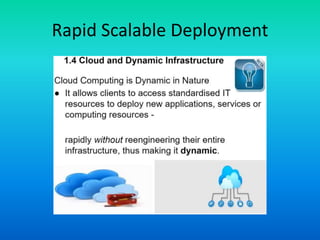
Rapid Scalable Deployment
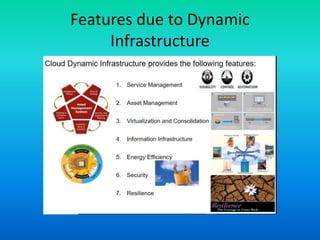
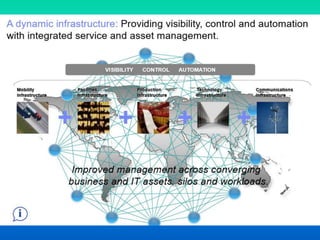
Features due to Dynamic
Infrastructure
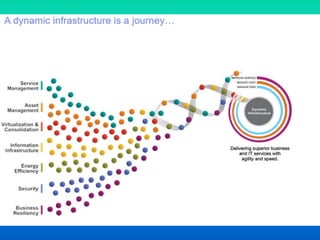
Service Management
• Service Management: Service
management solutions help you create
and manage a more agile, business-
oriented and dynamic infrastructure so you
can rapidly respond to change and deliver
higher quality services at a lower cost.
Learn more about Service management
Asset management
• Asset management: Hardware, software,
and services from IBM help you maximize
the performance and lifetime value of
assets across your enterprise—
production, facilities, transportation and
IT—and closely align them with your
overall business strategy.
Virtualization & Consolidation
• Virtualization & Consolidation:
Virtualization and consolidation can
reduce IT complexity to help your data
center become more resilient and secure
while reducing costs.
• The ability to deploy capacity and server
images virtually increases speed of
deployment roughly by a factor of 30
times.
Information Infrastructure
• Information Infrastructure: A comprehensive
approach to information infrastructure addresses
compliance, availability, retention, and security
requirements while helping businesses get the
right information to the right person at the right
time.
• Potential benefits include up to: 75% decrease in
capital costs, 600% increase in input capacity,
300x improvement in throughput, 500x
improvement in hardware price/performance ratio.
Energy Efficiency
• Energy Efficiency: Energy efficiency
solutions can help lower data center
energy costs by up to 40% or more
through facilities design, power and
cooling infrastructure, active energy
management, and efficient, scalable IBM
systems.
Security
• Security: Security solutions deliver the full
breadth and depth of capabilities that
enable organizations to take a business-
driven, holistic approach to security,
compliance and risk management in
alignment with an IT governance
framework, supporting the secure delivery
of services with speed and agility in the
dynamic infrastructure.
Business Resiliency
• Business Resiliency: Business continuity and
resiliency solutions keep your business running in
the event of an internal or external risk, planned or
unplanned, and allow your IT experts to devote
more time to innovation.
• Less than 50% percent companies surveyed have
disaster recovery and business continuity
strategies in place.
• And among those who have planned for business
continuity and resiliency, 75 percent report that
efforts are likely to be “haphazard” and “untested.”
Assignment
• Explain the concept and benefits of dynamic
infrastructure using cloud computing

Cloud computing 5 cloud and the dynamic infrastructure

  • 1.
    Cloud Computing:5 Cloud andDynamic Infrastructure Prof Neeraj Bhargava Vaibhav Khanna Department of Computer Science School of Engineering and Systems Sciences Maharshi Dayanand Saraswati University Ajmer
  • 2.
  • 3.
    Features due toDynamic Infrastructure
  • 5.
    Service Management • ServiceManagement: Service management solutions help you create and manage a more agile, business- oriented and dynamic infrastructure so you can rapidly respond to change and deliver higher quality services at a lower cost. Learn more about Service management
  • 6.
    Asset management • Assetmanagement: Hardware, software, and services from IBM help you maximize the performance and lifetime value of assets across your enterprise— production, facilities, transportation and IT—and closely align them with your overall business strategy.
  • 7.
    Virtualization & Consolidation •Virtualization & Consolidation: Virtualization and consolidation can reduce IT complexity to help your data center become more resilient and secure while reducing costs. • The ability to deploy capacity and server images virtually increases speed of deployment roughly by a factor of 30 times.
  • 8.
    Information Infrastructure • InformationInfrastructure: A comprehensive approach to information infrastructure addresses compliance, availability, retention, and security requirements while helping businesses get the right information to the right person at the right time. • Potential benefits include up to: 75% decrease in capital costs, 600% increase in input capacity, 300x improvement in throughput, 500x improvement in hardware price/performance ratio.
  • 9.
    Energy Efficiency • EnergyEfficiency: Energy efficiency solutions can help lower data center energy costs by up to 40% or more through facilities design, power and cooling infrastructure, active energy management, and efficient, scalable IBM systems.
  • 10.
    Security • Security: Securitysolutions deliver the full breadth and depth of capabilities that enable organizations to take a business- driven, holistic approach to security, compliance and risk management in alignment with an IT governance framework, supporting the secure delivery of services with speed and agility in the dynamic infrastructure.
  • 11.
    Business Resiliency • BusinessResiliency: Business continuity and resiliency solutions keep your business running in the event of an internal or external risk, planned or unplanned, and allow your IT experts to devote more time to innovation. • Less than 50% percent companies surveyed have disaster recovery and business continuity strategies in place. • And among those who have planned for business continuity and resiliency, 75 percent report that efforts are likely to be “haphazard” and “untested.”
  • 13.
    Assignment • Explain theconcept and benefits of dynamic infrastructure using cloud computing