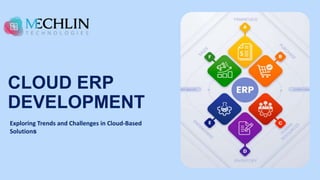
CLOUD ERP
DEVELOPMENT
Exploring Trends and Challenges in Cloud-Based
Solutions
AGENDA
2
• Introduction
• Trends in Cloud ERP Development
• Scalability in Cloud ERP
• Security in Cloud ERP
• Accessibility in Cloud ERP
• Development Considerations
• Testing and Quality Assurance
• Deployment and Implementation
• Conclusion
INTRODUCTION
3
Cloud ERP (Enterprise Resource Planning) refers to a comprehensive business management
system that operates in the cloud computing environment. Unlike traditional ERP systems that
are hosted on-premises, cloud ERP solutions are delivered as a service over the internet,
allowing organizations to access and manage their critical business functions remotely.
The importance of cloud-based solutions in modern business environments cannot be
overstated, as they offer numerous advantages that enable organizations to thrive in today's
competitive landscape.
TRENDS IN CLOUD ERP DEVELOPMENT
4
• The rise of cloud adoption in ERP systems reflects a strategic shift towards scalable, cost-
effective solutions for streamlined business operations.
• The shift towards subscription-based models (SaaS) signifies a departure from traditional
software purchasing, offering businesses flexible and cost-efficient access to cutting-edge
technology.
• The integration of AI and machine learning in ERP systems empowers businesses with
advanced analytics capabilities, driving informed decision-making and operational
efficiency.
• The emphasis on mobile accessibility and collaboration tools underscores the importance
of seamless connectivity and teamwork, enabling employees to work efficiently from
anywhere, at any time.
SCALABILITY IN CLOUD ERP
5
• Scalability is vital for growing businesses as it ensures the ability to expand operations
seamlessly, meeting increased demand without compromising performance or efficiency.
• The elasticity of cloud infrastructure enables businesses to effortlessly adapt to changing
workloads, ensuring optimal resource allocation and performance at all times.
• Horizontal and vertical scaling strategies offer businesses flexibility in adjusting resources
either by adding more instances (horizontal) or increasing the capacity of existing
resources (vertical), optimizing performance and cost-efficiency.
• Challenges in scaling complex ERP systems include balancing performance with resource
allocation, maintaining data integrity, and ensuring seamless integration across multiple
modules and processes.
SECURITY IN CLOUD ERP
6
•Addressing security concerns in cloud environments involves implementing robust encryption
protocols, access controls, and proactive threat detection measures to safeguard sensitive data and
ensure compliance with industry regulations.
•Encryption and data protection measures are essential components of cybersecurity strategies,
safeguarding sensitive information from unauthorized access or theft by converting it into unreadable
code that can only be deciphered with the appropriate encryption key.
•Identity and access management (IAM) ensures that only authorized individuals or entities have access
to resources and systems, helping organizations maintain security and compliance while managing user
identities and permissions efficiently.
•Compliance with industry regulations such as GDPR and HIPAA is crucial for businesses, ensuring that
they adhere to legal requirements regarding data privacy, security, and confidentiality to protect
sensitive information and maintain trust with customers and stakeholders.
ACCESSIBILITY IN CLOUD ERP
7
• The advantages of anytime, anywhere access to ERP systems include increased productivity,
flexibility, and collaboration among employees, enabling seamless operations regardless of
location or time zone.
• Support for multiple devices and platforms ensures that users can access ERP systems from
various devices such as laptops, tablets, and smartphones, enhancing flexibility and convenience
in managing business operations.
• User-friendly interfaces in ERP systems enhance usability by providing intuitive navigation and
intuitive design, empowering users to efficiently perform tasks and access information, ultimately
driving productivity and satisfaction.
• Challenges in ensuring seamless accessibility across geographies and networks include managing
latency issues, addressing connectivity limitations, and maintaining consistent user experiences
across diverse locations, ultimately requiring robust infrastructure and optimization strategies.
DEVELOPMENT CONSIDERATIONS
8
• Choosing the right cloud platform, such as AWS, Azure, or Google Cloud, is critical for businesses,
as it determines the scalability, performance, and reliability of their cloud-based solutions,
aligning with specific requirements and objectives.
• Architectural design for cloud-native applications involves building scalable, resilient, and modular
systems that leverage cloud services and microservices architecture, enabling flexibility and agility
in deployment and management.
• A microservices-based approach enhances modularity and flexibility in software development by
breaking down applications into small, independently deployable services, facilitating easier
maintenance, scalability, and innovation.
• Continuous integration and deployment (CI/CD) pipelines streamline the development process by
automating code integration, testing, and deployment, ensuring rapid and reliable delivery of
software updates and enhancements.
TESTING AND QUALITY ASSURANCE
9
• Testing strategies for cloud-based ERP solutions involve comprehensive approaches to ensure
functionality, performance, and security, addressing unique challenges in distributed
environments to deliver reliable and scalable systems.
• Automated testing frameworks are essential for ensuring the scalability and reliability of cloud-
based ERP solutions, enabling efficient and consistent testing processes to identify and mitigate
potential issues early in the development lifecycle.
• Performance testing in cloud environments evaluates the responsiveness, stability, and scalability
of ERP systems under various conditions, ensuring optimal performance and user experience for
all stakeholders.
• Ensuring data integrity and security during testing is crucial for maintaining the confidentiality,
availability, and accuracy of sensitive information, mitigating risks and vulnerabilities throughout
the development process.
DEPLOYMENT AND IMPLEMENTATION
10
• Planning for cloud ERP deployment involves strategic considerations and meticulous preparation
to ensure a smooth transition, minimizing disruptions and maximizing the benefits of the new
system for the organization.
• Data migration strategies from on-premises systems to the cloud entail careful planning and
execution to transfer data efficiently and securely, preserving integrity and ensuring compatibility
with the new cloud environment.
• Configuration and setup of cloud-based ERP modules involve tailoring system settings and
parameters to align with business requirements, ensuring seamless integration and optimal
functionality for effective operations.
• The go-live strategy and post-deployment support are critical phases in the ERP implementation
process, ensuring a smooth transition to the new system and providing ongoing assistance to
address any issues and optimize performance.
CONCLUSION
In conclusion, cloud ERP development presents a dynamic landscape marked by evolving trends and
formidable challenges. Embracing scalability, security, and accessibility as core pillars, businesses can
harness the transformative potential of cloud-based ERP solutions to drive efficiency, innovation,
and competitiveness in today's digital era.
In navigating the complexities of cloud ERP development, businesses must remain vigilant to
emerging trends while proactively addressing challenges. Scalability ensures adaptability to evolving
needs, while robust security measures safeguard against potential threats. Moreover, emphasizing
accessibility fosters collaboration and flexibility across diverse work environments. By embracing
these principles, organizations can harness the full potential of cloud-based ERP solutions to
optimize operations, empower decision-making, and foster sustainable growth in an ever-changing
business landscape.
THANKYOU!
Mechlin Technologies
sales@mechlintech.com
www.mechlintech.com

Cloud ERP Development: Exploring Trends and Challenges.pptx

  • 1.
    CLOUD ERP DEVELOPMENT Exploring Trendsand Challenges in Cloud-Based Solutions
  • 2.
    AGENDA 2 • Introduction • Trendsin Cloud ERP Development • Scalability in Cloud ERP • Security in Cloud ERP • Accessibility in Cloud ERP • Development Considerations • Testing and Quality Assurance • Deployment and Implementation • Conclusion
  • 3.
    INTRODUCTION 3 Cloud ERP (EnterpriseResource Planning) refers to a comprehensive business management system that operates in the cloud computing environment. Unlike traditional ERP systems that are hosted on-premises, cloud ERP solutions are delivered as a service over the internet, allowing organizations to access and manage their critical business functions remotely. The importance of cloud-based solutions in modern business environments cannot be overstated, as they offer numerous advantages that enable organizations to thrive in today's competitive landscape.
  • 4.
    TRENDS IN CLOUDERP DEVELOPMENT 4 • The rise of cloud adoption in ERP systems reflects a strategic shift towards scalable, cost- effective solutions for streamlined business operations. • The shift towards subscription-based models (SaaS) signifies a departure from traditional software purchasing, offering businesses flexible and cost-efficient access to cutting-edge technology. • The integration of AI and machine learning in ERP systems empowers businesses with advanced analytics capabilities, driving informed decision-making and operational efficiency. • The emphasis on mobile accessibility and collaboration tools underscores the importance of seamless connectivity and teamwork, enabling employees to work efficiently from anywhere, at any time.
  • 5.
    SCALABILITY IN CLOUDERP 5 • Scalability is vital for growing businesses as it ensures the ability to expand operations seamlessly, meeting increased demand without compromising performance or efficiency. • The elasticity of cloud infrastructure enables businesses to effortlessly adapt to changing workloads, ensuring optimal resource allocation and performance at all times. • Horizontal and vertical scaling strategies offer businesses flexibility in adjusting resources either by adding more instances (horizontal) or increasing the capacity of existing resources (vertical), optimizing performance and cost-efficiency. • Challenges in scaling complex ERP systems include balancing performance with resource allocation, maintaining data integrity, and ensuring seamless integration across multiple modules and processes.
  • 6.
    SECURITY IN CLOUDERP 6 •Addressing security concerns in cloud environments involves implementing robust encryption protocols, access controls, and proactive threat detection measures to safeguard sensitive data and ensure compliance with industry regulations. •Encryption and data protection measures are essential components of cybersecurity strategies, safeguarding sensitive information from unauthorized access or theft by converting it into unreadable code that can only be deciphered with the appropriate encryption key. •Identity and access management (IAM) ensures that only authorized individuals or entities have access to resources and systems, helping organizations maintain security and compliance while managing user identities and permissions efficiently. •Compliance with industry regulations such as GDPR and HIPAA is crucial for businesses, ensuring that they adhere to legal requirements regarding data privacy, security, and confidentiality to protect sensitive information and maintain trust with customers and stakeholders.
  • 7.
    ACCESSIBILITY IN CLOUDERP 7 • The advantages of anytime, anywhere access to ERP systems include increased productivity, flexibility, and collaboration among employees, enabling seamless operations regardless of location or time zone. • Support for multiple devices and platforms ensures that users can access ERP systems from various devices such as laptops, tablets, and smartphones, enhancing flexibility and convenience in managing business operations. • User-friendly interfaces in ERP systems enhance usability by providing intuitive navigation and intuitive design, empowering users to efficiently perform tasks and access information, ultimately driving productivity and satisfaction. • Challenges in ensuring seamless accessibility across geographies and networks include managing latency issues, addressing connectivity limitations, and maintaining consistent user experiences across diverse locations, ultimately requiring robust infrastructure and optimization strategies.
  • 8.
    DEVELOPMENT CONSIDERATIONS 8 • Choosingthe right cloud platform, such as AWS, Azure, or Google Cloud, is critical for businesses, as it determines the scalability, performance, and reliability of their cloud-based solutions, aligning with specific requirements and objectives. • Architectural design for cloud-native applications involves building scalable, resilient, and modular systems that leverage cloud services and microservices architecture, enabling flexibility and agility in deployment and management. • A microservices-based approach enhances modularity and flexibility in software development by breaking down applications into small, independently deployable services, facilitating easier maintenance, scalability, and innovation. • Continuous integration and deployment (CI/CD) pipelines streamline the development process by automating code integration, testing, and deployment, ensuring rapid and reliable delivery of software updates and enhancements.
  • 9.
    TESTING AND QUALITYASSURANCE 9 • Testing strategies for cloud-based ERP solutions involve comprehensive approaches to ensure functionality, performance, and security, addressing unique challenges in distributed environments to deliver reliable and scalable systems. • Automated testing frameworks are essential for ensuring the scalability and reliability of cloud- based ERP solutions, enabling efficient and consistent testing processes to identify and mitigate potential issues early in the development lifecycle. • Performance testing in cloud environments evaluates the responsiveness, stability, and scalability of ERP systems under various conditions, ensuring optimal performance and user experience for all stakeholders. • Ensuring data integrity and security during testing is crucial for maintaining the confidentiality, availability, and accuracy of sensitive information, mitigating risks and vulnerabilities throughout the development process.
  • 10.
    DEPLOYMENT AND IMPLEMENTATION 10 •Planning for cloud ERP deployment involves strategic considerations and meticulous preparation to ensure a smooth transition, minimizing disruptions and maximizing the benefits of the new system for the organization. • Data migration strategies from on-premises systems to the cloud entail careful planning and execution to transfer data efficiently and securely, preserving integrity and ensuring compatibility with the new cloud environment. • Configuration and setup of cloud-based ERP modules involve tailoring system settings and parameters to align with business requirements, ensuring seamless integration and optimal functionality for effective operations. • The go-live strategy and post-deployment support are critical phases in the ERP implementation process, ensuring a smooth transition to the new system and providing ongoing assistance to address any issues and optimize performance.
  • 11.
    CONCLUSION In conclusion, cloudERP development presents a dynamic landscape marked by evolving trends and formidable challenges. Embracing scalability, security, and accessibility as core pillars, businesses can harness the transformative potential of cloud-based ERP solutions to drive efficiency, innovation, and competitiveness in today's digital era. In navigating the complexities of cloud ERP development, businesses must remain vigilant to emerging trends while proactively addressing challenges. Scalability ensures adaptability to evolving needs, while robust security measures safeguard against potential threats. Moreover, emphasizing accessibility fosters collaboration and flexibility across diverse work environments. By embracing these principles, organizations can harness the full potential of cloud-based ERP solutions to optimize operations, empower decision-making, and foster sustainable growth in an ever-changing business landscape.
  • 12.