
Cloud and Smarter Infrastructure – Cloud
Enabled Data Center
Glenda Lyon
glyon@us.ibm.com
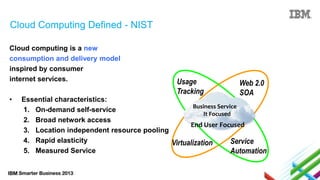
Cloud Computing Defined - NIST
Cloud computing is a new
consumption and delivery model
inspired by consumer
internet services.
•

Usage
Tracking

Web 2.0
SOA

Essential characteristics:
Business Service
1. On-demand self-service
It Focused
2. Broad network access
End User Focused
3. Location independent resource pooling
4. Rapid elasticity
Service
Virtualization
5. Measured Service
Automation
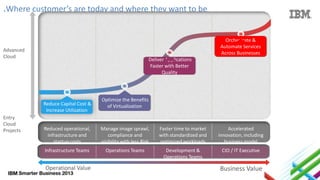
.Where customer’s are today and where they want to be
Orchestrate &
Automate Services
Across Businesses

Advanced
Cloud

Deliver Applications
Faster with Better
Quality

Reduce Capital Cost &
Increase Utilization
Entry
Cloud
Projects

Optimize the Benefits
of Virtualization

Reduced operational,
infrastructure and
startup costs

Manage image sprawl,
compliance and
visibility with less Risk

Faster time to market
with standardized and
optimized workloads

Accelerated
innovation, including
business model

Infrastructure Teams

Operations
OperationsTeams
Teams

Development & Operations
Development &
Teams

CIO IT Executive
CIO / /IT Executive

Operations Teams

Operational Value

Business Value
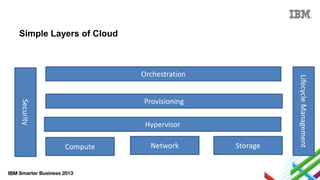
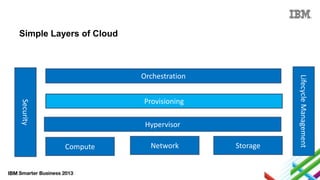
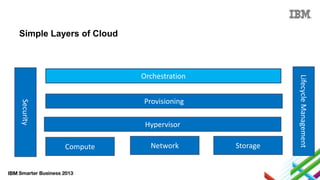
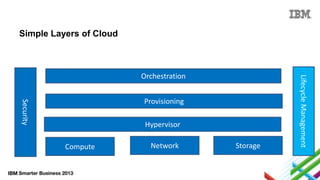
Simple Layers of Cloud

Security

Provisioning
Hypervisor
Compute

Network

Storage

Lifecycle Management

Orchestration
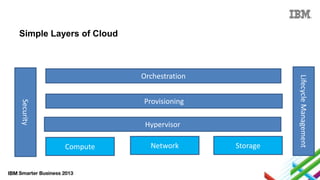
Simple Layers of Cloud

Security

Provisioning
Hypervisor
Compute

Network

Storage

Lifecycle Management

Orchestration
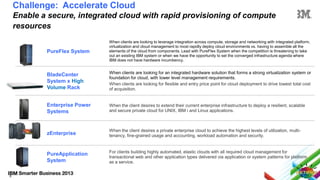
Challenge: Accelerate Cloud
Enable a secure, integrated cloud with rapid provisioning of compute
resources
PureFlex System

BladeCenter
System x High
Volume Rack

When clients are looking for an integrated hardware solution that forms a strong virtualization system or
foundation for cloud, with lower level management requirements.
When clients are looking for flexible and entry price point for cloud deployment to drive lowest total cost
of acquisition.

Enterprise Power
Systems

When the client desires to extend their current enterprise infrastructure to deploy a resilient, scalable
and secure private cloud for UNIX, IBM i and Linux applications.

zEnterprise

When the client desires a private enterprise cloud to achieve the highest levels of utilization, multitenancy, fine-grained usage and accounting, workload automation and security.

PureApplication
System
6

When clients are looking to leverage integration across compute, storage and networking with integrated platform,
virtualization and cloud management to most rapidly deploy cloud environments vs. having to assemble all the
elements of the cloud from components. Lead with PureFlex System when the competition is threatening to take
out an existing IBM system or when we have the opportunity to set the converged infrastructure agenda where
IBM does not have hardware incumbency.

For clients building highly automated, elastic clouds with all required cloud management for
transactional web and other application types delivered via application or system patterns for platform
as a service.
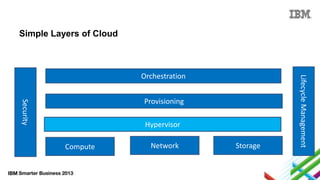
Simple Layers of Cloud

Security

Provisioning
Hypervisor
Compute

Network

Storage

Lifecycle Management

Orchestration
Hypervisors: provides the ability to divide physical system
resources into isolated logical partitions. Each logical partition
operates like an independent system running its own operating
environment
•

Xen

•

VMware

•

Microsoft

•

KVM

•

Power, etc.
Simple Layers of Cloud

Security

Provisioning
Hypervisor
Compute

Network

Storage

Lifecycle Management

Orchestration
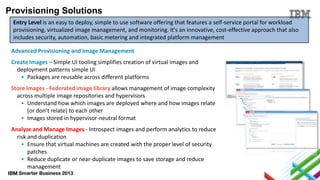
Provisioning Solutions
Entry Level is an easy to deploy, simple to use software offering that features a self-service portal for workload
provisioning, virtualized image management, and monitoring. It's an innovative, cost-effective approach that also
includes security, automation, basic metering and integrated platform management

Advanced Provisioning and Image Management
Create Images – Simple UI tooling simplifies creation of virtual images and
deployment patterns simple UI
• Packages are reusable across different platforms
Store Images - Federated image library allows management of image complexity
across multiple image repositories and hypervisors
• Understand how which images are deployed where and how images relate
(or don’t relate) to each other
• Images stored in hypervisor-neutral format

Analyze and Manage Images - Introspect images and perform analytics to reduce
risk and duplication
• Ensure that virtual machines are created with the proper level of security
patches
• Reduce duplicate or near-duplicate images to save storage and reduce
management
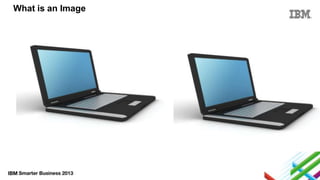
What is an Image
What is Image Sprawl
What is Image Drift
Simple Layers of Cloud

Security

Provisioning
Hypervisor
Compute

Network

Storage

Lifecycle Management

Orchestration
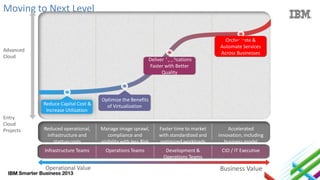
Moving to Next Level
Orchestrate &
Automate Services
Across Businesses

Advanced
Cloud

Deliver Applications
Faster with Better
Quality

Reduce Capital Cost &
Increase Utilization
Entry
Cloud
Projects

Optimize the Benefits
of Virtualization

Reduced operational,
infrastructure and
startup costs

Manage image sprawl,
compliance and
visibility with less Risk

Faster time to market
with standardized and
optimized workloads

Accelerated
innovation, including
business model

Infrastructure Teams

Operations
OperationsTeams
Teams

Development & Operations
Development &
Teams

CIO IT Executive
CIO / /IT Executive

Operations Teams

Operational Value

Business Value
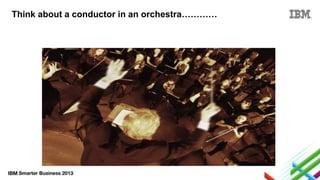
Think about a conductor in an orchestra…………
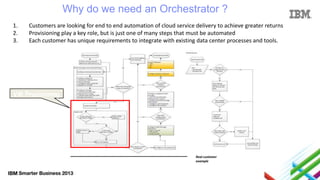
Why do we need an Orchestrator ?
1.
2.
3.

Customers are looking for end to end automation of cloud service delivery to achieve greater returns
Provisioning play a key role, but is just one of many steps that must be automated
Each customer has unique requirements to integrate with existing data center processes and tools.

VM Provisioning

Real customer
example
Simple Layers of Cloud

Security

Provisioning
Hypervisor
Compute

Network

Storage

Lifecycle Management

Orchestration
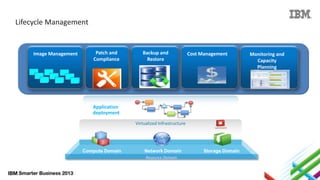
Lifecycle Management

Image Management

Patch and
Compliance

Backup and
Restore

Cost Management

Application
deployment
Virtualized Infrastructure

Compute Domain

Network Domain
Resource Domain

Storage Domain

Monitoring and
Capacity
Planning
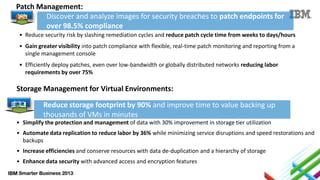
Patch Management:
Patch
Discover and analyze images for security breaches to patch endpoints for
and
Complia
over 98.5% compliance
nce
• Reduce security risk by slashing remediation cycles and reduce patch cycle time from weeks to days/hours
• Gain greater visibility into patch compliance with flexible, real-time patch monitoring and reporting from a
single management console
• Efficiently deploy patches, even over low-bandwidth or globally distributed networks reducing labor
requirements by over 75%

Storage Management for Virtual Environments:
Reduce storage footprint by 90% and improve time to value backing up thousands of VMs in
Backup
and
Restore

minutesReduce storage footprint by 90%

and improve time to value backing up

thousands of VMs in minutes

• Simplify the protection and management of data with 30% improvement in storage tier utilization
• Automate data replication to reduce labor by 36% while minimizing service disruptions and speed restorations and
backups

• Increase efficiencies and conserve resources with data de-duplication and a hierarchy of storage
• Enhance data security with advanced access and encryption features
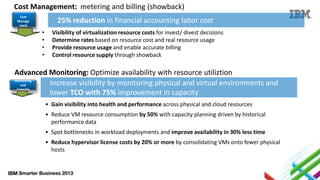
Cost Management: metering and billing (showback)
Cost
Manage
ment

25% reduction in financial accounting labor cost
•
•
•
•

Visibility of virtualization resource costs for invest/ divest decisions
Determine rates based on resource cost and real resource usage
Provide resource usage and enable accurate billing
Control resource supply through showback

Advanced Monitoring: Optimize availability with resource utiliztion
Monitoring
Increase visibility by monitoring physical and virtual environments and
and
Capacity
lower TCO with 75% improvement in capacity
• Gain visibility into health and performance across physical and cloud resources

• Reduce VM resource consumption by 50% with capacity planning driven by historical
performance data
• Spot bottlenecks in workload deployments and improve availability in 30% less time
• Reduce hypervisor license costs by 20% or more by consolidating VMs onto fewer physical
hosts
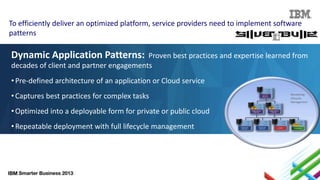
To efficiently deliver an optimized platform, service providers need to implement software
patterns

Dynamic Application Patterns:

Proven best practices and expertise learned from
decades of client and partner engagements
• Pre-defined architecture of an application or Cloud service
• Captures best practices for complex tasks
• Optimized into a deployable form for private or public cloud
• Repeatable deployment with full lifecycle management

Monitoring
Lifecycle
Management
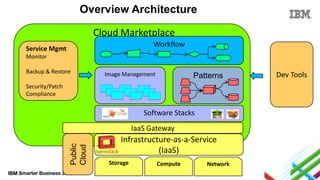
Overview Architecture
Cloud Marketplace
Workflow

Service Mgmt
Monitor
Backup & Restore

Image Management

Patterns

Security/Patch
Compliance

Software Stacks

Public
Cloud

IaaS Gateway

Infrastructure-as-a-Service
(IaaS)
Storage

Compute

Network

Dev Tools
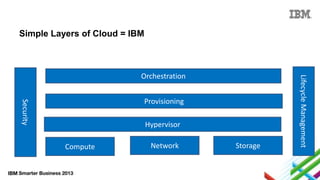
Simple Layers of Cloud = IBM

Security

Provisioning
Hypervisor
Compute

Network

Storage

Lifecycle Management

Orchestration
The Cloud Enabled Datacenter - Smarter Business 2013

The Cloud Enabled Datacenter - Smarter Business 2013

  • 1.
    Cloud and SmarterInfrastructure – Cloud Enabled Data Center Glenda Lyon glyon@us.ibm.com
  • 2.
    Cloud Computing Defined- NIST Cloud computing is a new consumption and delivery model inspired by consumer internet services. • Usage Tracking Web 2.0 SOA Essential characteristics: Business Service 1. On-demand self-service It Focused 2. Broad network access End User Focused 3. Location independent resource pooling 4. Rapid elasticity Service Virtualization 5. Measured Service Automation
  • 3.
    .Where customer’s aretoday and where they want to be Orchestrate & Automate Services Across Businesses Advanced Cloud Deliver Applications Faster with Better Quality Reduce Capital Cost & Increase Utilization Entry Cloud Projects Optimize the Benefits of Virtualization Reduced operational, infrastructure and startup costs Manage image sprawl, compliance and visibility with less Risk Faster time to market with standardized and optimized workloads Accelerated innovation, including business model Infrastructure Teams Infrastructure Teams Operations OperationsTeams Teams Development & Operations Development & Teams CIO IT Executive CIO / /IT Executive Operations Teams Operational Value Business Value
  • 4.
    Simple Layers ofCloud Security Provisioning Hypervisor Compute Network Storage Lifecycle Management Orchestration
  • 5.
    Simple Layers ofCloud Security Provisioning Hypervisor Compute Network Storage Lifecycle Management Orchestration
  • 6.
    Challenge: Accelerate Cloud Enablea secure, integrated cloud with rapid provisioning of compute resources PureFlex System BladeCenter System x High Volume Rack When clients are looking for an integrated hardware solution that forms a strong virtualization system or foundation for cloud, with lower level management requirements. When clients are looking for flexible and entry price point for cloud deployment to drive lowest total cost of acquisition. Enterprise Power Systems When the client desires to extend their current enterprise infrastructure to deploy a resilient, scalable and secure private cloud for UNIX, IBM i and Linux applications. zEnterprise When the client desires a private enterprise cloud to achieve the highest levels of utilization, multitenancy, fine-grained usage and accounting, workload automation and security. PureApplication System 6 When clients are looking to leverage integration across compute, storage and networking with integrated platform, virtualization and cloud management to most rapidly deploy cloud environments vs. having to assemble all the elements of the cloud from components. Lead with PureFlex System when the competition is threatening to take out an existing IBM system or when we have the opportunity to set the converged infrastructure agenda where IBM does not have hardware incumbency. For clients building highly automated, elastic clouds with all required cloud management for transactional web and other application types delivered via application or system patterns for platform as a service.
  • 7.
    Simple Layers ofCloud Security Provisioning Hypervisor Compute Network Storage Lifecycle Management Orchestration
  • 8.
    Hypervisors: provides theability to divide physical system resources into isolated logical partitions. Each logical partition operates like an independent system running its own operating environment • Xen • VMware • Microsoft • KVM • Power, etc.
  • 9.
    Simple Layers ofCloud Security Provisioning Hypervisor Compute Network Storage Lifecycle Management Orchestration
  • 10.
    Provisioning Solutions Entry Levelis an easy to deploy, simple to use software offering that features a self-service portal for workload provisioning, virtualized image management, and monitoring. It's an innovative, cost-effective approach that also includes security, automation, basic metering and integrated platform management Advanced Provisioning and Image Management Create Images – Simple UI tooling simplifies creation of virtual images and deployment patterns simple UI • Packages are reusable across different platforms Store Images - Federated image library allows management of image complexity across multiple image repositories and hypervisors • Understand how which images are deployed where and how images relate (or don’t relate) to each other • Images stored in hypervisor-neutral format Analyze and Manage Images - Introspect images and perform analytics to reduce risk and duplication • Ensure that virtual machines are created with the proper level of security patches • Reduce duplicate or near-duplicate images to save storage and reduce management
  • 11.
  • 12.
  • 13.
  • 14.
    Simple Layers ofCloud Security Provisioning Hypervisor Compute Network Storage Lifecycle Management Orchestration
  • 15.
    Moving to NextLevel Orchestrate & Automate Services Across Businesses Advanced Cloud Deliver Applications Faster with Better Quality Reduce Capital Cost & Increase Utilization Entry Cloud Projects Optimize the Benefits of Virtualization Reduced operational, infrastructure and startup costs Manage image sprawl, compliance and visibility with less Risk Faster time to market with standardized and optimized workloads Accelerated innovation, including business model Infrastructure Teams Infrastructure Teams Operations OperationsTeams Teams Development & Operations Development & Teams CIO IT Executive CIO / /IT Executive Operations Teams Operational Value Business Value
  • 16.
    Think about aconductor in an orchestra…………
  • 17.
    Why do weneed an Orchestrator ? 1. 2. 3. Customers are looking for end to end automation of cloud service delivery to achieve greater returns Provisioning play a key role, but is just one of many steps that must be automated Each customer has unique requirements to integrate with existing data center processes and tools. VM Provisioning Real customer example
  • 18.
    Simple Layers ofCloud Security Provisioning Hypervisor Compute Network Storage Lifecycle Management Orchestration
  • 19.
    Lifecycle Management Image Management Patchand Compliance Backup and Restore Cost Management Application deployment Virtualized Infrastructure Compute Domain Network Domain Resource Domain Storage Domain Monitoring and Capacity Planning
  • 20.
    Patch Management: Patch Discover andanalyze images for security breaches to patch endpoints for and Complia over 98.5% compliance nce • Reduce security risk by slashing remediation cycles and reduce patch cycle time from weeks to days/hours • Gain greater visibility into patch compliance with flexible, real-time patch monitoring and reporting from a single management console • Efficiently deploy patches, even over low-bandwidth or globally distributed networks reducing labor requirements by over 75% Storage Management for Virtual Environments: Reduce storage footprint by 90% and improve time to value backing up thousands of VMs in Backup and Restore minutesReduce storage footprint by 90% and improve time to value backing up thousands of VMs in minutes • Simplify the protection and management of data with 30% improvement in storage tier utilization • Automate data replication to reduce labor by 36% while minimizing service disruptions and speed restorations and backups • Increase efficiencies and conserve resources with data de-duplication and a hierarchy of storage • Enhance data security with advanced access and encryption features
  • 21.
    Cost Management: meteringand billing (showback) Cost Manage ment 25% reduction in financial accounting labor cost • • • • Visibility of virtualization resource costs for invest/ divest decisions Determine rates based on resource cost and real resource usage Provide resource usage and enable accurate billing Control resource supply through showback Advanced Monitoring: Optimize availability with resource utiliztion Monitoring Increase visibility by monitoring physical and virtual environments and and Capacity lower TCO with 75% improvement in capacity • Gain visibility into health and performance across physical and cloud resources • Reduce VM resource consumption by 50% with capacity planning driven by historical performance data • Spot bottlenecks in workload deployments and improve availability in 30% less time • Reduce hypervisor license costs by 20% or more by consolidating VMs onto fewer physical hosts
  • 22.
    To efficiently deliveran optimized platform, service providers need to implement software patterns Dynamic Application Patterns: Proven best practices and expertise learned from decades of client and partner engagements • Pre-defined architecture of an application or Cloud service • Captures best practices for complex tasks • Optimized into a deployable form for private or public cloud • Repeatable deployment with full lifecycle management Monitoring Lifecycle Management
  • 23.
    Overview Architecture Cloud Marketplace Workflow ServiceMgmt Monitor Backup & Restore Image Management Patterns Security/Patch Compliance Software Stacks Public Cloud IaaS Gateway Infrastructure-as-a-Service (IaaS) Storage Compute Network Dev Tools
  • 24.
    Simple Layers ofCloud = IBM Security Provisioning Hypervisor Compute Network Storage Lifecycle Management Orchestration