Cloud Computing: 18
Factors affecting the Service Life Cycle
Prof Neeraj Bhargava
Vaibhav Khanna
Department of Computer Science
School of Engineering and Systems Sciences
Maharshi Dayanand Saraswati University Ajmer
Key Factors in a Services Lifecycle
 Seven Key Factors
1. Data and Information
2. Processes people
3. Resources
4. Finance factors
5. Knowledge
6. Skills
7. Innovation and Technology.
29
Data/Information
The output of a business company is typically one of
two things: either physical products/goods or business
services, which can be fulfilled by manufacturing systems
and services systems, respectively.
30
Data/Information
The difference between a services system and a
manufacturing system is that, services system is a “soft”
system in that it may not produce “hard” products/goods
as a manufacturing system typically does; instead, it
generates valuable information or manipulates information
and service resources to benefit service consumers.
31
Data/Information
When a customer requests a service, a business object
(e.g., an order) is usually submitted; when a service
provider wants to charge the customer,
a bill is presented containing detailed billing information.
32
Processes
• A services system is typically comprised of business
processes to fulfill business objectives.
• A process usually contains a series of organized activities
with regulated inputs and outputs, while chaining different
roles together.
• The efficiency of a business process highly depends on core
competency of related service providers.
• A process can also be further decomposed into sub-
processes.
33
People
Business services typically require people
involvement to leverage services, software, or other assets
to deliver services to customers. Therefore, people are
considered as one individual key factor in a services
system. Two types of actors are identified: service
customers and service consultants.
34
People
Service customers refer to the end users of a services
system, whose demands need to be fully understood by
corresponding service providers. They are logically
considered as an integral part of a services system in that
they may influence the status and operations of the system
through interactions.
35
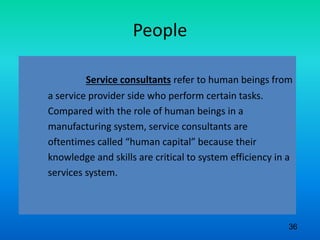
People
Service consultants refer to human beings from
a service provider side who perform certain tasks.
Compared with the role of human beings in a
manufacturing system, service consultants are
oftentimes called “human capital” because their
knowledge and skills are critical to system efficiency in a
services system.
36
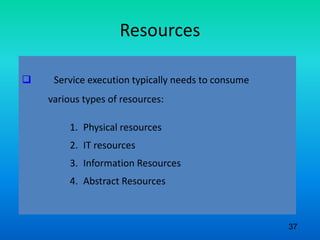
Resources
 Service execution typically needs to consume
various types of resources:
1. Physical resources
2. IT resources
3. Information Resources
4. Abstract Resources
37
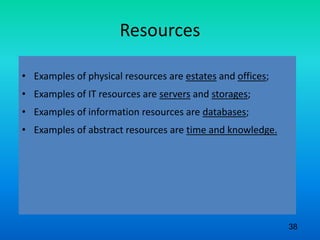
Resources
• Examples of physical resources are estates and offices;
• Examples of IT resources are servers and storages;
• Examples of information resources are databases;
• Examples of abstract resources are time and knowledge.
38
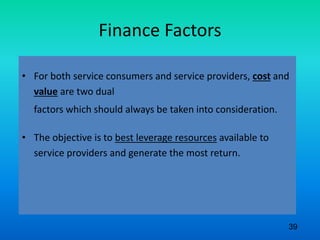
Finance Factors
• For both service consumers and service providers, cost and
value are two dual
factors which should always be taken into consideration.
• The objective is to best leverage resources available to
service providers and generate the most return.
39
Knowledge and Skills
• The degree of the ownership of knowledge and
mastering of unique skills (e.g., IT operation) often
differentiate a service provider from its competitors.
• In a service business unit, the employees should
continuously be trained to master up-to-date knowledge.
40
Assignment
• Explain the factors affecting the service life
cycle

Cloud computing 18 factors affecting service life cycle

  • 1.
    Cloud Computing: 18 Factorsaffecting the Service Life Cycle Prof Neeraj Bhargava Vaibhav Khanna Department of Computer Science School of Engineering and Systems Sciences Maharshi Dayanand Saraswati University Ajmer
  • 2.
    Key Factors ina Services Lifecycle  Seven Key Factors 1. Data and Information 2. Processes people 3. Resources 4. Finance factors 5. Knowledge 6. Skills 7. Innovation and Technology. 29
  • 3.
    Data/Information The output ofa business company is typically one of two things: either physical products/goods or business services, which can be fulfilled by manufacturing systems and services systems, respectively. 30
  • 4.
    Data/Information The difference betweena services system and a manufacturing system is that, services system is a “soft” system in that it may not produce “hard” products/goods as a manufacturing system typically does; instead, it generates valuable information or manipulates information and service resources to benefit service consumers. 31
  • 5.
    Data/Information When a customerrequests a service, a business object (e.g., an order) is usually submitted; when a service provider wants to charge the customer, a bill is presented containing detailed billing information. 32
  • 6.
    Processes • A servicessystem is typically comprised of business processes to fulfill business objectives. • A process usually contains a series of organized activities with regulated inputs and outputs, while chaining different roles together. • The efficiency of a business process highly depends on core competency of related service providers. • A process can also be further decomposed into sub- processes. 33
  • 7.
    People Business services typicallyrequire people involvement to leverage services, software, or other assets to deliver services to customers. Therefore, people are considered as one individual key factor in a services system. Two types of actors are identified: service customers and service consultants. 34
  • 8.
    People Service customers referto the end users of a services system, whose demands need to be fully understood by corresponding service providers. They are logically considered as an integral part of a services system in that they may influence the status and operations of the system through interactions. 35
  • 9.
    People Service consultants referto human beings from a service provider side who perform certain tasks. Compared with the role of human beings in a manufacturing system, service consultants are oftentimes called “human capital” because their knowledge and skills are critical to system efficiency in a services system. 36
  • 10.
    Resources  Service executiontypically needs to consume various types of resources: 1. Physical resources 2. IT resources 3. Information Resources 4. Abstract Resources 37
  • 11.
    Resources • Examples ofphysical resources are estates and offices; • Examples of IT resources are servers and storages; • Examples of information resources are databases; • Examples of abstract resources are time and knowledge. 38
  • 12.
    Finance Factors • Forboth service consumers and service providers, cost and value are two dual factors which should always be taken into consideration. • The objective is to best leverage resources available to service providers and generate the most return. 39
  • 13.
    Knowledge and Skills •The degree of the ownership of knowledge and mastering of unique skills (e.g., IT operation) often differentiate a service provider from its competitors. • In a service business unit, the employees should continuously be trained to master up-to-date knowledge. 40
  • 14.
    Assignment • Explain thefactors affecting the service life cycle