

Business  Research Methods Information Systems and Knowledge Management
Global Information System
Global Information System An organized collection of computer hardware, communication equipment,  software, data, and personnel designed to capture, store, update, manipulate, analyze, and immediately display information about worldwide business activities.
Data versus Information Data —the raw facts—record measures of certain phenomena which are necessary to provide Information —facts in a form suitable for managers to base decisions on.
Characteristics of Valuable Information Relevance Quality Timeliness Completeness
Decision Support System A computer-based system that helps decision makers confront problems through direct interaction with databases and analytical software programs.  The purpose of a decision support system is to store data and transform them into organized information that is easily accessible to marketing managers.
A Decision Support System  Has Two Components Database Software
Database A database is a collection of raw data arranged logically and organized in a form that can be stored and processed by a computer
Data Warehousing Information management term The process that allows information from operational systems to be stored and organized into separate systems designed for simple access
Customer Relationship Management (CRM) Bring together lots of pieces of information  customer profiles sales marketing effectiveness/responsiveness  market trends Provides the enterprise with a complete, dependable, and integrated view of its customer base.
Customer Relationship Management (CRM) Management, salespeople, customer service, and perhaps the customer can directly access information e.g. other products a customer has purchased match customer needs with satisfying product offerings remind customers of service requirements
Software Various types of programs that tell computers, printers, and other hardware  what to do Software allows managers to combine and restructure databases, diagnose relationships, build analytical models, estimate variables, and otherwise analyze the various databases
Business Intelligence The application of software tools to analyze data in extensive data warehouses to discover significant patterns and relationships.
Four Major Sources of Input For a Decision Support System Internal records Proprietary business research Business intelligence Outside vendors and external distributors
Internal Records Internal records that may become useful information for managers. Accounting reports of sales and inventory figures, provide considerable data. Data about costs, shipments, inventory, sales, and other aspects of regular operations are routinely collected and entered into the computer.
Outside Vendors And External Distributors Distributors of  market information as their products.  Many organizations specialize in the collection and publication of high-quality information.  e.g.  A. C. Nielsen Company provides television program ratings, audience counts.
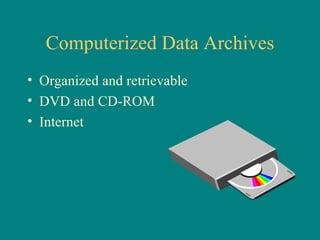
Computerized Data Archives Organized and retrievable DVD and CD-ROM Internet
On-line Database  Searching Systems DOW-JONES NEWS RETREVIAL Business Newsstand Historical Market Data Center EMERALD
Types Of Databases Bibliographic/text Statistical/geographic Financial Image and video
Proprietary  Research Emphasizes the company’s gathering of new data.  Not conducted regularly or continuously.  Projects conducted to study specific company problems.
Business Intelligence A business intelligence system consists of a network of sources and regular procedures by which executives obtain everyday information about nonrecurring developments in the external business environment.
Input Management Inputs - all numerical, text, voice, and image data entered into the decision support system
Electronic Data Interchange Electronic Data Interchange (EDI) is the term used when one company’s computer systems is integrated directly with another company’s proprietary computer system.
Internet A worldwide network of computers that allows users access to information and documents from distant sources. A combination of a worldwide communication system and the world’s largest library.
URL Uniform resource locator Web site address
World Wide Web (WWW) Graphic  interface 1000s of interconnected pages or documents
Selected Web Sites http:// www.brecorder.com http://www.businessweek.com http://www.adcritic.com http://www.ceoexpress.com http://www.sbp.gov.pk
Links Or Hyperlinks  Lead To Other Pages
Search Engine A computerized directory to search the WWW YAHOO -www.yahoo.com HOTBOT - www.hotbot.com GOOGLE - www.google.com DOGPILE - www.dogpile.com
Push Technology Smart agents Find information Do the searching for you Distribute it to desktop
Smart Agent Learns an individual user’s preferences Automatically searches out information Delivers information to the desktop
Cookies “ Magic cookies” Small computer files Provides saves onto the computer of someone who visits Tracks websites and files visited
Intranet Private data network Uses internet standards and technology Firewalls for security

Ch02

  • 1.
    Business ResearchMethods Information Systems and Knowledge Management
  • 2.
  • 3.
    Global Information SystemAn organized collection of computer hardware, communication equipment, software, data, and personnel designed to capture, store, update, manipulate, analyze, and immediately display information about worldwide business activities.
  • 4.
    Data versus InformationData —the raw facts—record measures of certain phenomena which are necessary to provide Information —facts in a form suitable for managers to base decisions on.
  • 5.
    Characteristics of ValuableInformation Relevance Quality Timeliness Completeness
  • 6.
    Decision Support SystemA computer-based system that helps decision makers confront problems through direct interaction with databases and analytical software programs. The purpose of a decision support system is to store data and transform them into organized information that is easily accessible to marketing managers.
  • 7.
    A Decision SupportSystem Has Two Components Database Software
  • 8.
    Database A databaseis a collection of raw data arranged logically and organized in a form that can be stored and processed by a computer
  • 9.
    Data Warehousing Informationmanagement term The process that allows information from operational systems to be stored and organized into separate systems designed for simple access
  • 10.
    Customer Relationship Management(CRM) Bring together lots of pieces of information customer profiles sales marketing effectiveness/responsiveness market trends Provides the enterprise with a complete, dependable, and integrated view of its customer base.
  • 11.
    Customer Relationship Management(CRM) Management, salespeople, customer service, and perhaps the customer can directly access information e.g. other products a customer has purchased match customer needs with satisfying product offerings remind customers of service requirements
  • 12.
    Software Various typesof programs that tell computers, printers, and other hardware what to do Software allows managers to combine and restructure databases, diagnose relationships, build analytical models, estimate variables, and otherwise analyze the various databases
  • 13.
    Business Intelligence Theapplication of software tools to analyze data in extensive data warehouses to discover significant patterns and relationships.
  • 14.
    Four Major Sourcesof Input For a Decision Support System Internal records Proprietary business research Business intelligence Outside vendors and external distributors
  • 15.
    Internal Records Internalrecords that may become useful information for managers. Accounting reports of sales and inventory figures, provide considerable data. Data about costs, shipments, inventory, sales, and other aspects of regular operations are routinely collected and entered into the computer.
  • 16.
    Outside Vendors AndExternal Distributors Distributors of market information as their products. Many organizations specialize in the collection and publication of high-quality information. e.g. A. C. Nielsen Company provides television program ratings, audience counts.
  • 17.
    Computerized Data ArchivesOrganized and retrievable DVD and CD-ROM Internet
  • 18.
    On-line Database Searching Systems DOW-JONES NEWS RETREVIAL Business Newsstand Historical Market Data Center EMERALD
  • 19.
    Types Of DatabasesBibliographic/text Statistical/geographic Financial Image and video
  • 20.
    Proprietary ResearchEmphasizes the company’s gathering of new data. Not conducted regularly or continuously. Projects conducted to study specific company problems.
  • 21.
    Business Intelligence Abusiness intelligence system consists of a network of sources and regular procedures by which executives obtain everyday information about nonrecurring developments in the external business environment.
  • 22.
    Input Management Inputs- all numerical, text, voice, and image data entered into the decision support system
  • 23.
    Electronic Data InterchangeElectronic Data Interchange (EDI) is the term used when one company’s computer systems is integrated directly with another company’s proprietary computer system.
  • 24.
    Internet A worldwidenetwork of computers that allows users access to information and documents from distant sources. A combination of a worldwide communication system and the world’s largest library.
  • 25.
    URL Uniform resourcelocator Web site address
  • 26.
    World Wide Web(WWW) Graphic interface 1000s of interconnected pages or documents
  • 27.
    Selected Web Siteshttp:// www.brecorder.com http://www.businessweek.com http://www.adcritic.com http://www.ceoexpress.com http://www.sbp.gov.pk
  • 28.
    Links Or Hyperlinks Lead To Other Pages
  • 29.
    Search Engine Acomputerized directory to search the WWW YAHOO -www.yahoo.com HOTBOT - www.hotbot.com GOOGLE - www.google.com DOGPILE - www.dogpile.com
  • 30.
    Push Technology Smartagents Find information Do the searching for you Distribute it to desktop
  • 31.
    Smart Agent Learnsan individual user’s preferences Automatically searches out information Delivers information to the desktop
  • 32.
    Cookies “ Magiccookies” Small computer files Provides saves onto the computer of someone who visits Tracks websites and files visited
  • 33.
    Intranet Private datanetwork Uses internet standards and technology Firewalls for security