CMU Summer Academy

Embodied Futures and Service
          Design
         June 23-25


          lpatric@fe.up.pt


                               1
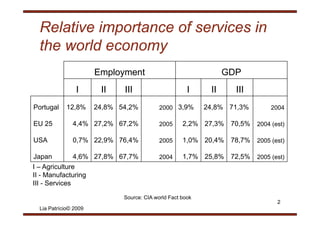
Relative importance of services in
 the world economy
                      Employment                                 GDP
                I      II    III                      I     II     III
Portugal    12,8%     24,8% 54,2%          2000 3,9%       24,8% 71,3%        2004

EU 25         4,4% 27,2% 67,2%             2005     2,2% 27,3% 70,5%     2004 (est)

USA           0,7% 22,9% 76,4%
              0 7% 22 9% 76 4%             2005     1,0% 20,4% 78,7%
                                                    1 0% 20 4% 78 7%     2005 ( t)
                                                                              (est)

Japan          4,6% 27,8% 67,7%            2004     1,7% 25,8% 72,5%     2005 (est)
I – A i lt
     Agriculture
II - Manufacturing
III - Services

                             Source: CIA world Fact book
                                                                                2
 Lia Patrício© 2009
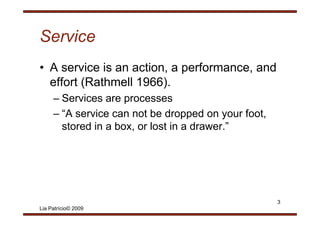
Service
• A service is an action, a performance, and
  effort (Rathmell 1966).
         (              )
     – Services are processes
     – “A service can not be dropped on your foot
        A                                     foot,
       stored in a box, or lost in a drawer.”


                                                      3
Lia Patrício© 2009
Categories of services
• P
  Pure t
       tangible product
           ibl     d t
    – salt, detergent, rice.
• T
  Tangible product with supplementary services
      ibl     d t ith       l    t        i
    – car, computer
• H b id product
  Hybrid    d t
    – Restaurants
• S i with a product component
  Service ith   d t          t
    – Air transportation
• Pure service
    – Health club, medical advice

                                                 4
Lia Patrício© 2009
Distinctive characteristics of
services
•   Intangibility
•   Simultaneity
•   Heterogeneity
•   Perishability


                                 5
Lia Patrício© 2009
Intangibility
• A service cannot be touched or put on a shelf,
  because they have no physical existence.
• This intangibility raises challenges for
  consumers in evaluating the service before
                            g
  consumption.
• The design of the physical evidence is crucial for
  a good service experience.
     – The look of a bank branch, display of degrees and
       certifications of medical doctors or lawyers,
       cleanliness of a restaurant.
                                                           6
Lia Patrício© 2009
Simultaneity between production
and consumption
• S i
  Services are consumed as th are
                          d    they
  produced (theater, class…)
• Frequently, the customer actively
  p
  participates in the p
         p            process, being na
                             ,      g
  important concreator of the service(ex:
  educat o )
  education).
• Service provision requires a high degree
  of interaction between the customer and
  the provider
                                             7
Lia Patrício© 2009
Heterogeneity
• Services result from the interaction
  beween people and other p p , or
           p p                people,
  people and the service environment.
• This interactive nature of service
  experience makes it more difficult to
  standardize services.


                                          8
Lia Patrício© 2009
Perishability
• S i
  Services cannot be stored f future
                   t b t d for f t
  consumption. (ex: seat in a plane or hotel
  rooms)
• Perishability raises importante challenges
              y          p               g
  for service management, requiring a
  st o g demand a age e t effort.
  strong de a d management e o t
• Some demand management strategies:
     – Differentiated prices, reservations
                      prices
     – Part-time workers,
                                               9
Lia Patrício© 2009
Distictive challenges posed to
Service design
• Services cannot be stored for future
  consumption
• The intangible elements frequently represent the
            g                   q      y p
  largest share in value co-creation
• Services are difficult to visualize and understand
• Customers play a crucial role in value co-
  creation
• Service inputs and outputs tend to vary more
• Time assumes is crucial for service
  management
• Service can be provided through virtual delivery
  channels                                         10
Lia Patrício© 2009
The 7 P’s of Services Marketing
      Ps
(Bitner e Booms 1981)

•   Product
•   Price
•   Promotion
•   Place
    Pl
• Participants
     – Service workers and customers who co create the
                                         co-create
       service.
• Physical evidence
    y
     – Service tangible aspects that facilitate communication
       and provision.
• Process of service delivery
     – Procedures and activity flows that contribute to the
       service provision.
               p
                                                              11
Lia Patrício© 2009
The importance of interaction
design in service design
• Service experiences
     – The service experience results from all the moments
       of contact (service encounters) between the customer
       and the firm.
• V l i use
  Value in
     – Value is no longer embbeded in physical offerings,
       but is
       b t i co-created th
                     t d through customer i t
                               h    t     interactions.
                                                 ti
• Implications for service design
     – Firms no longer design pre-determined services, but
       they offer value propositions, which customer turn into
       value th
          l through usage.
                    h
                                                            12
Lia Patrício© 2009
Service Systems
• Services are delivered by systems of
  p p , processes and p y
  people, p              physical evidence.

• All system components should b
         t             t h ld be
  integrated to enhace the service
  experience and value co-creation by the
  customer.


                                            13
Lia Patrício© 2009
Co-
Co-creation of value
• New service centered paradigm (Vargo and Lusch 2004)
     – Value is no longer embedded in tangible products, but is co-
       created by customers through interaction and usage.
     – Customers are always co creators of value and firms can only
                               co-creators value,
       offer value propositions.


• Service Systems (ifm and IBM 2008).
     – complex service systems involve multi-channel configurations of
       people and t h l
           l    d technology th t enable customers t co-create value.
                             that    bl      t     to         t    l


            What are the implications of value co-
                                               co
             creation for service system design?

                                                                      14
Lia Patrício© 2009
Service delivery systems
• “Co-creating configuration of resources,
  such as people, technology and
           p p ,           gy
  organizations, all connected internally and
  externally through value propositions” (ifm &
                           propositions
    IBM 2008)


                                              15
Lia Patrício© 2009
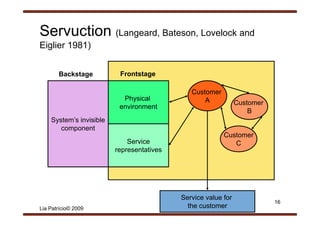
Se uc o ( g
Servuction (Langeard,, Bateson,, Lovelock and
Eiglier 1981)


       Backstage          Frontstage

                                              Customer
                           Physical               A            Customer
                          environment
                                                                   B
    System’s invisible
       component
                                                         Customer
                             Service                        C
                         representatives


                                           Service value for
                                                                          16
Lia Patrício© 2009                           the customer
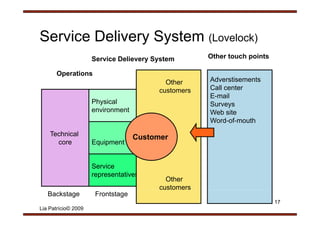
Service Delivery System (Lovelock)
                     Service Delievery System
                                     y y             Other touch points

      Operations
                                           Other     Adverstisements
                                         customers   Call center
                                                     E-mail
                     Physical                        Surveys
                     environment                     Web site
                                                     Word-of-mouth
    Technical                      Customer
      core           Equipment


                     Service
                     S i
                     representatives
                                           Other
                                         customers
   Backstage          Frontstage
                                                                          17
Lia Patrício© 2009
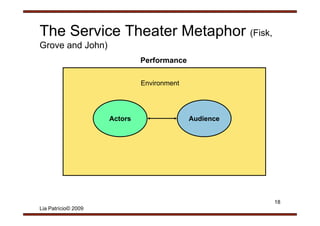
The Service Theater Metaphor (Fisk,,
  e Se ce ea e e ap o (
Grove and John)
                              Performance

                              Environment


                     Actors                 Audience


                                                       18
Lia Patrício© 2009

Embodied Futures and Service Design - Introduction

  • 1.
    CMU Summer Academy EmbodiedFutures and Service Design June 23-25 lpatric@fe.up.pt 1
  • 2.
    Relative importance ofservices in the world economy Employment GDP I II III I II III Portugal 12,8% 24,8% 54,2% 2000 3,9% 24,8% 71,3% 2004 EU 25 4,4% 27,2% 67,2% 2005 2,2% 27,3% 70,5% 2004 (est) USA 0,7% 22,9% 76,4% 0 7% 22 9% 76 4% 2005 1,0% 20,4% 78,7% 1 0% 20 4% 78 7% 2005 ( t) (est) Japan 4,6% 27,8% 67,7% 2004 1,7% 25,8% 72,5% 2005 (est) I – A i lt Agriculture II - Manufacturing III - Services Source: CIA world Fact book 2 Lia Patrício© 2009
  • 3.
    Service • A serviceis an action, a performance, and effort (Rathmell 1966). ( ) – Services are processes – “A service can not be dropped on your foot A foot, stored in a box, or lost in a drawer.” 3 Lia Patrício© 2009
  • 4.
    Categories of services •P Pure t tangible product ibl d t – salt, detergent, rice. • T Tangible product with supplementary services ibl d t ith l t i – car, computer • H b id product Hybrid d t – Restaurants • S i with a product component Service ith d t t – Air transportation • Pure service – Health club, medical advice 4 Lia Patrício© 2009
  • 5.
    Distinctive characteristics of services • Intangibility • Simultaneity • Heterogeneity • Perishability 5 Lia Patrício© 2009
  • 6.
    Intangibility • A servicecannot be touched or put on a shelf, because they have no physical existence. • This intangibility raises challenges for consumers in evaluating the service before g consumption. • The design of the physical evidence is crucial for a good service experience. – The look of a bank branch, display of degrees and certifications of medical doctors or lawyers, cleanliness of a restaurant. 6 Lia Patrício© 2009
  • 7.
    Simultaneity between production andconsumption • S i Services are consumed as th are d they produced (theater, class…) • Frequently, the customer actively p participates in the p p process, being na , g important concreator of the service(ex: educat o ) education). • Service provision requires a high degree of interaction between the customer and the provider 7 Lia Patrício© 2009
  • 8.
    Heterogeneity • Services resultfrom the interaction beween people and other p p , or p p people, people and the service environment. • This interactive nature of service experience makes it more difficult to standardize services. 8 Lia Patrício© 2009
  • 9.
    Perishability • S i Services cannot be stored f future t b t d for f t consumption. (ex: seat in a plane or hotel rooms) • Perishability raises importante challenges y p g for service management, requiring a st o g demand a age e t effort. strong de a d management e o t • Some demand management strategies: – Differentiated prices, reservations prices – Part-time workers, 9 Lia Patrício© 2009
  • 10.
    Distictive challenges posedto Service design • Services cannot be stored for future consumption • The intangible elements frequently represent the g q y p largest share in value co-creation • Services are difficult to visualize and understand • Customers play a crucial role in value co- creation • Service inputs and outputs tend to vary more • Time assumes is crucial for service management • Service can be provided through virtual delivery channels 10 Lia Patrício© 2009
  • 11.
    The 7 P’sof Services Marketing Ps (Bitner e Booms 1981) • Product • Price • Promotion • Place Pl • Participants – Service workers and customers who co create the co-create service. • Physical evidence y – Service tangible aspects that facilitate communication and provision. • Process of service delivery – Procedures and activity flows that contribute to the service provision. p 11 Lia Patrício© 2009
  • 12.
    The importance ofinteraction design in service design • Service experiences – The service experience results from all the moments of contact (service encounters) between the customer and the firm. • V l i use Value in – Value is no longer embbeded in physical offerings, but is b t i co-created th t d through customer i t h t interactions. ti • Implications for service design – Firms no longer design pre-determined services, but they offer value propositions, which customer turn into value th l through usage. h 12 Lia Patrício© 2009
  • 13.
    Service Systems • Servicesare delivered by systems of p p , processes and p y people, p physical evidence. • All system components should b t t h ld be integrated to enhace the service experience and value co-creation by the customer. 13 Lia Patrício© 2009
  • 14.
    Co- Co-creation of value •New service centered paradigm (Vargo and Lusch 2004) – Value is no longer embedded in tangible products, but is co- created by customers through interaction and usage. – Customers are always co creators of value and firms can only co-creators value, offer value propositions. • Service Systems (ifm and IBM 2008). – complex service systems involve multi-channel configurations of people and t h l l d technology th t enable customers t co-create value. that bl t to t l What are the implications of value co- co creation for service system design? 14 Lia Patrício© 2009
  • 15.
    Service delivery systems •“Co-creating configuration of resources, such as people, technology and p p , gy organizations, all connected internally and externally through value propositions” (ifm & propositions IBM 2008) 15 Lia Patrício© 2009
  • 16.
    Se uc o( g Servuction (Langeard,, Bateson,, Lovelock and Eiglier 1981) Backstage Frontstage Customer Physical A Customer environment B System’s invisible component Customer Service C representatives Service value for 16 Lia Patrício© 2009 the customer
  • 17.
    Service Delivery System(Lovelock) Service Delievery System y y Other touch points Operations Other Adverstisements customers Call center E-mail Physical Surveys environment Web site Word-of-mouth Technical Customer core Equipment Service S i representatives Other customers Backstage Frontstage 17 Lia Patrício© 2009
  • 18.
    The Service TheaterMetaphor (Fisk,, e Se ce ea e e ap o ( Grove and John) Performance Environment Actors Audience 18 Lia Patrício© 2009