PRESENTED BY– 
•Syed Mohammad Ibrahim Khalil 
www.tunespeak.us
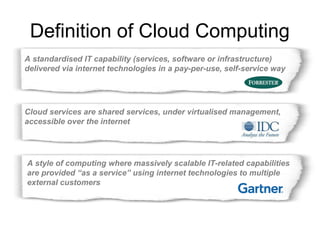
Definition of Cloud Computing 
A standardised IT capability (services, software or infrastructure) 
delivered via internet technologies in a pay-per-use, self-service way 
Cloud services are shared services, under virtualised management, 
accessible over the internet 
A style of computing where massively scalable IT-related capabilities 
are provided “as a service” using internet technologies to multiple 
external customers
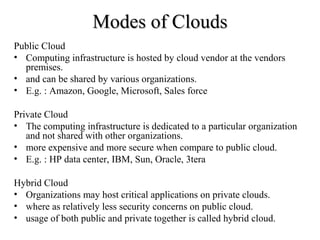
MMooddeess ooff CClloouuddss 
Public Cloud 
• Computing infrastructure is hosted by cloud vendor at the vendors 
premises. 
• and can be shared by various organizations. 
• E.g. : Amazon, Google, Microsoft, Sales force 
Private Cloud 
• The computing infrastructure is dedicated to a particular organization 
and not shared with other organizations. 
• more expensive and more secure when compare to public cloud. 
• E.g. : HP data center, IBM, Sun, Oracle, 3tera 
Hybrid Cloud 
• Organizations may host critical applications on private clouds. 
• where as relatively less security concerns on public cloud. 
• usage of both public and private together is called hybrid cloud.
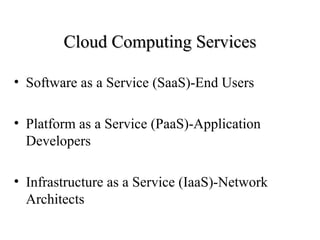
CClloouudd CCoommppuuttiinngg SSeerrvviicceess 
• Software as a Service (SaaS)-End Users 
• Platform as a Service (PaaS)-Application 
Developers 
• Infrastructure as a Service (IaaS)-Network 
Architects
CHARACTERISTICS OF CLOUD 
COMPUTING 
•Application programming interface. 
•Device and location independence. 
•Virtualization . 
•Reliability. 
•Maintenance . 
•Security . 
•Performance. 
•Agility.
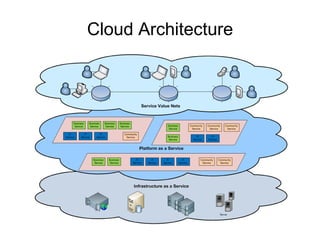
Cloud Architecture
Cloud Operating Systems 
• Eye OS 
• Amoeba OS 
• Glide OS 
• Start force 
• myGoya 
• CorneliOS 
• Lucid Desktop 
• Cloudo, Ghost, Zimdesk, Start force etc.,
BENEFITS OF CLOUD 
• Reduce spending on technology 
• Globalize your work force 
on the cheap 
• Reduce capital cost 
• Improve accessibility 
• Improve flexibility 
• Less personal training is needed 
• Monitor project more effectively 
• Achieve economic of scale
Disadvantages of Cloud Computing 
• Cloud computing is impossible if you cannot connect to the 
Internet. 
• Since you use the Internet to connect to both your applications 
and documents, if you do not have an Internet connection you 
cannot access anything, even your own documents. 
• A dead Internet connection means no work and in areas where 
Internet connections are few or inherently unreliable, this 
could be a deal-breaker. 
• When you are offline, cloud computing simply does not work.
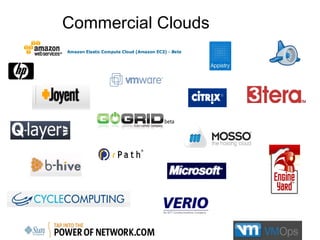
Commercial Clouds
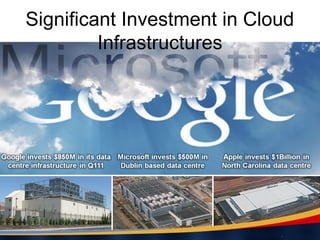
Significant Investment in Cloud 
Infrastructures 
.
Thanking You 
Queries?..

Cloud computing

  • 2.
    PRESENTED BY– •SyedMohammad Ibrahim Khalil www.tunespeak.us
  • 3.
    Definition of CloudComputing A standardised IT capability (services, software or infrastructure) delivered via internet technologies in a pay-per-use, self-service way Cloud services are shared services, under virtualised management, accessible over the internet A style of computing where massively scalable IT-related capabilities are provided “as a service” using internet technologies to multiple external customers
  • 4.
    MMooddeess ooff CClloouuddss Public Cloud • Computing infrastructure is hosted by cloud vendor at the vendors premises. • and can be shared by various organizations. • E.g. : Amazon, Google, Microsoft, Sales force Private Cloud • The computing infrastructure is dedicated to a particular organization and not shared with other organizations. • more expensive and more secure when compare to public cloud. • E.g. : HP data center, IBM, Sun, Oracle, 3tera Hybrid Cloud • Organizations may host critical applications on private clouds. • where as relatively less security concerns on public cloud. • usage of both public and private together is called hybrid cloud.
  • 5.
    CClloouudd CCoommppuuttiinngg SSeerrvviicceess • Software as a Service (SaaS)-End Users • Platform as a Service (PaaS)-Application Developers • Infrastructure as a Service (IaaS)-Network Architects
  • 6.
    CHARACTERISTICS OF CLOUD COMPUTING •Application programming interface. •Device and location independence. •Virtualization . •Reliability. •Maintenance . •Security . •Performance. •Agility.
  • 7.
  • 8.
    Cloud Operating Systems • Eye OS • Amoeba OS • Glide OS • Start force • myGoya • CorneliOS • Lucid Desktop • Cloudo, Ghost, Zimdesk, Start force etc.,
  • 9.
    BENEFITS OF CLOUD • Reduce spending on technology • Globalize your work force on the cheap • Reduce capital cost • Improve accessibility • Improve flexibility • Less personal training is needed • Monitor project more effectively • Achieve economic of scale
  • 10.
    Disadvantages of CloudComputing • Cloud computing is impossible if you cannot connect to the Internet. • Since you use the Internet to connect to both your applications and documents, if you do not have an Internet connection you cannot access anything, even your own documents. • A dead Internet connection means no work and in areas where Internet connections are few or inherently unreliable, this could be a deal-breaker. • When you are offline, cloud computing simply does not work.
  • 11.
  • 12.
    Significant Investment inCloud Infrastructures .
  • 13.

Editor's Notes

  • #4 Now I expect you could ask ten different people to provide a definition of what they think cloud computing is and I expect you would get ten completely different answers. So why would analyst firms be any different. Numerous definitions have been released over the last few years, here are just three of them. Even though technically these all describe a cloud environment very well, I believe that the quote from Forrester provides one of the most succinct definitions available today, namely A standardised IT capability (services, software or infrastructure) delivered via internet technologies in a pay per use, self service way.
  • #13 To support the expected growth in cloud computing adoption by both consumers and enterprises around the world, many leading software and IT companies are starting to build huge data centres around the world. Google investing nearly a billion dollars in its data centre infrastructure in the first quarter of 2011 alone, Microsoft investing half a billion in their European data centre in Dublin and Apple investing a billion dollars in a new data centre in North Carolina in the U.S. If rumours are to be believed then Apple built this particular data centre 50% bigger than it needed to be just to show its competitors that it has serious intentions of being one of the largest providers of cloud based environments in the world.