CLOUD BROADCASTING:
SERVICES AND SECURITY
CHALLENGES
WHAT IS CLOUD
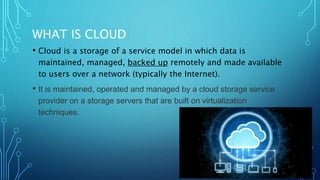
• Cloud is a storage of a service model in which data is
maintained, managed, backed up remotely and made available
to users over a network (typically the Internet).
• It is maintained, operated and managed by a cloud storage service
provider on a storage servers that are built on virtualization
techniques.
HISTORY OF CLOUD
• The concept came in the 1960s, and the model itself has matured from IBM's
use of virtualized mainframes with thin clients in the 1980s to the mid-2000s
• 1999: SALESFORCE.COM – delivery of applications via web
• 2002: Amazon web services (AWS)
• 2006: google docs, amazon elastic compute cloud(EC2)
• 2008: Eucalyptus
• 2009 Microsoft Azure
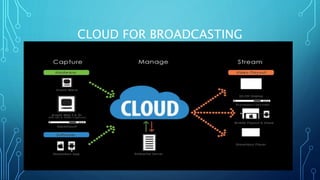
CLOUD FOR BROADCASTING
• Traditionally, video content transmission has been solely based on a baseband
service, in which multimedia data (program content) was transported across a
single channel, such as coaxial cable or satellite.
• Today, multimedia transmission is transitioning toward a broadband service,
in which multimedia data is transported across multiple channels of signals
and traffic types simultaneously
CLOUD FOR BROADCASTING
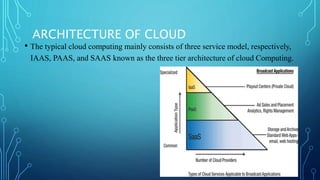
ARCHITECTURE OF CLOUD
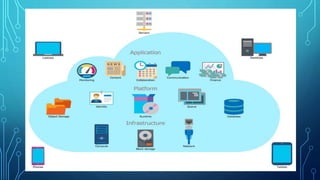
• The typical cloud computing mainly consists of three service model, respectively,
IAAS, PAAS, and SAAS known as the three tier architecture of cloud Computing.
ARCHITECTURE OF CLOUD BROADCASTING
• Software as a Service (SaaS):
--It offers renting application functionality from a service provider rather than
buying, installing and running software by the user.
• Platform as a Service (PaaS) :
--It provides a platform in the cloud, upon which applications can be developed
and executed.
• Infrastructure as a Service (IaaS) :
-- vendors offer computing power and storage space on demand
DEPLOYMENT MODEL
• Private cloud
--The cloud is managed by an organization and serve it solely.
• Public cloud
--The cloud infrastructure is owned and managed by a large Cloud Service Provider
(CSP).
• Community cloud
--The cloud is managed by several organizations and supports a specific community
that has the same interest.
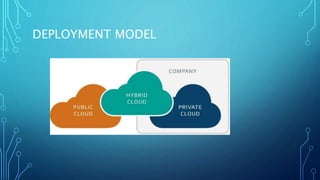
• Hybrid cloud
-- The cloud infrastructure is composed of two or more of the above models
DEPLOYMENT MODEL
NEED FOR CLOUD IN BROADCASTING
• Cloud provides virtually unlimited storage capacity.
• Cloud can support various activities such as transcoding, watermarking, metadata
and other value added services through end to end processing on an as needed
basis.
• Content delivery network performance options: it provides live streaming and on-
demand content in radio and television stations.
• New services can be provided far faster.
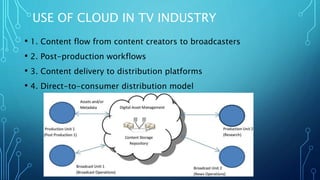
USE OF CLOUD IN TV INDUSTRY
• 1. Content flow from content creators to broadcasters
• 2. Post-production workflows
• 3. Content delivery to distribution platforms
• 4. Direct-to-consumer distribution model
• BEFEFITS OF CLOUD BROADCASTING
THERE ARE THREE KEY AREAS THAT STAND TO BENEFIT FROM CLOUD.
I. CONTENT PROVIDERS(E.G. BIG HOLLYWOOD STUDIOS)
II. BROADCASTERS(E.G. BBC)
III. PAY-TV OPERATORS(E.G. BSKYB)
CHALANGES OF CLOUD BROADCASTING
COMPLEXITY OF DELIVERING MULTIMEDIA CONTENT.
HIGHER BANDWIDTH REQUIREMENT FOR HIGH DEFINITION CONTENT DELIVERY.
NEED OF INTERNET READY MULTIMEDIA DEVICES.
MISREPRESENTATION DUE TO UNMATCHED HARDWARE.
WORKFLOW OF CLOUD BROADCAST
OPERATION
• The cloud facilitates greater collaboration throughout broadcast production and delivery
workflows.
• This workflow illustrates how users at different locations can join forces effectively, working
simultaneously and in parallel to fulfil an order or complete a project.
• In this case, media companies can maximize the value and efficiency of their staff by applying
the right talent to the right job.
• Or, when staff at one location is stressed, the company can prevent bottlenecks by bringing
person from other sites onboard.
• Tracking of media, metadata, users and projects from beginning to end, regardless of their
location, helps to ensure that content is finished and taken to air on schedule.
• These capabilities are not unique to the cloud, but it can be very difficult to achieve this agility
with “on-the-ground” software.
WORK FLOW CONTINUE
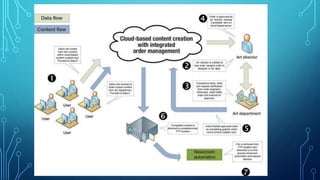
• As shown in figure users can create their own content within cloud based content creation
tool after which the complete content is delivered to a predetermined file transfer
protocol (FTP) location.
• This file is retrieved from FTP location and delivered to on-ground newsroom automation
and play out devices.
• Even users can choose to order custom content from art department.
• Art director is notified of new order and assign it to designer in art department.
• If any query is required then artist can request for clarification from order originator
otherwise artist fulfils order and submits for approval.
• This order approved by art director after viewing it on cloud based server. Thereafter
artist finishes approved order by completing graphics within cloud content creation tool.
• And again the complete content is delivered to a predetermined file transfer protocol
(FTP) location.
BASIC LEVEL SECURITY I
• SQL injection: It can be done by injecting the SQL commands into the database of
an application to crash the database.
• Man in the middle attack: This is another issue of network security that will happen
if secure socket layer (SSL) is not properly configured.
• Cross site scripting: It is a type of attack in which user enters right URL of a
website and hacker on the other site redirect the user to its own website and hack its
credentials.
NETWORK LEVEL SECURITY ISSUE
• DNS attacks: Domain hijacking: Domain hijacking is defined as changing the name of a domain
without the knowledge or permission from the domain’s owner or creator. This enable the
intruders to access the sensitive information
• Network Sniffing: Another type of attack is network sniffer, it is a more critical issue of network
security in which unencrypted data are hacked through network.
• IP spoofing:
DOS attack: When hackers overflows a network server or web server with frequent request of
services to damage the network, the denial of service cannot keep up with them, server could not
legitimate client regular requests.
APPLICATION LEVEL SECURITY ISSUE
• Cloud malware injection attack: In this attack a malicious virtual machine or a service implementation is injected into the
cloud system. one solution to prevent this is to perform the integrity check to the service instance.
• Cookie poisoning: In this an unauthorized access is made into the application by modifying the contents of the
cookie. One solution is to clean up the cookie or encrypt the cookie data.
• Backdoor and Debug Option: Debug option is for the developers who use it to implement any changes requested
at later stage in a website since these debug option provides back entry for the developers, sometimes these debug options
are left enabled unnoticed, they may provide easy access to the hackers and allow them to make changes in the website.
• Hidden Field Manipulation: Certain fields are hidden in the web-site and is used by the developers. Hacker can easily
modify on the web page
DATA LEVEL SECURITY ISSUE.
• Data Breach: 1.privacy
2. Integrity
• Data Lock in: Users may lose data if they migrate from one vendor to another vendor.
• Data Remanence: It is the residual representation of data that have been nominally erased or removed in some way.
• Data Recovery: Sometimes server may break down and cause damage or loss to users data. To avoid this, data should be backed up to be recovered in future
• Data Locality: In SAAS model of cloud environment, the user doesn’t know where the data is stored which may be an issue. The issue can be solved by creating secure
SAAS model which can provide reliability to the customer on the location of the data of the user.
CHALLENGES IN CLOUD BROADCASTING
• Security
• Multi-tenancy
• Service level agreement
• Common cloud Standards
• Server Consolidation
• Reliability & Availability of Service:

Cloud broadcasting and computing

  • 1.
  • 2.
    WHAT IS CLOUD •Cloud is a storage of a service model in which data is maintained, managed, backed up remotely and made available to users over a network (typically the Internet). • It is maintained, operated and managed by a cloud storage service provider on a storage servers that are built on virtualization techniques.
  • 4.
    HISTORY OF CLOUD •The concept came in the 1960s, and the model itself has matured from IBM's use of virtualized mainframes with thin clients in the 1980s to the mid-2000s • 1999: SALESFORCE.COM – delivery of applications via web • 2002: Amazon web services (AWS) • 2006: google docs, amazon elastic compute cloud(EC2) • 2008: Eucalyptus • 2009 Microsoft Azure
  • 5.
    CLOUD FOR BROADCASTING •Traditionally, video content transmission has been solely based on a baseband service, in which multimedia data (program content) was transported across a single channel, such as coaxial cable or satellite. • Today, multimedia transmission is transitioning toward a broadband service, in which multimedia data is transported across multiple channels of signals and traffic types simultaneously
  • 6.
  • 7.
    ARCHITECTURE OF CLOUD •The typical cloud computing mainly consists of three service model, respectively, IAAS, PAAS, and SAAS known as the three tier architecture of cloud Computing.
  • 8.
    ARCHITECTURE OF CLOUDBROADCASTING • Software as a Service (SaaS): --It offers renting application functionality from a service provider rather than buying, installing and running software by the user. • Platform as a Service (PaaS) : --It provides a platform in the cloud, upon which applications can be developed and executed. • Infrastructure as a Service (IaaS) : -- vendors offer computing power and storage space on demand
  • 9.
    DEPLOYMENT MODEL • Privatecloud --The cloud is managed by an organization and serve it solely. • Public cloud --The cloud infrastructure is owned and managed by a large Cloud Service Provider (CSP). • Community cloud --The cloud is managed by several organizations and supports a specific community that has the same interest. • Hybrid cloud -- The cloud infrastructure is composed of two or more of the above models
  • 10.
  • 11.
    NEED FOR CLOUDIN BROADCASTING • Cloud provides virtually unlimited storage capacity. • Cloud can support various activities such as transcoding, watermarking, metadata and other value added services through end to end processing on an as needed basis. • Content delivery network performance options: it provides live streaming and on- demand content in radio and television stations. • New services can be provided far faster.
  • 12.
    USE OF CLOUDIN TV INDUSTRY • 1. Content flow from content creators to broadcasters • 2. Post-production workflows • 3. Content delivery to distribution platforms • 4. Direct-to-consumer distribution model
  • 13.
    • BEFEFITS OFCLOUD BROADCASTING THERE ARE THREE KEY AREAS THAT STAND TO BENEFIT FROM CLOUD. I. CONTENT PROVIDERS(E.G. BIG HOLLYWOOD STUDIOS) II. BROADCASTERS(E.G. BBC) III. PAY-TV OPERATORS(E.G. BSKYB) CHALANGES OF CLOUD BROADCASTING COMPLEXITY OF DELIVERING MULTIMEDIA CONTENT. HIGHER BANDWIDTH REQUIREMENT FOR HIGH DEFINITION CONTENT DELIVERY. NEED OF INTERNET READY MULTIMEDIA DEVICES. MISREPRESENTATION DUE TO UNMATCHED HARDWARE.
  • 14.
    WORKFLOW OF CLOUDBROADCAST OPERATION • The cloud facilitates greater collaboration throughout broadcast production and delivery workflows. • This workflow illustrates how users at different locations can join forces effectively, working simultaneously and in parallel to fulfil an order or complete a project. • In this case, media companies can maximize the value and efficiency of their staff by applying the right talent to the right job. • Or, when staff at one location is stressed, the company can prevent bottlenecks by bringing person from other sites onboard. • Tracking of media, metadata, users and projects from beginning to end, regardless of their location, helps to ensure that content is finished and taken to air on schedule. • These capabilities are not unique to the cloud, but it can be very difficult to achieve this agility with “on-the-ground” software.
  • 16.
    WORK FLOW CONTINUE •As shown in figure users can create their own content within cloud based content creation tool after which the complete content is delivered to a predetermined file transfer protocol (FTP) location. • This file is retrieved from FTP location and delivered to on-ground newsroom automation and play out devices. • Even users can choose to order custom content from art department. • Art director is notified of new order and assign it to designer in art department. • If any query is required then artist can request for clarification from order originator otherwise artist fulfils order and submits for approval. • This order approved by art director after viewing it on cloud based server. Thereafter artist finishes approved order by completing graphics within cloud content creation tool. • And again the complete content is delivered to a predetermined file transfer protocol (FTP) location.
  • 17.
    BASIC LEVEL SECURITYI • SQL injection: It can be done by injecting the SQL commands into the database of an application to crash the database. • Man in the middle attack: This is another issue of network security that will happen if secure socket layer (SSL) is not properly configured. • Cross site scripting: It is a type of attack in which user enters right URL of a website and hacker on the other site redirect the user to its own website and hack its credentials.
  • 18.
    NETWORK LEVEL SECURITYISSUE • DNS attacks: Domain hijacking: Domain hijacking is defined as changing the name of a domain without the knowledge or permission from the domain’s owner or creator. This enable the intruders to access the sensitive information • Network Sniffing: Another type of attack is network sniffer, it is a more critical issue of network security in which unencrypted data are hacked through network. • IP spoofing: DOS attack: When hackers overflows a network server or web server with frequent request of services to damage the network, the denial of service cannot keep up with them, server could not legitimate client regular requests.
  • 19.
    APPLICATION LEVEL SECURITYISSUE • Cloud malware injection attack: In this attack a malicious virtual machine or a service implementation is injected into the cloud system. one solution to prevent this is to perform the integrity check to the service instance. • Cookie poisoning: In this an unauthorized access is made into the application by modifying the contents of the cookie. One solution is to clean up the cookie or encrypt the cookie data. • Backdoor and Debug Option: Debug option is for the developers who use it to implement any changes requested at later stage in a website since these debug option provides back entry for the developers, sometimes these debug options are left enabled unnoticed, they may provide easy access to the hackers and allow them to make changes in the website. • Hidden Field Manipulation: Certain fields are hidden in the web-site and is used by the developers. Hacker can easily modify on the web page
  • 20.
    DATA LEVEL SECURITYISSUE. • Data Breach: 1.privacy 2. Integrity • Data Lock in: Users may lose data if they migrate from one vendor to another vendor. • Data Remanence: It is the residual representation of data that have been nominally erased or removed in some way. • Data Recovery: Sometimes server may break down and cause damage or loss to users data. To avoid this, data should be backed up to be recovered in future • Data Locality: In SAAS model of cloud environment, the user doesn’t know where the data is stored which may be an issue. The issue can be solved by creating secure SAAS model which can provide reliability to the customer on the location of the data of the user.
  • 21.
    CHALLENGES IN CLOUDBROADCASTING • Security • Multi-tenancy • Service level agreement • Common cloud Standards • Server Consolidation • Reliability & Availability of Service: