Peer Learning Activity
Task Force
Diversity and Inclusion
22nd of October 2021
▪
▪
▪
▪
▪
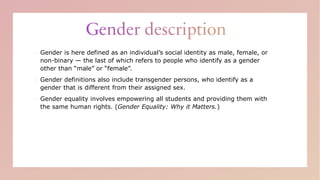
▪ Gender is here defined as an individual’s social identity as male, female, or
non-binary — the last of which refers to people who identify as a gender
other than “male” or “female”.
▪ Gender definitions also include transgender persons, who identify as a
gender that is different from their assigned sex.
▪ Gender equality involves empowering all students and providing them with
the same human rights. (Gender Equality: Why it Matters.)
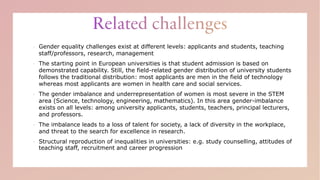
▪ Gender equality challenges exist at different levels: applicants and students, teaching
staff/professors, research, management
▪ The starting point in European universities is that student admission is based on
demonstrated capability. Still, the field-related gender distribution of university students
follows the traditional distribution: most applicants are men in the field of technology
whereas most applicants are women in health care and social services.
▪ The gender imbalance and underrepresentation of women is most severe in the STEM
area (Science, technology, engineering, mathematics). In this area gender-imbalance
exists on all levels: among university applicants, students, teachers, principal lecturers,
and professors.
▪ The imbalance leads to a loss of talent for society, a lack of diversity in the workplace,
and threat to the search for excellence in research.
▪ Structural reproduction of inequalities in universities: e.g. study counselling, attitudes of
teaching staff, recruitment and career progression
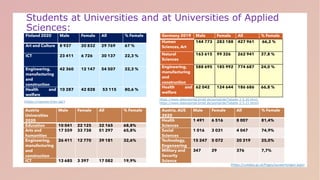
Students at Universities and at Universities of Applied
Sciences:
Finland 2020 Male Female All % Female
Art and Culture 8 937 20 832 29 769 67 %
ICT 23 411 6 726 30 137 22,3 %
Engineering,
manufacturing
and
construction
42 360 12 147 54 507 22,3 %
Health and
welfare
10 287 42 828 53 115 80,6 %
Germany 2019 Male Female All % Female
Human
Sciences, Art
144 773 283 188 427 961 66,2 %
Natural
Sciences
163 615 99 326 262 941 37,8 %
Engineering,
manufacturing
and
construction
588 695 185 992 774 687 24,0 %
Health and
welfare
62 042 124 644 186 686 66,8 %
Austria
Universities
2020
Male Female All % Female
Education 10 041 22 125 32 165 68,8%
Arts and
humanities
17 559 33 738 51 297 65,8%
Engineering,
manufacturing
and
construction
26 411 12 770 39 181 32,6%
ICT 13 685 3 397 17 082 19,9%
Austria, AUS
2020
Male Female All % Female
Health
Sciences
1 491 6 516 8 007 81,4%
Social
Sciences
1 016 3 031 4 047 74,9%
Technology,
Engeneering
15 247 5 072 20 319 25,0%
Military and
Security
Science
347 29 376 7,7%
https://www.datenportal.bmbf.de/portal/de/Tabelle-2.5.20.html,
https://www.datenportal.bmbf.de/portal/de/Tabelle-2.5.21.html)
(https://vipunen.fi/en-gb/)
(https://unidata.gv.at/Pages/auswertungen.aspx)
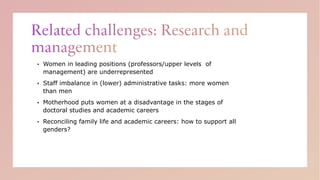
▪ Women in leading positions (professors/upper levels of
management) are underrepresented
▪ Staff imbalance in (lower) administrative tasks: more women
than men
▪ Motherhood puts women at a disadvantage in the stages of
doctoral studies and academic careers
▪ Reconciling family life and academic careers: how to support all
genders?
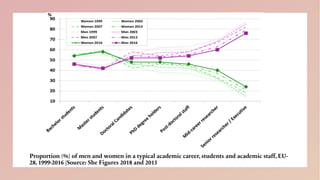
Proportion (%) of men and women in a typical academic career, students and academic staff, EU-
28, 1999-2016 |Source: She Figures 2018 and 2015
▪
▪
▪
▪
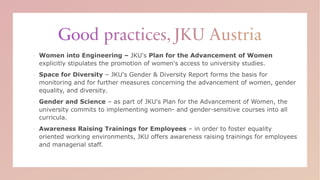
▪ Gender equality is a central development objective of the FernUniversity in
Hagen, Germany, and is considered an issue of shared and social responsibility
based on a legal framework involving all areas of the university.
▪ The university has developed several instruments to implement gender equality in
the last years, among them the central gender equality plan, which applies to the
whole university as well as gender equality plans for the faculties and units.
▪ Moreover, FernUniversity has a Gender Equality Concept.
▪ All universities in Finland are required to have a written equality and non-
discrimination plan.
▪ Tampere University of Applied Sciences (TAMK) has an equality plan that describes
the equality situation at TAMK and measures to promote staff’s and students’
equality.
▪ TAMK leads a nation-wide project Equal Career Paths for Women – NOW! which
aims to support and promote equal employment and career development for women.
▪ TAMK’s project Naistech encourages girls in secondary and upper-secondary
education to take an open-minded approach to technology studies at university level.
▪ Individual projects may improve and have improved gender balance
and awareness in some measure, but…
▪ In order to address structural reproduction of inequalities, it is crucial
to identify and act upon the mechanisms that need to be changed.

Task Force Diversity and Inclusion PLA - Gender

  • 1.
    Peer Learning Activity TaskForce Diversity and Inclusion 22nd of October 2021
  • 2.
  • 3.
    ▪ Gender ishere defined as an individual’s social identity as male, female, or non-binary — the last of which refers to people who identify as a gender other than “male” or “female”. ▪ Gender definitions also include transgender persons, who identify as a gender that is different from their assigned sex. ▪ Gender equality involves empowering all students and providing them with the same human rights. (Gender Equality: Why it Matters.)
  • 4.
    ▪ Gender equalitychallenges exist at different levels: applicants and students, teaching staff/professors, research, management ▪ The starting point in European universities is that student admission is based on demonstrated capability. Still, the field-related gender distribution of university students follows the traditional distribution: most applicants are men in the field of technology whereas most applicants are women in health care and social services. ▪ The gender imbalance and underrepresentation of women is most severe in the STEM area (Science, technology, engineering, mathematics). In this area gender-imbalance exists on all levels: among university applicants, students, teachers, principal lecturers, and professors. ▪ The imbalance leads to a loss of talent for society, a lack of diversity in the workplace, and threat to the search for excellence in research. ▪ Structural reproduction of inequalities in universities: e.g. study counselling, attitudes of teaching staff, recruitment and career progression
  • 5.
    Students at Universitiesand at Universities of Applied Sciences: Finland 2020 Male Female All % Female Art and Culture 8 937 20 832 29 769 67 % ICT 23 411 6 726 30 137 22,3 % Engineering, manufacturing and construction 42 360 12 147 54 507 22,3 % Health and welfare 10 287 42 828 53 115 80,6 % Germany 2019 Male Female All % Female Human Sciences, Art 144 773 283 188 427 961 66,2 % Natural Sciences 163 615 99 326 262 941 37,8 % Engineering, manufacturing and construction 588 695 185 992 774 687 24,0 % Health and welfare 62 042 124 644 186 686 66,8 % Austria Universities 2020 Male Female All % Female Education 10 041 22 125 32 165 68,8% Arts and humanities 17 559 33 738 51 297 65,8% Engineering, manufacturing and construction 26 411 12 770 39 181 32,6% ICT 13 685 3 397 17 082 19,9% Austria, AUS 2020 Male Female All % Female Health Sciences 1 491 6 516 8 007 81,4% Social Sciences 1 016 3 031 4 047 74,9% Technology, Engeneering 15 247 5 072 20 319 25,0% Military and Security Science 347 29 376 7,7% https://www.datenportal.bmbf.de/portal/de/Tabelle-2.5.20.html, https://www.datenportal.bmbf.de/portal/de/Tabelle-2.5.21.html) (https://vipunen.fi/en-gb/) (https://unidata.gv.at/Pages/auswertungen.aspx)
  • 6.
    ▪ Women inleading positions (professors/upper levels of management) are underrepresented ▪ Staff imbalance in (lower) administrative tasks: more women than men ▪ Motherhood puts women at a disadvantage in the stages of doctoral studies and academic careers ▪ Reconciling family life and academic careers: how to support all genders?
  • 7.
    Proportion (%) ofmen and women in a typical academic career, students and academic staff, EU- 28, 1999-2016 |Source: She Figures 2018 and 2015
  • 8.
  • 9.
    ▪ Gender equalityis a central development objective of the FernUniversity in Hagen, Germany, and is considered an issue of shared and social responsibility based on a legal framework involving all areas of the university. ▪ The university has developed several instruments to implement gender equality in the last years, among them the central gender equality plan, which applies to the whole university as well as gender equality plans for the faculties and units. ▪ Moreover, FernUniversity has a Gender Equality Concept.
  • 10.
    ▪ All universitiesin Finland are required to have a written equality and non- discrimination plan. ▪ Tampere University of Applied Sciences (TAMK) has an equality plan that describes the equality situation at TAMK and measures to promote staff’s and students’ equality. ▪ TAMK leads a nation-wide project Equal Career Paths for Women – NOW! which aims to support and promote equal employment and career development for women. ▪ TAMK’s project Naistech encourages girls in secondary and upper-secondary education to take an open-minded approach to technology studies at university level.
  • 11.
    ▪ Individual projectsmay improve and have improved gender balance and awareness in some measure, but… ▪ In order to address structural reproduction of inequalities, it is crucial to identify and act upon the mechanisms that need to be changed.