ClO2 Dosing For ETP UF & RO
Prepared By: Anirban Mahanta
anirbanmahanta@gmail.com
1
 Chlorine Dioxide is a greenish-yellow gas and is a single-electron-
transfer oxidizing agent with a chlorine-like odor.
 Pure chlorine dioxide is an unstable gas and therefore is generated as
needed
 Although chlorine dioxide has "chlorine" in its name, its chemistry is
radically different from that of chlorine. When reacting with other
substances, it is weaker and more selective.
 Chemical Formula: ClO2
 Molecular Weight: 67.45 g/mole
 Melting Point (°C): -59
 Boiling Point (°C): +11
 Density: 2.4 times that of air
2
Introduction:
Physical & Chemical Characteristics:
 The chemical formula is ClO2
 A highly soluble gas in water
 Exhibits a yellow color, which can be used in
quantitative analysis.
 It has an odor similar to chlorine
 Selective Oxidation / Rapid Reaction
 Effective over wide pH range (2-10)
 Volatile in nature
 5 NaClO2 + 4 HCl → 5 NaCl + 4 ClO2 + 2 H2O
3
Antimicrobial Activity of ClO2:
Chlorine dioxide (ClO2) acts as an oxidizing agent "steal"
electrons from the cell membrane (oxidation), it breaks their
molecular bonds, resulting in the death of the organism by the
break up of the cellClO2 destroy the enzymatic action of
microbes, causing very rapid bacterial kills. The potency of
chlorine dioxide is attributable to the simultaneous, oxidative
attack on many proteins thereby preventing the cells from
mutating to a resistant form. Additionally, because of the lower
reactivity of chlorine dioxide, its antimicrobial action is
retained longer in the presence of organic matter.
4
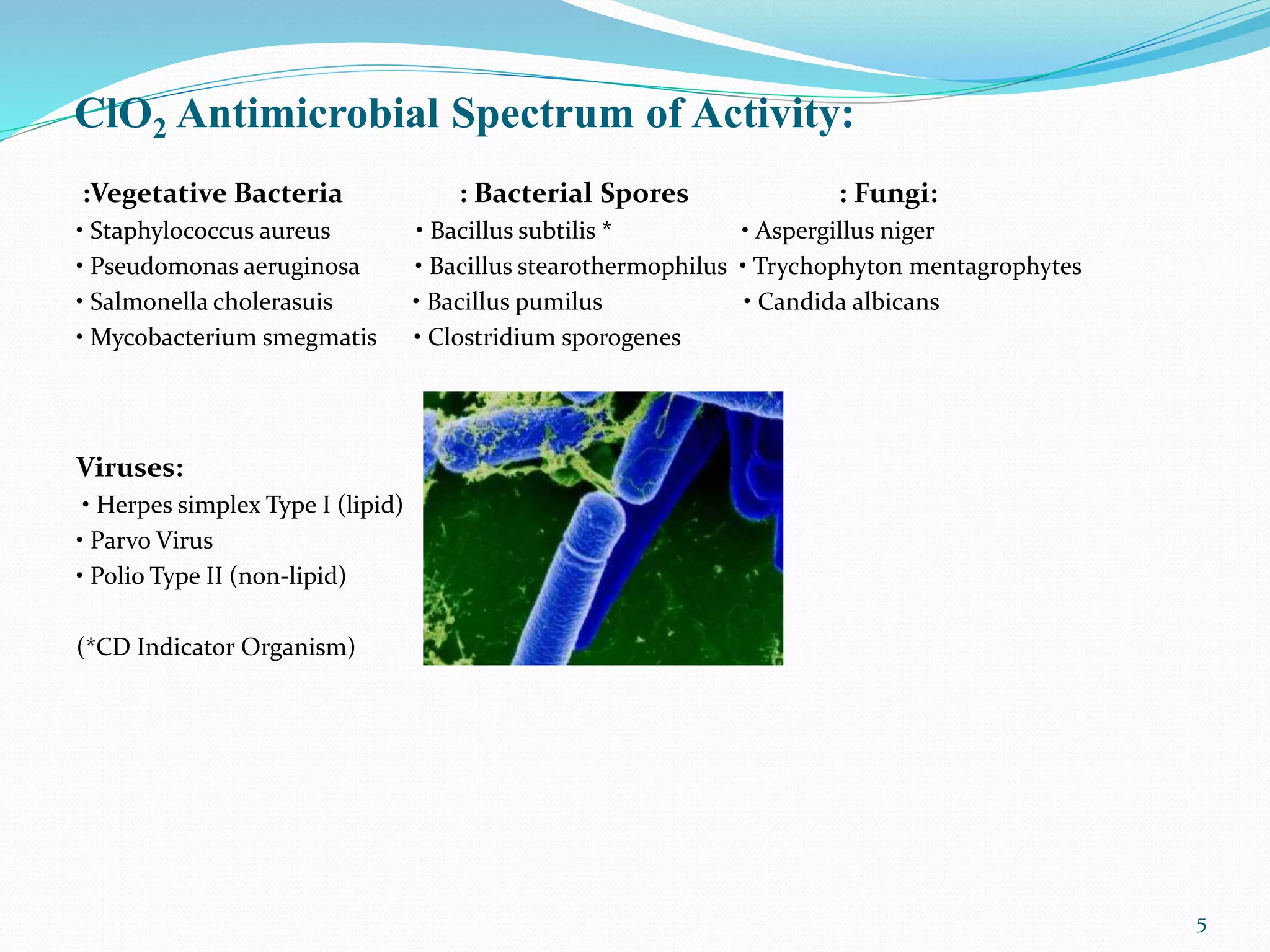
ClO2 Antimicrobial Spectrum of Activity:
:Vegetative Bacteria : Bacterial Spores : Fungi:
• Staphylococcus aureus • Bacillus subtilis * • Aspergillus niger
• Pseudomonas aeruginosa • Bacillus stearothermophilus • Trychophyton mentagrophytes
• Salmonella cholerasuis • Bacillus pumilus • Candida albicans
• Mycobacterium smegmatis • Clostridium sporogenes
Viruses:
• Herpes simplex Type I (lipid)
• Parvo Virus
• Polio Type II (non-lipid)
(*CD Indicator Organism)
5
ClO2 Installation At WTP:
6
 The CLO2 generator installed at UBL-Kalyani has the capacity of 120 gm/Hr.
 In 1 hrs 1lit of 9% HCl and Sodium chlorite produce 40gm of CLO2.
 3Lit/hr dosing pump is available for both HCl and Sodium Chlorite which
transfer both to CLO2 Reactor .
 1Kl/hr Water passes from bypass water which absorb CLO2 from the reactor
through the NRV.
 This CLO2 mixed with water is stored at a intermediate tank from where CLO2
is dosed to processed water as per requirement.
 ORP sensor is attached to water line which sense the presence of CLO2 in
terms of milli volt.
 410mV= 0.1 ppm CLO2 and 750mV= 0.2 ppm CLO2.
 450 to 550 mV of CLO2 is required to sanitized water.
 Calculation to measure ppm to be dosed= gm/hr
kl/hr
7
Operation Procedure:
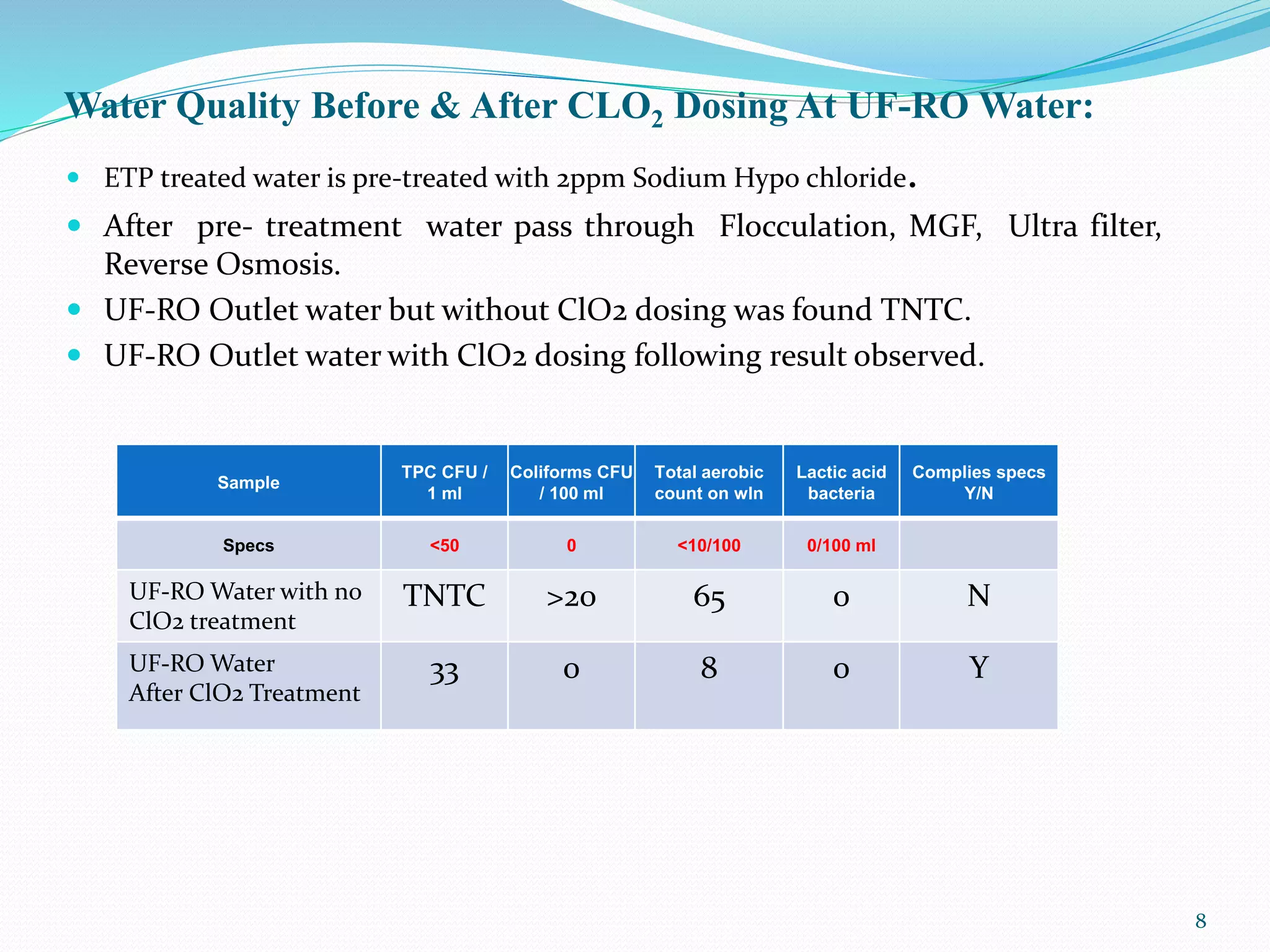
Water Quality Before & After CLO2 Dosing At UF-RO Water:
 ETP treated water is pre-treated with 2ppm Sodium Hypo chloride.
 After pre- treatment water pass through Flocculation, MGF, Ultra filter,
Reverse Osmosis.
 UF-RO Outlet water but without ClO2 dosing was found TNTC.
 UF-RO Outlet water with ClO2 dosing following result observed.
Sample
TPC CFU /
1 ml
Coliforms CFU
/ 100 ml
Total aerobic
count on wln
Lactic acid
bacteria
Complies specs
Y/N
Specs <50 0 <10/100 0/100 ml
UF-RO Water with no
ClO2 treatment
TNTC >20 65 0 N
UF-RO Water
After ClO2 Treatment
33 0 8 0 Y
8
HSE Guideline for Safe Handling of ClO2:
 STORAGE: Store aqueous solution in a cool, dry environment in suitable storage
containers. Containers should be UV protected.
 LARGE SPILL: Isolate hazard area and deny entry to unnecessary or unprotected
personnel. Ventilate area of spill or leak. Remove gas with a fine water spray. Stop leak
with Wearing a self-contained breathing apparatus. Contain spilled liquid with sand or
earth. Place in a disposal container. Avoid runoff into storm sewers and ditches that lead
to waterways.
 Never discharge directly into a lake, pond, stream, river, or other natural body of water.
 SMALL SPILL: Rinse with large amounts of water..
 HANDLING: Wear appropriate protective clothing. Avoid prolonged contact with skin
and clothing. Avoid breathing vapors. Wash with soap and water after handling
 RESPIRATORY PROTECTION: Use general room ventilation or local exhaust ventilation
to keep airborne exposure .
 SKIN PROTECTION: Wear impervious gloves, boots and apron. .
 EYE PROTECTION: Always wear safety glasses with side shields or a full face shield.
9
THANK YOU
10

Clo2 use in water treatment

  • 1.
    ClO2 Dosing ForETP UF & RO Prepared By: Anirban Mahanta anirbanmahanta@gmail.com 1
  • 2.
     Chlorine Dioxideis a greenish-yellow gas and is a single-electron- transfer oxidizing agent with a chlorine-like odor.  Pure chlorine dioxide is an unstable gas and therefore is generated as needed  Although chlorine dioxide has "chlorine" in its name, its chemistry is radically different from that of chlorine. When reacting with other substances, it is weaker and more selective.  Chemical Formula: ClO2  Molecular Weight: 67.45 g/mole  Melting Point (°C): -59  Boiling Point (°C): +11  Density: 2.4 times that of air 2 Introduction:
  • 3.
    Physical & ChemicalCharacteristics:  The chemical formula is ClO2  A highly soluble gas in water  Exhibits a yellow color, which can be used in quantitative analysis.  It has an odor similar to chlorine  Selective Oxidation / Rapid Reaction  Effective over wide pH range (2-10)  Volatile in nature  5 NaClO2 + 4 HCl → 5 NaCl + 4 ClO2 + 2 H2O 3
  • 4.
    Antimicrobial Activity ofClO2: Chlorine dioxide (ClO2) acts as an oxidizing agent "steal" electrons from the cell membrane (oxidation), it breaks their molecular bonds, resulting in the death of the organism by the break up of the cellClO2 destroy the enzymatic action of microbes, causing very rapid bacterial kills. The potency of chlorine dioxide is attributable to the simultaneous, oxidative attack on many proteins thereby preventing the cells from mutating to a resistant form. Additionally, because of the lower reactivity of chlorine dioxide, its antimicrobial action is retained longer in the presence of organic matter. 4
  • 5.
    ClO2 Antimicrobial Spectrumof Activity: :Vegetative Bacteria : Bacterial Spores : Fungi: • Staphylococcus aureus • Bacillus subtilis * • Aspergillus niger • Pseudomonas aeruginosa • Bacillus stearothermophilus • Trychophyton mentagrophytes • Salmonella cholerasuis • Bacillus pumilus • Candida albicans • Mycobacterium smegmatis • Clostridium sporogenes Viruses: • Herpes simplex Type I (lipid) • Parvo Virus • Polio Type II (non-lipid) (*CD Indicator Organism) 5
  • 6.
  • 7.
     The CLO2generator installed at UBL-Kalyani has the capacity of 120 gm/Hr.  In 1 hrs 1lit of 9% HCl and Sodium chlorite produce 40gm of CLO2.  3Lit/hr dosing pump is available for both HCl and Sodium Chlorite which transfer both to CLO2 Reactor .  1Kl/hr Water passes from bypass water which absorb CLO2 from the reactor through the NRV.  This CLO2 mixed with water is stored at a intermediate tank from where CLO2 is dosed to processed water as per requirement.  ORP sensor is attached to water line which sense the presence of CLO2 in terms of milli volt.  410mV= 0.1 ppm CLO2 and 750mV= 0.2 ppm CLO2.  450 to 550 mV of CLO2 is required to sanitized water.  Calculation to measure ppm to be dosed= gm/hr kl/hr 7 Operation Procedure:
  • 8.
    Water Quality Before& After CLO2 Dosing At UF-RO Water:  ETP treated water is pre-treated with 2ppm Sodium Hypo chloride.  After pre- treatment water pass through Flocculation, MGF, Ultra filter, Reverse Osmosis.  UF-RO Outlet water but without ClO2 dosing was found TNTC.  UF-RO Outlet water with ClO2 dosing following result observed. Sample TPC CFU / 1 ml Coliforms CFU / 100 ml Total aerobic count on wln Lactic acid bacteria Complies specs Y/N Specs <50 0 <10/100 0/100 ml UF-RO Water with no ClO2 treatment TNTC >20 65 0 N UF-RO Water After ClO2 Treatment 33 0 8 0 Y 8
  • 9.
    HSE Guideline forSafe Handling of ClO2:  STORAGE: Store aqueous solution in a cool, dry environment in suitable storage containers. Containers should be UV protected.  LARGE SPILL: Isolate hazard area and deny entry to unnecessary or unprotected personnel. Ventilate area of spill or leak. Remove gas with a fine water spray. Stop leak with Wearing a self-contained breathing apparatus. Contain spilled liquid with sand or earth. Place in a disposal container. Avoid runoff into storm sewers and ditches that lead to waterways.  Never discharge directly into a lake, pond, stream, river, or other natural body of water.  SMALL SPILL: Rinse with large amounts of water..  HANDLING: Wear appropriate protective clothing. Avoid prolonged contact with skin and clothing. Avoid breathing vapors. Wash with soap and water after handling  RESPIRATORY PROTECTION: Use general room ventilation or local exhaust ventilation to keep airborne exposure .  SKIN PROTECTION: Wear impervious gloves, boots and apron. .  EYE PROTECTION: Always wear safety glasses with side shields or a full face shield. 9
  • 10.