Slide 1
Cl2 vs. ClO2
Slide 2
ClO2 vs. Cl2 for Biofilm Control:
What the literature says about
Cl2 for control of biofilm.
Cl2 for Biofilm Control
Slide 3
Hypochlorite ion is so reactive with the
biofilm constituents that it is effectively
removed by reaction before it can
penetrate the biofilm
Boivin, J. W., Shapka, R., Khoury, A. E., Blenkinsopp, S.,
and Costerton, J. W., "An Old and a New Method of
Control for Biofilm Bacteria," Paper No 171, Corrosion 92.
Cl2 for Biofilm Control
Slide 4
Chlorine does not penetrate
well into a biofilm
Chen, X., and Stewart, P., “Chlorine Penetration into
Artificial Biofilm is Limited by a Reaction-Diffusion
Interaction,” Environmental Science & Technology 30(6),
2078(1996).
Cl2 for Biofilm Control
Slide 5
Cells in biofilms are protected from
biocide action and are killed only at
biocide concentrations orders of
magnitude higher than that necessary
to kill suspended cells
de Beer, D., Srinivasan, R., and Stewart, P., “Direct
Measurement of Chlorine Penetration into Biofilms during
Disinfection,” Applied Environmental Microbiology, 60(12),
4339(1994).
Cl2 for Biofilm Control
Slide 6
1 - 2 ppm free chlorine does not
prevent the growth of biofilms
Nagy, L. A. et. al., “Biofilm Composition, Formation and
Control in the Los Angeles Aqueduct System,” Proc.
1982 AWWA WQTC, Nashville, Tenn.
Cl2 for Biofilm Control
Slide 7
Coliforms were recovered from a
potable water supply one week after
scrubbing a redwood tank with a 200
ppm chlorine solution
Seidler, R., Morrow, J., and Bagley, S., “Klebsielleae in
Drinking Water Emanating From Redwood Tanks,”
Applied Environmental Microbiology, 33, 893(1977).
Cl2 for Biofilm Control
Slide 8
It is not possible to clean up a biofouled system
simply by resuming a discontinued
microbiological control program. A fully
developed biofilm can be removed only through
intensified on-line or off-line treatment
Kozelski, K. J., “Field Experience with a Simple Cooling
Water Biofilm Monitoring Device,” TP IWC-83-46,
International Water Conference, Pittsburgh, PA, October
24-26, 1983.
Cl2 for Biofilm Control
Slide 9
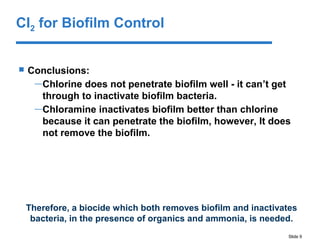
 Conclusions:
—Chlorine does not penetrate biofilm well - it can’t get
through to inactivate biofilm bacteria.
—Chloramine inactivates biofilm better than chlorine
because it can penetrate the biofilm, however, It does
not remove the biofilm.
Therefore, a biocide which both removes biofilm and inactivates
bacteria, in the presence of organics and ammonia, is needed.
Cl2 for Biofilm Control
Slide 10
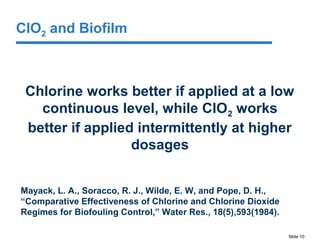
ClO2 and Biofilm
Chlorine works better if applied at a low
continuous level, while ClO2 works
better if applied intermittently at higher
dosages
Mayack, L. A., Soracco, R. J., Wilde, E. W, and Pope, D. H.,
“Comparative Effectiveness of Chlorine and Chlorine Dioxide
Regimes for Biofouling Control,” Water Res., 18(5),593(1984).
Slide 11
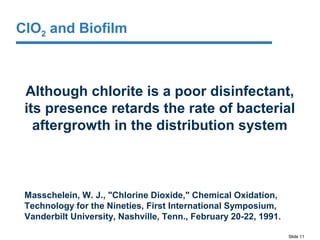
Although chlorite is a poor disinfectant,
its presence retards the rate of bacterial
aftergrowth in the distribution system
Masschelein, W. J., "Chlorine Dioxide," Chemical Oxidation,
Technology for the Nineties, First International Symposium,
Vanderbilt University, Nashville, Tenn., February 20-22, 1991.
ClO2 and Biofilm
Slide 12
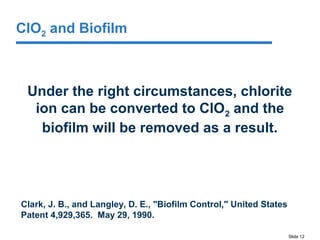
Under the right circumstances, chlorite
ion can be converted to ClO2 and the
biofilm will be removed as a result.
Clark, J. B., and Langley, D. E., "Biofilm Control," United States
Patent 4,929,365. May 29, 1990.
ClO2 and Biofilm
Slide 13
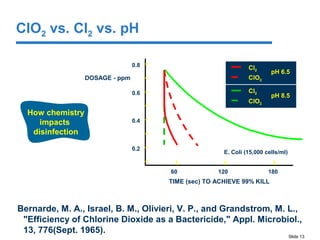
Bernarde, M. A., Israel, B. M., Olivieri, V. P., and Grandstrom, M. L.,
"Efficiency of Chlorine Dioxide as a Bactericide," Appl. Microbiol.,
13, 776(Sept. 1965).
TIME (sec) TO ACHIEVE 99% KILL
DOSAGE - ppm
60 120 180
0.8
0.6
0.4
0.2
E. Coli (15,000 cells/ml)
Cl2
ClO2
Cl2
ClO2
pH 6.5
pH 8.5
How chemistry
impacts
disinfection
ClO2 vs. Cl2 vs. pH
Slide 14
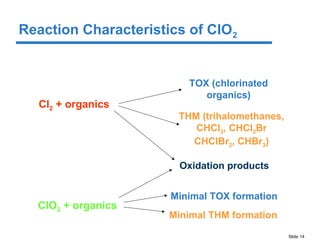
Cl2 + organics
TOX (chlorinated
organics)
THM (trihalomethanes,
CHCl3, CHCl2Br
CHClBr2, CHBr3)
ClO2 + organics
Minimal TOX formation
Minimal THM formation
Oxidation products
Reaction Characteristics of ClO2
Slide 15
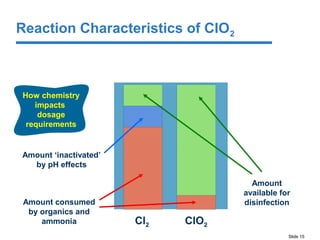
How chemistry
impacts
dosage
requirements
Amount consumed
by organics and
ammonia Cl2 ClO2
Amount ‘inactivated’
by pH effects
Amount
available for
disinfection
Reaction Characteristics of ClO2
Slide 16
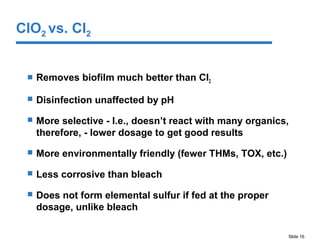
 Removes biofilm much better than Cl2
 Disinfection unaffected by pH
 More selective - I.e., doesn’t react with many organics,
therefore, - lower dosage to get good results
 More environmentally friendly (fewer THMs, TOX, etc.)
 Less corrosive than bleach
 Does not form elemental sulfur if fed at the proper
dosage, unlike bleach
ClO2 vs. Cl2
Slide 17
 Must be made on site
 Generally requires 2 or 3 precursors
 Requires a special reactor called a ‘generator’
 Economics generally do not favor ClO2, but it may in
highly contaminated water.
Disadvantages of ClO2

Cl2 vs ClO2

  • 1.
  • 2.
    Slide 2 ClO2 vs.Cl2 for Biofilm Control: What the literature says about Cl2 for control of biofilm. Cl2 for Biofilm Control
  • 3.
    Slide 3 Hypochlorite ionis so reactive with the biofilm constituents that it is effectively removed by reaction before it can penetrate the biofilm Boivin, J. W., Shapka, R., Khoury, A. E., Blenkinsopp, S., and Costerton, J. W., "An Old and a New Method of Control for Biofilm Bacteria," Paper No 171, Corrosion 92. Cl2 for Biofilm Control
  • 4.
    Slide 4 Chlorine doesnot penetrate well into a biofilm Chen, X., and Stewart, P., “Chlorine Penetration into Artificial Biofilm is Limited by a Reaction-Diffusion Interaction,” Environmental Science & Technology 30(6), 2078(1996). Cl2 for Biofilm Control
  • 5.
    Slide 5 Cells inbiofilms are protected from biocide action and are killed only at biocide concentrations orders of magnitude higher than that necessary to kill suspended cells de Beer, D., Srinivasan, R., and Stewart, P., “Direct Measurement of Chlorine Penetration into Biofilms during Disinfection,” Applied Environmental Microbiology, 60(12), 4339(1994). Cl2 for Biofilm Control
  • 6.
    Slide 6 1 -2 ppm free chlorine does not prevent the growth of biofilms Nagy, L. A. et. al., “Biofilm Composition, Formation and Control in the Los Angeles Aqueduct System,” Proc. 1982 AWWA WQTC, Nashville, Tenn. Cl2 for Biofilm Control
  • 7.
    Slide 7 Coliforms wererecovered from a potable water supply one week after scrubbing a redwood tank with a 200 ppm chlorine solution Seidler, R., Morrow, J., and Bagley, S., “Klebsielleae in Drinking Water Emanating From Redwood Tanks,” Applied Environmental Microbiology, 33, 893(1977). Cl2 for Biofilm Control
  • 8.
    Slide 8 It isnot possible to clean up a biofouled system simply by resuming a discontinued microbiological control program. A fully developed biofilm can be removed only through intensified on-line or off-line treatment Kozelski, K. J., “Field Experience with a Simple Cooling Water Biofilm Monitoring Device,” TP IWC-83-46, International Water Conference, Pittsburgh, PA, October 24-26, 1983. Cl2 for Biofilm Control
  • 9.
    Slide 9  Conclusions: —Chlorinedoes not penetrate biofilm well - it can’t get through to inactivate biofilm bacteria. —Chloramine inactivates biofilm better than chlorine because it can penetrate the biofilm, however, It does not remove the biofilm. Therefore, a biocide which both removes biofilm and inactivates bacteria, in the presence of organics and ammonia, is needed. Cl2 for Biofilm Control
  • 10.
    Slide 10 ClO2 andBiofilm Chlorine works better if applied at a low continuous level, while ClO2 works better if applied intermittently at higher dosages Mayack, L. A., Soracco, R. J., Wilde, E. W, and Pope, D. H., “Comparative Effectiveness of Chlorine and Chlorine Dioxide Regimes for Biofouling Control,” Water Res., 18(5),593(1984).
  • 11.
    Slide 11 Although chloriteis a poor disinfectant, its presence retards the rate of bacterial aftergrowth in the distribution system Masschelein, W. J., "Chlorine Dioxide," Chemical Oxidation, Technology for the Nineties, First International Symposium, Vanderbilt University, Nashville, Tenn., February 20-22, 1991. ClO2 and Biofilm
  • 12.
    Slide 12 Under theright circumstances, chlorite ion can be converted to ClO2 and the biofilm will be removed as a result. Clark, J. B., and Langley, D. E., "Biofilm Control," United States Patent 4,929,365. May 29, 1990. ClO2 and Biofilm
  • 13.
    Slide 13 Bernarde, M.A., Israel, B. M., Olivieri, V. P., and Grandstrom, M. L., "Efficiency of Chlorine Dioxide as a Bactericide," Appl. Microbiol., 13, 776(Sept. 1965). TIME (sec) TO ACHIEVE 99% KILL DOSAGE - ppm 60 120 180 0.8 0.6 0.4 0.2 E. Coli (15,000 cells/ml) Cl2 ClO2 Cl2 ClO2 pH 6.5 pH 8.5 How chemistry impacts disinfection ClO2 vs. Cl2 vs. pH
  • 14.
    Slide 14 Cl2 +organics TOX (chlorinated organics) THM (trihalomethanes, CHCl3, CHCl2Br CHClBr2, CHBr3) ClO2 + organics Minimal TOX formation Minimal THM formation Oxidation products Reaction Characteristics of ClO2
  • 15.
    Slide 15 How chemistry impacts dosage requirements Amountconsumed by organics and ammonia Cl2 ClO2 Amount ‘inactivated’ by pH effects Amount available for disinfection Reaction Characteristics of ClO2
  • 16.
    Slide 16  Removesbiofilm much better than Cl2  Disinfection unaffected by pH  More selective - I.e., doesn’t react with many organics, therefore, - lower dosage to get good results  More environmentally friendly (fewer THMs, TOX, etc.)  Less corrosive than bleach  Does not form elemental sulfur if fed at the proper dosage, unlike bleach ClO2 vs. Cl2
  • 17.
    Slide 17  Mustbe made on site  Generally requires 2 or 3 precursors  Requires a special reactor called a ‘generator’  Economics generally do not favor ClO2, but it may in highly contaminated water. Disadvantages of ClO2