This document contains a marking key for a clinical methods and skills exam consisting of two sections - Section A with short answer questions and Section B of true/false statements. Section A covers topics like components of history taking, calculating pack-years smoked, measuring vital signs, and demonstrating skills like blood pressure measurement. Section B evaluates understanding of clinical conditions and procedures. The marking key provides the answers or ranges of acceptable answers for each question to guide exam scoring.
![SECTION A – SHORT NOTES
MAXIMUM TOTAL – 132 MARKS
1. List 10 components of history taking [10 marks]
DEMOGRAPHICS [1 mark]
CHIEF COMPLAINT [1 mark]
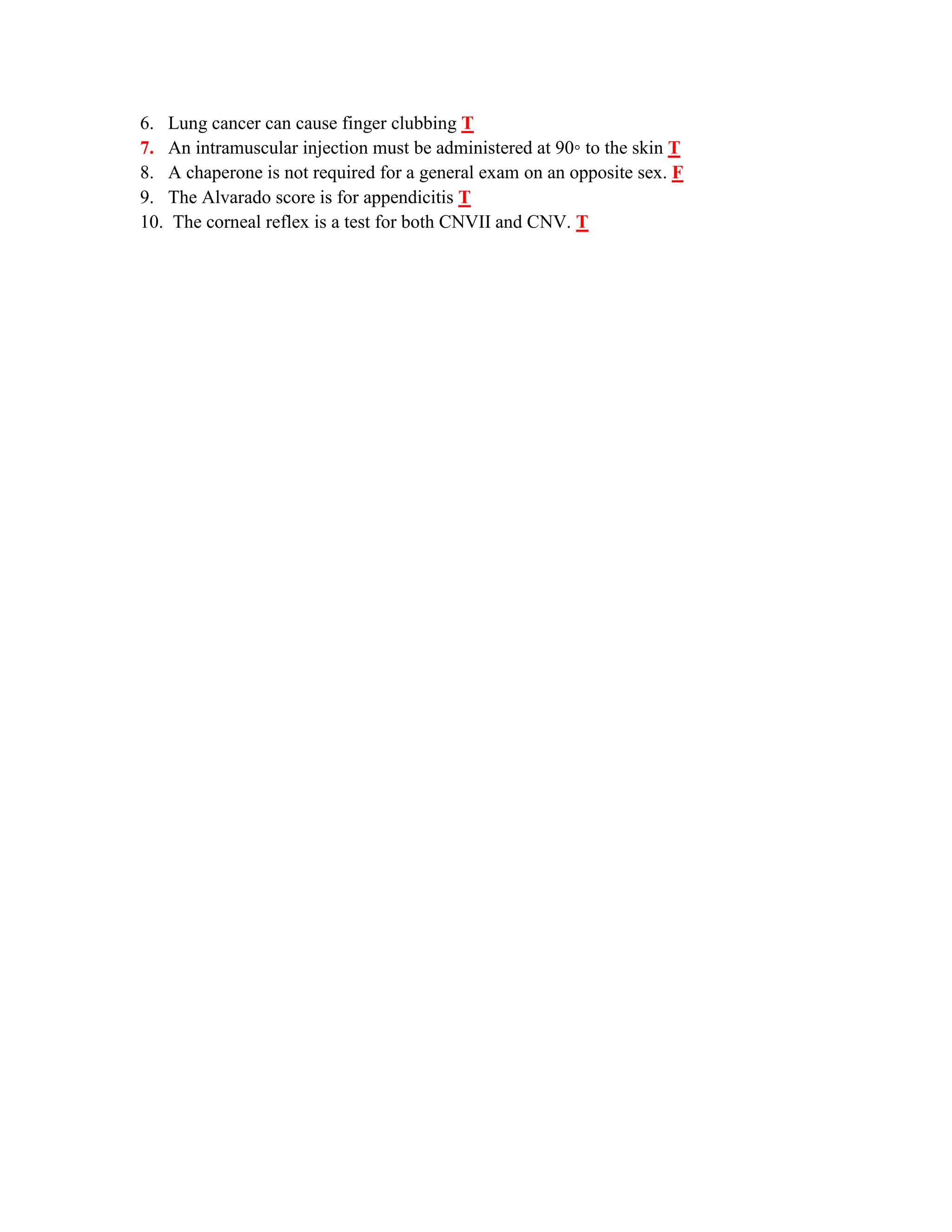
HISTORY OF PRESENTING COMPLAINT [1 mark]
REVIEW OF SYSTEMS [1 mark]
PAST MEDICAL HISTORY [1 mark]
PAST SURGICAL HISTORY [1 mark]
DRUG HISTORY [1 mark]
FAMILY HISTORY [1 mark]
SOCIOECONOMIC HISTORY [1 mark]
SUMMARY [1 mark]
2. What does the term RVD-R and RVD-NR stand for? [2 marks]
RETROVIRAL DISEASE REACTIVE [1 mark]
RETROVIRAL DISEASE NON REACTIVE [1 mark]
3. List the disease components abbreviated in the term DEATHS. [3 marks]
DIABETES MELLITUS [1/2 marks]
EPILEPSY [1/2 marks]
ASTHMA [1/2 marks]
TUBERCULOSIS [1/2 marks]
HYPERTENSION/ HIV [1/2 marks]
SICKLE CELL DISEASE [1/2 marks]
4. A patient tells you they are HIV positive. List 4 questions you will ask this patient about
his HIV status. [4 marks]
WHEN DIAGNOSED?
WHERE AND HOW DIAGNOSED?
ON TREATMENT? WHICH TREATMENT?
LAST VIRAL LOAD?
LAST CD4+ COUNT?](https://image.slidesharecdn.com/clinicalskills2020-21theorytest1markingkey-231019221137-fe7b9078/75/CLINICAL-SKILLS-2020-21-THEORY-TEST-1-MARKING-KEY-pdf-2-2048.jpg)
![**pick any 4 out of the following and award 1 mark for each. If answer provided is
not as above, judge whether sensible or not and award maximum ½ marks.
5. A patient tells you they have been smoking an average of 15 cigarettes per day for the
past 12 years.
Calculate the number pack-years smoked by this patient. [3 marks]
Formula – No. of packs smoked per day x No. of years smoked
(No. cigarretes smoked per day / 20) x No, years smoked [1 mark]
= 15/20 * 12 [1 mark]
= 9 PACK-YEARS [1 mark]
Are these significantly harmful to the patient’s health (yes/no)? [1 mark]
YES [1 mark]
6. List the four (4) characters of a pulse [4 marks]
RATE, RHYTHM, VOLUME AND SYNCHRONICITY [4 MARKS]
7. You receive a patient that you suspect is obese. Your consultant doctor asks you to
calculate his BMI.
What is BMI? [1 mark]
BODY MASS INDEX [1 MARK]
How do you calculate it? And what are its units. [5 marks]
WEIGHT (KG)/HEIGHT (M2) [2.5 marks]
UNITS – KG/ M2 [2.5 marks]
What range of BMI values would qualify this patient being obese? [2 marks]
>/= 30 KG/M2 [2 marks]](https://image.slidesharecdn.com/clinicalskills2020-21theorytest1markingkey-231019221137-fe7b9078/75/CLINICAL-SKILLS-2020-21-THEORY-TEST-1-MARKING-KEY-pdf-3-2048.jpg)
![8. Name the instrument [1 mark]. Label it’s different parts [4 marks]
Name of instrument –
ANEROID [1 mark] SPHYGMOMANOMETER [1 mark]
Labels;
A – BULB/ INFLATION BULB [1 mark]
B – CUFF [1 mark]
C – GAUGE/ MANOMETER GAUGE/ DIAL [1 mark]
D – BLADDER/ INFLATABLE BLADDER [1 mark]
9. How do you determine right cuff size for checking blood pressure? (2 marks)
WIDTH OF THE INFLATABLE BLADDER SHOULD BE 40% OF THE
CIRCUMFERENCE OF THE UPPER ARM.
LENGTH OF THE INFLATABLE BLADDER SHOULD BE 80% OF UPPER ARM
CIRCUMFERENCE.
OR MID UPPER ARM CIRCUMFERENCE COINCIDES WITH LABEL ON
SPHYGMOMANOMETER.](https://image.slidesharecdn.com/clinicalskills2020-21theorytest1markingkey-231019221137-fe7b9078/75/CLINICAL-SKILLS-2020-21-THEORY-TEST-1-MARKING-KEY-pdf-4-2048.jpg)
![10. When measuring Blood Pressure, the pressure at which the radial pulse disappears is
important. Give 2 reasons why it is important. [2 MARKS]
TO PREVENT DISCOMFORT BY EXCESS INFLATION.
TO PREVENT ERRORS CAUSED BY THE ASCULTATORY GAP.
11. Fill the spaces in the table below. [4 marks]
AXILLARY TEMPERATURE ACCEPT ANY RANGE OF AT LEAST 1°C
BETWEEN 35°C TO 37.5°C.
NORMAL PULSE RATE 60-100 BEATS PER MINUTE.
OPTIMAL BLOOD PRESSURE IS <120MMHG SYSTOLIC AND < 80MMHG
DIASTOLIC.
NORMAL RESPIRATORY RATE IS 12-20 BREATHES PER MINUTE.
**accept slight variation.
**1 mark for each correct range
**do not give marks if units are not clearly indicated
12. List the sites for intra-muscular injection [3 marks].
DELTOID REGION [1 mark]
LATERAL THIGH [1 mark]
UPPER – OUTER QUADRANT OF BUTTOCK [1 mark]
13. Explain the 7 rights of injection [7 marks]
RIGHT PATIENT
RIGHT TIME
RIGHT DRUG/VACCINE
RIGHT DOSAGE
RIGHT ROUTE/NEEDLE/TECHNIQUE
RIGHT SITE
RIGHT DOCUMENTATION
**1 mark each](https://image.slidesharecdn.com/clinicalskills2020-21theorytest1markingkey-231019221137-fe7b9078/75/CLINICAL-SKILLS-2020-21-THEORY-TEST-1-MARKING-KEY-pdf-5-2048.jpg)
![14. How do you get a clean catch urine? Explain. [2 marks]
ADEQUATE CLEANING OF GENITALIA [1 mark]
OBTAIN MID – STREAM URINE [1 mark]
15. List any 2 causes of glucose in urine? [2 marks]
DIABETES [1/2 mark] MELLTIUS [1/2 mark]
PREGNANCY [1 mark]
DRUGS [1 mark]
RENAL TUBULAR DISORDERS [1 mark]
** If answer not indicated above, consult medical literature to check if correct
16. i. What is the normal Capillary Refill Time? [1 mark]
< 2 SECONDS [1 mark]
ii. List 5 signs that may be observed on a patient’s hand with ANY cardiac underlying
conditions. [5 marks]
** accept any of the above, 1 mark each
** if not above, consult medical literature to check if correct and award mark accordingly.
17. You are doing a cardiac examination on a patient, and you elicit grade 3 finger clubbing.
What sign indicates grade 3 of finger clubbing? [1 mark]
ACCENTUATED CONVEXITY/CURVATURE OF NAIL
Mention any 3 congenital heart diseases that can cause finger clubbing. [3 marks]
** accept any of the above, 1 mark each
** if not above, consult medical literature to check if correct and award mark accordingly.](https://image.slidesharecdn.com/clinicalskills2020-21theorytest1markingkey-231019221137-fe7b9078/75/CLINICAL-SKILLS-2020-21-THEORY-TEST-1-MARKING-KEY-pdf-6-2048.jpg)
![18. What is the normal Jugular Venous Pressure from the right atrium? (in cm) [1 mark]
LESS THAN 8/9CM
19. Define an apex beat. What is the normal location of the of the apex beat? [2 marks]
DEFINITION – LOWER-MOST AND OUT-MOST P.M.I OF CARDIAC IMPULSE [1
mark]
**accept similar logical answers
NORMAL LOCATION – 5TH
ICS, LEFT MID CLAVICULARLINE [1 mark]
20. State the sites at which the following areas are best auscultated (e.g. 6th
intercostal space,
mid clavicular line): [4 marks]
Aortic – 2ND
ICS, RIGHT PARASTERNAL
Pulmonic -2ND
ICS, LEFT PARASTERNAL
Mitral – 5TH
ICS, LEFT MID CLAVICULAR LINE
Tricuspid – 4TH
ICS, LEFT PARASTERNAL
17. List 5 signs of respiratory distress [5 marks]
INCREASED RR, NASAL FLARING, INTERCOSTAL AND SUBCOSTAL
RECESSIONS, USE OF ACCESSORY MUSCLES, GRUNTING RESPIRATIONS,
DIAPHORESIS
** accept any of the above, 1 mark each
** if not above, consult medical literature to check if correct and award mark accordingly
18. What are the signs of Horner’s syndrome? [3 marks]
MIOSIS [1 mark]
PARTIAL PTOSIS [1 mark]
ANIHYDROSIS [1 mark]
19. What are the landmarks for the McBurney’s point? [4 marks]
2/3 FROM UMBILICUS [2 marks]
1/3 FROM ASIS [2 marks]
20. What is the order of examination of the abdomen? [4 marks]
INSPECTION>PALPATION>PERCUSSION>AUSCULTATION [4 MARKS]](https://image.slidesharecdn.com/clinicalskills2020-21theorytest1markingkey-231019221137-fe7b9078/75/CLINICAL-SKILLS-2020-21-THEORY-TEST-1-MARKING-KEY-pdf-7-2048.jpg)
![21. Study the diagram below and answer the questions that follow;
(i) In which region the spleen is located? [1 mark]
LEFT HYPOCHONDRIUM
(ii) Which region is the site for the Rovsing sign test? [1 mark]
LEFT ILIAC FOSSA
What is Basic Life Support? [1 mark]
THE IMMEDIATE, LIFE SAVING MEDICAL AID (INCLUDING CARDIO –
PULMONARY RESCUSCITATION) GIVEN TO AN INDIVIDUAL, WITH USE
OF NO OR MINIMAL MEDICAL EQUIPMENT/DRUGS AND LARGELY
THE SKILLS OF THE RESCUSCITATOR
22. Mention any 2 factors that improve the effectiveness of Basic Life Support? [2 marks]
EARLY RECOGNITION
EARLY INITIATION
MINIMAL BREAKS
COORDINATED ACTION/ TEAM WORK
EFFECTIVE CHEST COMPRESSIONS (DEPTH/RATE/TECHNIQUE)
** accept any of the above, 1 mark each
** if not above, consult medical literature to check if correct and award mark accordingly](https://image.slidesharecdn.com/clinicalskills2020-21theorytest1markingkey-231019221137-fe7b9078/75/CLINICAL-SKILLS-2020-21-THEORY-TEST-1-MARKING-KEY-pdf-8-2048.jpg)
![23. In resuscitation, what is the ratio of compressions to breaths in adults and neonates?
[2marks].
Adult – 30 COMPRESSIONS: 2 BREATHS [1 mark]
Neonates – 3 COMPRESSIONS: 1 BREATH [1 mark]
24. From superficial to deep, List the 10 Layers penetrated by a spinal needle during a
lumbar puncture. (5 marks)
SKIN,
SUBCUTANEOUS TISSUE,
SUPRASPINOUS LIGAMENT,
INTERSPINOUS LIGAMENT,
LIGAMENTUM FLAVUM,
EPIDURAL SPACE
DURA MATER,
SUB-DURAL SPACE
ARACHNOID MATER
SUBARACHNOID SPACE
**1/2 mark each
**subtract 1 mark for incorrect order
25. What is the instrument below called and what is it used for? [2 marks]
Name – 3 – WAY STOP COCK [1 mark]
Use – ATTACHMENT OF MANOMETER TO MEASURE CSF PRESSURE [1 mark]](https://image.slidesharecdn.com/clinicalskills2020-21theorytest1markingkey-231019221137-fe7b9078/75/CLINICAL-SKILLS-2020-21-THEORY-TEST-1-MARKING-KEY-pdf-9-2048.jpg)
![26. Mention 3 methods of confirming correct placement of a naso-gastric tube insertion [3
marks]
MEASUREMENT OF NG ASPIRATE PH USING PH INDICATOR PAPER
CHEST X-RAY
AUSCULTATION OF AIR INSUFFLATED THROUGH THE FEEDING TUBE
COLORIMETRIC CAPNOGRAPHY
MANOMETRY
** accept any of the above, 1 mark each
** if not above, consult medical literature to check if correct and award mark accordingly
27. The following patient was suspeted to have meningitis. What sign is being ilicitated
below? [2 marks]
KERNIGS SIGN
28. What does the term OTPP stand for? [2 marks]
ORIENTED TO TIME PLACE PERSON
29. List the 12 cranial nerves, in their order. [6 marks]
**1/2 mark each
**subtract 2 marks for incorrect order](https://image.slidesharecdn.com/clinicalskills2020-21theorytest1markingkey-231019221137-fe7b9078/75/CLINICAL-SKILLS-2020-21-THEORY-TEST-1-MARKING-KEY-pdf-10-2048.jpg)
![30. What do the letters APGAR stand for? [5 marks]
A-APPEARANCE/ACTIVITY
P-PULSE
G-GRIMACE
A-ACTIVITY/APPEARANCE
R-RESPIRATION [5 MARKS]
31. What do the letters GCS stand for? [1 mark]
GLASGOW COMA SCALE
Name the 3 parameters assessed in GCS. [3 marks]
MOTOR
VISION
VERBAL
Give its highest and lowest possible scores. [1 mark]
LOWEST – 3/15 [1/2 mark]
HIGHEST – 15/15 [1/2 mark]
SECTION B – TRUE OR FALSE
MAXIMUM TOTAL – 10 MARKS
CLEARLY INDICATE EITHER TRUE OR FALSE AT THE END OF EACH STATEMENT.
DO NOT USE “T” OR “F.
Each statement carries 1 mark.
-1/2 mark for a wrong answer
1. Tuberculosis is considered as a familial disease F
2. Janeway lesions are tender, small erythematous macular/nodular lesions on the
palms/soles that are indicative of infective endocarditis. F
3. It is not safe to smoke 1 pack year T
4. A naso-gastric tube can safely be inserted in a patient that underwent nasal septoplasty
(surgical procedure to fix a deviated nasal septum). F
5. Blood tinged CSF is a sign of sub-arachnoid haemorrhage T](https://image.slidesharecdn.com/clinicalskills2020-21theorytest1markingkey-231019221137-fe7b9078/75/CLINICAL-SKILLS-2020-21-THEORY-TEST-1-MARKING-KEY-pdf-11-2048.jpg)