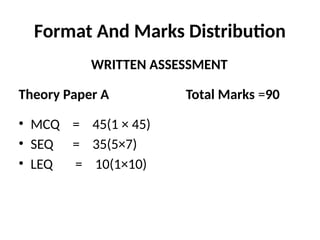
Format And MarksDistribution
WRITTEN ASSESSMENT
Theory Paper A Total Marks =90
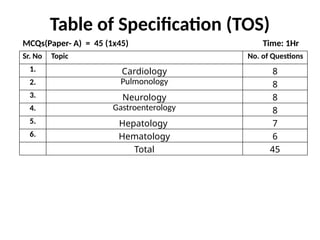
• MCQ = 45(1 × 45)
• SEQ = 35(5×7)
• LEQ = 10(1×10)
4.
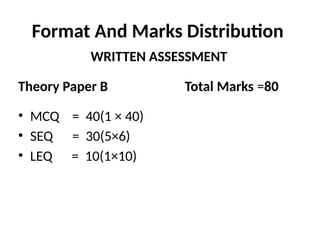
Format And MarksDistribution
WRITTEN ASSESSMENT
Theory Paper B Total Marks =80
• MCQ = 40(1 × 40)
• SEQ = 30(5×6)
• LEQ = 10(1×10)
5.
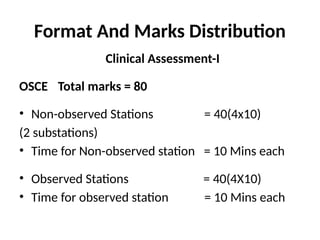
Format And MarksDistribution
Clinical Assessment-I
OSCE Total marks = 80
• Non-observed Stations = 40(4x10)
(2 substations)
• Time for Non-observed station = 10 Mins each
• Observed Stations = 40(4X10)
• Time for observed station = 10 Mins each
6.
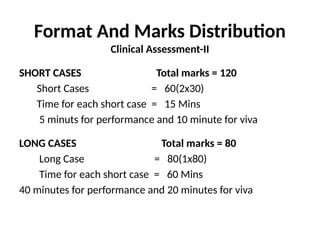
Format And MarksDistribution
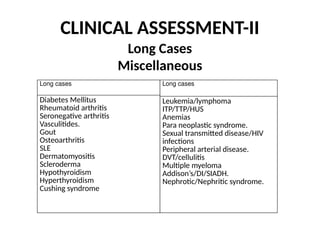
Clinical Assessment-II
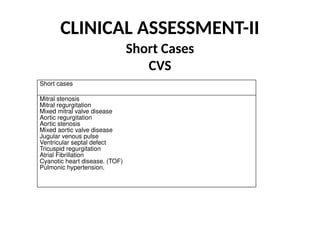
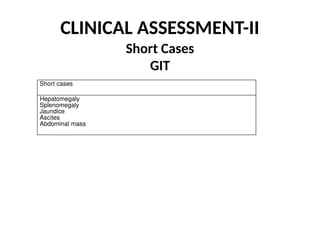
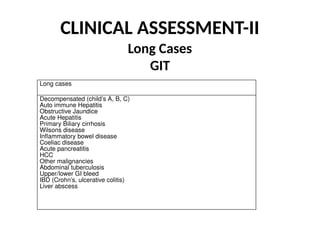
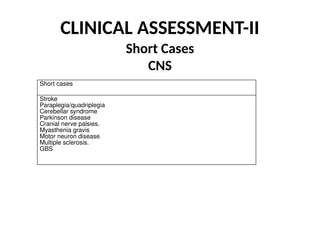
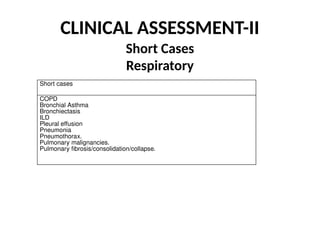
SHORT CASES Total marks = 120
Short Cases = 60(2x30)
Time for each short case = 15 Mins
5 minuts for performance and 10 minute for viva
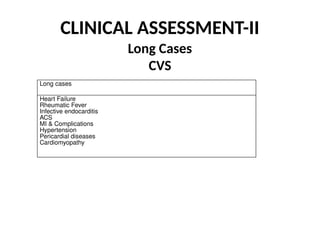
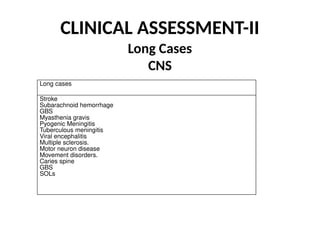
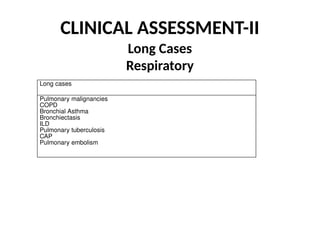
LONG CASES Total marks = 80
Long Case = 80(1x80)
Time for each short case = 60 Mins
40 minutes for performance and 20 minutes for viva
7.
Format And MarksDistribution
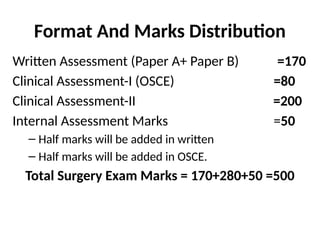
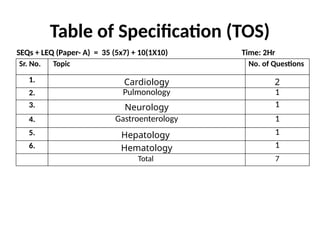
Written Assessment (Paper A+ Paper B) =170
Clinical Assessment-I (OSCE) =80
Clinical Assessment-II =200
Internal Assessment Marks =50
– Half marks will be added in written
– Half marks will be added in OSCE.
Total Surgery Exam Marks = 170+280+50 =500
8.
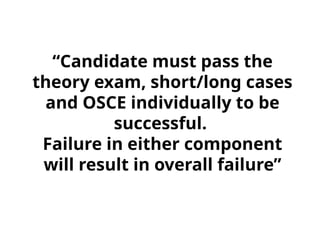
“Candidate must passthe
theory exam, short/long cases
and OSCE individually to be
successful.
Failure in either component
will result in overall failure”
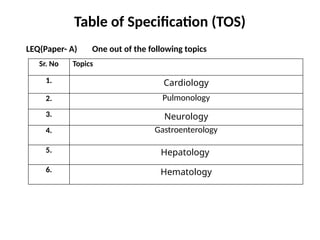
Table of Specification(TOS)
LEQ(Paper- A) One out of the following topics
Sr. No Topics
1. Cardiology
2. Pulmonology
3. Neurology
4. Gastroenterology
5. Hepatology
6. Hematology
13.
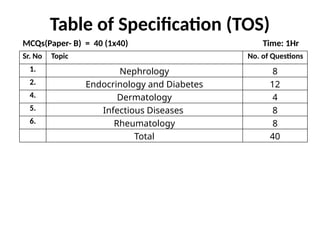
Table of Specification(TOS)
Sr. No Topic No. of Questions
1. Nephrology 8
2. Endocrinology and Diabetes 12
4. Dermatology 4
5. Infectious Diseases 8
6. Rheumatology 8
Total 40
MCQs(Paper- B) = 40 (1x40) Time: 1Hr
14.
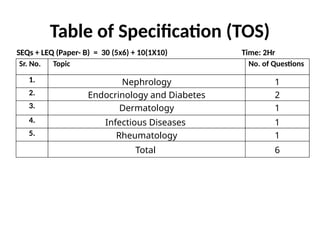
Table of Specification(TOS)
SEQs + LEQ (Paper- B) = 30 (5x6) + 10(1X10) Time: 2Hr
Sr. No. Topic No. of Questions
1. Nephrology 1
2. Endocrinology and Diabetes 2
3. Dermatology 1
4. Infectious Diseases 1
5. Rheumatology 1
Total 6
15.
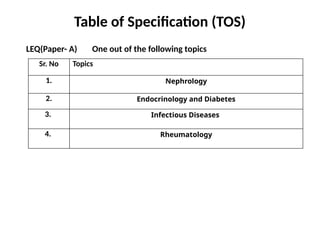
Table of Specification(TOS)
LEQ(Paper- A) One out of the following topics
Sr. No Topics
1. Nephrology
2. Endocrinology and Diabetes
3. Infectious Diseases
4. Rheumatology
CLINICAL ASSESSMENT-I
OSCE
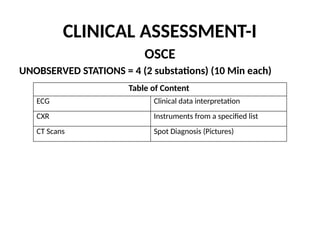
UNOBSERVED STATIONS= 4 (2 substations) (10 Min each)
Table of Content
ECG Clinical data interpretation
CXR Instruments from a specified list
CT Scans Spot Diagnosis (Pictures)
18.
CLINICAL ASSESSMENT-I
OSCE
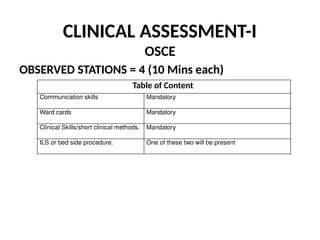
OBSERVED STATIONS= 4 (10 Mins each)
Table of Content
Communication skills Mandatory
Ward cards Mandatory
Clinical Skills/short clinical methods. Mandatory
ILS or bed side procedure. One of these two will be present
19.
CLINICAL ASSESSMENT-I
OSCE
OBSERVED STATIONS
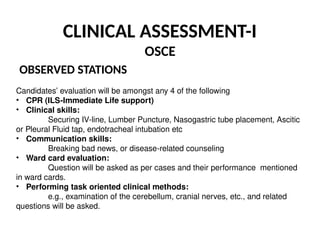
Candidates’evaluation will be amongst any 4 of the following
• CPR (ILS-Immediate Life support)
• Clinical skills:
Securing IV-line, Lumber Puncture, Nasogastric tube placement, Ascitic
or Pleural Fluid tap, endotracheal intubation etc
• Communication skills:
Breaking bad news, or disease-related counseling
• Ward card evaluation:
Question will be asked as per cases and their performance mentioned
in ward cards.
• Performing task oriented clinical methods:
e.g., examination of the cerebellum, cranial nerves, etc., and related
questions will be asked.
20.
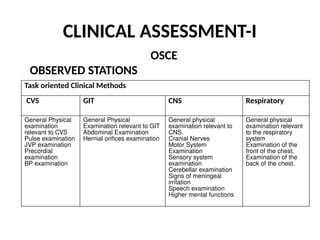
CVS GIT CNSRespiratory
General Physical
examination
relevant to CVS
Pulse examination
JVP examination
Precordial
examination
BP examination
General Physical
Examination relevant to GIT
Abdominal Examination
Hernial orifices examination
General physical
examination relevant to
CNS.
Cranial Nerves
Motor System
Examination
Sensory system
examination
Cerebellar examination
Signs of meningeal
irritation
Speech examination
Higher mental functions
General physical
examination relevant
to the respiratory
system
Examination of the
front of the chest.
Examination of the
back of the chest.
Task oriented Clinical Methods
CLINICAL ASSESSMENT-I
OSCE
OBSERVED STATIONS
22
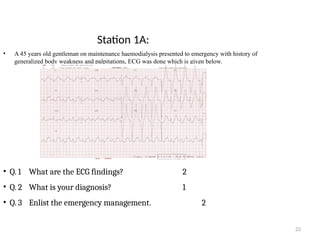
Station 1A:
• A45 years old gentleman on maintenance haemodialysis presented to emergency with history of
generalized body weakness and palpitations, ECG was done which is given below.
• Q. 1 What are the ECG findings? 2
• Q. 2 What is your diagnosis? 1
• Q. 3 Enlist the emergency management. 2
23.
23
Station 1B
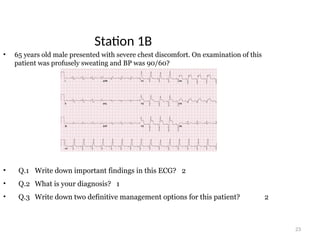
• 65years old male presented with severe chest discomfort. On examination of this
patient was profusely sweating and BP was 90/60?
• Q.1 Write down important findings in this ECG? 2
• Q.2 What is your diagnosis? 1
• Q.3 Write down two definitive management options for this patient? 2
24.
24
Station 2 a
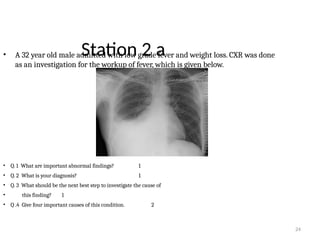
•A 32 year old male admitted with low grade fever and weight loss. CXR was done
as an investigation for the workup of fever, which is given below.
• Q. 1 What are important abnormal findings? 1
• Q. 2 What is your diagnosis? 1
• Q. 3 What should be the next best step to investigate the cause of
• this finding? 1
• Q .4 Give four important causes of this condition. 2
25.
25
Station 2b
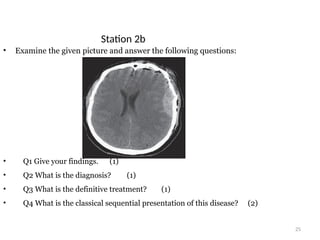
• Examinethe given picture and answer the following questions:
• Q1 Give your findings. (1)
• Q2 What is the diagnosis? (1)
• Q3 What is the definitive treatment? (1)
• Q4 What is the classical sequential presentation of this disease? (2)
26.
26
Station 3A
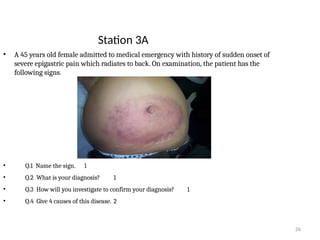
• A45 years old female admitted to medical emergency with history of sudden onset of
severe epigastric pain which radiates to back. On examination, the patient has the
following signs.
• Q.1 Name the sign. 1
• Q.2 What is your diagnosis? 1
• Q.3 How will you investigate to confirm your diagnosis? 1
• Q.4 Give 4 causes of this disease. 2
27.
27
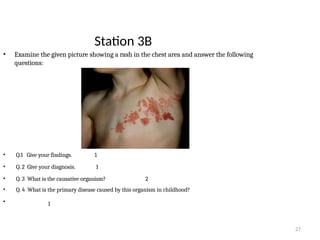
Station 3B
• Examinethe given picture showing a rash in the chest area and answer the following
questions:
• Q.1 Give your findings. 1
• Q. 2 Give your diagnosis. 1
• Q. 3 What is the causative organism? 2
• Q. 4 What is the primary disease caused by this organism in childhood?
• 1
28.
28
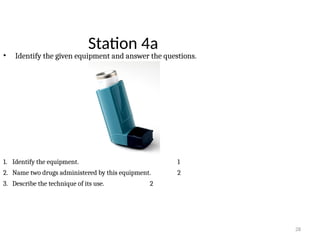
Station 4a
• Identifythe given equipment and answer the questions.
1. Identify the equipment. 1
2. Name two drugs administered by this equipment. 2
3. Describe the technique of its use. 2
29.
29
Station 4b
• 40-year-oldfemale, Known diabetic patient presented in emergency ward with
unconsciousness. She was on oral anti-diabetic drugs.
• Q. Identify the drug and tell us about its usage in this patient. [5]
30.
30
Station 5
• INTERACTIVE
•
•A 50-year-old lady is diagnosed as having Heart failure. Educate the patient
regarding lifestyle modification and vaccination (10)

![29
Station 4b
• 40-year-old female, Known diabetic patient presented in emergency ward with
unconsciousness. She was on oral anti-diabetic drugs.
• Q. Identify the drug and tell us about its usage in this patient. [5]](https://image.slidesharecdn.com/finalpresentationgeneralmedicine03-08-2024-250810082059-1664d824/85/Final-Presentation-General-Medicine-03-08-2024-pptx-29-320.jpg)
![31
Station 6
• INTERACTIVE
• Describe/perform the procedure of abdominal paracentesis. [10]](https://image.slidesharecdn.com/finalpresentationgeneralmedicine03-08-2024-250810082059-1664d824/85/Final-Presentation-General-Medicine-03-08-2024-pptx-31-320.jpg)
![32
Station 7
• INTERACTIVE
• Examine the JVP [10]](https://image.slidesharecdn.com/finalpresentationgeneralmedicine03-08-2024-250810082059-1664d824/85/Final-Presentation-General-Medicine-03-08-2024-pptx-32-320.jpg)
![33
Station 8
• INTERACTIVE
• Ward Cards
[10]](https://image.slidesharecdn.com/finalpresentationgeneralmedicine03-08-2024-250810082059-1664d824/85/Final-Presentation-General-Medicine-03-08-2024-pptx-33-320.jpg)