ADDRESSING
THE
PROBLEMS
OF CLIMATE
CHANGE
What are the
causes and effects
of climate change?
If we have the
knowledge and
understanding that
the products we use
daily affect climate
change from the
process of
production down to
consumption:
Why do we still use these products?
Can we survive without these
products?
If we cannot survive without these
products, what can we do to help
curve the effects of climate change?
Make a pledge of
commitment to save the
environment from the
adverse effects of climate
change.
What did you feel
while coming-up
with your
personal pledge?
How important is
caring for the
environment for
you?
Individual
Actions That
Can Mitigate
Climate Chang
Here are 12 Simple
Things You Can Do Right
Now on Climate Change:
1. Switch to 100%
green power
2. Save Energy!
3. Optimize
your diet
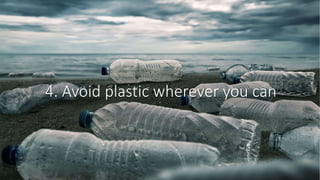
4. Avoid plastic wherever you can
5. Sharing is
Caring
6. Shrink your
digital footprint
7. Avoid flying
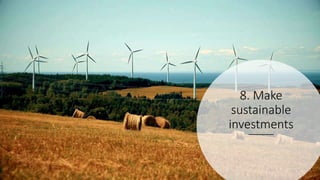
8. Make
sustainable
investments
9. Get on your
bike!
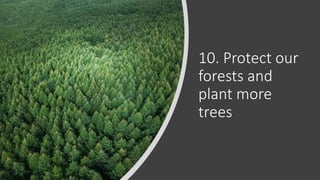
10. Protect our
forests and
plant more
trees
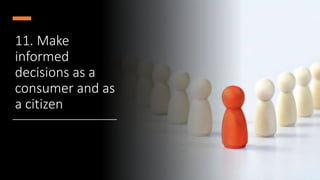
11. Make
informed
decisions as a
consumer and as
a citizen
12. Go out on
the street and
make your
voice heard!
Caring for the
Environment and
Delaying Climate
Change
What is Being
Done about
Climate Change
The School and
Community can Rise
Up against Climate
Change
Organizations Fighting Climate Change
• Some environmental NGOs are Wildlife Conservation Society, IBON
Foundations, Amazon Conservation Association, Cool Earth Organization,
Alliance for Water Efficiency, and Soil and Water Conservation Society.
Their common goal is to ensure that nature is sustained for future
generations and to make the international community recognize the
importance of wildlife and natural resources for ecological balance. They
promote the cleanliness of rivers, lakes, and other bodies of water to
safeguard marine life and aquatic resources.
• At the global level, member-nations of the UN ratified
the UN Framework Convention on Climate Change
(UNFCCC) to come up with strategies to address the
effects of climate change. The convention took effect
in 1994.
• In 1995, the first conference of the Parties
(COP) was held in Berlin to evaluate the
weakness of the UNFCCC and strengthen
commitments by setting policies, objectives,
and time frames. In 1997, the Kyoto Protocol
was established, providing targets and
timetables for the huge reduction of emissions
by many industrialized nations. However, the
U.S refused to ratify it and other countries
failed to comply in cutting targets. In 2015, the
Paris Agreement was adopted to make
countries promise to reduce the GHG
emissions with the goal to hold the increase in
the global average temperature to less than
2°C, and to limit the GHG emissions to what
the trees, soil, and the oceans can naturally
absorb starting anytime between 2050 and
2100. The Paris Agreement was enforced on
November 4, 2016. Countries which signed
the treaty must ratify it in their respective
governments
Change in
Government
Policies
Use of Renewable Energy
New Agricultural Practices
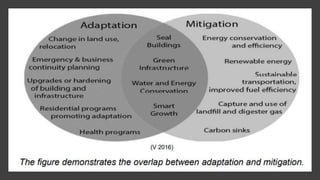
Adaptation and
Mitigation
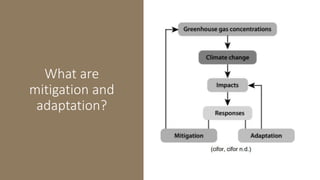
What are
mitigation and
adaptation?
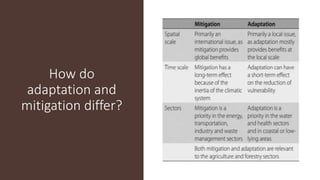
How do
adaptation and
mitigation differ?
Thank you

Trend and Networks W7.pptx