Global warming
Impacts of climate
change
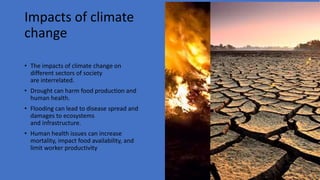
• The impacts of climate change on
different sectors of society
are interrelated.
• Drought can harm food production and
human health.
• Flooding can lead to disease spread and
damages to ecosystems
and infrastructure.
• Human health issues can increase
mortality, impact food availability, and
limit worker productivity
Main causes of
global warming
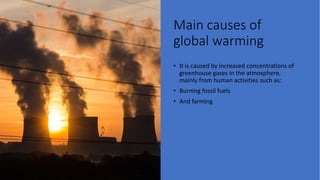
• It is caused by increased concentrations of
greenhouse gases in the atmosphere,
mainly from human activities such as:
• Burning fossil fuels
• And farming
Prevention of
global warming
• We can prevent Global Warming by
reducing the demand of fossil fuels
and by using the energy
more wisely.
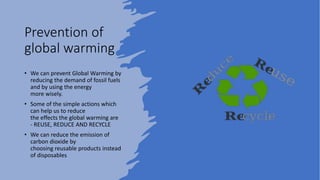
• Some of the simple actions which
can help us to reduce
the effects the global warming are
- REUSE, REDUCE AND RECYCLE
• We can reduce the emission of
carbon dioxide by
choosing reusable products instead
of disposables
By planting trees
• We should plant more and more trees as
they absorb carbon dioxide and give off
oxygen.
• They are an integral part of the natural
atmospheric exchange cycle here on Earth
Invest in energy-
efficient appliances
• Since they were first implemented
nationally in 1987, efficiency standards
for dozens of appliances and products
have kept 2.3 billion tons of carbon
dioxide out of the air.
• That’s about the same amount as the
annual carbon pollution coughed up by
nearly 440 million cars.
• Energy efficiency is the lowest-cost way
to reduce emissions.
Reduce water waste
• Saving water reduces carbon pollution, too. That's
because it takes a lot of energy to pump, heat,
and treat your water.
• So take shorter showers, turn off the tap while
brushing your teeth, and switch to WaterSense-
labeled fixtures and appliances.
• The EPA estimates that if just one out of every 100
American homes were retrofitted with water-
efficient fixtures, about 100 million kilowatt-hours
of electricity per year would be saved 80,000 tons
of global warming pollution.
Buy better bulbs
• LED lightbulbs use up to 80 percent less
energy than
conventional incandescents.
• They’re also cheaper in the long run.
• A 10-watt LED that replaces your
traditional 60-watt bulb will save you
$125 over the lightbulb’s life.
Eat the food you buy
and make less of it
meat.
• Approximately 15 percent of energy use
goes into growing, processing, packaging,
and shipping food about 40 percent of
which just winds up in the landfill.
• And since livestock products are among
the most resource-intensive to produce,
eating meat-free meals can make a big
difference, too.
• If you’re wasting less food, you’re likely
cutting down on energy consumption.
Climate change vendo sk

Climate change vendo sk

  • 1.
  • 2.
    Impacts of climate change •The impacts of climate change on different sectors of society are interrelated. • Drought can harm food production and human health. • Flooding can lead to disease spread and damages to ecosystems and infrastructure. • Human health issues can increase mortality, impact food availability, and limit worker productivity
  • 3.
    Main causes of globalwarming • It is caused by increased concentrations of greenhouse gases in the atmosphere, mainly from human activities such as: • Burning fossil fuels • And farming
  • 4.
    Prevention of global warming •We can prevent Global Warming by reducing the demand of fossil fuels and by using the energy more wisely. • Some of the simple actions which can help us to reduce the effects the global warming are - REUSE, REDUCE AND RECYCLE • We can reduce the emission of carbon dioxide by choosing reusable products instead of disposables
  • 5.
    By planting trees •We should plant more and more trees as they absorb carbon dioxide and give off oxygen. • They are an integral part of the natural atmospheric exchange cycle here on Earth
  • 6.
    Invest in energy- efficientappliances • Since they were first implemented nationally in 1987, efficiency standards for dozens of appliances and products have kept 2.3 billion tons of carbon dioxide out of the air. • That’s about the same amount as the annual carbon pollution coughed up by nearly 440 million cars. • Energy efficiency is the lowest-cost way to reduce emissions.
  • 7.
    Reduce water waste •Saving water reduces carbon pollution, too. That's because it takes a lot of energy to pump, heat, and treat your water. • So take shorter showers, turn off the tap while brushing your teeth, and switch to WaterSense- labeled fixtures and appliances. • The EPA estimates that if just one out of every 100 American homes were retrofitted with water- efficient fixtures, about 100 million kilowatt-hours of electricity per year would be saved 80,000 tons of global warming pollution.
  • 8.
    Buy better bulbs •LED lightbulbs use up to 80 percent less energy than conventional incandescents. • They’re also cheaper in the long run. • A 10-watt LED that replaces your traditional 60-watt bulb will save you $125 over the lightbulb’s life.
  • 9.
    Eat the foodyou buy and make less of it meat. • Approximately 15 percent of energy use goes into growing, processing, packaging, and shipping food about 40 percent of which just winds up in the landfill. • And since livestock products are among the most resource-intensive to produce, eating meat-free meals can make a big difference, too. • If you’re wasting less food, you’re likely cutting down on energy consumption.