A simple definition . 
a gradual increase in the overall temperature of the earth's atmosphere 
generally attributed to the greenhouse effect caused by increased levels of 
carbon dioxide, CFCs, and other pollutants 
Global warming is the rise in the average temperature of Earth's 
atmosphere and oceans since the late 19th century and its projected 
continuation. 
Since the early 20th century, Earth's mean surface temperature has 
increased by about 0.8 °C (1.4 °F), with about two-thirds of the increase 
occurring since 1980.[2] Warming of the climate system is unequivocal, and 
scientists are 95-100% certain that it is primarily caused by increasing 
concentrations of greenhouse gases produced by human activities such as 
the burning of fossil fuels and deforestation.
Human beings have increased the CO2 concentration in the atmosphere by 
about thirty percent, which is an extremely significant increase, even on inter-glacial 
timescales. 
It is believed that human beings are responsible for this because the increase 
is almost perfectly correlated with increases in fossil fuel combustion, and also 
due other evidence, such as changes in the ratios of different carbon isotopes 
in atmospheric CO2 that are consistent with "anthropogenic" (human caused) 
emissions. 
The simple fact is, that under "business as usual" conditions, we'll soon reach 
carbon dioxide concentrations that haven't been seen on Earth in the last 50 
million years. 
Combustion of Fossil Fuels, for electricity generation, transportation, and 
heating, and also the manufacture of cement, all result in the total worldwide 
emission of about 22 billion tons of carbon dioxide to the atmosphere each 
year.
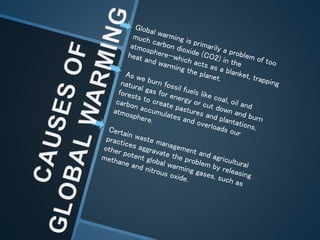
Global Warming is caused by many things. The causes are split up into two groups, 
man-made or anthropogenic causes, and natural causes. 
Natural Causes 
Natural causes are causes created by nature. One natural cause is a release of 
methane gas from arctic tundra and wetlands. Methane is a greenhouse gas. A 
greenhouse gas is a gas that traps heat in the earth's atmosphere. Another natural 
cause is that the earth goes through a cycle of climate change. This climate 
change usually lasts about 40,000 years. 
Man-made Causes 
Man-made causes probably do the most damage. There are many man-made 
causes. Pollution is one of the biggest man-made problems. Pollution comes in 
many shapes and sizes. Burning fossil fuels is one thing that causes pollution. 
Fossil fuels are fuels made of organic matter such as coal, or oil. When fossil fuels 
are burned they give off a green house gas called CO2.
1. Reduce, Reuse, Recycle 
Do your part to reduce waste by choosing reusable products instead 
of disposables. Buying products with minimal packaging (including 
the economy size when that makes sense for you) will help to 
reduce waste 
2. Use Less Heat and Air Conditioning 
Adding insulation to your walls and attic, and installing weather 
stripping or caulking around doors and windows can lower your 
heating costs more than 25 percent. 
3. Change a Light Bulb 
Wherever practical, replace regular light bulbs with compact 
fluorescent light (CFL) bulbs. Replacing just one 60-watt 
incandescent light bulb with a CFL will save you $30 over the life 
of the bulb. CFLs also last 10 times longer than incandescent 
bulbs.
4. Use Less Hot Water 
Set your water heater at 120 degrees to save energy, and wrap it in 
an insulating blanket if it is more than 5 years old. Buy low-flow 
showerheads to save hot water and about 350 pounds of carbon 
dioxide yearly. Wash your clothes in warm or cold water to reduce 
your use of hot water and the energy required to produce it. That 
change alone can save at least 500 pounds of carbon dioxide annually 
in most households. Use the energy-saving settings on your 
dishwasher and let the dishes air-dry. 
5. Buy Energy-Efficient Products 
When it's time to buy a new car, choose one that offers good gas 
mileage. Home appliances now come in a range of energy-efficient 
models, and compact florescent bulbs are designed to 
provide more natural-looking light while using far less energy than 
standard light bulbs
Global warming
Global warming

Global warming

  • 2.
    A simple definition. a gradual increase in the overall temperature of the earth's atmosphere generally attributed to the greenhouse effect caused by increased levels of carbon dioxide, CFCs, and other pollutants Global warming is the rise in the average temperature of Earth's atmosphere and oceans since the late 19th century and its projected continuation. Since the early 20th century, Earth's mean surface temperature has increased by about 0.8 °C (1.4 °F), with about two-thirds of the increase occurring since 1980.[2] Warming of the climate system is unequivocal, and scientists are 95-100% certain that it is primarily caused by increasing concentrations of greenhouse gases produced by human activities such as the burning of fossil fuels and deforestation.
  • 3.
    Human beings haveincreased the CO2 concentration in the atmosphere by about thirty percent, which is an extremely significant increase, even on inter-glacial timescales. It is believed that human beings are responsible for this because the increase is almost perfectly correlated with increases in fossil fuel combustion, and also due other evidence, such as changes in the ratios of different carbon isotopes in atmospheric CO2 that are consistent with "anthropogenic" (human caused) emissions. The simple fact is, that under "business as usual" conditions, we'll soon reach carbon dioxide concentrations that haven't been seen on Earth in the last 50 million years. Combustion of Fossil Fuels, for electricity generation, transportation, and heating, and also the manufacture of cement, all result in the total worldwide emission of about 22 billion tons of carbon dioxide to the atmosphere each year.
  • 6.
    Global Warming iscaused by many things. The causes are split up into two groups, man-made or anthropogenic causes, and natural causes. Natural Causes Natural causes are causes created by nature. One natural cause is a release of methane gas from arctic tundra and wetlands. Methane is a greenhouse gas. A greenhouse gas is a gas that traps heat in the earth's atmosphere. Another natural cause is that the earth goes through a cycle of climate change. This climate change usually lasts about 40,000 years. Man-made Causes Man-made causes probably do the most damage. There are many man-made causes. Pollution is one of the biggest man-made problems. Pollution comes in many shapes and sizes. Burning fossil fuels is one thing that causes pollution. Fossil fuels are fuels made of organic matter such as coal, or oil. When fossil fuels are burned they give off a green house gas called CO2.
  • 8.
    1. Reduce, Reuse,Recycle Do your part to reduce waste by choosing reusable products instead of disposables. Buying products with minimal packaging (including the economy size when that makes sense for you) will help to reduce waste 2. Use Less Heat and Air Conditioning Adding insulation to your walls and attic, and installing weather stripping or caulking around doors and windows can lower your heating costs more than 25 percent. 3. Change a Light Bulb Wherever practical, replace regular light bulbs with compact fluorescent light (CFL) bulbs. Replacing just one 60-watt incandescent light bulb with a CFL will save you $30 over the life of the bulb. CFLs also last 10 times longer than incandescent bulbs.
  • 9.
    4. Use LessHot Water Set your water heater at 120 degrees to save energy, and wrap it in an insulating blanket if it is more than 5 years old. Buy low-flow showerheads to save hot water and about 350 pounds of carbon dioxide yearly. Wash your clothes in warm or cold water to reduce your use of hot water and the energy required to produce it. That change alone can save at least 500 pounds of carbon dioxide annually in most households. Use the energy-saving settings on your dishwasher and let the dishes air-dry. 5. Buy Energy-Efficient Products When it's time to buy a new car, choose one that offers good gas mileage. Home appliances now come in a range of energy-efficient models, and compact florescent bulbs are designed to provide more natural-looking light while using far less energy than standard light bulbs