GLOBAL WARMING AND ITS EFFECT
ON AGRICULTURE
PRESENTED BY
DEBASIS DAS
Ph.D AGRONOMY
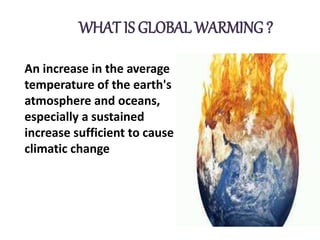
WHAT IS GLOBAL WARMING ?
An increase in the average
temperature of the earth's
atmosphere and oceans,
especially a sustained
increase sufficient to cause
climatic change
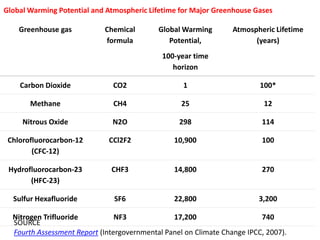
Global Warming Potential and Atmospheric Lifetime for Major Greenhouse Gases
Greenhouse gas Chemical
formula
Global Warming
Potential,
100-year time
horizon
Atmospheric Lifetime
(years)
Carbon Dioxide CO2 1 100*
Methane CH4 25 12
Nitrous Oxide N2O 298 114
Chlorofluorocarbon-12
(CFC-12)
CCl2F2 10,900 100
Hydrofluorocarbon-23
(HFC-23)
CHF3 14,800 270
Sulfur Hexafluoride SF6 22,800 3,200
Nitrogen Trifluoride NF3 17,200 740
SOURCE
Fourth Assessment Report (Intergovernmental Panel on Climate Change IPCC, 2007).
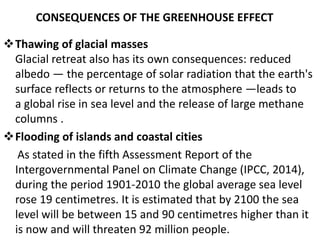
Thawing of glacial masses
Glacial retreat also has its own consequences: reduced
albedo — the percentage of solar radiation that the earth's
surface reflects or returns to the atmosphere —leads to
a global rise in sea level and the release of large methane
columns .
Flooding of islands and coastal cities
As stated in the fifth Assessment Report of the
Intergovernmental Panel on Climate Change (IPCC, 2014),
during the period 1901-2010 the global average sea level
rose 19 centimetres. It is estimated that by 2100 the sea
level will be between 15 and 90 centimetres higher than it
is now and will threaten 92 million people.
CONSEQUENCES OF THE GREENHOUSE EFFECT
Migration of species
Many animal species will be forced to migrate in order
to survive the changes in the main climatic
patterns altered by the progressive increase in
temperatures.
Desertification of fertile areas
Global warming is having a profound impact on the
processes of soil degradation and is contributing to
the desertification of the most arid areas on the
planet. Desertification destroys all the biological
potential of affected regions, turning them into
barren and unproductive land. As recognised by the
UN on the occasion of the World Day to Combat
Desertification in 2018, 30% of land has been
degraded and lost its real value.
 Spread of diseases and pandemics
In addition to the problems derived directly from
pollution, the World Health Organization (WHO)
states that global warming will cause infectious
diseases such as malaria, cholera or dengue to
spread to many more areas of the planet. On the
other hand, extreme heat will increase and
aggravate cardiovascular and respiratory
problems.
IMPACT OF GLOBAL
WARMING ON
AGRICULTURE
Effect of elevated concentrations of
CO2 on crop growth
 Carbon dioxide concentrations are also important in
regulating the openness of stomata pores through which
plants exchange gases. Open stomata allow CO2 to diffuse into
leaves for photosynthesis, but also provide a pathway for
water to diffuse out of leaves.
 Bit it compromises in maintaining high rates of photosynthesis
and low rates of water loss.
 So, under elevated CO2 , stomatal conductance of water by
decreases on an average of 22% (Ainsworth & Rogers 2007)
 This would decrease overall plant water use, which affect plant
size, morphology, and leaf temperature. (Leakey et al. 2009).
 Leaf nitrogen concentrations in plant tissues typically
decrease in under elevated CO2, decrease in tissue
nitrogen leads to decreased uptake of minerals from
the soil which ultimately decreases the rate of
assimilation of nitrate into organic compounds
(Bloom et al. 2010).
Protein concentrations in plant tissues are related to
plant nitrogen status. So, protein concentrations in
grains of wheat, rice and barley, and in potato tubers,
are decreased by 5–14% under elevated CO2
(Taub et al. 2008).
Crop concentrations of nutritionally important
minerals including calcium, magnesium and
phosphorus also be decreased under elevated
CO2 (Loladze 2002; Taub & Wang 2008).
Tropospheric Ozone Pollution
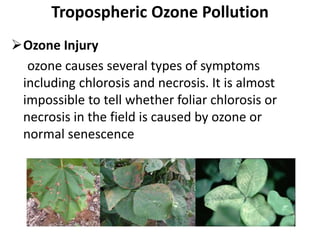
Ozone Injury
ozone causes several types of symptoms
including chlorosis and necrosis. It is almost
impossible to tell whether foliar chlorosis or
necrosis in the field is caused by ozone or
normal senescence
Effect of increasing temperature on crop
growth
Reduce crop duration, the number of grains
formed, and crop yield;
 inhibit sucrose assimilation in grains;
 Affect the survival and distribution of pest
populations;
hasten nutrient mineralization in soil, decrease
fertilizer-use efficiency;
 Increase evaporation
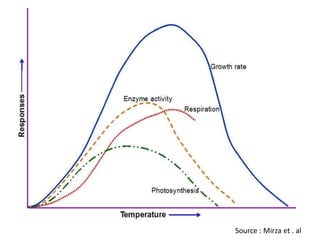
Source : Mirza et . al
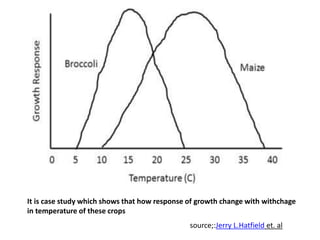
It is case study which shows that how response of growth change with withchage
in temperature of these crops
source;:Jerry L.Hatfield et. al
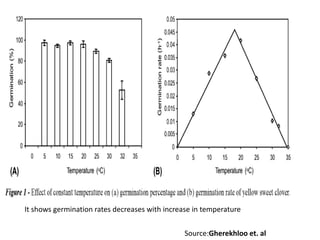
It shows germination rates decreases with increase in temperature
Source:Gherekhloo et. al
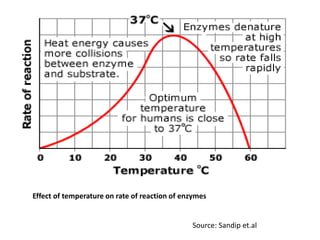
Effect of temperature on rate of reaction of enzymes
Source: Sandip et.al
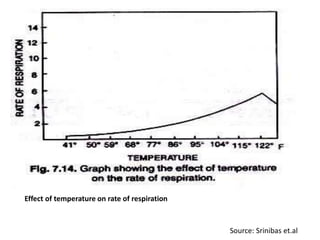
Effect of temperature on rate of respiration
Source: Srinibas et.al
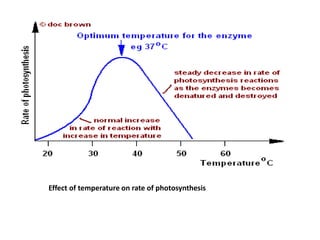
Effect of temperature on rate of photosynthesis
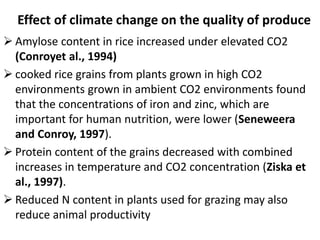
Effect of climate change on the quality of produce
 Amylose content in rice increased under elevated CO2
(Conroyet al., 1994)
 cooked rice grains from plants grown in high CO2
environments grown in ambient CO2 environments found
that the concentrations of iron and zinc, which are
important for human nutrition, were lower (Seneweera
and Conroy, 1997).
 Protein content of the grains decreased with combined
increases in temperature and CO2 concentration (Ziska et
al., 1997).
 Reduced N content in plants used for grazing may also
reduce animal productivity
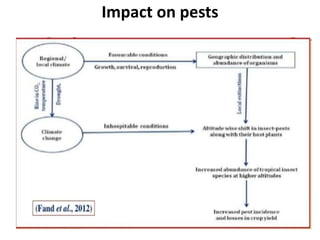
Impact on pests
Impact on soil fertility
Global warming cause soil degradation, which
could influence soil fertility.
An increase in temperature would increase the
mineral production rate and lessen soil organic
matter content (Salinger, 1989) .
High temperatures could increase the rate of
microbial decomposition of organic matter, thus
adversely affecting soil fertility, (Buol et al., 1990).
Increased rainfall in regions that are already moist,
for example, could lead to increased leaching of
minerals, especially nitrates. Large increases in
fertilizer applications would be necessary to
restore productivity (Pitovranov et al., 1988).
Decreased rainfall, particularly during summers,
could have a dramatic effect on the soil through
the increased frequency of dry spells, leading to
increased proneness to wind erosion.
MITIGATION STRATEGY
Crop-based approaches
 Reduced waterlogging
 Weed control
 Banding of fertilizers,
 Better stand establishment,
 Less crop lodging,
 Reduced seeding rates
 Short duration crops
Adopting new cropping systems
Cultivars suitable for high temperature,
drought, salinity and submergence tolerance
1)Tao et al. (2008) identified rice hybrid
Guodao 6 as heat-tolerant.
2) CRIDA in Hyderabad has developed a
sorghum cultivar (transgenic), “SPV 462,” that
possesses tolerance of water deficit and salt
stress
Cultivars that respond to high CO2 concentration
• The elevated concentrations of CO2 will lead to
higher assimilation rates and an increase in
stomatal resistance, resulting in a decline in
transpiration rate and improved water-use
efficiency in crops.
• Plant breeders developing cultivars that are able
to benefit from the high CO2 fertilization effect.
They are working to alter the photosynthesis of
rice from the C3 to C4 pathway by introducing
cloned genes from C4 species
Conclusion
• Climate change is a reality. Elevated CO2
concentration may increase crop growth and
yield due to increased photosynthesis, decreased
photorespiration, and decreased stomatal
conductance. The increase in temperature,
however, decrease grain yields due to the shorter
duration of crop growth.
• A multidisciplinary approach to the problem is
required in which plant breeders, crop
physiologists, agrometeorologists, and
agronomists need to interact to find long-term
solutions in sustaining agricultural production
• There is a need for strategic research to
enhance the resilience of Indian agriculture,
including crops, natural resource
management, horticulture, livestock, and
fisheries, for the development and application
of improved production and risk management
technologies.
• In addition, there is a need for technology
demonstration of existing management
practices for enhancing the resilience of crops
and livestock to climate change.
THANK YOU

Global warming

  • 1.
    GLOBAL WARMING ANDITS EFFECT ON AGRICULTURE PRESENTED BY DEBASIS DAS Ph.D AGRONOMY
  • 2.
    WHAT IS GLOBALWARMING ? An increase in the average temperature of the earth's atmosphere and oceans, especially a sustained increase sufficient to cause climatic change
  • 5.
    Global Warming Potentialand Atmospheric Lifetime for Major Greenhouse Gases Greenhouse gas Chemical formula Global Warming Potential, 100-year time horizon Atmospheric Lifetime (years) Carbon Dioxide CO2 1 100* Methane CH4 25 12 Nitrous Oxide N2O 298 114 Chlorofluorocarbon-12 (CFC-12) CCl2F2 10,900 100 Hydrofluorocarbon-23 (HFC-23) CHF3 14,800 270 Sulfur Hexafluoride SF6 22,800 3,200 Nitrogen Trifluoride NF3 17,200 740 SOURCE Fourth Assessment Report (Intergovernmental Panel on Climate Change IPCC, 2007).
  • 8.
    Thawing of glacialmasses Glacial retreat also has its own consequences: reduced albedo — the percentage of solar radiation that the earth's surface reflects or returns to the atmosphere —leads to a global rise in sea level and the release of large methane columns . Flooding of islands and coastal cities As stated in the fifth Assessment Report of the Intergovernmental Panel on Climate Change (IPCC, 2014), during the period 1901-2010 the global average sea level rose 19 centimetres. It is estimated that by 2100 the sea level will be between 15 and 90 centimetres higher than it is now and will threaten 92 million people. CONSEQUENCES OF THE GREENHOUSE EFFECT
  • 9.
    Migration of species Manyanimal species will be forced to migrate in order to survive the changes in the main climatic patterns altered by the progressive increase in temperatures. Desertification of fertile areas Global warming is having a profound impact on the processes of soil degradation and is contributing to the desertification of the most arid areas on the planet. Desertification destroys all the biological potential of affected regions, turning them into barren and unproductive land. As recognised by the UN on the occasion of the World Day to Combat Desertification in 2018, 30% of land has been degraded and lost its real value.
  • 10.
     Spread ofdiseases and pandemics In addition to the problems derived directly from pollution, the World Health Organization (WHO) states that global warming will cause infectious diseases such as malaria, cholera or dengue to spread to many more areas of the planet. On the other hand, extreme heat will increase and aggravate cardiovascular and respiratory problems.
  • 11.
  • 12.
    Effect of elevatedconcentrations of CO2 on crop growth  Carbon dioxide concentrations are also important in regulating the openness of stomata pores through which plants exchange gases. Open stomata allow CO2 to diffuse into leaves for photosynthesis, but also provide a pathway for water to diffuse out of leaves.  Bit it compromises in maintaining high rates of photosynthesis and low rates of water loss.  So, under elevated CO2 , stomatal conductance of water by decreases on an average of 22% (Ainsworth & Rogers 2007)  This would decrease overall plant water use, which affect plant size, morphology, and leaf temperature. (Leakey et al. 2009).
  • 13.
     Leaf nitrogenconcentrations in plant tissues typically decrease in under elevated CO2, decrease in tissue nitrogen leads to decreased uptake of minerals from the soil which ultimately decreases the rate of assimilation of nitrate into organic compounds (Bloom et al. 2010). Protein concentrations in plant tissues are related to plant nitrogen status. So, protein concentrations in grains of wheat, rice and barley, and in potato tubers, are decreased by 5–14% under elevated CO2 (Taub et al. 2008). Crop concentrations of nutritionally important minerals including calcium, magnesium and phosphorus also be decreased under elevated CO2 (Loladze 2002; Taub & Wang 2008).
  • 14.
    Tropospheric Ozone Pollution OzoneInjury ozone causes several types of symptoms including chlorosis and necrosis. It is almost impossible to tell whether foliar chlorosis or necrosis in the field is caused by ozone or normal senescence
  • 16.
    Effect of increasingtemperature on crop growth Reduce crop duration, the number of grains formed, and crop yield;  inhibit sucrose assimilation in grains;  Affect the survival and distribution of pest populations; hasten nutrient mineralization in soil, decrease fertilizer-use efficiency;  Increase evaporation
  • 17.
  • 18.
    It is casestudy which shows that how response of growth change with withchage in temperature of these crops source;:Jerry L.Hatfield et. al
  • 19.
    It shows germinationrates decreases with increase in temperature Source:Gherekhloo et. al
  • 20.
    Effect of temperatureon rate of reaction of enzymes Source: Sandip et.al
  • 21.
    Effect of temperatureon rate of respiration Source: Srinibas et.al
  • 22.
    Effect of temperatureon rate of photosynthesis
  • 23.
    Effect of climatechange on the quality of produce  Amylose content in rice increased under elevated CO2 (Conroyet al., 1994)  cooked rice grains from plants grown in high CO2 environments grown in ambient CO2 environments found that the concentrations of iron and zinc, which are important for human nutrition, were lower (Seneweera and Conroy, 1997).  Protein content of the grains decreased with combined increases in temperature and CO2 concentration (Ziska et al., 1997).  Reduced N content in plants used for grazing may also reduce animal productivity
  • 24.
  • 25.
    Impact on soilfertility Global warming cause soil degradation, which could influence soil fertility. An increase in temperature would increase the mineral production rate and lessen soil organic matter content (Salinger, 1989) . High temperatures could increase the rate of microbial decomposition of organic matter, thus adversely affecting soil fertility, (Buol et al., 1990).
  • 26.
    Increased rainfall inregions that are already moist, for example, could lead to increased leaching of minerals, especially nitrates. Large increases in fertilizer applications would be necessary to restore productivity (Pitovranov et al., 1988). Decreased rainfall, particularly during summers, could have a dramatic effect on the soil through the increased frequency of dry spells, leading to increased proneness to wind erosion.
  • 27.
    MITIGATION STRATEGY Crop-based approaches Reduced waterlogging  Weed control  Banding of fertilizers,  Better stand establishment,  Less crop lodging,  Reduced seeding rates  Short duration crops
  • 28.
    Adopting new croppingsystems Cultivars suitable for high temperature, drought, salinity and submergence tolerance 1)Tao et al. (2008) identified rice hybrid Guodao 6 as heat-tolerant. 2) CRIDA in Hyderabad has developed a sorghum cultivar (transgenic), “SPV 462,” that possesses tolerance of water deficit and salt stress
  • 29.
    Cultivars that respondto high CO2 concentration • The elevated concentrations of CO2 will lead to higher assimilation rates and an increase in stomatal resistance, resulting in a decline in transpiration rate and improved water-use efficiency in crops. • Plant breeders developing cultivars that are able to benefit from the high CO2 fertilization effect. They are working to alter the photosynthesis of rice from the C3 to C4 pathway by introducing cloned genes from C4 species
  • 30.
    Conclusion • Climate changeis a reality. Elevated CO2 concentration may increase crop growth and yield due to increased photosynthesis, decreased photorespiration, and decreased stomatal conductance. The increase in temperature, however, decrease grain yields due to the shorter duration of crop growth. • A multidisciplinary approach to the problem is required in which plant breeders, crop physiologists, agrometeorologists, and agronomists need to interact to find long-term solutions in sustaining agricultural production
  • 31.
    • There isa need for strategic research to enhance the resilience of Indian agriculture, including crops, natural resource management, horticulture, livestock, and fisheries, for the development and application of improved production and risk management technologies. • In addition, there is a need for technology demonstration of existing management practices for enhancing the resilience of crops and livestock to climate change.
  • 32.