The Landscape of Open
Science in Africa
Why Open Science Matters to Libraries
1
Ina Smith
30 October 2018
With direction from
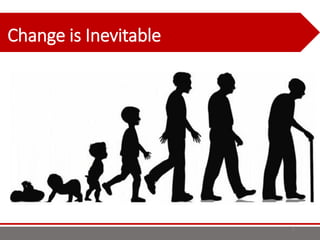
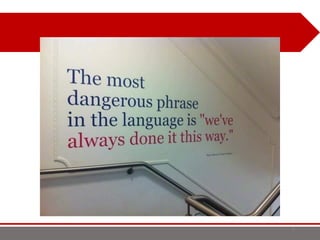
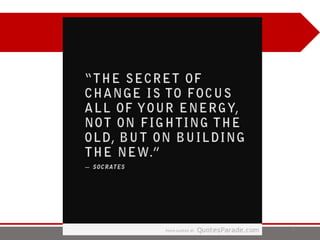
Change is Inevitable
2
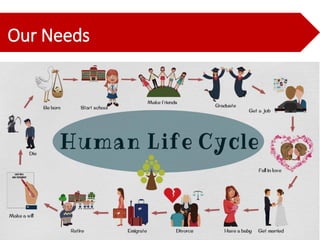
Our Needs
3
4
5
6
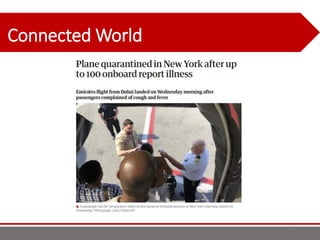
Connected World
7
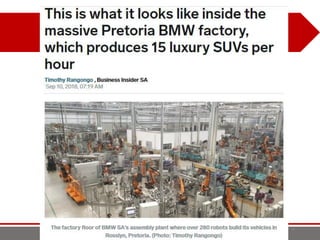
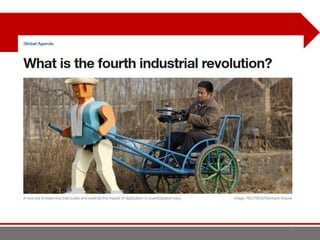
Fourth Industrial Revolution
• Before: Steam & Water, Electricity &
assembly lines, Computerization
• Current and developing environment in
which disruptive technologies and trends
such as the Internet of Things, robotics,
virtual reality (VR) and artificial intelligence
(AI) are changing the way we live and
work
• Smart technologies to allow machines to
interact, visualise production chain, make
autonomous decisions
8
• What is the 4th Industrial Revolution?
https://www.youtube.com/watch?time_co
ntinue=5&v=kpW9JcWxKq0
• Integration between natural & artificial –
become more efficient
9
• ”It is characterized by a fusion of
technologies that is blurring the lines
between the physical, digital, and
biological spheres.”
• “Constant connection may deprive us of
one of life’s most important assets: the time
to pause, reflect, and engage in
meaningful conversation.”
https://www.weforum.org/agenda/2016/01/the-fourth-industrial-
revolution-what-it-means-and-how-to-respond
10
11
12
• Risks & opportunities:
“decision-makers are too often caught in
traditional, linear (and non-disruptive)
thinking or too absorbed by immediate
concerns to think strategically about the
forces of disruption and innovation shaping
our future.“
- Prof Klaus Schwab, Founder & CEO of World Economic Forum
13
National Development Plan
• “… offers a long-term perspective. It defines a
desired destination and identifies the role different
sectors of society need to play in reaching that
goal …”
• “ …. aims to eliminate poverty and reduce
inequality by 2030. According to the plan, South
Africa can realise these goals by drawing on the
energies of its people, growing an inclusive
economy, building capabilities, enhancing the
capacity of the state, and promoting leadership
and partnerships throughout society.”
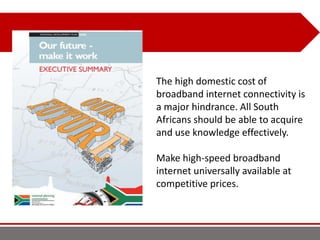
The high domestic cost of
broadband internet connectivity is
a major hindrance. All South
Africans should be able to acquire
and use knowledge effectively.
Make high-speed broadband
internet universally available at
competitive prices.
Which of your tasks as a librarian in your
library will never be replaced by AI, VR,
robots?
16
17
18
“The spread of information and
communications technology and global
interconnectedness has great potential to
accelerate human progress, to bridge the
digital divide and to develop knowledge
societies, as does scientific and
technological innovation across areas as
diverse as medicine and energy.”
Transforming our world: the UN2030
Agenda for Sustainable Development -
Science
19
20
21
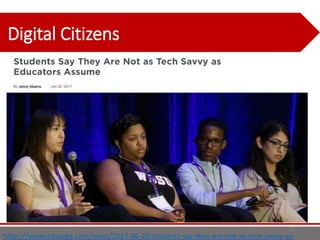
Digital Citizens
https://www.edsurge.com/news/2017-06-20-students-say-they-are-not-as-tech-savvy-as-
22
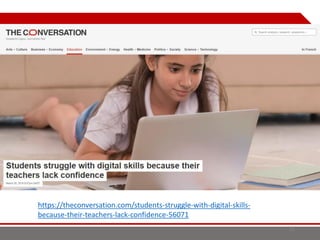
https://theconversation.com/students-struggle-with-digital-skills-
because-their-teachers-lack-confidence-56071
23
24
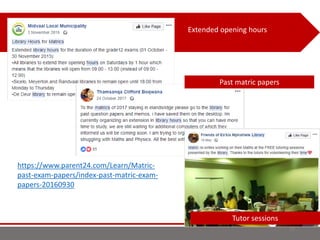
Extended opening hours
Past matric papers
Tutor sessions
https://www.parent24.com/Learn/Matric-
past-exam-papers/index-past-matric-exam-
papers-20160930
25
`
26
27
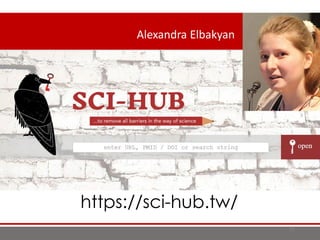
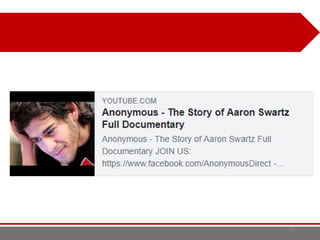
https://sci-hub.tw/
Alexandra Elbakyan
28
29
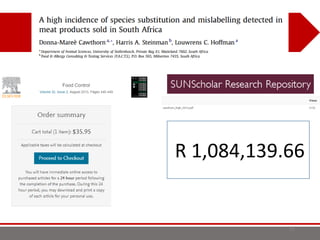
R 1,084,139.66
30
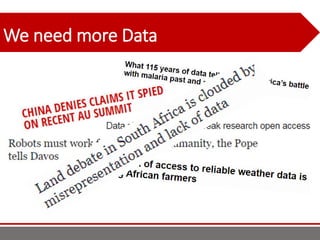
We need more Data
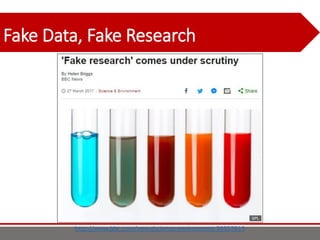
Fake Data, Fake Research
http://www.bbc.com/news/science-environment-39357819
35
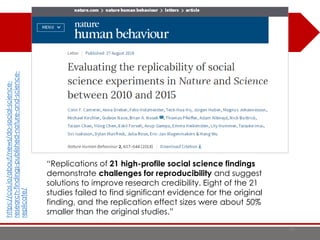
“Replications of 21 high-profile social science findings
demonstrate challenges for reproducibility and suggest
solutions to improve research credibility. Eight of the 21
studies failed to find significant evidence for the original
finding, and the replication effect sizes were about 50%
smaller than the original studies.”
https://cos.io/about/news/do-social-science-
research-findings-published-nature-and-science-
replicate/
Data bring Power, but also Responsibility
36
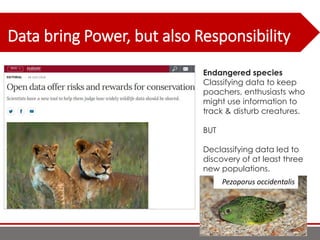
Endangered species
Classifying data to keep
poachers, enthusiasts who
might use information to
track & disturb creatures.
BUT
Declassifying data led to
discovery of at least three
new populations.
Pezoporus occidentalis
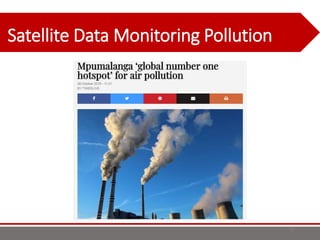
Satellite Data Monitoring Pollution
37
Slide Credit: Laura Merson, IDDO
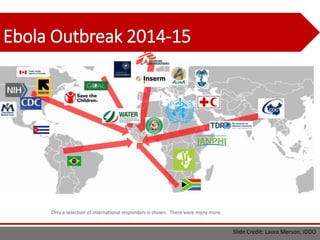
Ebola Outbreak 2014-15
Slide Credit: Laura Merson, IDDO
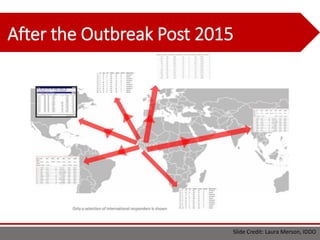
After the Outbreak Post 2015
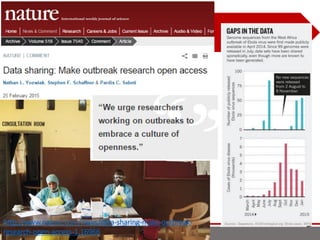
http://www.nature.com/news/data-sharing-make-outbreak-
research-open-access-1.16966
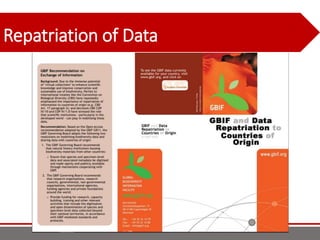
Repatriation of Data
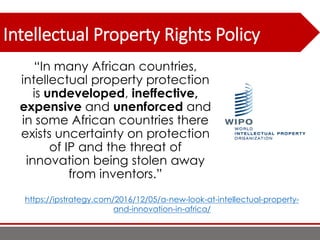
Intellectual Property Rights Policy
“In many African countries,
intellectual property protection
is undeveloped, ineffective,
expensive and unenforced and
in some African countries there
exists uncertainty on protection
of IP and the threat of
innovation being stolen away
from inventors.”
https://ipstrategy.com/2016/12/05/a-new-look-at-intellectual-property-
and-innovation-in-africa/
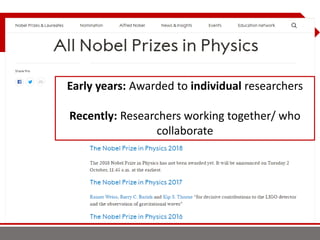
Early years: Awarded to individual researchers
Recently: Researchers working together/ who
collaborate
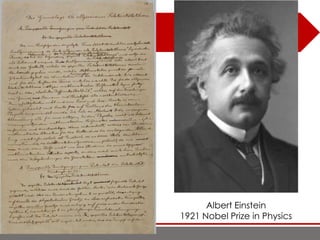
Albert Einstein
1921 Nobel Prize in Physics
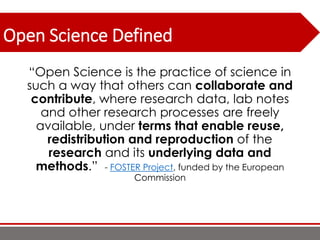
Open Science Defined
“Open Science is the practice of science in
such a way that others can collaborate and
contribute, where research data, lab notes
and other research processes are freely
available, under terms that enable reuse,
redistribution and reproduction of the
research and its underlying data and
methods.” - FOSTER Project, funded by the European
Commission
But Open Science is more than just process - it is
also about collaboration, and strong
engagement with and participation of wider
society, of which citizen science is also a
component. It is a vital enabler in maintaining
the rigour and reliability of science; in creatively
integrating diverse data resources to address
complex modern challenges; in open
innovation and in engaging with other societal
actors as knowledge partners in tackling shared
problems. It is fundamental to realisation of the
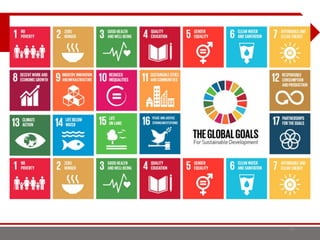
Sustainable Development Goals.
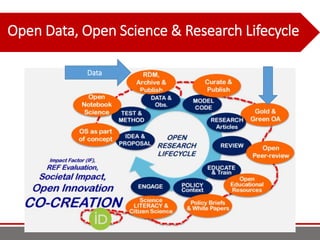
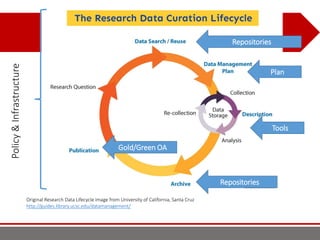
Open Data, Open Science & Research Lifecycle
Data
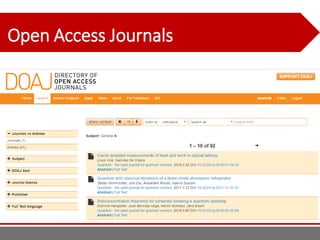
Open Access Journals
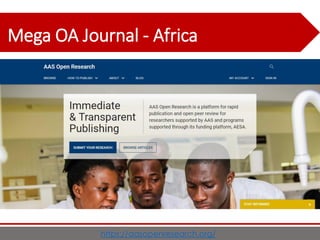
Mega OA Journal - Africa
https://aasopenresearch.org/
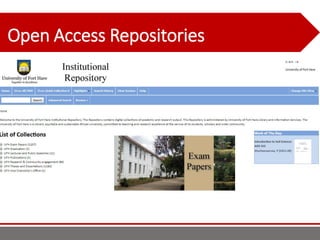
Open Access Repositories
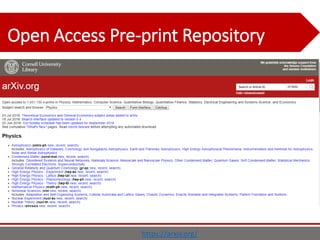
Open Access Pre-print Repository
https://arxiv.org/
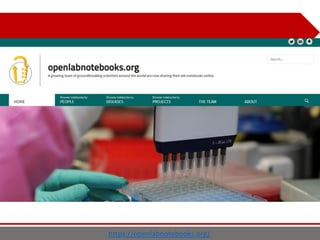
https://openlabnotebooks.org/
Original Research Data Lifecycle image from University of California, Santa Cruz
http://guides.library.ucsc.edu/datamanagement/
Repositories
Repositories
Tools
Gold/Green OA
Plan
Policy&Infrastructure
Benefits of Open Data
• Improve efficiency in science
• Reduce duplication and the costs of creating,
transferring and re-using data
• Enable more research on the same data
• Multiply opportunities for domestic and global
participation in the research process
• Increase transparency and quality in the
research validation process
• Allow greater replication and validation of
scientific results
• Speed the transfer of knowledge
• Reduce delays in the re-use of the results of
scientific research, including articles and data
sets
• Promote swifter development from research to
innovation
• Increase knowledge spill-overs to the
economy
• Increased access to the results of publicly
funded research can foster spill-overs and
boost innovation across the economy
• Increase awareness and conscious choices
among consumers
• Promote citizens’ engagement in science
and research
• Open Science and Open Data initiatives may
promote awareness and trust in science
among citizens
• In some cases, greater citizen engagement
may lead to active participation in scientific
experiments and data collection
• Address global challenges more
effectively
• Global challenges require coordinated
international actions
• Open Science and Open Data can promote
collaborative efforts and faster knowledge
transfer for a better understanding of
challenges such as climate change, and could
help identify solutions
“Several open science activities are
underway across Africa, but a great deal
will be gained if, in the context of
developing inter-regional links, these
activities were to be coordinated and
developed through such a coordinating
initiative.” - CODATA
Collaboration
• Strength in collaboration
• Disciplines group themselves together
• Without collaboration, competition will
continue
• Diversity & pooling knowledge together
help to accelerate discoveries
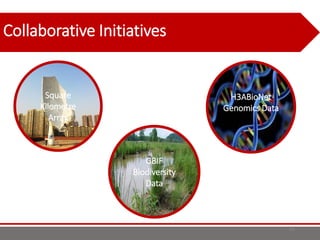
Square
Kilometre
Array
H3ABioNet
Genomics Data
GBIF
Biodiversity
Data
Collaborative Initiatives
63
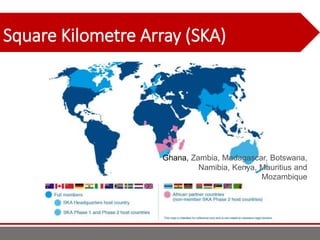
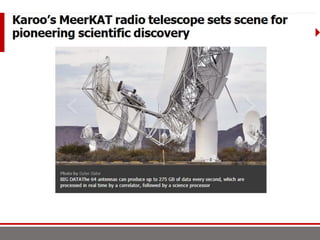
Square Kilometre Array (SKA)
Ghana, Zambia, Madagascar, Botswana,
Namibia, Kenya, Mauritius and
Mozambique
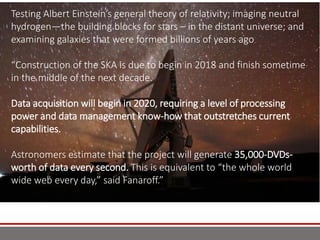
Testing Albert Einstein’s general theory of relativity; imaging neutral
hydrogen—the building blocks for stars – in the distant universe; and
examining galaxies that were formed billions of years ago
“Construction of the SKA is due to begin in 2018 and finish sometime
in the middle of the next decade.
Data acquisition will begin in 2020, requiring a level of processing
power and data management know-how that outstretches current
capabilities.
Astronomers estimate that the project will generate 35,000-DVDs-
worth of data every second. This is equivalent to “the whole world
wide web every day,” said Fanaroff.”
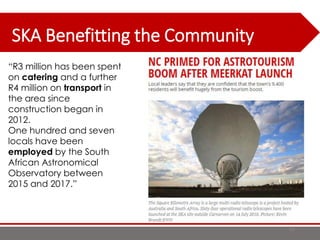
SKA Benefitting the Community
67
“R3 million has been spent
on catering and a further
R4 million on transport in
the area since
construction began in
2012.
One hundred and seven
locals have been
employed by the South
African Astronomical
Observatory between
2015 and 2017.”
SKA Benefitting South Africans
SKA SA Managing Director Rob Adam
said, “We have electricians being trained,
boilermakers, fitters and turners and people
splashing the fibre that carries the signal
from the satellites through the computers,
that fibre is being splashed by people from
the local community.”
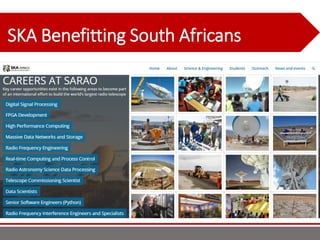
SKA Benefitting South Africans
SKA Benefitting Africa
The SKA project will also transfer skills and
knowledge to African countries, which will
build, maintain, operate and use radio
telescopes.
It’s hoped the program will bring new
science opportunities to Africa in a relatively
short timescale and develop radio
astronomy science communities in SKA
partner countries.
71
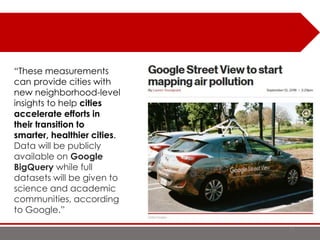
“These measurements
can provide cities with
new neighborhood-level
insights to help cities
accelerate efforts in
their transition to
smarter, healthier cities.
Data will be publicly
available on Google
BigQuery while full
datasets will be given to
science and academic
communities, according
to Google.”
72
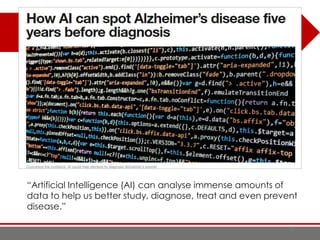
“Artificial Intelligence (AI) can analyse immense amounts of
data to help us better study, diagnose, treat and even prevent
disease.”
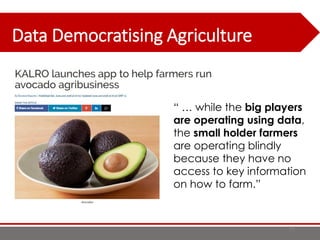
Data Democratising Agriculture
73
“ … while the big players
are operating using data,
the small holder farmers
are operating blindly
because they have no
access to key information
on how to farm.”
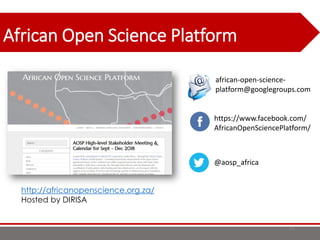
African Open Science Platform
74
http://africanopenscience.org.za/
Hosted by DIRISA
african-open-science-
platform@googlegroups.com
https://www.facebook.com/
AfricanOpenSciencePlatform/
@aosp_africa
75
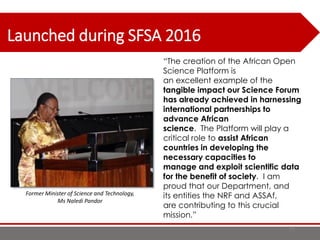
Launched during SFSA 2016
“The creation of the African Open
Science Platform is
an excellent example of the
tangible impact our Science Forum
has already achieved in harnessing
international partnerships to
advance African
science. The Platform will play a
critical role to assist African
countries in developing the
necessary capacities to
manage and exploit scientific data
for the benefit of society. I am
proud that our Department, and
its entities the NRF and ASSAf,
are contributing to this crucial
mission.”
Former Minister of Science and Technology,
Ms Naledi Pandor
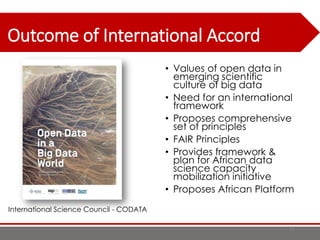
Outcome of International Accord
76
• Values of open data in
emerging scientific
culture of big data
• Need for an international
framework
• Proposes comprehensive
set of principles
• FAIR Principles
• Provides framework &
plan for African data
science capacity
mobilization initiative
• Proposes African Platform
International Science Council - CODATA
Draft SA White Paper on STI, 2018
77
“As part of its commitment to African
STI cooperation, South Africa will also
work to advance the open science
agenda elsewhere on the continent
and within regional frameworks. The
strategic role of the African Open
Science Platform, hosted by the
Academy of Science of South Africa,
which promotes African-wide
development and coordination of data
policies, data training and data
infrastructure, will be leveraged with
the support of the DST and the National
Research Foundation (NRF). In
addition, South Africa is one of the
founding members of the global Open
Government Partnership (OECD) ….”Input by 18 October 2018
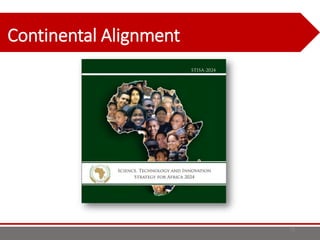
Continental Alignment
78
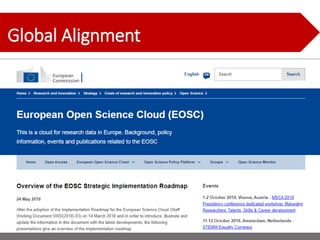
Global Alignment
79
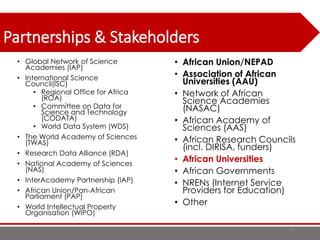
• Global Network of Science
Academies (IAP)
• International Science
Council(ISC)
• Regional Office for Africa
(ROA)
• Committee on Data for
Science and Technology
(CODATA)
• World Data System (WDS)
• The World Academy of Sciences
(TWAS)
• Research Data Alliance (RDA)
• National Academy of Sciences
(NAS)
• InterAcademy Partnership (IAP)
• African Union/Pan-African
Parliament (PAP)
• World Intellectual Property
Organisation (WIPO)
80
Partnerships & Stakeholders
• African Union/NEPAD
• Association of African
Universities (AAU)
• Network of African
Science Academies
(NASAC)
• African Academy of
Sciences (AAS)
• African Research Councils
(incl. DIRISA, funders)
• African Universities
• African Governments
• NRENs (Internet Service
Providers for Education)
• Other
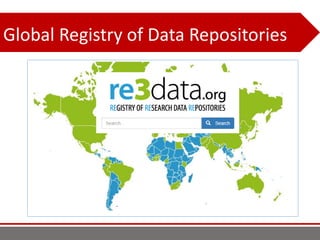
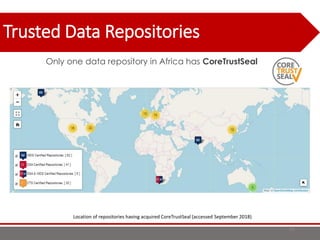
Global Registry of Data Repositories
Only one data repository in Africa has CoreTrustSeal
Location of repositories having acquired CoreTrustSeal (accessed September 2018)
Trusted Data Repositories
82
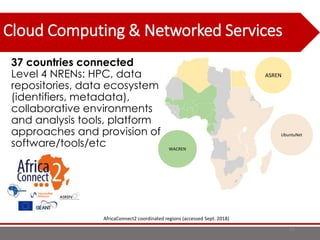
Cloud Computing & Networked Services
37 countries connected
Level 4 NRENs: HPC, data
repositories, data ecosystem
(identifiers, metadata),
collaborative environments
and analysis tools, platform
approaches and provision of
software/tools/etc
85
ASREN
WACREN
UbuntuNet
AfricaConnect2 coordinated regions (accessed Sept. 2018)
Cloud Computing & Networked Services
86
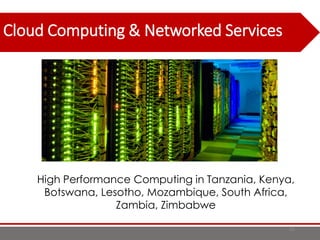
High Performance Computing in Tanzania, Kenya,
Botswana, Lesotho, Mozambique, South Africa,
Zambia, Zimbabwe
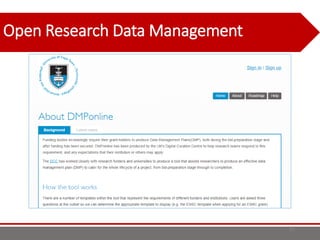
Open Research Data Management
87
88
89
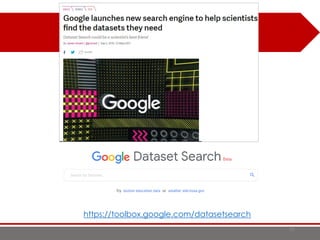
https://toolbox.google.com/datasetsearch
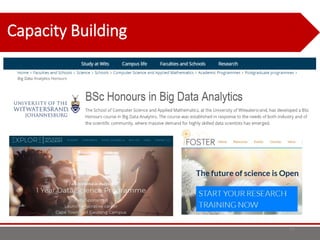
Capacity Building
90
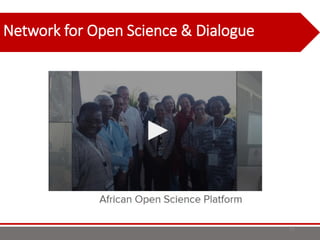
Network for Open Science & Dialogue
91
UN Key Message
Africa Regional Forum on Sustainable Development,
Dakar, May 2018
UN: Economic Commission for Africa
“79. The creation of an African platform for research
and innovation exchange will enable the
dissemination of goal-relevant African research and
innovation to governments and citizens. It could
form the basis for linking researchers and innovators
with the funding required to scale up their work. The
proposed platform would showcase and share
Africa’s efforts to develop goal-relevant research
and innovation and could be coordinated with the
Global Innovation Exchange.”
92
93
“For [a country] to be competitive, it is
important that it keeps up with the global
trends in the provision of modern LIS that
exploit all the benefits of ICTs.
The LIS sector’s capacity to contribute to the
nation’s ability to convert knowledge into
innovations and wealth will determine its
value to the nation.”
- LIS Transformation Charter (2014) -
Thank You
94
ina@assaf.org.za

Why Open Science Matters to Libraries/Ina Smith

  • 1.
    The Landscape ofOpen Science in Africa Why Open Science Matters to Libraries 1 Ina Smith 30 October 2018 With direction from
  • 2.
  • 3.
  • 4.
  • 5.
  • 6.
  • 7.
  • 8.
    Fourth Industrial Revolution •Before: Steam & Water, Electricity & assembly lines, Computerization • Current and developing environment in which disruptive technologies and trends such as the Internet of Things, robotics, virtual reality (VR) and artificial intelligence (AI) are changing the way we live and work • Smart technologies to allow machines to interact, visualise production chain, make autonomous decisions 8
  • 9.
    • What isthe 4th Industrial Revolution? https://www.youtube.com/watch?time_co ntinue=5&v=kpW9JcWxKq0 • Integration between natural & artificial – become more efficient 9
  • 10.
    • ”It ischaracterized by a fusion of technologies that is blurring the lines between the physical, digital, and biological spheres.” • “Constant connection may deprive us of one of life’s most important assets: the time to pause, reflect, and engage in meaningful conversation.” https://www.weforum.org/agenda/2016/01/the-fourth-industrial- revolution-what-it-means-and-how-to-respond 10
  • 11.
  • 12.
  • 13.
    • Risks &opportunities: “decision-makers are too often caught in traditional, linear (and non-disruptive) thinking or too absorbed by immediate concerns to think strategically about the forces of disruption and innovation shaping our future.“ - Prof Klaus Schwab, Founder & CEO of World Economic Forum 13
  • 14.
    National Development Plan •“… offers a long-term perspective. It defines a desired destination and identifies the role different sectors of society need to play in reaching that goal …” • “ …. aims to eliminate poverty and reduce inequality by 2030. According to the plan, South Africa can realise these goals by drawing on the energies of its people, growing an inclusive economy, building capabilities, enhancing the capacity of the state, and promoting leadership and partnerships throughout society.”
  • 15.
    The high domesticcost of broadband internet connectivity is a major hindrance. All South Africans should be able to acquire and use knowledge effectively. Make high-speed broadband internet universally available at competitive prices.
  • 16.
    Which of yourtasks as a librarian in your library will never be replaced by AI, VR, robots? 16
  • 17.
  • 18.
    18 “The spread ofinformation and communications technology and global interconnectedness has great potential to accelerate human progress, to bridge the digital divide and to develop knowledge societies, as does scientific and technological innovation across areas as diverse as medicine and energy.” Transforming our world: the UN2030 Agenda for Sustainable Development -
  • 19.
  • 20.
  • 21.
  • 22.
  • 23.
  • 24.
    24 Extended opening hours Pastmatric papers Tutor sessions https://www.parent24.com/Learn/Matric- past-exam-papers/index-past-matric-exam- papers-20160930
  • 25.
  • 26.
  • 27.
  • 28.
  • 29.
  • 30.
  • 31.
  • 32.
    Fake Data, FakeResearch http://www.bbc.com/news/science-environment-39357819
  • 35.
    35 “Replications of 21high-profile social science findings demonstrate challenges for reproducibility and suggest solutions to improve research credibility. Eight of the 21 studies failed to find significant evidence for the original finding, and the replication effect sizes were about 50% smaller than the original studies.” https://cos.io/about/news/do-social-science- research-findings-published-nature-and-science- replicate/
  • 36.
    Data bring Power,but also Responsibility 36 Endangered species Classifying data to keep poachers, enthusiasts who might use information to track & disturb creatures. BUT Declassifying data led to discovery of at least three new populations. Pezoporus occidentalis
  • 37.
  • 38.
    Slide Credit: LauraMerson, IDDO Ebola Outbreak 2014-15
  • 39.
    Slide Credit: LauraMerson, IDDO After the Outbreak Post 2015
  • 40.
  • 41.
  • 42.
    Intellectual Property RightsPolicy “In many African countries, intellectual property protection is undeveloped, ineffective, expensive and unenforced and in some African countries there exists uncertainty on protection of IP and the threat of innovation being stolen away from inventors.” https://ipstrategy.com/2016/12/05/a-new-look-at-intellectual-property- and-innovation-in-africa/
  • 43.
    Early years: Awardedto individual researchers Recently: Researchers working together/ who collaborate
  • 44.
  • 45.
    Open Science Defined “OpenScience is the practice of science in such a way that others can collaborate and contribute, where research data, lab notes and other research processes are freely available, under terms that enable reuse, redistribution and reproduction of the research and its underlying data and methods.” - FOSTER Project, funded by the European Commission
  • 46.
    But Open Scienceis more than just process - it is also about collaboration, and strong engagement with and participation of wider society, of which citizen science is also a component. It is a vital enabler in maintaining the rigour and reliability of science; in creatively integrating diverse data resources to address complex modern challenges; in open innovation and in engaging with other societal actors as knowledge partners in tackling shared problems. It is fundamental to realisation of the Sustainable Development Goals.
  • 47.
    Open Data, OpenScience & Research Lifecycle Data
  • 48.
  • 49.
    Mega OA Journal- Africa https://aasopenresearch.org/
  • 50.
  • 51.
    Open Access Pre-printRepository https://arxiv.org/
  • 53.
  • 54.
    Original Research DataLifecycle image from University of California, Santa Cruz http://guides.library.ucsc.edu/datamanagement/ Repositories Repositories Tools Gold/Green OA Plan Policy&Infrastructure
  • 55.
    Benefits of OpenData • Improve efficiency in science • Reduce duplication and the costs of creating, transferring and re-using data • Enable more research on the same data • Multiply opportunities for domestic and global participation in the research process
  • 56.
    • Increase transparencyand quality in the research validation process • Allow greater replication and validation of scientific results
  • 57.
    • Speed thetransfer of knowledge • Reduce delays in the re-use of the results of scientific research, including articles and data sets • Promote swifter development from research to innovation
  • 58.
    • Increase knowledgespill-overs to the economy • Increased access to the results of publicly funded research can foster spill-overs and boost innovation across the economy • Increase awareness and conscious choices among consumers
  • 59.
    • Promote citizens’engagement in science and research • Open Science and Open Data initiatives may promote awareness and trust in science among citizens • In some cases, greater citizen engagement may lead to active participation in scientific experiments and data collection
  • 60.
    • Address globalchallenges more effectively • Global challenges require coordinated international actions • Open Science and Open Data can promote collaborative efforts and faster knowledge transfer for a better understanding of challenges such as climate change, and could help identify solutions
  • 61.
    “Several open scienceactivities are underway across Africa, but a great deal will be gained if, in the context of developing inter-regional links, these activities were to be coordinated and developed through such a coordinating initiative.” - CODATA
  • 62.
    Collaboration • Strength incollaboration • Disciplines group themselves together • Without collaboration, competition will continue • Diversity & pooling knowledge together help to accelerate discoveries
  • 63.
  • 64.
    Square Kilometre Array(SKA) Ghana, Zambia, Madagascar, Botswana, Namibia, Kenya, Mauritius and Mozambique
  • 65.
    Testing Albert Einstein’sgeneral theory of relativity; imaging neutral hydrogen—the building blocks for stars – in the distant universe; and examining galaxies that were formed billions of years ago “Construction of the SKA is due to begin in 2018 and finish sometime in the middle of the next decade. Data acquisition will begin in 2020, requiring a level of processing power and data management know-how that outstretches current capabilities. Astronomers estimate that the project will generate 35,000-DVDs- worth of data every second. This is equivalent to “the whole world wide web every day,” said Fanaroff.”
  • 67.
    SKA Benefitting theCommunity 67 “R3 million has been spent on catering and a further R4 million on transport in the area since construction began in 2012. One hundred and seven locals have been employed by the South African Astronomical Observatory between 2015 and 2017.”
  • 68.
    SKA Benefitting SouthAfricans SKA SA Managing Director Rob Adam said, “We have electricians being trained, boilermakers, fitters and turners and people splashing the fibre that carries the signal from the satellites through the computers, that fibre is being splashed by people from the local community.”
  • 69.
  • 70.
    SKA Benefitting Africa TheSKA project will also transfer skills and knowledge to African countries, which will build, maintain, operate and use radio telescopes. It’s hoped the program will bring new science opportunities to Africa in a relatively short timescale and develop radio astronomy science communities in SKA partner countries.
  • 71.
    71 “These measurements can providecities with new neighborhood-level insights to help cities accelerate efforts in their transition to smarter, healthier cities. Data will be publicly available on Google BigQuery while full datasets will be given to science and academic communities, according to Google.”
  • 72.
    72 “Artificial Intelligence (AI)can analyse immense amounts of data to help us better study, diagnose, treat and even prevent disease.”
  • 73.
    Data Democratising Agriculture 73 “… while the big players are operating using data, the small holder farmers are operating blindly because they have no access to key information on how to farm.”
  • 74.
    African Open SciencePlatform 74 http://africanopenscience.org.za/ Hosted by DIRISA african-open-science- platform@googlegroups.com https://www.facebook.com/ AfricanOpenSciencePlatform/ @aosp_africa
  • 75.
    75 Launched during SFSA2016 “The creation of the African Open Science Platform is an excellent example of the tangible impact our Science Forum has already achieved in harnessing international partnerships to advance African science. The Platform will play a critical role to assist African countries in developing the necessary capacities to manage and exploit scientific data for the benefit of society. I am proud that our Department, and its entities the NRF and ASSAf, are contributing to this crucial mission.” Former Minister of Science and Technology, Ms Naledi Pandor
  • 76.
    Outcome of InternationalAccord 76 • Values of open data in emerging scientific culture of big data • Need for an international framework • Proposes comprehensive set of principles • FAIR Principles • Provides framework & plan for African data science capacity mobilization initiative • Proposes African Platform International Science Council - CODATA
  • 77.
    Draft SA WhitePaper on STI, 2018 77 “As part of its commitment to African STI cooperation, South Africa will also work to advance the open science agenda elsewhere on the continent and within regional frameworks. The strategic role of the African Open Science Platform, hosted by the Academy of Science of South Africa, which promotes African-wide development and coordination of data policies, data training and data infrastructure, will be leveraged with the support of the DST and the National Research Foundation (NRF). In addition, South Africa is one of the founding members of the global Open Government Partnership (OECD) ….”Input by 18 October 2018
  • 78.
  • 79.
  • 80.
    • Global Networkof Science Academies (IAP) • International Science Council(ISC) • Regional Office for Africa (ROA) • Committee on Data for Science and Technology (CODATA) • World Data System (WDS) • The World Academy of Sciences (TWAS) • Research Data Alliance (RDA) • National Academy of Sciences (NAS) • InterAcademy Partnership (IAP) • African Union/Pan-African Parliament (PAP) • World Intellectual Property Organisation (WIPO) 80 Partnerships & Stakeholders • African Union/NEPAD • Association of African Universities (AAU) • Network of African Science Academies (NASAC) • African Academy of Sciences (AAS) • African Research Councils (incl. DIRISA, funders) • African Universities • African Governments • NRENs (Internet Service Providers for Education) • Other
  • 81.
    Global Registry ofData Repositories
  • 82.
    Only one datarepository in Africa has CoreTrustSeal Location of repositories having acquired CoreTrustSeal (accessed September 2018) Trusted Data Repositories 82
  • 85.
    Cloud Computing &Networked Services 37 countries connected Level 4 NRENs: HPC, data repositories, data ecosystem (identifiers, metadata), collaborative environments and analysis tools, platform approaches and provision of software/tools/etc 85 ASREN WACREN UbuntuNet AfricaConnect2 coordinated regions (accessed Sept. 2018)
  • 86.
    Cloud Computing &Networked Services 86 High Performance Computing in Tanzania, Kenya, Botswana, Lesotho, Mozambique, South Africa, Zambia, Zimbabwe
  • 87.
    Open Research DataManagement 87
  • 88.
  • 89.
  • 90.
  • 91.
    Network for OpenScience & Dialogue 91
  • 92.
    UN Key Message AfricaRegional Forum on Sustainable Development, Dakar, May 2018 UN: Economic Commission for Africa “79. The creation of an African platform for research and innovation exchange will enable the dissemination of goal-relevant African research and innovation to governments and citizens. It could form the basis for linking researchers and innovators with the funding required to scale up their work. The proposed platform would showcase and share Africa’s efforts to develop goal-relevant research and innovation and could be coordinated with the Global Innovation Exchange.” 92
  • 93.
    93 “For [a country]to be competitive, it is important that it keeps up with the global trends in the provision of modern LIS that exploit all the benefits of ICTs. The LIS sector’s capacity to contribute to the nation’s ability to convert knowledge into innovations and wealth will determine its value to the nation.” - LIS Transformation Charter (2014) -
  • 94.