All rights Reserved by IIMAT
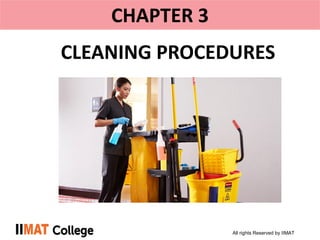
CHAPTER 3
CLEANING PROCEDURES
All rights Reserved by IIMAT
OBJECTIVE
• Explain the distribution of work at the beginning of
housekeeping day.
• Describe the daily sequence of functions
performed by the housekeeping department.
• Explain guestroom and bathroom cleaning
procedures.
• Discuss lost and found and guestroom inspection.
• Learn about public areas and back of the house
cleaning.
• Discuss cleaning and maintenance of surfaces.
All rights Reserved by IIMAT
TYPES OF CLEANING PROCEDURE
1. Guestroom Cleaning Procedures
2. Bathroom Cleaning Procedures
3. Lost-and-Found Procedures
4. Do-not-Disturb Procedures
5. Inspection of Rooms
6. The P.M. Room Report
7. The Evening Shift
8. Public Areas and Back-of-the-House Cleaning
9. Surface Cleaning
All rights Reserved by IIMAT
1. Guestroom Cleaning Procedures
• Early in the morning, distribution of work in the
housekeeping department is based on a report
provided by the front desk.
• The report specifies the status of all guestrooms.
• Each team supervisor is given a list of the status of
guestrooms in his/her sections.
• The team supervisors provide each section
housekeeper with a list with the status of rooms in
his/her section.
All rights Reserved by IIMAT
Guestroom Cleaning Procedures (Cont.)
• As soon as possible, the A.M. room check is
conducted by all teams entering the rooms
(except those with DND signs) at or about the
same time.
• The purpose of checking the status of the
guestrooms is to verify the accuracy of the
front desk report received early in the
morning.
• Any observed discrepancy is communicated
to the front desk immediately.
All rights Reserved by IIMAT
Guestroom Cleaning Procedures (Cont.)
• Step-by-step procedures for
guestroom cleaning should be clearly
defined in the department’s standing
operating procedures.
• All section housekeepers should be
trained to follow these procedures
exactly.
All rights Reserved by IIMAT
2. Bathroom Cleaning Procedures
• Section housekeepers should wear
gloves when cleaning the
guestrooms’ bathrooms for chemical
and germ protection.
• Procedures to clean bathrooms
should be well specified on the
department’s SOPs.
All rights Reserved by IIMAT
3. Lost-and-Found Procedures
• All guest items found should be controlled
by the housekeeping department.
• All found articles should be tagged,
logged, and kept in a safe location.
• It is customary to give articles not claimed
to the employee who found them or a
charitable organization.
All rights Reserved by IIMAT
4. Resolution of Do-not-Disturb Rooms
• Just before the end of the morning shift,
the status of the DND rooms should be
ascertained.
–It is important to verify what is inside a DND
room should a guest be in need of help or
unable to use the phone.
• Procedures for checking the status of DND
rooms should be clearly specified in the
department’s SOPs.
All rights Reserved by IIMAT
5. Inspections of Rooms
• Once cleaned, guestrooms should be
inspected by a qualified staff before they
are handed over to the front desk for
renting.
• A guestroom inspection form should be
used to conduct the inspection.
• The person who inspects rooms should
be well trained to detect errors and make
sure everything is in perfect order.
All rights Reserved by IIMAT
6. The P.M. Housekeeping Report
• Prior to the end of the morning shift, all section
housekeepers conduct a check of all rooms
simultaneously.
• The reports of all section housekeepers are
recorded and delivered to the front office.
• The front desk will compare the housekeeping
room status with the status kept in the front
desk computer. Any discrepancy is quickly
investigated and corrected.
All rights Reserved by IIMAT
7. The Evening Shift
• After the morning shift ends, one
housekeeping team conducts the evening
activities. These activities include:
– Turndown service
– Cleaning day-rate and late-checkout rooms
– Filling guest requests
– Restocking service carts
– Processing soiled linen
All rights Reserved by IIMAT
8. Public Areas and
Back-of-the-House Cleaning
• Public and employee areas are cleaned by
public areas attendants scheduled to work
regardless of the property’s occupancy.
• Special attention must be given to the foyer
and lobby where guests get the first
impression of the property.
• Public restrooms must be constantly checked,
cleaned, and stocked. Special germicidal and
disinfectant products should be used to
minimize the spread of disease.
All rights Reserved by IIMAT
9. Surface Cleaning
• The first step to redo floors is to remove the worn-out
finish using a stripping solution. After the floor dries,
porous surfaces are treated with a sealer to protect
them from wear and tear. The last step is to apply a
finish to give the floor a glossy, shiny look.
– Synthetic rubber floors are non-porous and only require
mopping to keep clean. The cleaning solution used should
be pH neutral.
– Vinyl floors are non-porous and resistant to most chemical
spills. Daily mop-and-rinse will remove most dirt and grime.
All rights Reserved by IIMAT
Surface Cleaning (Cont.)
– Wood floors are porous and must be well sealed to
prevent stains. These surfaces can be treated with a
combination sealer/finish made of waterborne
polyurethane.
– Carpets should be vacuumed daily to prevent gritty
soil tracked by guests from destroying the pile
fabric. Marks and stains can be removed by bonnet
cleaning. Placing walk-off mats in doorways and
plastic runners over high-traffic sections will
lengthen the life of carpets.
– Upholstered surfaces can be spot-cleaned with
most of the same products used on carpets.
All rights Reserved by IIMAT
Surface Cleaning (Cont.)
– Ceramic floors are resistant to water spills and easy
to clean. These surfaces are cleaned by sweeping and
damp mopping. Ceramic floors can be quite slippery
when wet.
– Marble/Terrazo floors are very sensitive to oils and
acid and alkaline cleaners. A mild detergent is all that
is needed to keep them clean. These type of surfaces
are porous and must be sealed after stripping.
– Epoxy floors are non-porous, and an alkaline
compound diluted in water is all that is needed to
keep them clean. Epoxy surfaces can be kept shiny
with a light finish application.
All rights Reserved by IIMAT
Surface Cleaning (Cont.)
– Concrete floors are porous surfaces that should be
sealed to prevent liquid stains from seeping in.
– Walls and ceilings:
• Painted surfaces: clean with mild detergent water.
• Plastic laminate: requires damp-wiping as it is non-
porous.
• Fabric materials: spot-clean with chemicals rather than
water and detergent to avoid shrinkage.
• Vinyl covering: durable and easy to clean with mild
detergents.
• Most wallpaper coverings: cannot be cleaned with
water.
All rights Reserved by IIMAT
TUTORIAL
• Why cleaning procedure are important? Discuss
and give your explanation. (5 Marks)
• List down types of Cleaning Procedure. (9 Marks)
• How can you explain the Guestroom Cleaning
Procedure? Elaborate by your own words.
(10 Marks)

Cleaning Procedure

  • 1.
    All rights Reservedby IIMAT CHAPTER 3 CLEANING PROCEDURES
  • 2.
    All rights Reservedby IIMAT OBJECTIVE • Explain the distribution of work at the beginning of housekeeping day. • Describe the daily sequence of functions performed by the housekeeping department. • Explain guestroom and bathroom cleaning procedures. • Discuss lost and found and guestroom inspection. • Learn about public areas and back of the house cleaning. • Discuss cleaning and maintenance of surfaces.
  • 3.
    All rights Reservedby IIMAT TYPES OF CLEANING PROCEDURE 1. Guestroom Cleaning Procedures 2. Bathroom Cleaning Procedures 3. Lost-and-Found Procedures 4. Do-not-Disturb Procedures 5. Inspection of Rooms 6. The P.M. Room Report 7. The Evening Shift 8. Public Areas and Back-of-the-House Cleaning 9. Surface Cleaning
  • 4.
    All rights Reservedby IIMAT 1. Guestroom Cleaning Procedures • Early in the morning, distribution of work in the housekeeping department is based on a report provided by the front desk. • The report specifies the status of all guestrooms. • Each team supervisor is given a list of the status of guestrooms in his/her sections. • The team supervisors provide each section housekeeper with a list with the status of rooms in his/her section.
  • 5.
    All rights Reservedby IIMAT Guestroom Cleaning Procedures (Cont.) • As soon as possible, the A.M. room check is conducted by all teams entering the rooms (except those with DND signs) at or about the same time. • The purpose of checking the status of the guestrooms is to verify the accuracy of the front desk report received early in the morning. • Any observed discrepancy is communicated to the front desk immediately.
  • 6.
    All rights Reservedby IIMAT Guestroom Cleaning Procedures (Cont.) • Step-by-step procedures for guestroom cleaning should be clearly defined in the department’s standing operating procedures. • All section housekeepers should be trained to follow these procedures exactly.
  • 7.
    All rights Reservedby IIMAT 2. Bathroom Cleaning Procedures • Section housekeepers should wear gloves when cleaning the guestrooms’ bathrooms for chemical and germ protection. • Procedures to clean bathrooms should be well specified on the department’s SOPs.
  • 8.
    All rights Reservedby IIMAT 3. Lost-and-Found Procedures • All guest items found should be controlled by the housekeeping department. • All found articles should be tagged, logged, and kept in a safe location. • It is customary to give articles not claimed to the employee who found them or a charitable organization.
  • 9.
    All rights Reservedby IIMAT 4. Resolution of Do-not-Disturb Rooms • Just before the end of the morning shift, the status of the DND rooms should be ascertained. –It is important to verify what is inside a DND room should a guest be in need of help or unable to use the phone. • Procedures for checking the status of DND rooms should be clearly specified in the department’s SOPs.
  • 10.
    All rights Reservedby IIMAT 5. Inspections of Rooms • Once cleaned, guestrooms should be inspected by a qualified staff before they are handed over to the front desk for renting. • A guestroom inspection form should be used to conduct the inspection. • The person who inspects rooms should be well trained to detect errors and make sure everything is in perfect order.
  • 11.
    All rights Reservedby IIMAT 6. The P.M. Housekeeping Report • Prior to the end of the morning shift, all section housekeepers conduct a check of all rooms simultaneously. • The reports of all section housekeepers are recorded and delivered to the front office. • The front desk will compare the housekeeping room status with the status kept in the front desk computer. Any discrepancy is quickly investigated and corrected.
  • 12.
    All rights Reservedby IIMAT 7. The Evening Shift • After the morning shift ends, one housekeeping team conducts the evening activities. These activities include: – Turndown service – Cleaning day-rate and late-checkout rooms – Filling guest requests – Restocking service carts – Processing soiled linen
  • 13.
    All rights Reservedby IIMAT 8. Public Areas and Back-of-the-House Cleaning • Public and employee areas are cleaned by public areas attendants scheduled to work regardless of the property’s occupancy. • Special attention must be given to the foyer and lobby where guests get the first impression of the property. • Public restrooms must be constantly checked, cleaned, and stocked. Special germicidal and disinfectant products should be used to minimize the spread of disease.
  • 14.
    All rights Reservedby IIMAT 9. Surface Cleaning • The first step to redo floors is to remove the worn-out finish using a stripping solution. After the floor dries, porous surfaces are treated with a sealer to protect them from wear and tear. The last step is to apply a finish to give the floor a glossy, shiny look. – Synthetic rubber floors are non-porous and only require mopping to keep clean. The cleaning solution used should be pH neutral. – Vinyl floors are non-porous and resistant to most chemical spills. Daily mop-and-rinse will remove most dirt and grime.
  • 15.
    All rights Reservedby IIMAT Surface Cleaning (Cont.) – Wood floors are porous and must be well sealed to prevent stains. These surfaces can be treated with a combination sealer/finish made of waterborne polyurethane. – Carpets should be vacuumed daily to prevent gritty soil tracked by guests from destroying the pile fabric. Marks and stains can be removed by bonnet cleaning. Placing walk-off mats in doorways and plastic runners over high-traffic sections will lengthen the life of carpets. – Upholstered surfaces can be spot-cleaned with most of the same products used on carpets.
  • 16.
    All rights Reservedby IIMAT Surface Cleaning (Cont.) – Ceramic floors are resistant to water spills and easy to clean. These surfaces are cleaned by sweeping and damp mopping. Ceramic floors can be quite slippery when wet. – Marble/Terrazo floors are very sensitive to oils and acid and alkaline cleaners. A mild detergent is all that is needed to keep them clean. These type of surfaces are porous and must be sealed after stripping. – Epoxy floors are non-porous, and an alkaline compound diluted in water is all that is needed to keep them clean. Epoxy surfaces can be kept shiny with a light finish application.
  • 17.
    All rights Reservedby IIMAT Surface Cleaning (Cont.) – Concrete floors are porous surfaces that should be sealed to prevent liquid stains from seeping in. – Walls and ceilings: • Painted surfaces: clean with mild detergent water. • Plastic laminate: requires damp-wiping as it is non- porous. • Fabric materials: spot-clean with chemicals rather than water and detergent to avoid shrinkage. • Vinyl covering: durable and easy to clean with mild detergents. • Most wallpaper coverings: cannot be cleaned with water.
  • 18.
    All rights Reservedby IIMAT TUTORIAL • Why cleaning procedure are important? Discuss and give your explanation. (5 Marks) • List down types of Cleaning Procedure. (9 Marks) • How can you explain the Guestroom Cleaning Procedure? Elaborate by your own words. (10 Marks)