“Sewing without the right tools
and equipment is like trying
to cook without the right
ingredients”.
Sewing Tools and Equipment and
their Uses
Sewing Tools and Equipment
Sewing Tools - instruments that aid in
accomplishing a sewing task. It can be
manipulated by hands.
Sewing Equipment - those are the more
complicated tool, it provides to carry out a
particular process or function.
MEASURING TOOLS - instruments used for
obtaining quantities, dimensions or forces of real world
objects.
 tape measure
 Sewing gauge
 Rulers
 yardsticks
 Tailors square
 French curve
MEASURING TOOLS
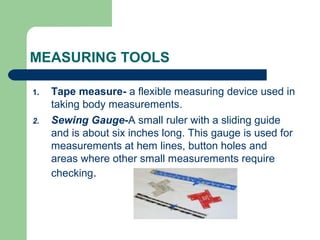
1. Tape measure- a flexible measuring device used in
taking body measurements.
2. Sewing Gauge-A small ruler with a sliding guide
and is about six inches long. This gauge is used for
measurements at hem lines, button holes and
areas where other small measurements require
checking.
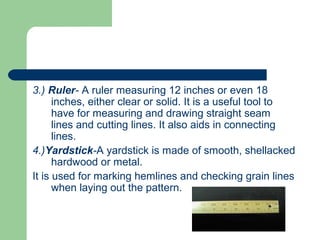
3.) Ruler- A ruler measuring 12 inches or even 18
inches, either clear or solid. It is a useful tool to
have for measuring and drawing straight seam
lines and cutting lines. It also aids in connecting
lines.
4.)Yardstick-A yardstick is made of smooth, shellacked
hardwood or metal.
It is used for marking hemlines and checking grain lines
when laying out the pattern.
5.) French Curve -This is used to shape the depth of the
neck hole and armhole of the pattern.
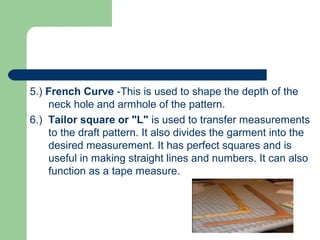
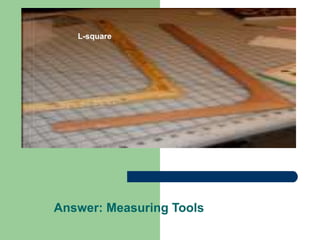
6.) Tailor square or "L" is used to transfer measurements
to the draft pattern. It also divides the garment into the
desired measurement. It has perfect squares and is
useful in making straight lines and numbers. It can also
function as a tape measure.
CUTTING TOOLS- a cutting implement; a
tool for cutting.
 Bent handled dressmaker’s shear
 Pinking shears
 Cutting scissors
 Thread clippers
 Seam ripper
CUTTING TOOLS
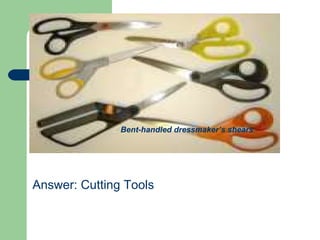
1.)Bent-handled dressmaker’s shears- These are
made of quality steel and hold a sharp cutting edge.
The blades move easily and cut smoothly along the
entire length and the points should come together.
Shears have the length of 7- 12 inches and are
satisfactory for most apparel fabrics.
2.) Pinking Shears- This is popular in zigzagging or
scalloped edge or for seam finishes. This is used to
finish seams and raw edges and to create decorative
edges on many types of fabric. It cuts a ravel-
resistant edge.
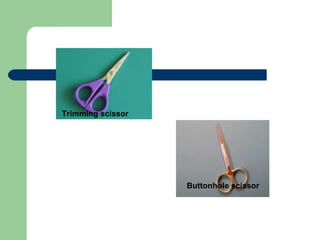
3.) Cutting scissors:
a. Trimming scissor -It is 3-4 inches long. It is used for
trimmings, clipping threads and snipping slashes.
b. Embroidery scissor-It has 4-5 inches finely tapered
blades. Both points are sharp for use in working with
fine details in delicate fabrics and in embroidery
work.
c. Buttonhole scissor -This is intended for making
buttonholes.
Trimming scissor
Buttonhole scissor
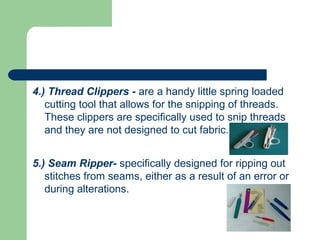
4.) Thread Clippers - are a handy little spring loaded
cutting tool that allows for the snipping of threads.
These clippers are specifically used to snip threads
and they are not designed to cut fabric.
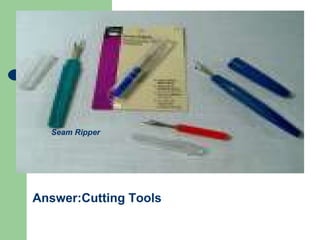
5.) Seam Ripper- specifically designed for ripping out
stitches from seams, either as a result of an error or
during alterations.
MARKING TOOLS-are required for
transferring pattern markings to garment fabric
pieces and for making alterations on garments.
Chalk Pencils/Dressmaker pencil
Liquid Marking Pen
Tailor’s Chalk
Tracing Wheel
MARKING TOOLS
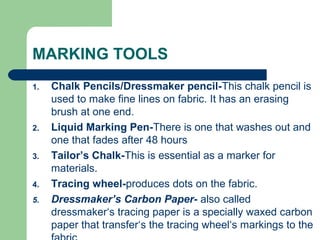
1. Chalk Pencils/Dressmaker pencil-This chalk pencil is
used to make fine lines on fabric. It has an erasing
brush at one end.
2. Liquid Marking Pen-There is one that washes out and
one that fades after 48 hours
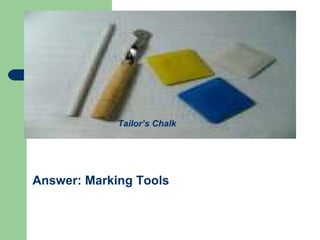
3. Tailor’s Chalk-This is essential as a marker for
materials.
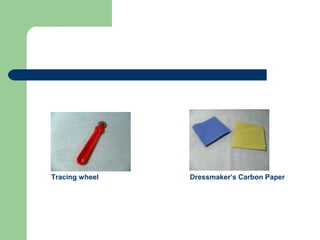
4. Tracing wheel-produces dots on the fabric.
5. Dressmaker’s Carbon Paper- also called
dressmaker‘s tracing paper is a specially waxed carbon
paper that transfer‘s the tracing wheel‘s markings to the
Tracing wheel Dressmaker’s Carbon Paper
PINNING AND SEWING TOOL
 Pincushion
 Hand Needle
 Sewing Needle Threader
 Thimble
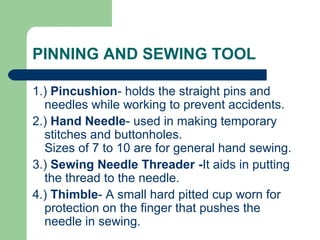
PINNING AND SEWING TOOL
1.) Pincushion- holds the straight pins and
needles while working to prevent accidents.
2.) Hand Needle- used in making temporary
stitches and buttonholes.
Sizes of 7 to 10 are for general hand sewing.
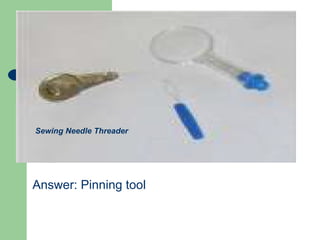
3.) Sewing Needle Threader -It aids in putting
the thread to the needle.
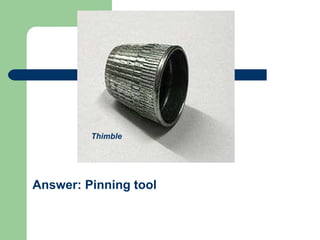
4.) Thimble- A small hard pitted cup worn for
protection on the finger that pushes the
needle in sewing.
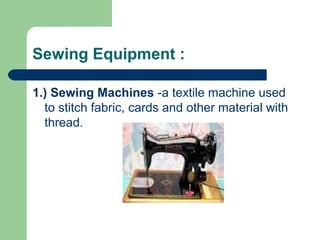
Sewing Equipment :
1.) Sewing Machines -a textile machine used
to stitch fabric, cards and other material with
thread.
Activity no.1
Direction: identify sewing tools properly.
Measuring Tools
Cutting Tools
Pinning Tools
Marking Tools
Answer: Measuring Tools
L-square
Answer:Cutting Tools
Seam Ripper
Answer: Marking Tools
Tailor’s Chalk
Answer: Pinning tool
Thimble
Answer: Cutting Tools
Bent-handled dressmaker’s shears
Answer: Pinning tool
Sewing Needle Threader
Measuring
tools
Cutting
tools
Pinning
tools
Marking
tools
Activity no.2
Direction: classify sewing tools according to their uses:
Pincushion tracing wheel
Thimble ruler
Seam ripper seam gauge
Tailor’s chalk L- square
Pinking shears hand needle
Answer:
Measuring
tools
Cutting tools Pinning tools Marking tools
seam gauge
L- square
Ruler
Seam ripper
Pinking shears
Pincushion
Thimble
hand needle
tracing wheel
Tailor’s chalk
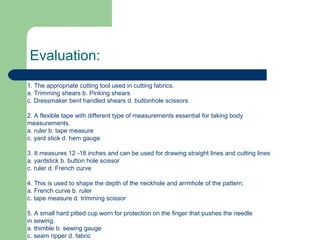
Evaluation:
1. The appropriate cutting tool used in cutting fabrics.
a. Trimming shears b. Pinking shears
c. Dressmaker bent handled shears d. buttonhole scissors
2. A flexible tape with different type of measurements essential for taking body
measurements.
a. ruler b. tape measure
c. yard stick d. hem gauge
3. It measures 12 -18 inches and can be used for drawing straight lines and cutting lines
a. yardstick b. button hole scissor
c. ruler d. French curve
4. This is used to shape the depth of the neckhole and arrmhole of the pattern.
a. French curve b. ruler
c. tape measure d. trimming scissor
5. A small hard pitted cup worn for protection on the finger that pushes the needle
in sewing.
a. thimble b. sewing gauge
c. seam ripper d. fabric
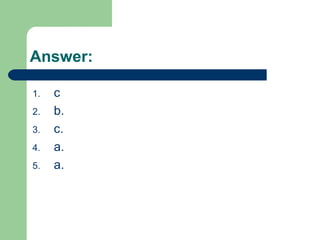
Answer:
1. c
2. b.
3. c.
4. a.
5. a.
Assignment:
1. Identify the different types of sewing
machines.
2. Identify the major parts of lockstitch sewing
machine.
Pages 13-16.
THANK YOU!!!

sewing tools and equipments

  • 1.
    “Sewing without theright tools and equipment is like trying to cook without the right ingredients”.
  • 2.
    Sewing Tools andEquipment and their Uses
  • 3.
    Sewing Tools andEquipment Sewing Tools - instruments that aid in accomplishing a sewing task. It can be manipulated by hands. Sewing Equipment - those are the more complicated tool, it provides to carry out a particular process or function.
  • 4.
    MEASURING TOOLS -instruments used for obtaining quantities, dimensions or forces of real world objects.  tape measure  Sewing gauge  Rulers  yardsticks  Tailors square  French curve
  • 5.
    MEASURING TOOLS 1. Tapemeasure- a flexible measuring device used in taking body measurements. 2. Sewing Gauge-A small ruler with a sliding guide and is about six inches long. This gauge is used for measurements at hem lines, button holes and areas where other small measurements require checking.
  • 6.
    3.) Ruler- Aruler measuring 12 inches or even 18 inches, either clear or solid. It is a useful tool to have for measuring and drawing straight seam lines and cutting lines. It also aids in connecting lines. 4.)Yardstick-A yardstick is made of smooth, shellacked hardwood or metal. It is used for marking hemlines and checking grain lines when laying out the pattern.
  • 7.
    5.) French Curve-This is used to shape the depth of the neck hole and armhole of the pattern. 6.) Tailor square or "L" is used to transfer measurements to the draft pattern. It also divides the garment into the desired measurement. It has perfect squares and is useful in making straight lines and numbers. It can also function as a tape measure.
  • 8.
    CUTTING TOOLS- acutting implement; a tool for cutting.  Bent handled dressmaker’s shear  Pinking shears  Cutting scissors  Thread clippers  Seam ripper
  • 9.
    CUTTING TOOLS 1.)Bent-handled dressmaker’sshears- These are made of quality steel and hold a sharp cutting edge. The blades move easily and cut smoothly along the entire length and the points should come together. Shears have the length of 7- 12 inches and are satisfactory for most apparel fabrics. 2.) Pinking Shears- This is popular in zigzagging or scalloped edge or for seam finishes. This is used to finish seams and raw edges and to create decorative edges on many types of fabric. It cuts a ravel- resistant edge.
  • 10.
    3.) Cutting scissors: a.Trimming scissor -It is 3-4 inches long. It is used for trimmings, clipping threads and snipping slashes. b. Embroidery scissor-It has 4-5 inches finely tapered blades. Both points are sharp for use in working with fine details in delicate fabrics and in embroidery work. c. Buttonhole scissor -This is intended for making buttonholes.
  • 11.
  • 12.
    4.) Thread Clippers- are a handy little spring loaded cutting tool that allows for the snipping of threads. These clippers are specifically used to snip threads and they are not designed to cut fabric. 5.) Seam Ripper- specifically designed for ripping out stitches from seams, either as a result of an error or during alterations.
  • 13.
    MARKING TOOLS-are requiredfor transferring pattern markings to garment fabric pieces and for making alterations on garments. Chalk Pencils/Dressmaker pencil Liquid Marking Pen Tailor’s Chalk Tracing Wheel
  • 14.
    MARKING TOOLS 1. ChalkPencils/Dressmaker pencil-This chalk pencil is used to make fine lines on fabric. It has an erasing brush at one end. 2. Liquid Marking Pen-There is one that washes out and one that fades after 48 hours 3. Tailor’s Chalk-This is essential as a marker for materials. 4. Tracing wheel-produces dots on the fabric. 5. Dressmaker’s Carbon Paper- also called dressmaker‘s tracing paper is a specially waxed carbon paper that transfer‘s the tracing wheel‘s markings to the
  • 15.
  • 16.
    PINNING AND SEWINGTOOL  Pincushion  Hand Needle  Sewing Needle Threader  Thimble
  • 17.
    PINNING AND SEWINGTOOL 1.) Pincushion- holds the straight pins and needles while working to prevent accidents. 2.) Hand Needle- used in making temporary stitches and buttonholes. Sizes of 7 to 10 are for general hand sewing. 3.) Sewing Needle Threader -It aids in putting the thread to the needle. 4.) Thimble- A small hard pitted cup worn for protection on the finger that pushes the needle in sewing.
  • 18.
    Sewing Equipment : 1.)Sewing Machines -a textile machine used to stitch fabric, cards and other material with thread.
  • 19.
    Activity no.1 Direction: identifysewing tools properly. Measuring Tools Cutting Tools Pinning Tools Marking Tools
  • 20.
  • 21.
  • 22.
  • 23.
  • 24.
  • 25.
  • 26.
    Measuring tools Cutting tools Pinning tools Marking tools Activity no.2 Direction: classifysewing tools according to their uses: Pincushion tracing wheel Thimble ruler Seam ripper seam gauge Tailor’s chalk L- square Pinking shears hand needle
  • 27.
    Answer: Measuring tools Cutting tools Pinningtools Marking tools seam gauge L- square Ruler Seam ripper Pinking shears Pincushion Thimble hand needle tracing wheel Tailor’s chalk
  • 28.
    Evaluation: 1. The appropriatecutting tool used in cutting fabrics. a. Trimming shears b. Pinking shears c. Dressmaker bent handled shears d. buttonhole scissors 2. A flexible tape with different type of measurements essential for taking body measurements. a. ruler b. tape measure c. yard stick d. hem gauge 3. It measures 12 -18 inches and can be used for drawing straight lines and cutting lines a. yardstick b. button hole scissor c. ruler d. French curve 4. This is used to shape the depth of the neckhole and arrmhole of the pattern. a. French curve b. ruler c. tape measure d. trimming scissor 5. A small hard pitted cup worn for protection on the finger that pushes the needle in sewing. a. thimble b. sewing gauge c. seam ripper d. fabric
  • 29.
    Answer: 1. c 2. b. 3.c. 4. a. 5. a.
  • 30.
    Assignment: 1. Identify thedifferent types of sewing machines. 2. Identify the major parts of lockstitch sewing machine. Pages 13-16.
  • 31.