CLEAN WATER AND
SANITATION FOR ALL
Stone Soup Sustainability Summit June 5-9th
Sustainable Development Goal 6
Nicholas Boutin, Maya McAndrews, Matthew Mosher, and Emily Price
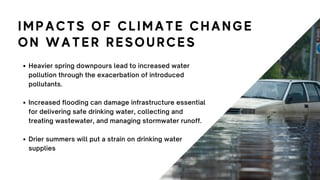
Heavier spring downpours lead to increased water
pollution through the exacerbation of introduced
pollutants.
Increased flooding can damage infrastructure essential
for delivering safe drinking water, collecting and
treating wastewater, and managing stormwater runoff.
Drier summers will put a strain on drinking water
supplies
IMPACTS OF CLIMATE CHANGE
ON WATER RESOURCES
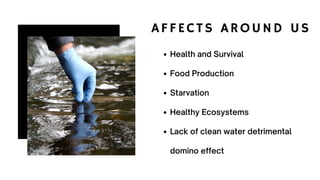
AFFECTS AROUND US
Health and Survival
Food Production
Starvation
Healthy Ecosystems
Lack of clean water detrimental
domino effect
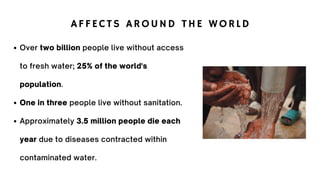
AFFECTS AROUND THE WORLD
Over two billion people live without access
to fresh water; 25% of the world's
population.
One in three people live without sanitation.
Approximately 3.5 million people die each
year due to diseases contracted within
contaminated water.
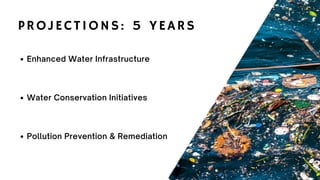
Enhanced Water Infrastructure
Water Conservation Initiatives
Pollution Prevention & Remediation
PROJECTIONS: 5 YEARS
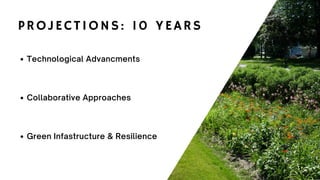
PROJECTIONS: 10 YEARS
Technological Advancments
Collaborative Approaches
Green Infastructure & Resilience
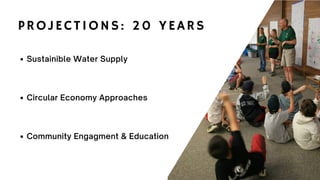
PROJECTIONS: 20 YEARS
Sustainible Water Supply
Circular Economy Approaches
Community Engagment & Education
Desalination is the process in which salt is removed from sea water to make it potable.
This process is not widely used due to the large amout of energy it use and it's inefficiency.
There have been recent developments in desalination to make it more eficcient and practical.
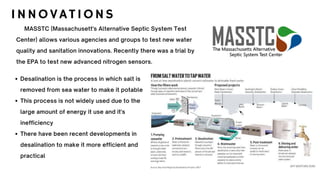
INNOVATIONS
MASSTC (Massachusett's Alternative Septic System Test
Center) allows various agencies and groups to test new water
quality and sanitation innovations. Recently there was a trial by
the EPA to test new advanced nitrogen sensors.
Desalination is the process in which salt is
removed from sea water to make it potable
This process is not widely used due to the
large amount of energy it use and it's
inefficiency
There have been recent developments in
desalination to make it more efficient and
practical
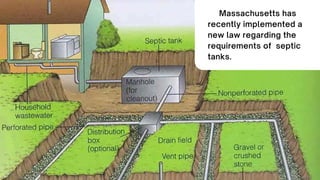
Massachusetts has
recently implemented a
new law regarding the
requirements of septic
tanks.
LEADERS/OUTLIERS
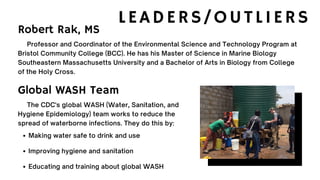
Professor and Coordinator of the Environmental Science and Technology Program at
Bristol Community College (BCC). He has his Master of Science in Marine Biology
Southeastern Massachusetts University and a Bachelor of Arts in Biology from College
of the Holy Cross.
Robert Rak, MS
Making water safe to drink and use
Improving hygiene and sanitation
Educating and training about global WASH
The CDC's global WASH (Water, Sanitation, and
Hygiene Epidemiology) team works to reduce the
spread of waterborne infections. They do this by:
Global WASH Team
Monitor the chemical levels in wastewater at various points in the plant process
Oversee the process of filtering and processing water for reuse
Tend pumps, conveyors, blowers, chlorinators, vacuum filters, and other equipment
used to treat wastewater.
Help clean-up efforts following water disasters like floods
Ensure that companies and organizations adhere to regulations regarding waste
disposal
Designing systems to delay influxes of wastewater
There are many different facets of wastewater management and water treatment.
The general tasks a person in this field may expect to complete are:
POTENTIAL CAREER PATHWAYS
Wastewater/Water Treatment Operator
Typically does not require more than a high school diploma and a limited
number of college courses/ certifications. Annual salary averages around
$35,000-$55,000
Environmental Consultant
Biology, chemistry, or environment related bachelor's Degree. Salary can range
from $45,000-$110,000
Civil Engineer
At least a bachelor's degree in civil engineering. Broad salary range of
$60,000-$120,000
These tasks fall under an array of different careers, each one requiring varying
degrees of education, certification, and experience. Some examples of these would be:
POTENTIAL CAREER PATHWAYS

Clean Water & Sanitation for All: UNSDG # 6

  • 1.
    CLEAN WATER AND SANITATIONFOR ALL Stone Soup Sustainability Summit June 5-9th Sustainable Development Goal 6 Nicholas Boutin, Maya McAndrews, Matthew Mosher, and Emily Price
  • 2.
    Heavier spring downpourslead to increased water pollution through the exacerbation of introduced pollutants. Increased flooding can damage infrastructure essential for delivering safe drinking water, collecting and treating wastewater, and managing stormwater runoff. Drier summers will put a strain on drinking water supplies IMPACTS OF CLIMATE CHANGE ON WATER RESOURCES
  • 3.
    AFFECTS AROUND US Healthand Survival Food Production Starvation Healthy Ecosystems Lack of clean water detrimental domino effect
  • 4.
    AFFECTS AROUND THEWORLD Over two billion people live without access to fresh water; 25% of the world's population. One in three people live without sanitation. Approximately 3.5 million people die each year due to diseases contracted within contaminated water.
  • 5.
    Enhanced Water Infrastructure WaterConservation Initiatives Pollution Prevention & Remediation PROJECTIONS: 5 YEARS
  • 6.
    PROJECTIONS: 10 YEARS TechnologicalAdvancments Collaborative Approaches Green Infastructure & Resilience
  • 7.
    PROJECTIONS: 20 YEARS SustainibleWater Supply Circular Economy Approaches Community Engagment & Education
  • 8.
    Desalination is theprocess in which salt is removed from sea water to make it potable. This process is not widely used due to the large amout of energy it use and it's inefficiency. There have been recent developments in desalination to make it more eficcient and practical. INNOVATIONS MASSTC (Massachusett's Alternative Septic System Test Center) allows various agencies and groups to test new water quality and sanitation innovations. Recently there was a trial by the EPA to test new advanced nitrogen sensors. Desalination is the process in which salt is removed from sea water to make it potable This process is not widely used due to the large amount of energy it use and it's inefficiency There have been recent developments in desalination to make it more efficient and practical
  • 9.
    Massachusetts has recently implementeda new law regarding the requirements of septic tanks.
  • 10.
    LEADERS/OUTLIERS Professor and Coordinatorof the Environmental Science and Technology Program at Bristol Community College (BCC). He has his Master of Science in Marine Biology Southeastern Massachusetts University and a Bachelor of Arts in Biology from College of the Holy Cross. Robert Rak, MS Making water safe to drink and use Improving hygiene and sanitation Educating and training about global WASH The CDC's global WASH (Water, Sanitation, and Hygiene Epidemiology) team works to reduce the spread of waterborne infections. They do this by: Global WASH Team
  • 11.
    Monitor the chemicallevels in wastewater at various points in the plant process Oversee the process of filtering and processing water for reuse Tend pumps, conveyors, blowers, chlorinators, vacuum filters, and other equipment used to treat wastewater. Help clean-up efforts following water disasters like floods Ensure that companies and organizations adhere to regulations regarding waste disposal Designing systems to delay influxes of wastewater There are many different facets of wastewater management and water treatment. The general tasks a person in this field may expect to complete are: POTENTIAL CAREER PATHWAYS
  • 12.
    Wastewater/Water Treatment Operator Typicallydoes not require more than a high school diploma and a limited number of college courses/ certifications. Annual salary averages around $35,000-$55,000 Environmental Consultant Biology, chemistry, or environment related bachelor's Degree. Salary can range from $45,000-$110,000 Civil Engineer At least a bachelor's degree in civil engineering. Broad salary range of $60,000-$120,000 These tasks fall under an array of different careers, each one requiring varying degrees of education, certification, and experience. Some examples of these would be: POTENTIAL CAREER PATHWAYS