PRESENTATION
ON
SUSTAINABLE
DEVELOPMENT
GOALS (10-17)
GROUP MEMBERS: COURSE TITLE:
MASHRAFI RAHMAN NADVI (1922127) HEA101
RABIUL ISLAM NAFI (1731591)
MEHEDI HASAN TANIM (1831208)
AL RAHAT RAHMAN (1811116)
What is Sustainable Development Goals?
The Sustainable Development Goals (SDGs) are the UN’s blueprint for a
more sustainable future for all. Their adoption put environmental
degradation, sustainability, climate change, and water security under the
international spotlight. The global goals aim to leave no one behind and are
vital to achieving CDP’s vision for a thriving economy that works for people
and planet. Corporate action will be crucial to delivering the 2030 Agenda
and by disclosing to CDP companies can contribute towards and track
progress against the SDGs.
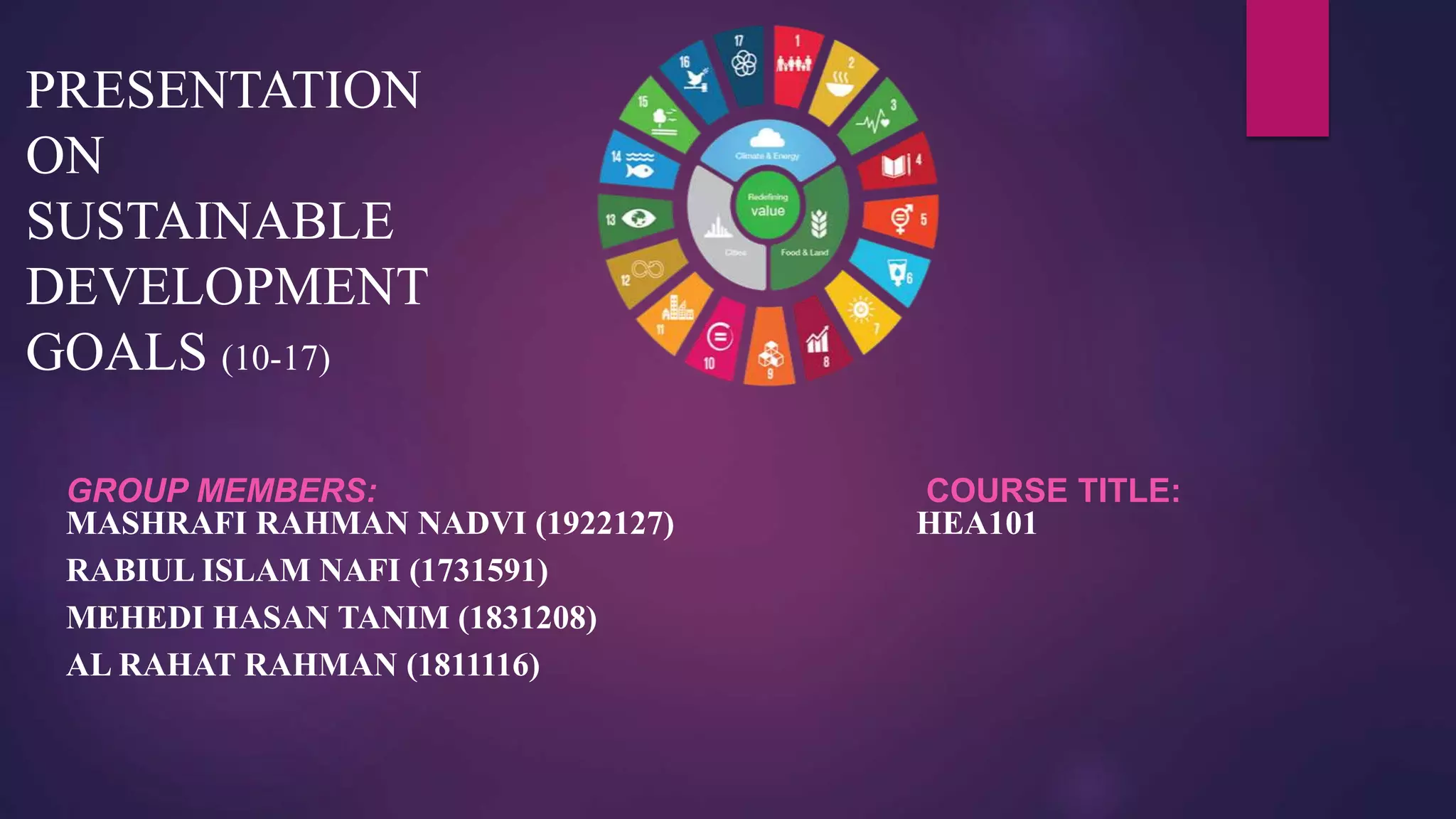
There are total 17 goals. Here we will describe on 10 to 17 goals shortly.
Goal 10: Reduced Inequalities:
 In developing countries, inequality has increased by 11 percent.
 Income inequality is a global problem that requires global
solution.
 Inequalities often leads to financial and social discrimination.
 In order for nations to flourish, equality and prosperity must be
available to everyone - regardless of gender, race, religious
beliefs or economic status.
Goal 11: Sustainable Cities & Communities:
• Sustainable development cannot be achieved without significantly
transform.
• Making cities safe and sustainable means ensuring access to safe
and affordable housing.
• It also involves investment in public transport .
• creating green public spaces, and improving urban planning and
management in a way that is both participatory and inclusive.
Goal 12:Responsible Consumption and Production:
 Implement the 10-year framework of programmers on
sustainable consumption and production, all countries
taking action, with developed countries taking the lead,
taking into account the development and capabilities of
developing countries
 By 2020, achieve the environmentally sound management
of chemicals and all wastes throughout their life cycle, in
accordance with agreed international frameworks, and
significantly reduce their release to air, water and soil in
order to minimize their adverse impacts on human health
and the environment
 Promote public procurement practices that are
sustainable, in accordance with national policies and
priorities
 Support developing countries to strengthen their
scientific and technological capacity to move towards
more sustainable patterns of consumption and production
 By 2030, achieve the sustainable management and
efficient use of natural resources
Goal 13:Climate Action:
 Environmental, Climate Change and
disaster risk reduction considerations are
integrated into project design, budgetary
allocations and implementation process
 500-meter wide green belt to be
established and protected along the coast
 At the turn of the century, under the
United Nations, all countries agreed to try
to achieve a set of ten Millennium
Development Goals (MDGs) by 2015
 Integrate climate change measures into
national policies, strategies, and planning
Goal 14:Life Below Water
● Oceans cover 71 percent of the Earth's surface.
40% of world population depends on ocean.
Absorbs 30% of total carbon dioxide emission.
● Acidification of water raised 26% from 1800
● Currently 13000 pieces of plastic scrap can be
found per square kilometer of ocean surface
● Protecting marine life and ecosystem from
pollution
Goal 15:Life On Land:
● Plants give 80% of human food.
Massive dependency on agriculture
● 30% of landmass covered with forests
provides important elements for human
survival
● Land degrading 35 times faster than
historical reports
● 12 million hectares of land lost to
desertification
● 8% animal species went extinct and
22% is on the brink of extinction
● Conserve and restore the use of
tertiary ecosystem by 2020
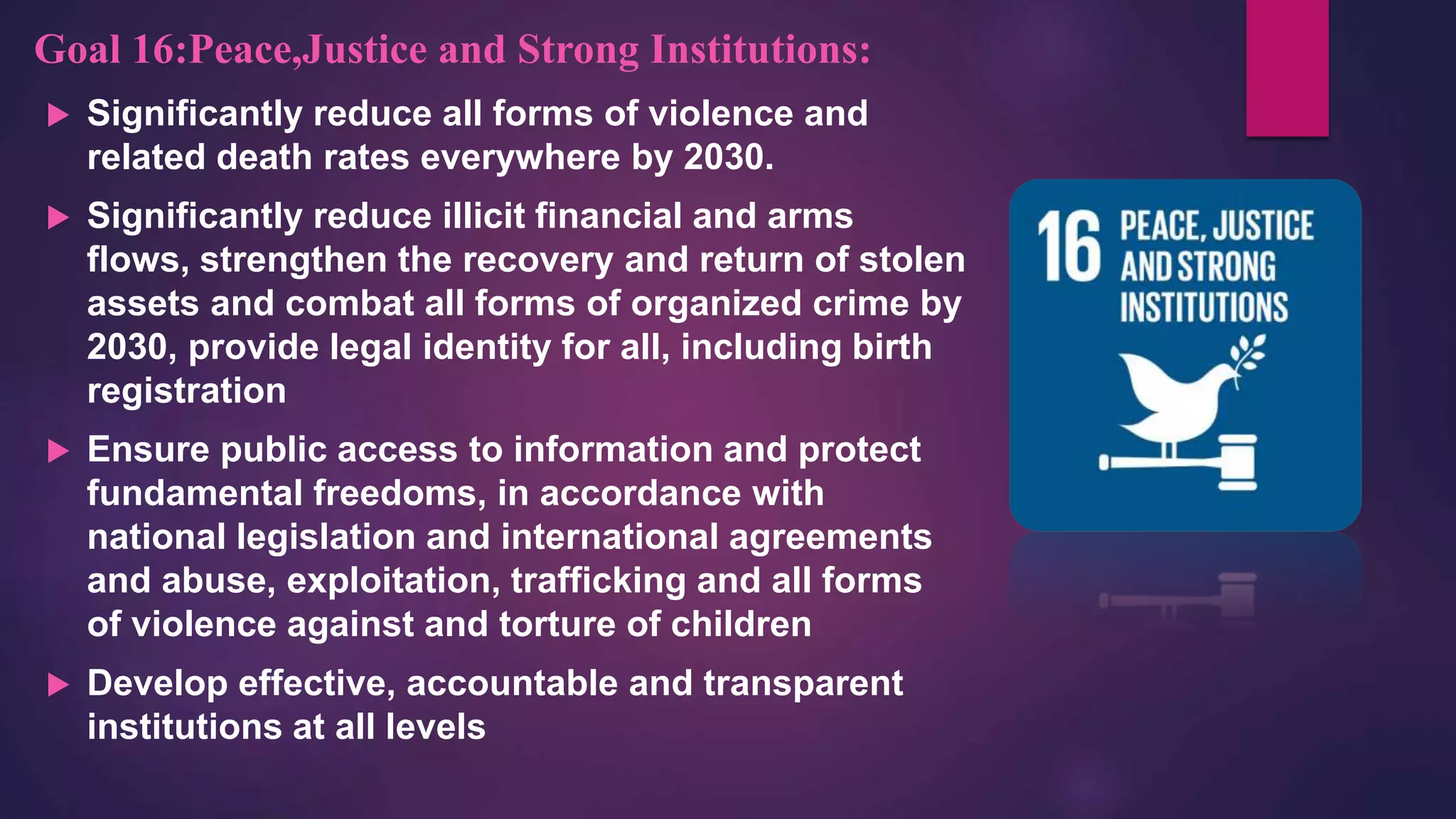
Goal 16:Peace,Justice and Strong Institutions:
 Significantly reduce all forms of violence and
related death rates everywhere by 2030.
 Significantly reduce illicit financial and arms
flows, strengthen the recovery and return of stolen
assets and combat all forms of organized crime by
2030, provide legal identity for all, including birth
registration
 Ensure public access to information and protect
fundamental freedoms, in accordance with
national legislation and international agreements
and abuse, exploitation, trafficking and all forms
of violence against and torture of children
 Develop effective, accountable and transparent
institutions at all levels
Goal 17. Partnerships for the goals:
 In 2017, net ODA totally $146.6 billion in 2017, a
decrease of 0.6 per cent from 2016 in real terms. ODA
as a share of donors’ gross national income (GNI)
remained low, at 0.31 per cent.
 In LDCs, debt service as a proportion of exports of
goods and services increased for five consecutive
years—from a low of 3.5 per cent in 2011 to 8.6 per
cent in 2016.
 During the decade from 2008 to 2017, 89 per cent of
countries or areas conducted at least one population
and housing census.
 In 2016, high-speed fixed-broadband reached 6 per
cent of the population in developing countries,
compared to 24 per cent in developed countries.

SDG (10-17)

  • 1.
    PRESENTATION ON SUSTAINABLE DEVELOPMENT GOALS (10-17) GROUP MEMBERS:COURSE TITLE: MASHRAFI RAHMAN NADVI (1922127) HEA101 RABIUL ISLAM NAFI (1731591) MEHEDI HASAN TANIM (1831208) AL RAHAT RAHMAN (1811116)
  • 2.
    What is SustainableDevelopment Goals? The Sustainable Development Goals (SDGs) are the UN’s blueprint for a more sustainable future for all. Their adoption put environmental degradation, sustainability, climate change, and water security under the international spotlight. The global goals aim to leave no one behind and are vital to achieving CDP’s vision for a thriving economy that works for people and planet. Corporate action will be crucial to delivering the 2030 Agenda and by disclosing to CDP companies can contribute towards and track progress against the SDGs. There are total 17 goals. Here we will describe on 10 to 17 goals shortly.
  • 3.
    Goal 10: ReducedInequalities:  In developing countries, inequality has increased by 11 percent.  Income inequality is a global problem that requires global solution.  Inequalities often leads to financial and social discrimination.  In order for nations to flourish, equality and prosperity must be available to everyone - regardless of gender, race, religious beliefs or economic status. Goal 11: Sustainable Cities & Communities: • Sustainable development cannot be achieved without significantly transform. • Making cities safe and sustainable means ensuring access to safe and affordable housing. • It also involves investment in public transport . • creating green public spaces, and improving urban planning and management in a way that is both participatory and inclusive.
  • 4.
    Goal 12:Responsible Consumptionand Production:  Implement the 10-year framework of programmers on sustainable consumption and production, all countries taking action, with developed countries taking the lead, taking into account the development and capabilities of developing countries  By 2020, achieve the environmentally sound management of chemicals and all wastes throughout their life cycle, in accordance with agreed international frameworks, and significantly reduce their release to air, water and soil in order to minimize their adverse impacts on human health and the environment  Promote public procurement practices that are sustainable, in accordance with national policies and priorities  Support developing countries to strengthen their scientific and technological capacity to move towards more sustainable patterns of consumption and production  By 2030, achieve the sustainable management and efficient use of natural resources
  • 5.
    Goal 13:Climate Action: Environmental, Climate Change and disaster risk reduction considerations are integrated into project design, budgetary allocations and implementation process  500-meter wide green belt to be established and protected along the coast  At the turn of the century, under the United Nations, all countries agreed to try to achieve a set of ten Millennium Development Goals (MDGs) by 2015  Integrate climate change measures into national policies, strategies, and planning
  • 6.
    Goal 14:Life BelowWater ● Oceans cover 71 percent of the Earth's surface. 40% of world population depends on ocean. Absorbs 30% of total carbon dioxide emission. ● Acidification of water raised 26% from 1800 ● Currently 13000 pieces of plastic scrap can be found per square kilometer of ocean surface ● Protecting marine life and ecosystem from pollution
  • 7.
    Goal 15:Life OnLand: ● Plants give 80% of human food. Massive dependency on agriculture ● 30% of landmass covered with forests provides important elements for human survival ● Land degrading 35 times faster than historical reports ● 12 million hectares of land lost to desertification ● 8% animal species went extinct and 22% is on the brink of extinction ● Conserve and restore the use of tertiary ecosystem by 2020
  • 8.
    Goal 16:Peace,Justice andStrong Institutions:  Significantly reduce all forms of violence and related death rates everywhere by 2030.  Significantly reduce illicit financial and arms flows, strengthen the recovery and return of stolen assets and combat all forms of organized crime by 2030, provide legal identity for all, including birth registration  Ensure public access to information and protect fundamental freedoms, in accordance with national legislation and international agreements and abuse, exploitation, trafficking and all forms of violence against and torture of children  Develop effective, accountable and transparent institutions at all levels
  • 9.
    Goal 17. Partnershipsfor the goals:  In 2017, net ODA totally $146.6 billion in 2017, a decrease of 0.6 per cent from 2016 in real terms. ODA as a share of donors’ gross national income (GNI) remained low, at 0.31 per cent.  In LDCs, debt service as a proportion of exports of goods and services increased for five consecutive years—from a low of 3.5 per cent in 2011 to 8.6 per cent in 2016.  During the decade from 2008 to 2017, 89 per cent of countries or areas conducted at least one population and housing census.  In 2016, high-speed fixed-broadband reached 6 per cent of the population in developing countries, compared to 24 per cent in developed countries.