 Classroom comparisons:
Student-student interactions
(Elham Coşkun)
 Corrective Feedback in the
Classroom
 (Nesrin Demirbaş)
 Questions In The Classroom
(Hülya Özger)
 Ethnography
 (Ercan Aksoy)
Classroom comparisons:
Student-student interactions
Observing Learning and Teaching in L2 Classroom
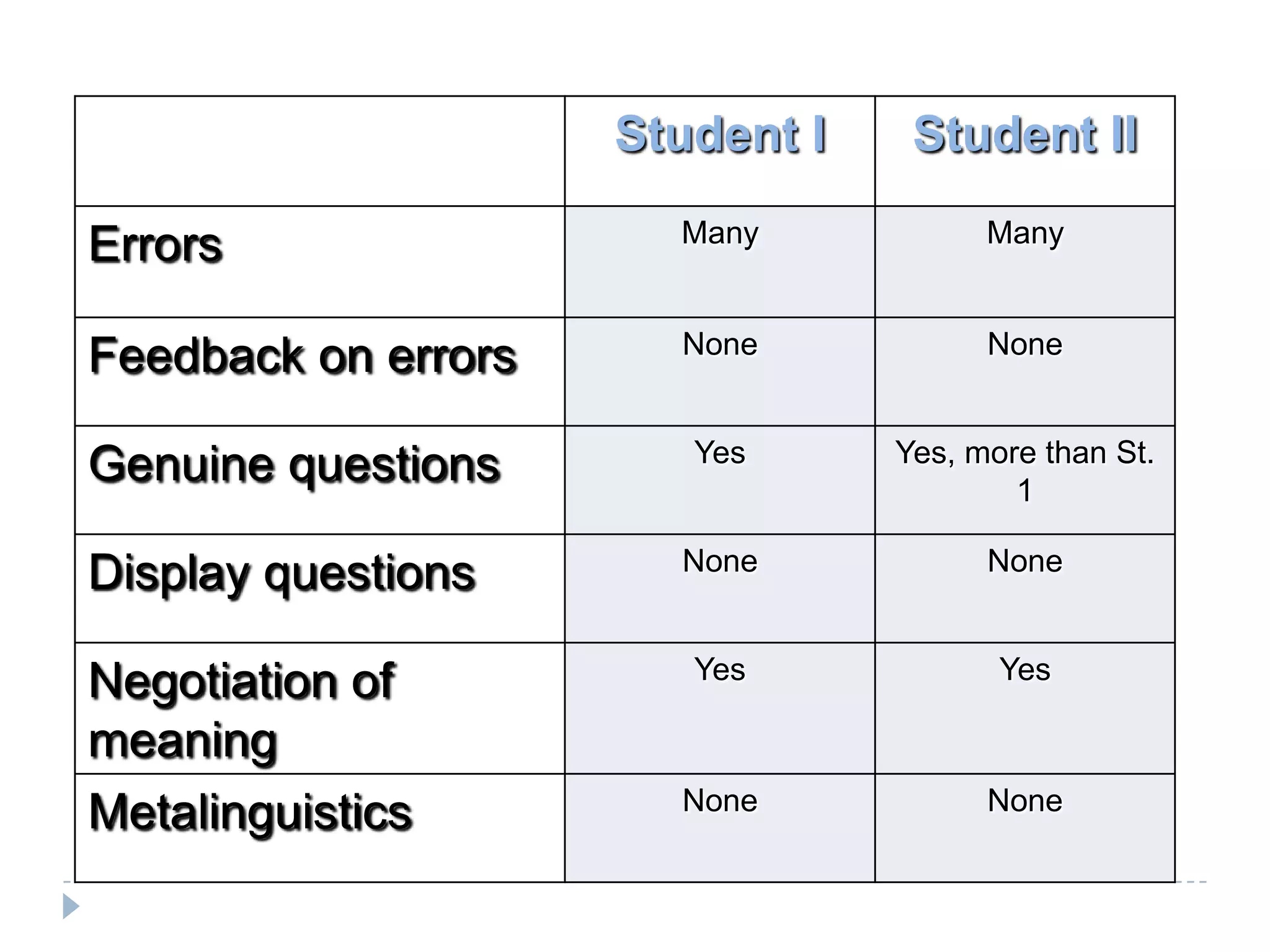
Student I Student II
Errors Many Many
Feedback on errors None None
Genuine questions Yes Yes, more than St.
1
Display questions None None
Negotiation of
meaning
Yes Yes
Metalinguistics None None
Conversation
 D : Elle. [She]
 D : Elle se souvient, non, Elle souuient qi elle a un ... une pratique de
 chorale, alors elle se lbve. I She remembers, no. She remembers that
 she has a choir practice so she gets upJ
 D : Tout a coup fSuddenly]
 N : Elle ssse [She ssse]
 D : Elle souuientlShe remembers]
 N : se souvie nt ov souaiezr ? lRemembers or remembers?]
 D : Elle souuient ... ahh, elle se souvient ... Elle souuient ... Elle se
 souvient, no. [She remembers ... ahh, she remembers ... She
 remembers ... She remembers, no]
 N : pas... [not]
 D : Elle souuient qi elle doit aller au band ... ? [She remembers that she
 has to go to bandl
 N : Chorale. lChoir]
 D : Chorale. lChoir]
 N : Tout a coup elle souuient qu'elle ... doit aller ) la chorale [All of
a sudden she remembers that she has to go to choir]
 D : [very softlyl elle se souvien ... non. [She remembers . .. no]
 D : Alors, elle [So, she]
 N : non, wait. tout i coup elle ...sudden she ... remembers?]
 D : Je pense pas que c'est se souvient. [I dont think it's
remember]
 N : oh, souvient ... souvient. [oh remember ... remember]
 D : Elle souuientqu elle a le chorale. [She remembers that she
has choir]
 N : Qu elle doit se prdparer. [that she has to get ready]
 D : Oui. [Yes]
 N : pour le chorale ... non, tout i coup elle souuientqu il ya une
pratique de chorale. [for choir ... no, all of a sudden she remembers
that there's a choir practice]
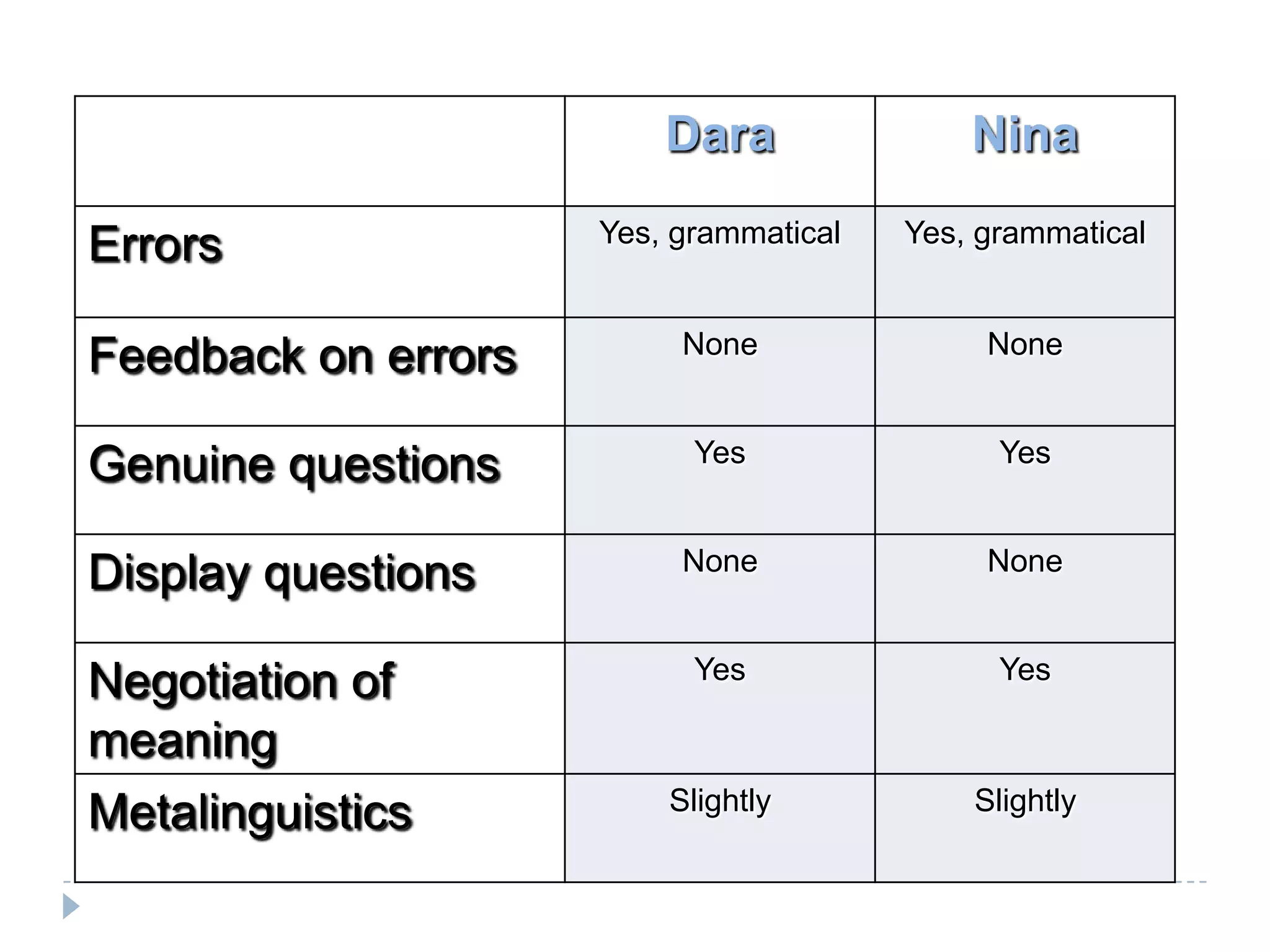
Dara Nina
Errors Yes, grammatical Yes, grammatical
Feedback on errors None None
Genuine questions Yes Yes
Display questions None None
Negotiation of
meaning
Yes Yes
Metalinguistics Slightly Slightly
Corrective Feedback
in the Classroom
Observing Learning and Teaching in L2 Classroom
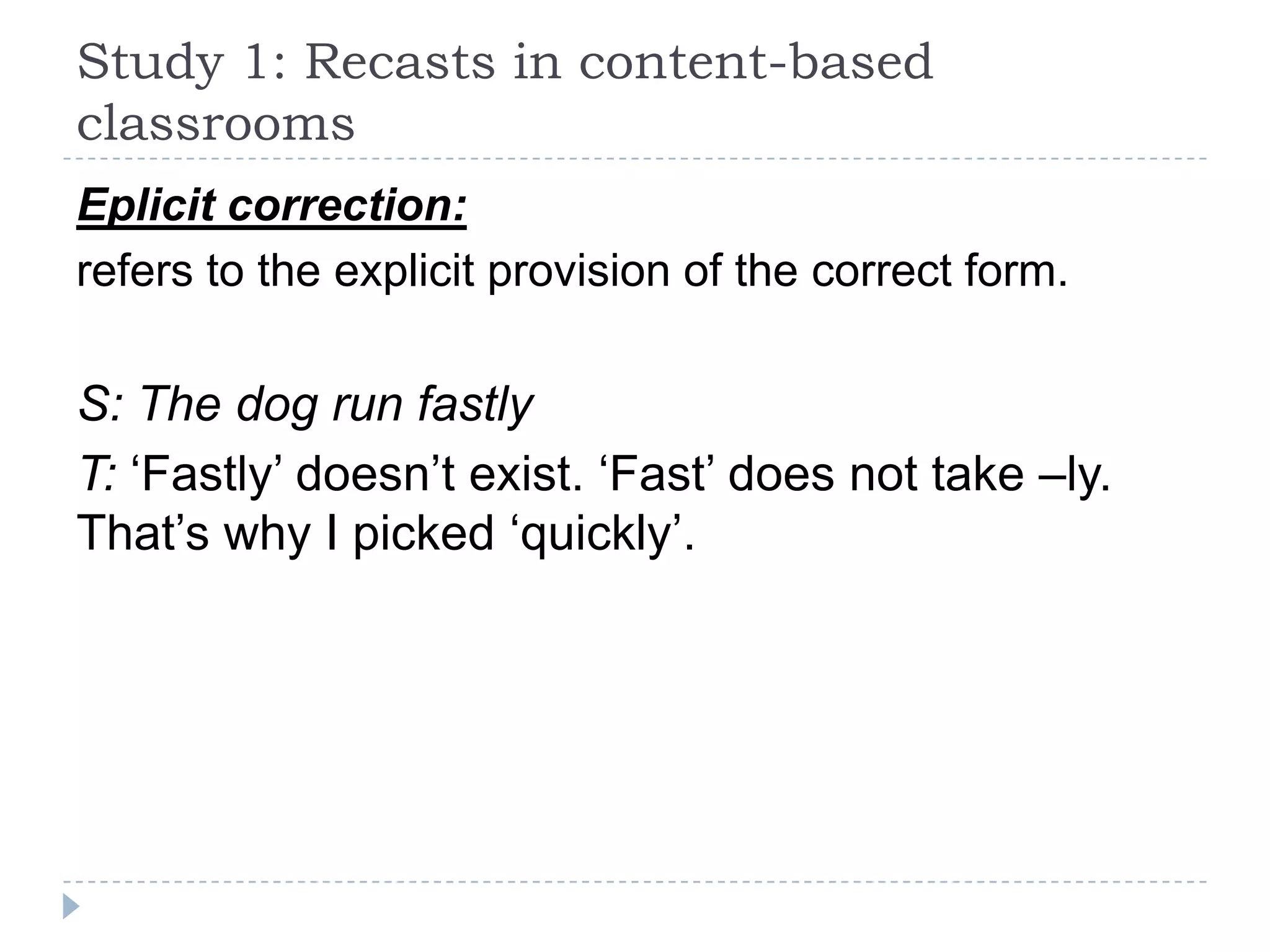
Eplicit correction:
refers to the explicit provision of the correct form.
S: The dog run fastly
T: ‘Fastly’ doesn’t exist. ‘Fast’ does not take –ly.
That’s why I picked ‘quickly’.
Study 1: Recasts in content-based
classrooms
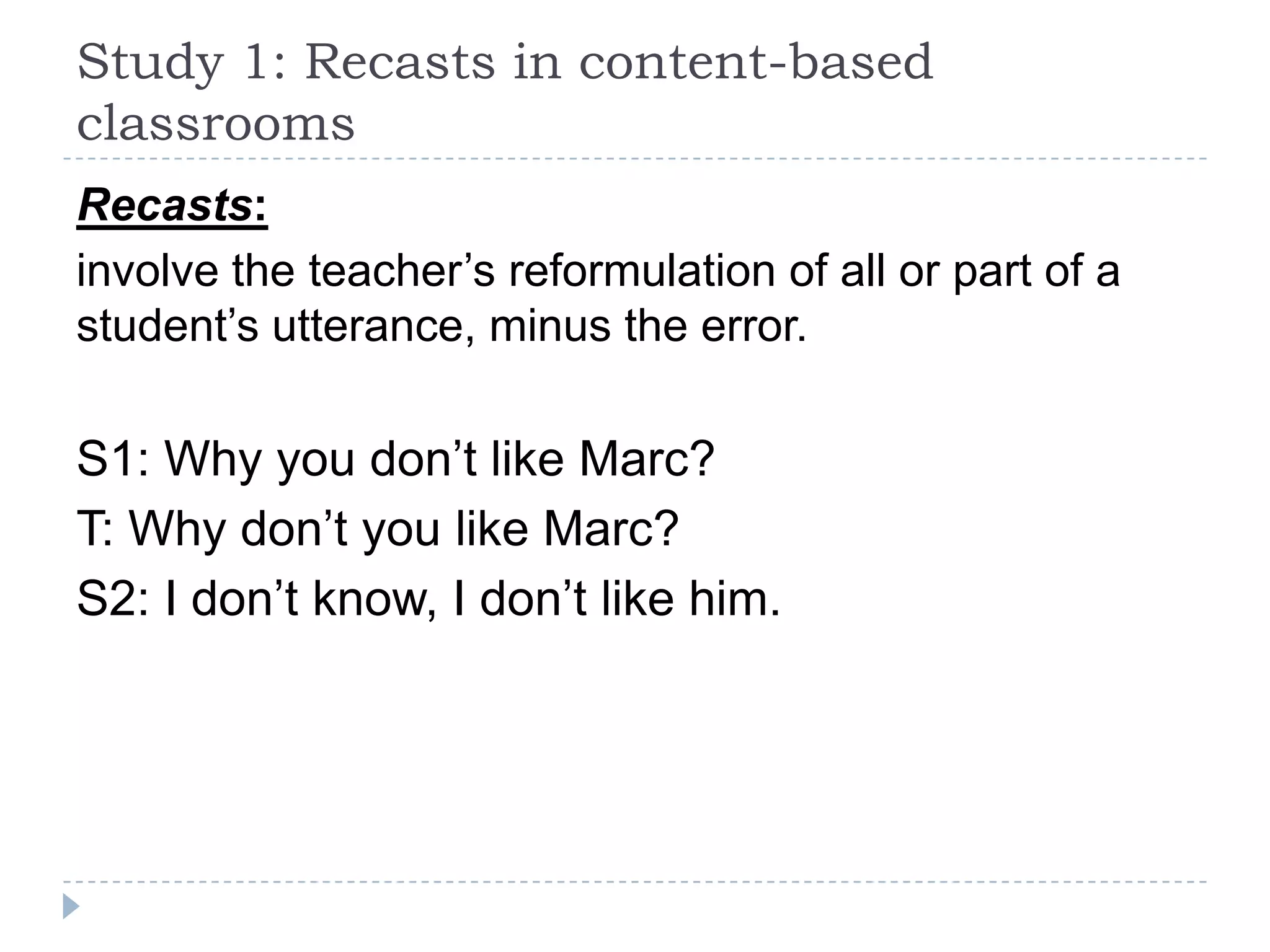
Recasts:
involve the teacher’s reformulation of all or part of a
student’s utterance, minus the error.
S1: Why you don’t like Marc?
T: Why don’t you like Marc?
S2: I don’t know, I don’t like him.
Study 1: Recasts in content-based
classrooms
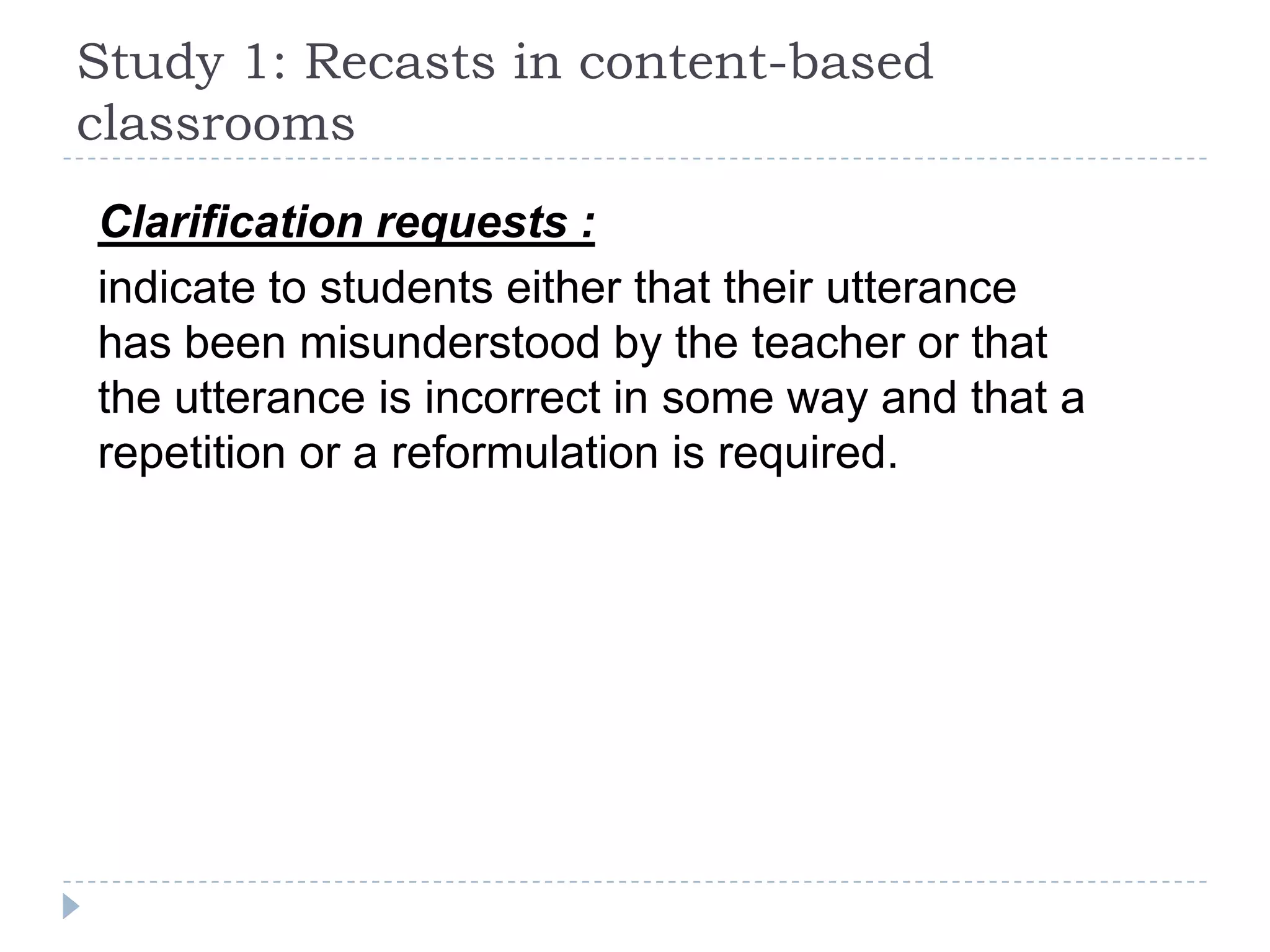
Clarification requests :
indicate to students either that their utterance
has been misunderstood by the teacher or that
the utterance is incorrect in some way and that a
repetition or a reformulation is required.
Study 1: Recasts in content-based
classrooms
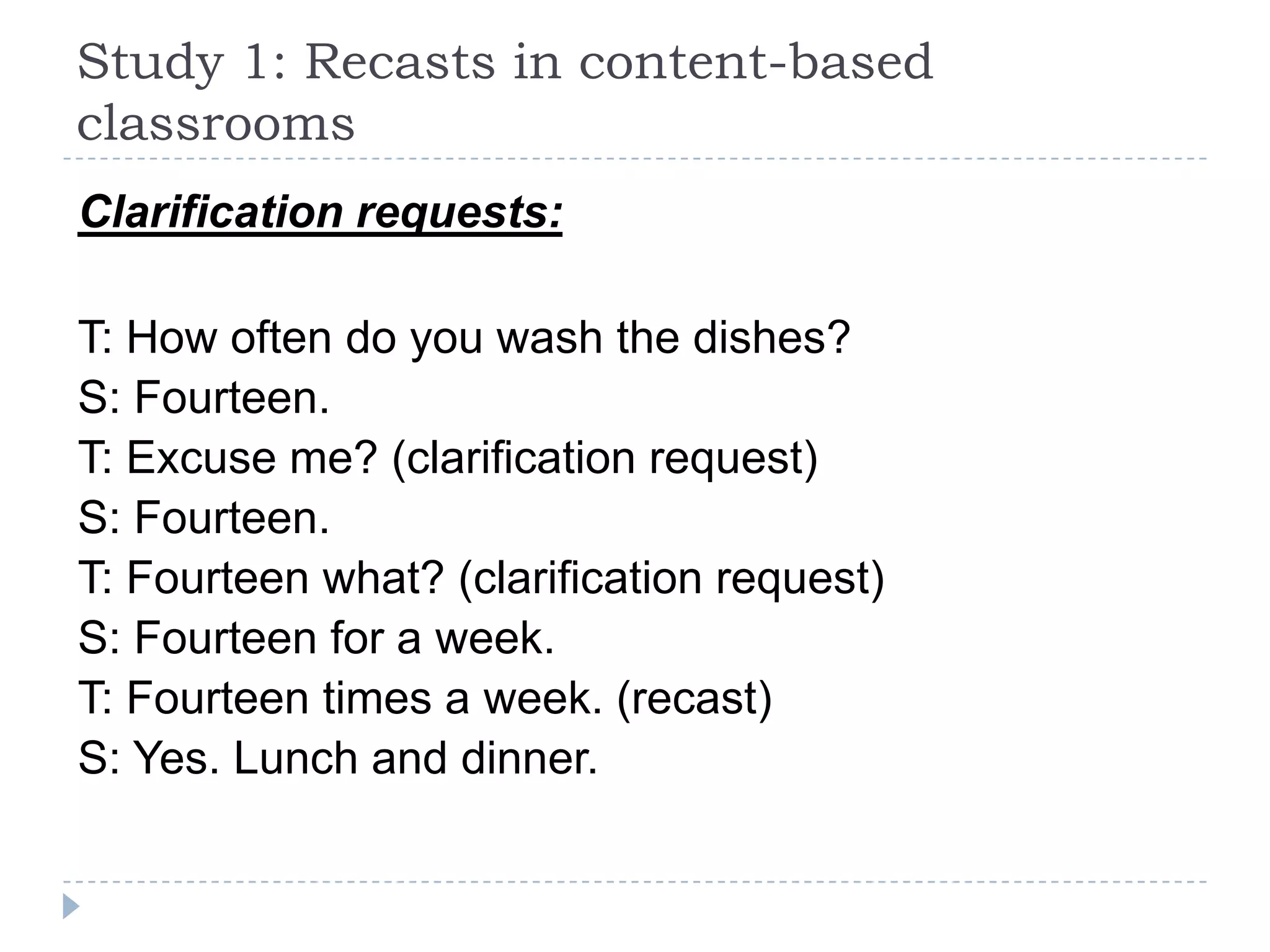
Clarification requests:
T: How often do you wash the dishes?
S: Fourteen.
T: Excuse me? (clarification request)
S: Fourteen.
T: Fourteen what? (clarification request)
S: Fourteen for a week.
T: Fourteen times a week. (recast)
S: Yes. Lunch and dinner.
Study 1: Recasts in content-based
classrooms
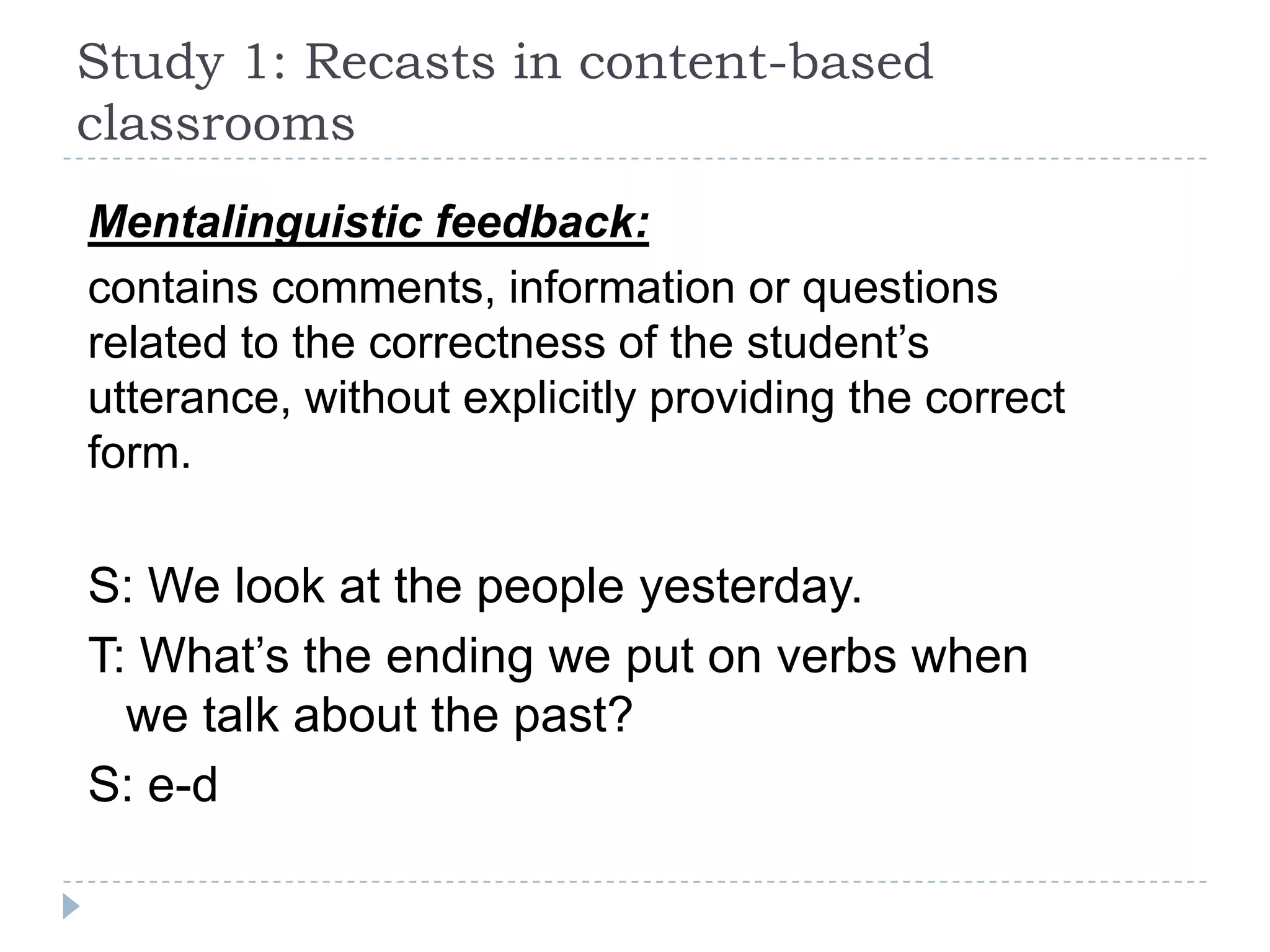
Mentalinguistic feedback:
contains comments, information or questions
related to the correctness of the student’s
utterance, without explicitly providing the correct
form.
S: We look at the people yesterday.
T: What’s the ending we put on verbs when
we talk about the past?
S: e-d
Study 1: Recasts in content-based
classrooms
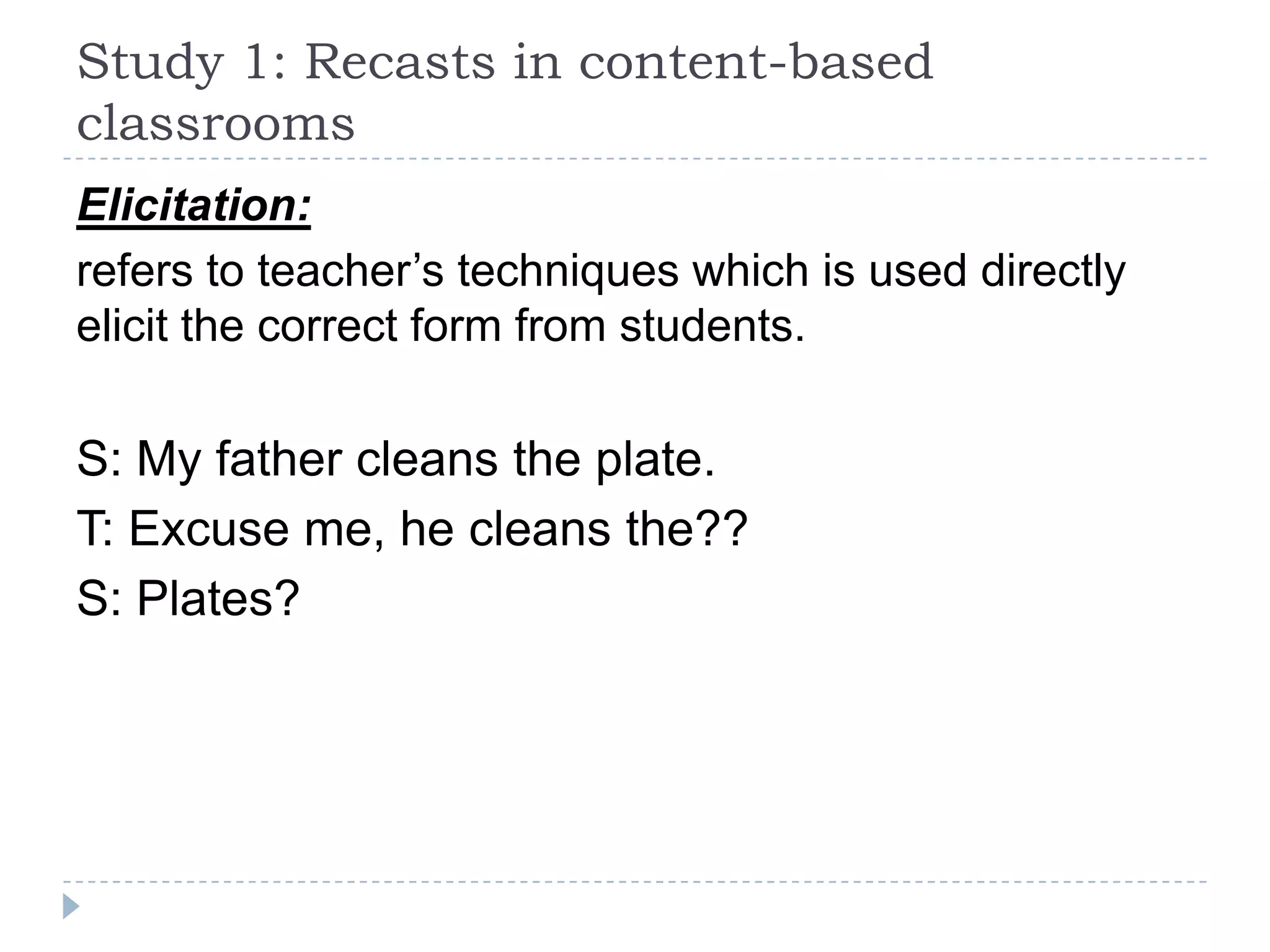
Elicitation:
refers to teacher’s techniques which is used directly
elicit the correct form from students.
S: My father cleans the plate.
T: Excuse me, he cleans the??
S: Plates?
Study 1: Recasts in content-based
classrooms
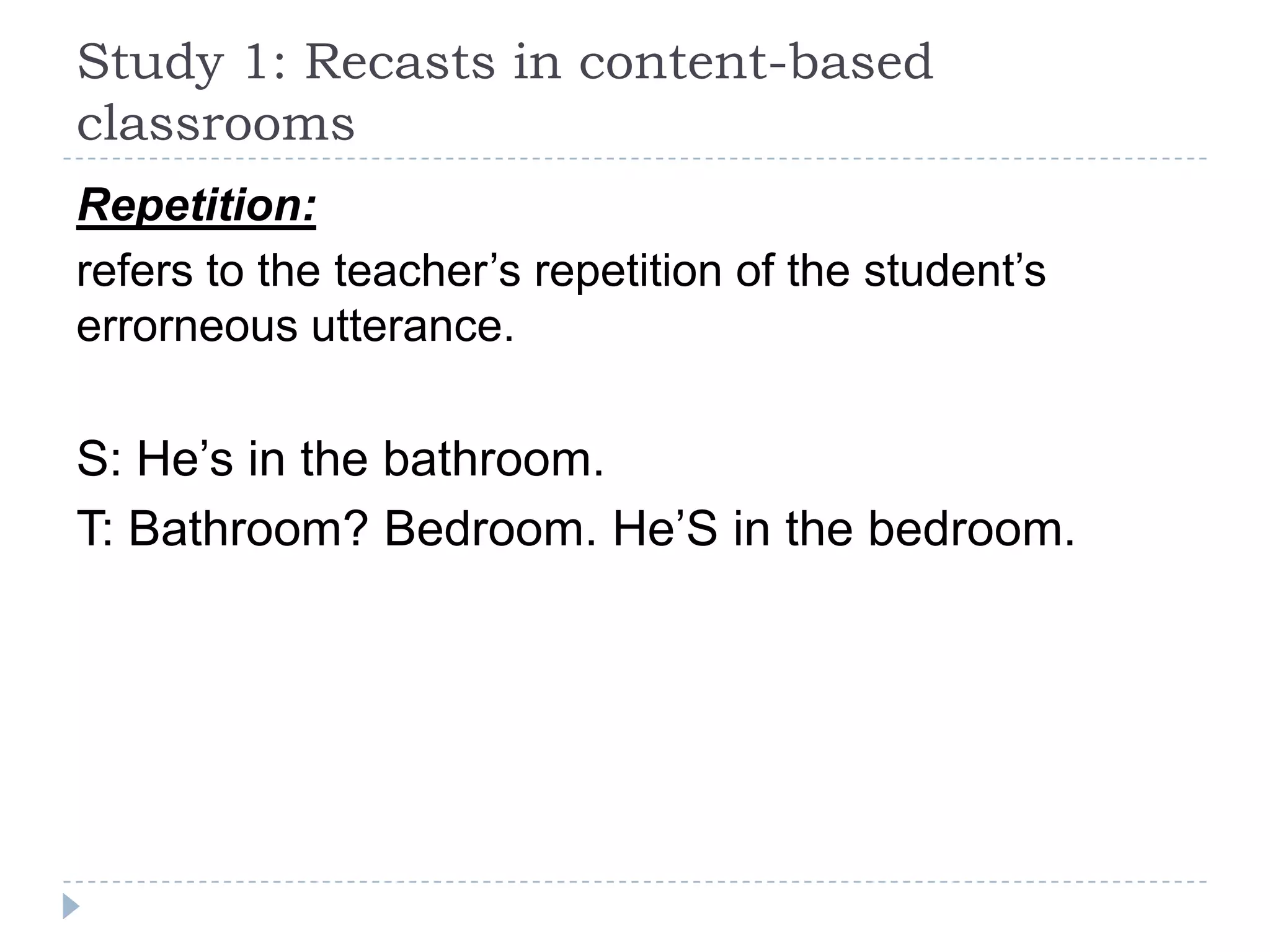
Repetition:
refers to the teacher’s repetition of the student’s
errorneous utterance.
S: He’s in the bathroom.
T: Bathroom? Bedroom. He’S in the bedroom.
Study 1: Recasts in content-based
classrooms
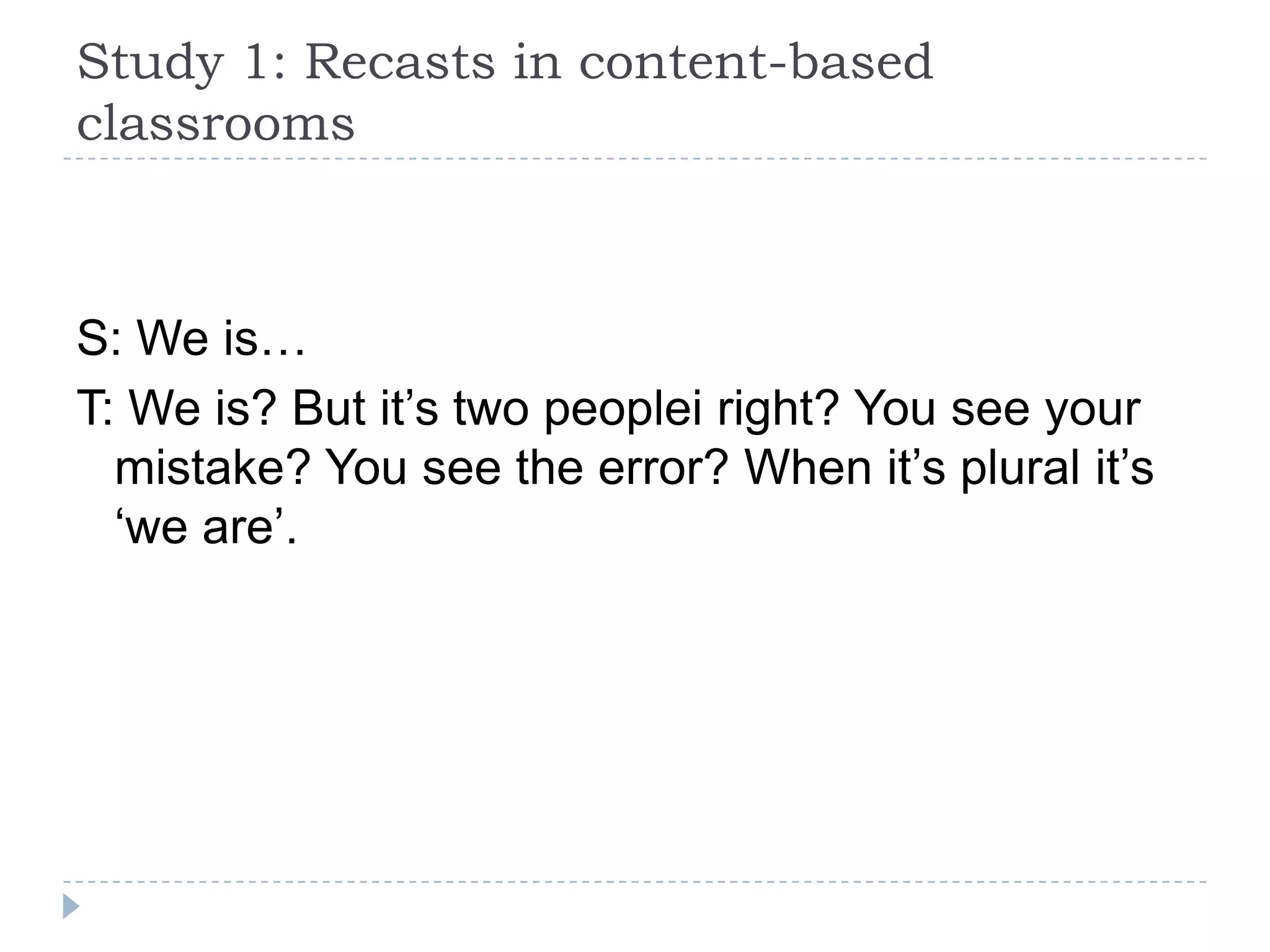
S: We is…
T: We is? But it’s two peoplei right? You see your
mistake? You see the error? When it’s plural it’s
‘we are’.
Study 1: Recasts in content-based
classrooms
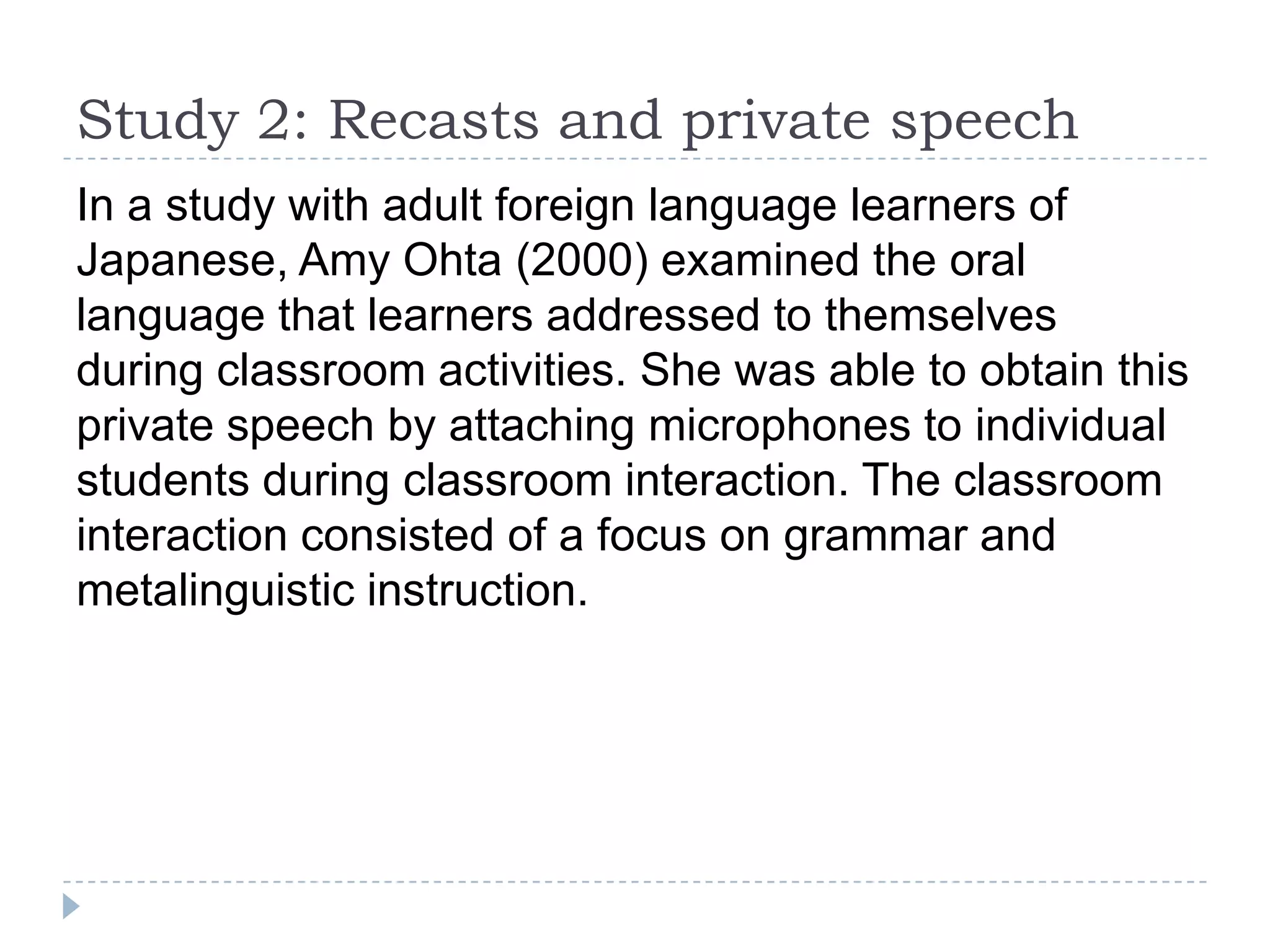
In a study with adult foreign language learners of
Japanese, Amy Ohta (2000) examined the oral
language that learners addressed to themselves
during classroom activities. She was able to obtain this
private speech by attaching microphones to individual
students during classroom interaction. The classroom
interaction consisted of a focus on grammar and
metalinguistic instruction.
Study 2: Recasts and private speech
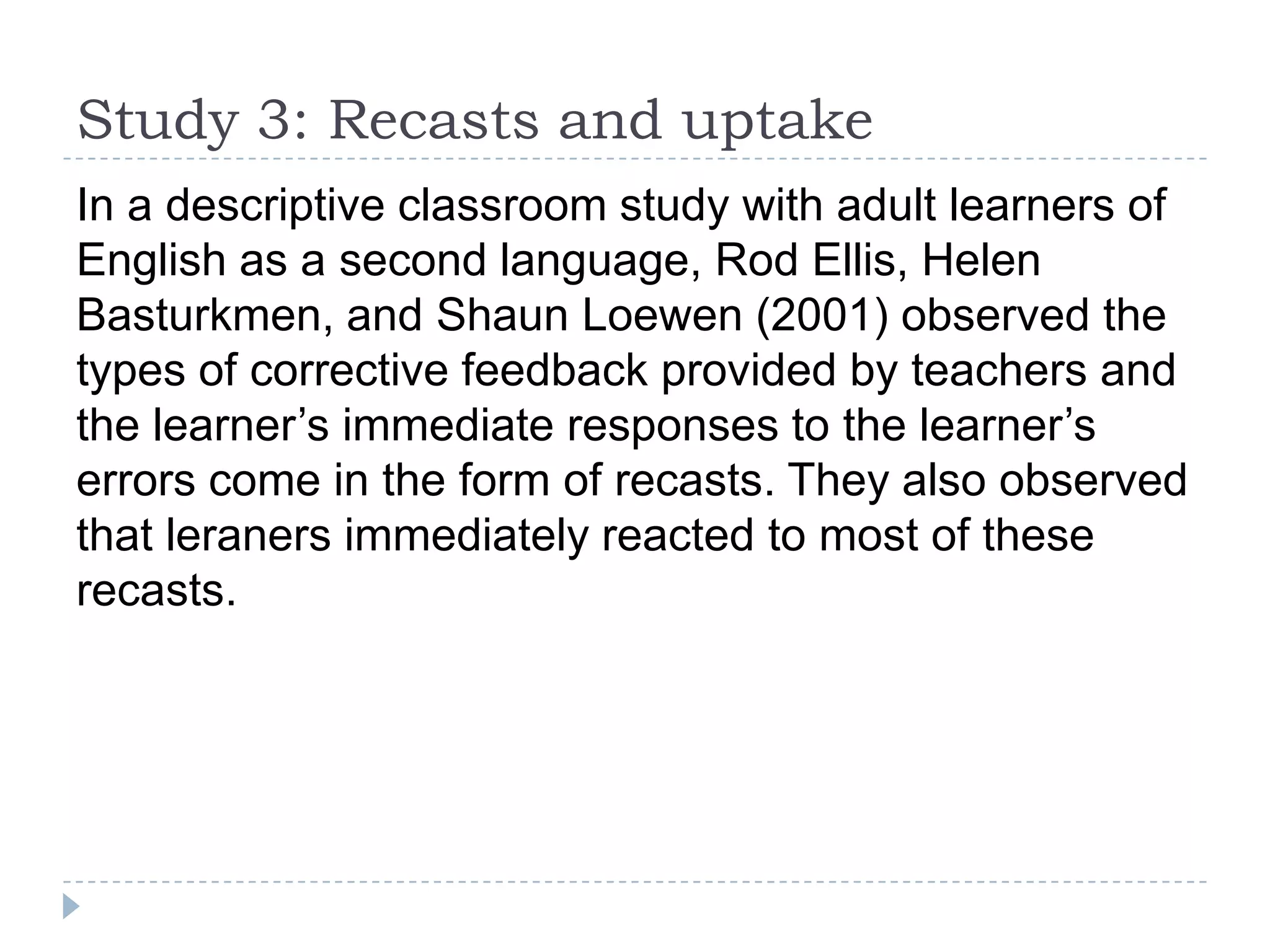
In a descriptive classroom study with adult learners of
English as a second language, Rod Ellis, Helen
Basturkmen, and Shaun Loewen (2001) observed the
types of corrective feedback provided by teachers and
the learner’s immediate responses to the learner’s
errors come in the form of recasts. They also observed
that leraners immediately reacted to most of these
recasts.
Study 3: Recasts and uptake
Rhonda Oliver and Alison Mackey (2003) carried out a
descriptive study of and Australian primary ESL
classroom with 6-12 year olds.
They identified four contexts on which the teachers
and learners interacted:
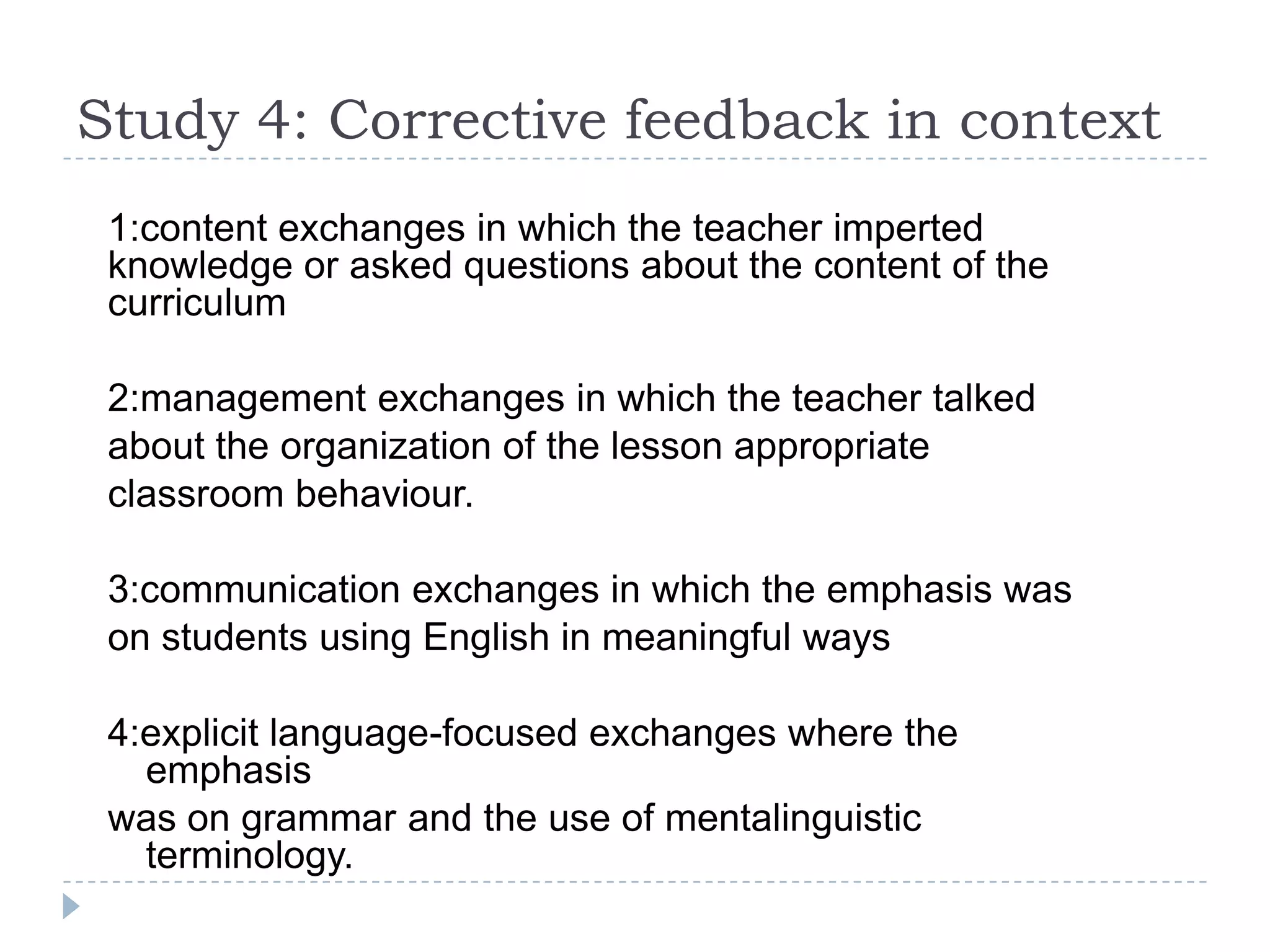
Study 4: Corrective feedback in context
1:content exchanges in which the teacher imperted
knowledge or asked questions about the content of the
curriculum
2:management exchanges in which the teacher talked
about the organization of the lesson appropriate
classroom behaviour.
3:communication exchanges in which the emphasis was
on students using English in meaningful ways
4:explicit language-focused exchanges where the
emphasis
was on grammar and the use of mentalinguistic
terminology.
Study 4: Corrective feedback in context
Questions In The
Classroom
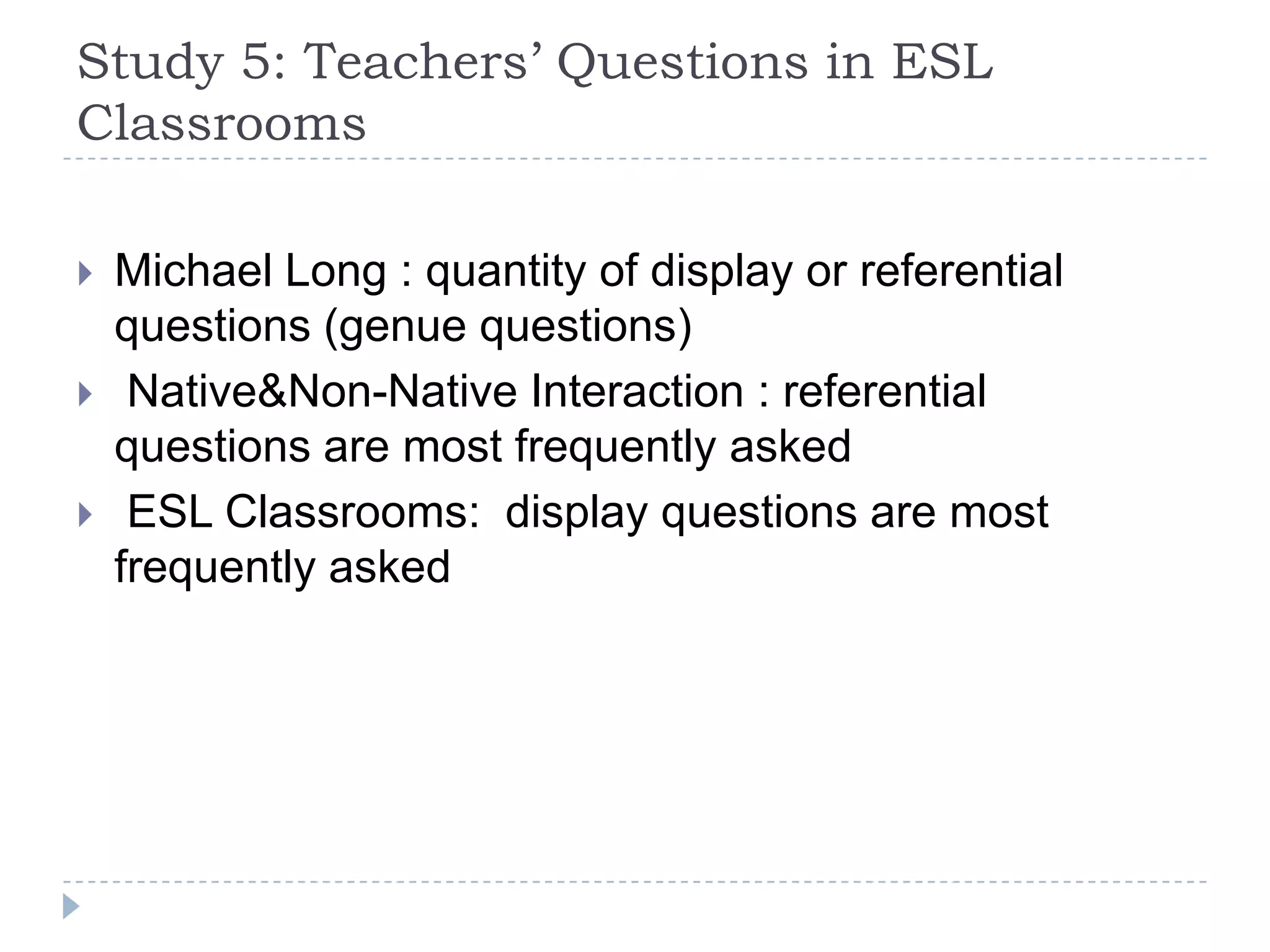
Study 5: Teachers’ Questions in ESL
Classrooms
 Michael Long : quantity of display or referential
questions (genue questions)
 Native&Non-Native Interaction : referential
questions are most frequently asked
 ESL Classrooms: display questions are most
frequently asked
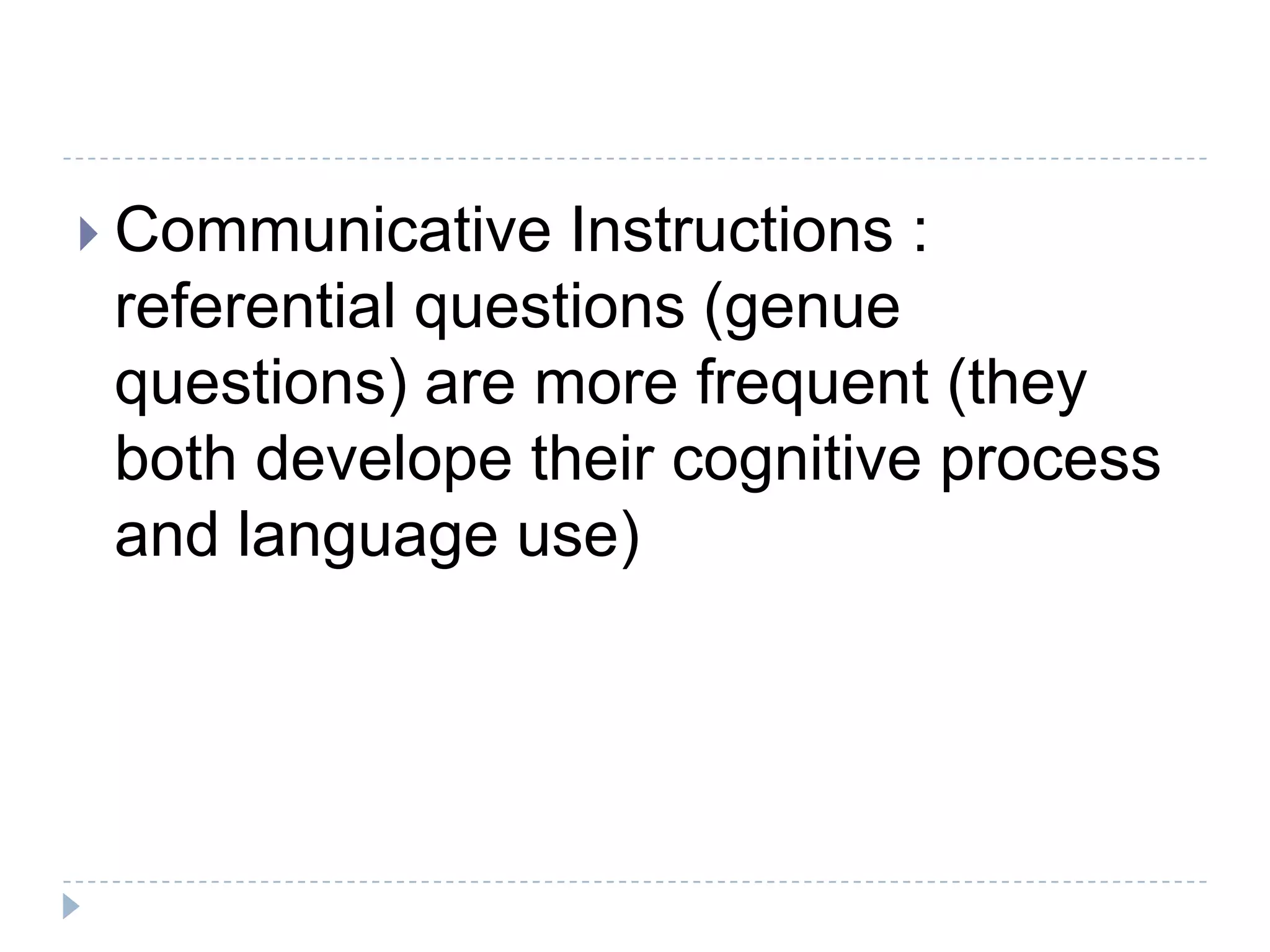
 Communicative Instructions :
referential questions (genue
questions) are more frequent (they
both develope their cognitive process
and language use)
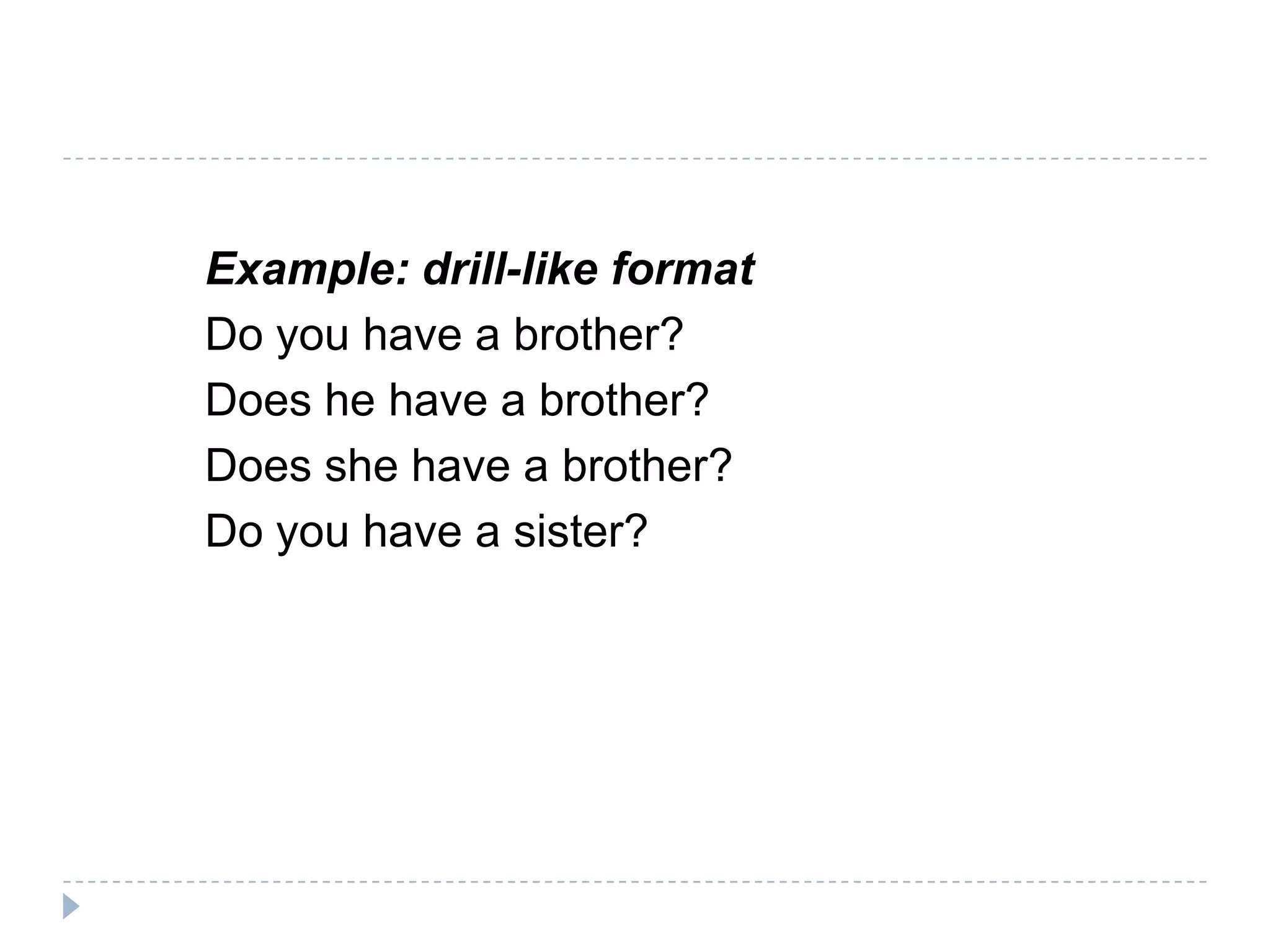
Example: drill-like format
Do you have a brother?
Does he have a brother?
Does she have a brother?
Do you have a sister?
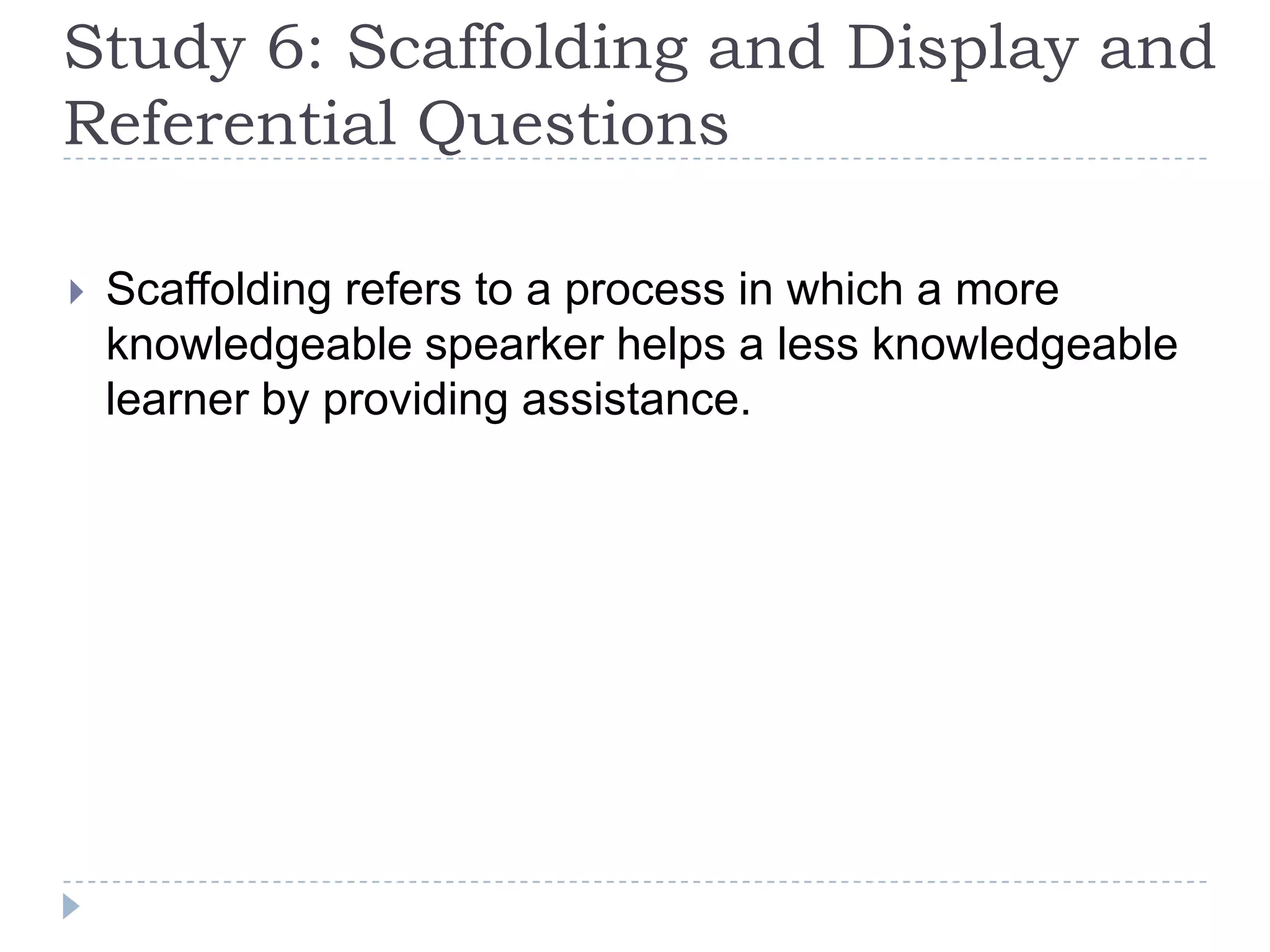
Study 6: Scaffolding and Display and
Referential Questions
 Scaffolding refers to a process in which a more
knowledgeable spearker helps a less knowledgeable
learner by providing assistance.
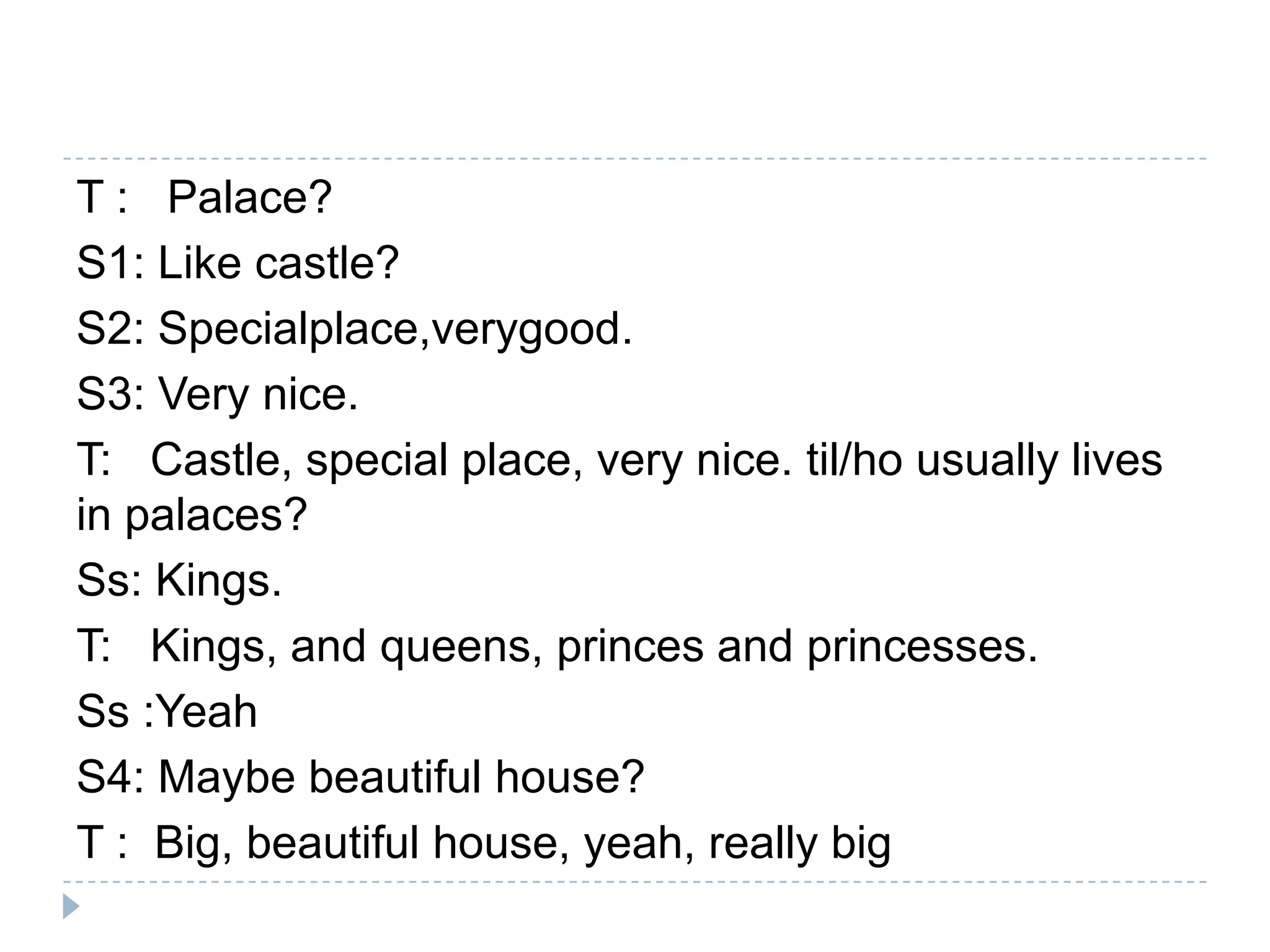
T : Palace?
S1: Like castle?
S2: Specialplace,verygood.
S3: Very nice.
T: Castle, special place, very nice. til/ho usually lives
in palaces?
Ss: Kings.
T: Kings, and queens, princes and princesses.
Ss :Yeah
S4: Maybe beautiful house?
T : Big, beautiful house, yeah, really big
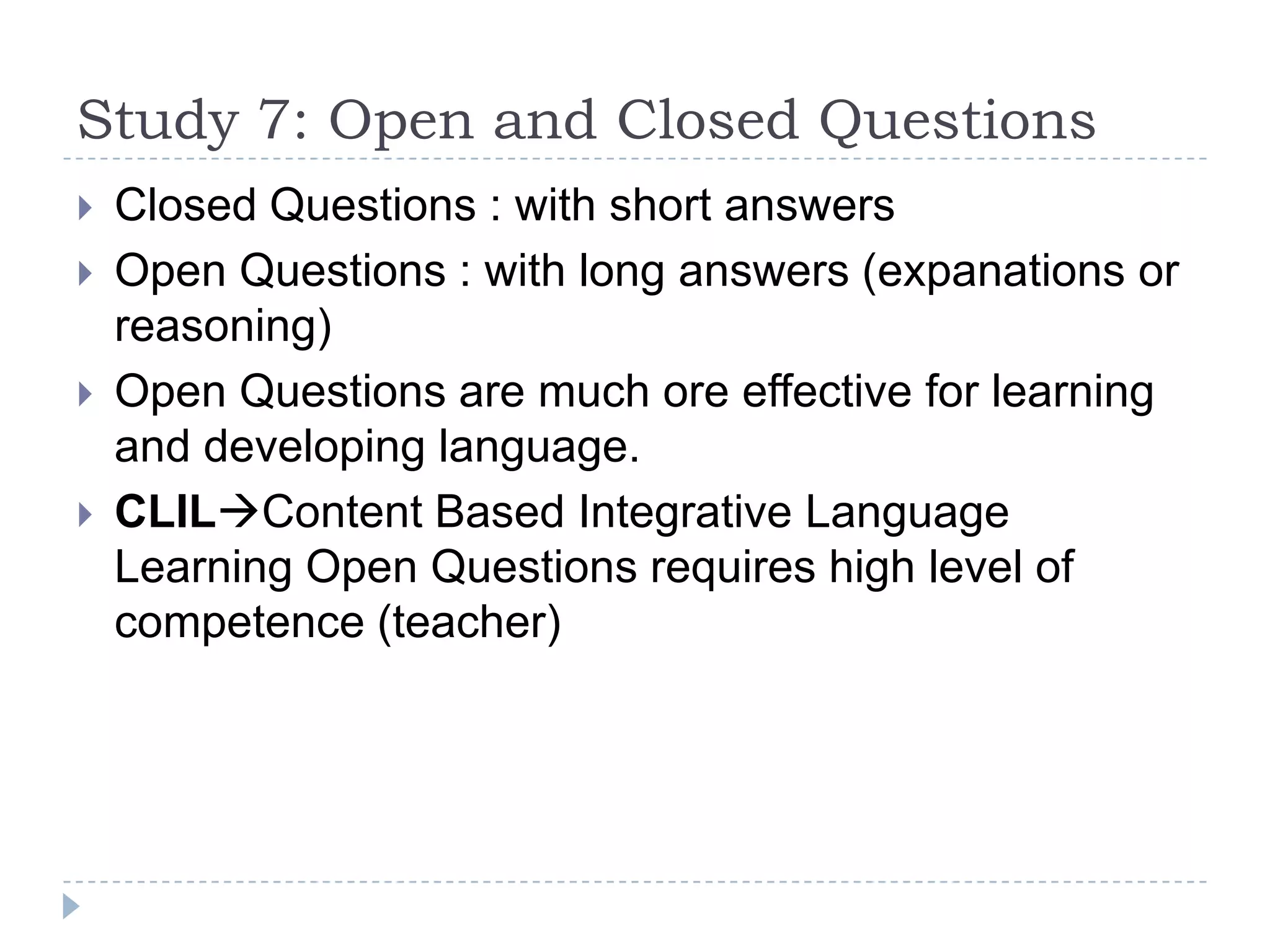
Study 7: Open and Closed Questions
 Closed Questions : with short answers
 Open Questions : with long answers (expanations or
reasoning)
 Open Questions are much ore effective for learning
and developing language.
 CLILContent Based Integrative Language
Learning Open Questions requires high level of
competence (teacher)
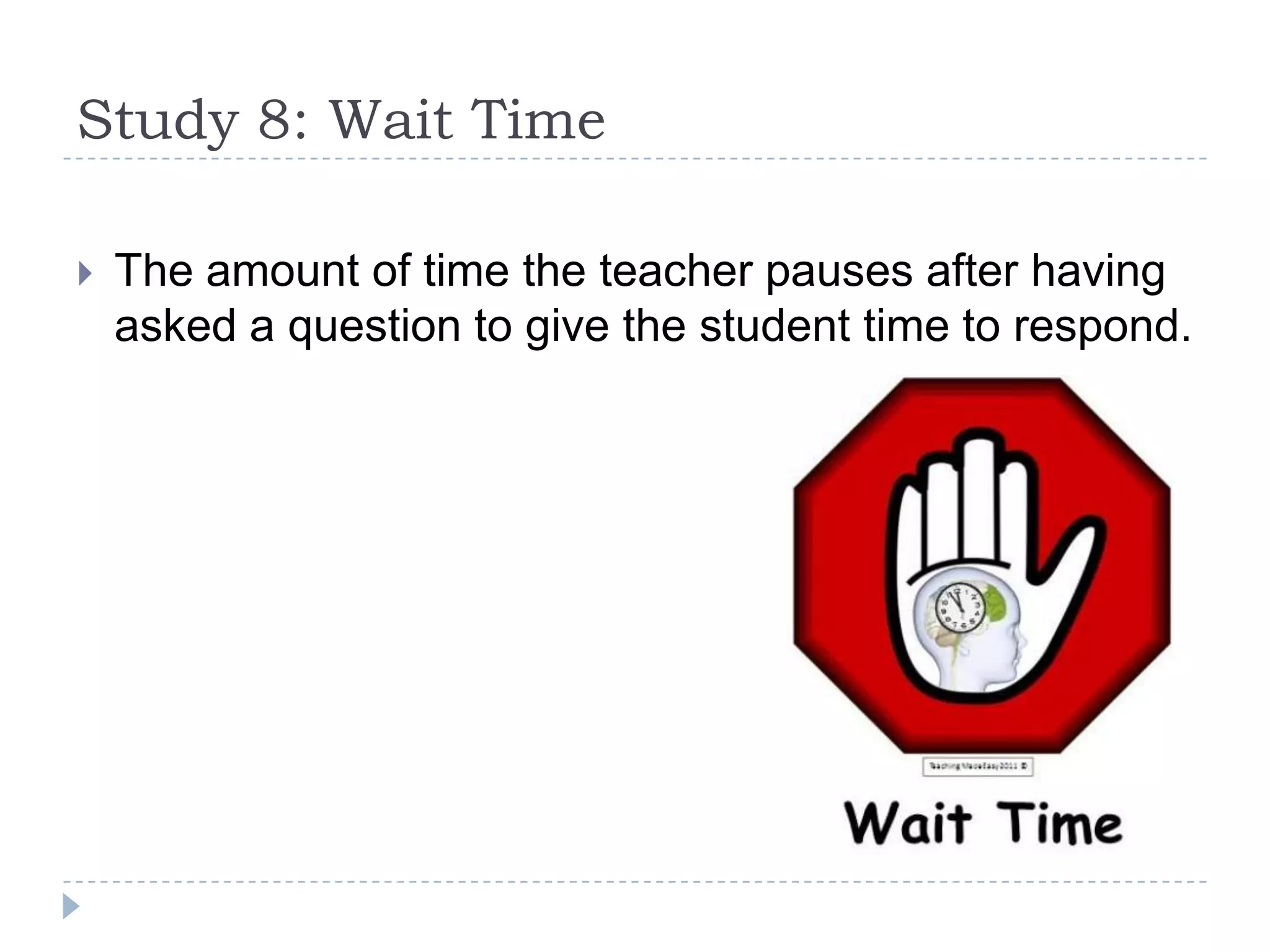
Study 8: Wait Time
 The amount of time the teacher pauses after having
asked a question to give the student time to respond.
ethnography
 Ethnographies are detailed long-
term (extensive) studies. They
try to analyze the impacts of
social, cultural or political
realities on learner’s cognitive,
social and linguistic
development.
 There are no pre-determined
categories. There is a observer
(participant or non-participant).
 If a student comes from a culture
where the silence is a symbol of
respect, the teacher should know
this (not to cause
misunderstanding)
Study 9 – Language in the Home & School
 Nine families in Solomon Islands.
 At home  rich language use & good communication,
different types of discourse
 At school  failed
 Because of formal language use at school and
restrictions of L1 use
 The real reason  parents questioned their children
and express their fears about children’s success at
school.
 These behaviors cause negative effects on their
learning.
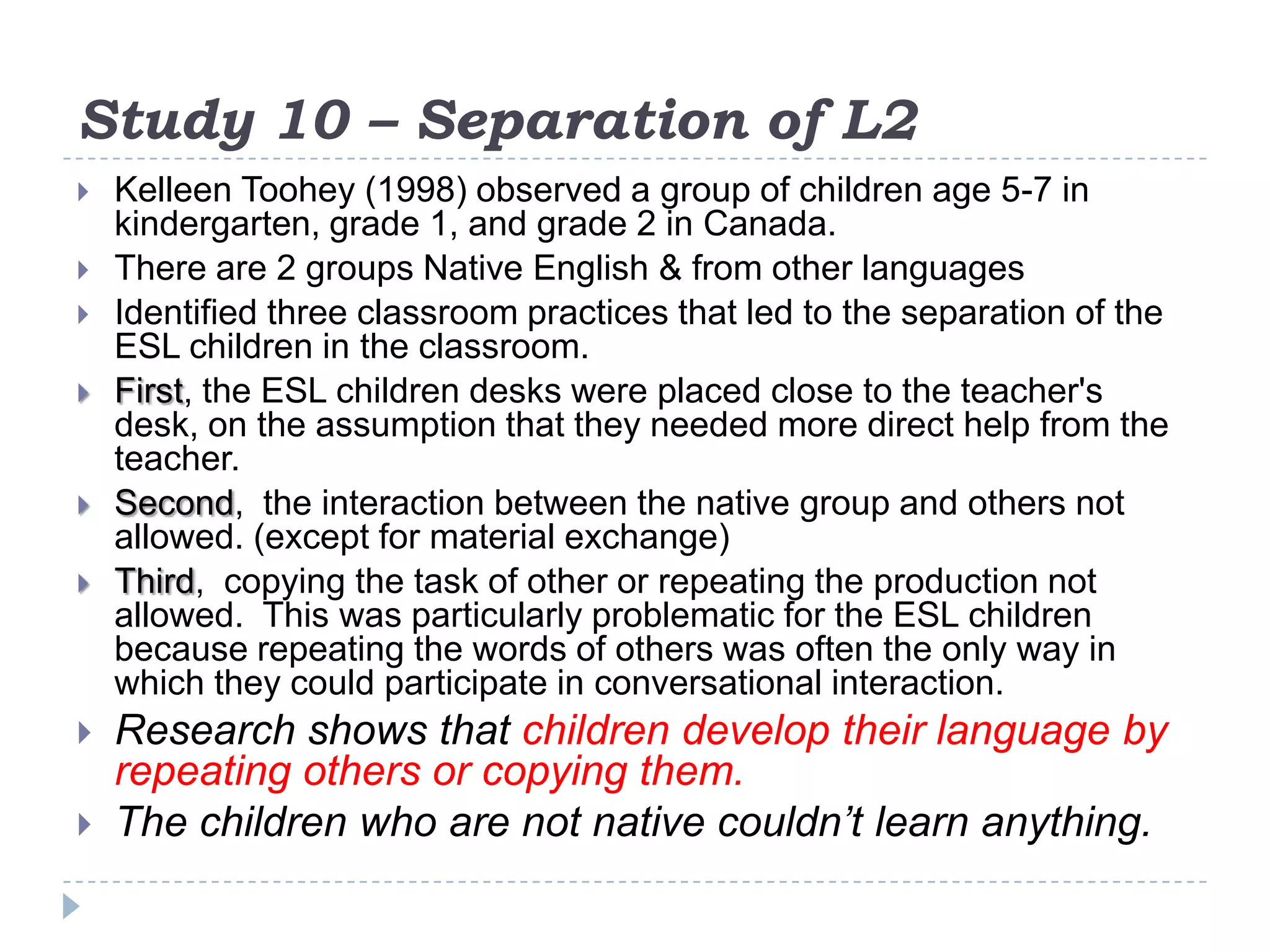
Study 10 – Separation of L2
 Kelleen Toohey (1998) observed a group of children age 5-7 in
kindergarten, grade 1, and grade 2 in Canada.
 There are 2 groups Native English & from other languages
 Identified three classroom practices that led to the separation of the
ESL children in the classroom.
 First, the ESL children desks were placed close to the teacher's
desk, on the assumption that they needed more direct help from the
teacher.
 Second, the interaction between the native group and others not
allowed. (except for material exchange)
 Third, copying the task of other or repeating the production not
allowed. This was particularly problematic for the ESL children
because repeating the words of others was often the only way in
which they could participate in conversational interaction.
 Research shows that children develop their language by
repeating others or copying them.
 The children who are not native couldn’t learn anything.
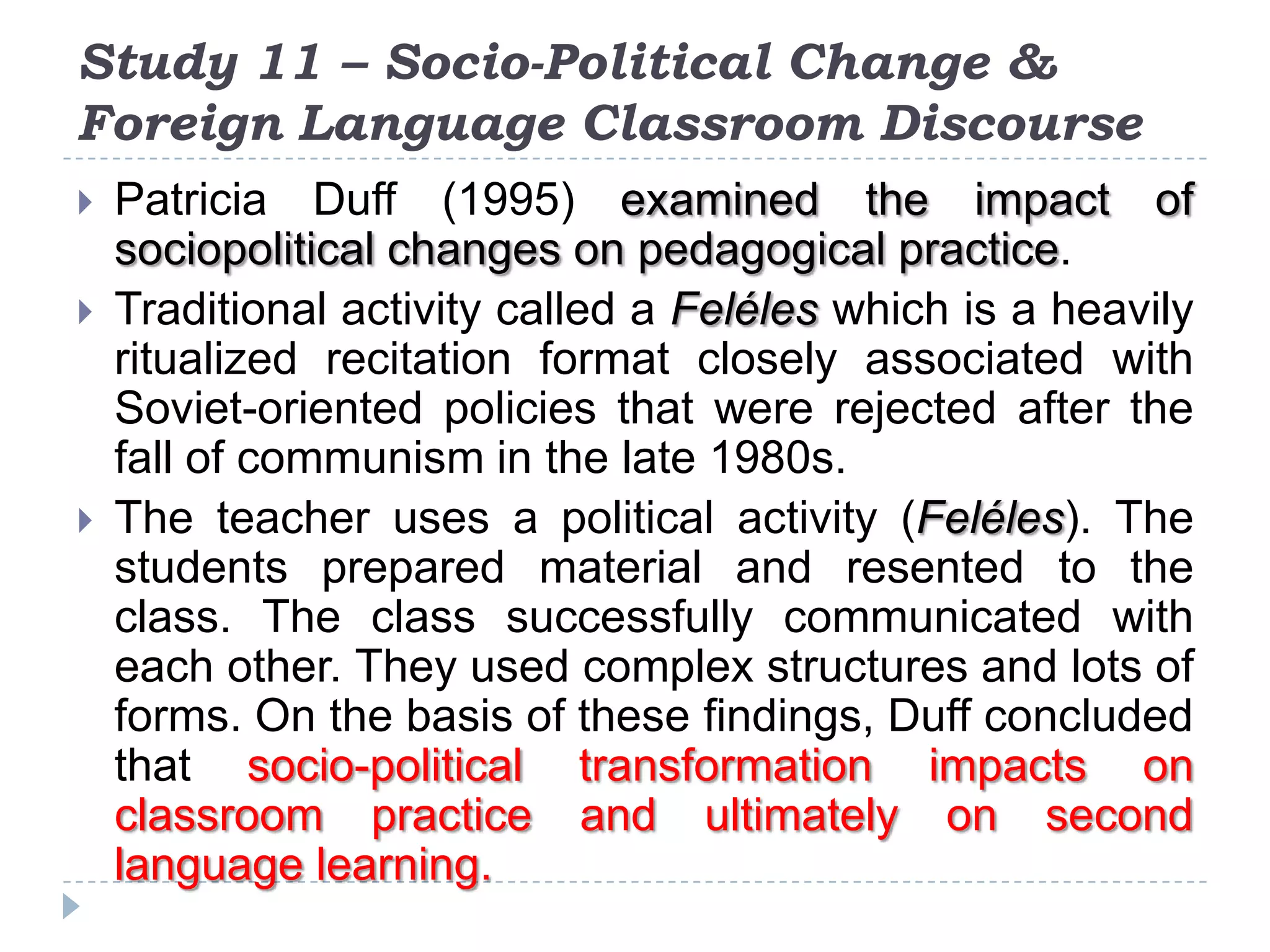
Study 11 – Socio-Political Change &
Foreign Language Classroom Discourse
 Patricia Duff (1995) examined the impact of
sociopolitical changes on pedagogical practice.
 Traditional activity called a Feléles which is a heavily
ritualized recitation format closely associated with
Soviet-oriented policies that were rejected after the
fall of communism in the late 1980s.
 The teacher uses a political activity (Feléles). The
students prepared material and resented to the
class. The class successfully communicated with
each other. They used complex structures and lots of
forms. On the basis of these findings, Duff concluded
that socio-political transformation impacts on
classroom practice and ultimately on second
language learning.

Classroom comparisons: Student-student interactions, Corrective Feedback in the Classroom, Questions In The Classroom, Ethnography

  • 1.
     Classroom comparisons: Student-studentinteractions (Elham Coşkun)  Corrective Feedback in the Classroom  (Nesrin Demirbaş)  Questions In The Classroom (Hülya Özger)  Ethnography  (Ercan Aksoy)
  • 2.
  • 3.
    Student I StudentII Errors Many Many Feedback on errors None None Genuine questions Yes Yes, more than St. 1 Display questions None None Negotiation of meaning Yes Yes Metalinguistics None None
  • 4.
    Conversation  D :Elle. [She]  D : Elle se souvient, non, Elle souuient qi elle a un ... une pratique de  chorale, alors elle se lbve. I She remembers, no. She remembers that  she has a choir practice so she gets upJ  D : Tout a coup fSuddenly]  N : Elle ssse [She ssse]  D : Elle souuientlShe remembers]  N : se souvie nt ov souaiezr ? lRemembers or remembers?]  D : Elle souuient ... ahh, elle se souvient ... Elle souuient ... Elle se  souvient, no. [She remembers ... ahh, she remembers ... She  remembers ... She remembers, no]  N : pas... [not]  D : Elle souuient qi elle doit aller au band ... ? [She remembers that she  has to go to bandl  N : Chorale. lChoir]  D : Chorale. lChoir]
  • 5.
     N :Tout a coup elle souuient qu'elle ... doit aller ) la chorale [All of a sudden she remembers that she has to go to choir]  D : [very softlyl elle se souvien ... non. [She remembers . .. no]  D : Alors, elle [So, she]  N : non, wait. tout i coup elle ...sudden she ... remembers?]  D : Je pense pas que c'est se souvient. [I dont think it's remember]  N : oh, souvient ... souvient. [oh remember ... remember]  D : Elle souuientqu elle a le chorale. [She remembers that she has choir]  N : Qu elle doit se prdparer. [that she has to get ready]  D : Oui. [Yes]  N : pour le chorale ... non, tout i coup elle souuientqu il ya une pratique de chorale. [for choir ... no, all of a sudden she remembers that there's a choir practice]
  • 6.
    Dara Nina Errors Yes,grammatical Yes, grammatical Feedback on errors None None Genuine questions Yes Yes Display questions None None Negotiation of meaning Yes Yes Metalinguistics Slightly Slightly
  • 7.
    Corrective Feedback in theClassroom Observing Learning and Teaching in L2 Classroom
  • 8.
    Eplicit correction: refers tothe explicit provision of the correct form. S: The dog run fastly T: ‘Fastly’ doesn’t exist. ‘Fast’ does not take –ly. That’s why I picked ‘quickly’. Study 1: Recasts in content-based classrooms
  • 9.
    Recasts: involve the teacher’sreformulation of all or part of a student’s utterance, minus the error. S1: Why you don’t like Marc? T: Why don’t you like Marc? S2: I don’t know, I don’t like him. Study 1: Recasts in content-based classrooms
  • 10.
    Clarification requests : indicateto students either that their utterance has been misunderstood by the teacher or that the utterance is incorrect in some way and that a repetition or a reformulation is required. Study 1: Recasts in content-based classrooms
  • 11.
    Clarification requests: T: Howoften do you wash the dishes? S: Fourteen. T: Excuse me? (clarification request) S: Fourteen. T: Fourteen what? (clarification request) S: Fourteen for a week. T: Fourteen times a week. (recast) S: Yes. Lunch and dinner. Study 1: Recasts in content-based classrooms
  • 12.
    Mentalinguistic feedback: contains comments,information or questions related to the correctness of the student’s utterance, without explicitly providing the correct form. S: We look at the people yesterday. T: What’s the ending we put on verbs when we talk about the past? S: e-d Study 1: Recasts in content-based classrooms
  • 13.
    Elicitation: refers to teacher’stechniques which is used directly elicit the correct form from students. S: My father cleans the plate. T: Excuse me, he cleans the?? S: Plates? Study 1: Recasts in content-based classrooms
  • 14.
    Repetition: refers to theteacher’s repetition of the student’s errorneous utterance. S: He’s in the bathroom. T: Bathroom? Bedroom. He’S in the bedroom. Study 1: Recasts in content-based classrooms
  • 15.
    S: We is… T:We is? But it’s two peoplei right? You see your mistake? You see the error? When it’s plural it’s ‘we are’. Study 1: Recasts in content-based classrooms
  • 16.
    In a studywith adult foreign language learners of Japanese, Amy Ohta (2000) examined the oral language that learners addressed to themselves during classroom activities. She was able to obtain this private speech by attaching microphones to individual students during classroom interaction. The classroom interaction consisted of a focus on grammar and metalinguistic instruction. Study 2: Recasts and private speech
  • 17.
    In a descriptiveclassroom study with adult learners of English as a second language, Rod Ellis, Helen Basturkmen, and Shaun Loewen (2001) observed the types of corrective feedback provided by teachers and the learner’s immediate responses to the learner’s errors come in the form of recasts. They also observed that leraners immediately reacted to most of these recasts. Study 3: Recasts and uptake
  • 18.
    Rhonda Oliver andAlison Mackey (2003) carried out a descriptive study of and Australian primary ESL classroom with 6-12 year olds. They identified four contexts on which the teachers and learners interacted: Study 4: Corrective feedback in context
  • 19.
    1:content exchanges inwhich the teacher imperted knowledge or asked questions about the content of the curriculum 2:management exchanges in which the teacher talked about the organization of the lesson appropriate classroom behaviour. 3:communication exchanges in which the emphasis was on students using English in meaningful ways 4:explicit language-focused exchanges where the emphasis was on grammar and the use of mentalinguistic terminology. Study 4: Corrective feedback in context
  • 20.
  • 21.
    Study 5: Teachers’Questions in ESL Classrooms  Michael Long : quantity of display or referential questions (genue questions)  Native&Non-Native Interaction : referential questions are most frequently asked  ESL Classrooms: display questions are most frequently asked
  • 22.
     Communicative Instructions: referential questions (genue questions) are more frequent (they both develope their cognitive process and language use)
  • 23.
    Example: drill-like format Doyou have a brother? Does he have a brother? Does she have a brother? Do you have a sister?
  • 24.
    Study 6: Scaffoldingand Display and Referential Questions  Scaffolding refers to a process in which a more knowledgeable spearker helps a less knowledgeable learner by providing assistance.
  • 25.
    T : Palace? S1:Like castle? S2: Specialplace,verygood. S3: Very nice. T: Castle, special place, very nice. til/ho usually lives in palaces? Ss: Kings. T: Kings, and queens, princes and princesses. Ss :Yeah S4: Maybe beautiful house? T : Big, beautiful house, yeah, really big
  • 26.
    Study 7: Openand Closed Questions  Closed Questions : with short answers  Open Questions : with long answers (expanations or reasoning)  Open Questions are much ore effective for learning and developing language.  CLILContent Based Integrative Language Learning Open Questions requires high level of competence (teacher)
  • 27.
    Study 8: WaitTime  The amount of time the teacher pauses after having asked a question to give the student time to respond.
  • 28.
    ethnography  Ethnographies aredetailed long- term (extensive) studies. They try to analyze the impacts of social, cultural or political realities on learner’s cognitive, social and linguistic development.  There are no pre-determined categories. There is a observer (participant or non-participant).  If a student comes from a culture where the silence is a symbol of respect, the teacher should know this (not to cause misunderstanding)
  • 29.
    Study 9 –Language in the Home & School  Nine families in Solomon Islands.  At home  rich language use & good communication, different types of discourse  At school  failed  Because of formal language use at school and restrictions of L1 use  The real reason  parents questioned their children and express their fears about children’s success at school.  These behaviors cause negative effects on their learning.
  • 30.
    Study 10 –Separation of L2  Kelleen Toohey (1998) observed a group of children age 5-7 in kindergarten, grade 1, and grade 2 in Canada.  There are 2 groups Native English & from other languages  Identified three classroom practices that led to the separation of the ESL children in the classroom.  First, the ESL children desks were placed close to the teacher's desk, on the assumption that they needed more direct help from the teacher.  Second, the interaction between the native group and others not allowed. (except for material exchange)  Third, copying the task of other or repeating the production not allowed. This was particularly problematic for the ESL children because repeating the words of others was often the only way in which they could participate in conversational interaction.  Research shows that children develop their language by repeating others or copying them.  The children who are not native couldn’t learn anything.
  • 31.
    Study 11 –Socio-Political Change & Foreign Language Classroom Discourse  Patricia Duff (1995) examined the impact of sociopolitical changes on pedagogical practice.  Traditional activity called a Feléles which is a heavily ritualized recitation format closely associated with Soviet-oriented policies that were rejected after the fall of communism in the late 1980s.  The teacher uses a political activity (Feléles). The students prepared material and resented to the class. The class successfully communicated with each other. They used complex structures and lots of forms. On the basis of these findings, Duff concluded that socio-political transformation impacts on classroom practice and ultimately on second language learning.