Speaking Activities for CLIL
Warmer...
 What was the purpose of this task?
 Have you ever done anything similar with
your class?
 How could you adapt / scaffold these
tasks for different subjects?
Warmers to use:
 http://busyteacher.org/teaching_ideas_and_techniques/warmers/
 http://eslgames.com/no-prep-warm-up-activities/
 http://www.onestopenglish.com/teenagers/skills/warmers/
 https://teachertrove.wikispaces.com/Warmers+and+Fillers
 https://www.englishclub.com/english-clubs/warmups.htm
 https://www.britishcouncil.es/sites/default/files/warmers_and_fille
rs_booklet.pdf
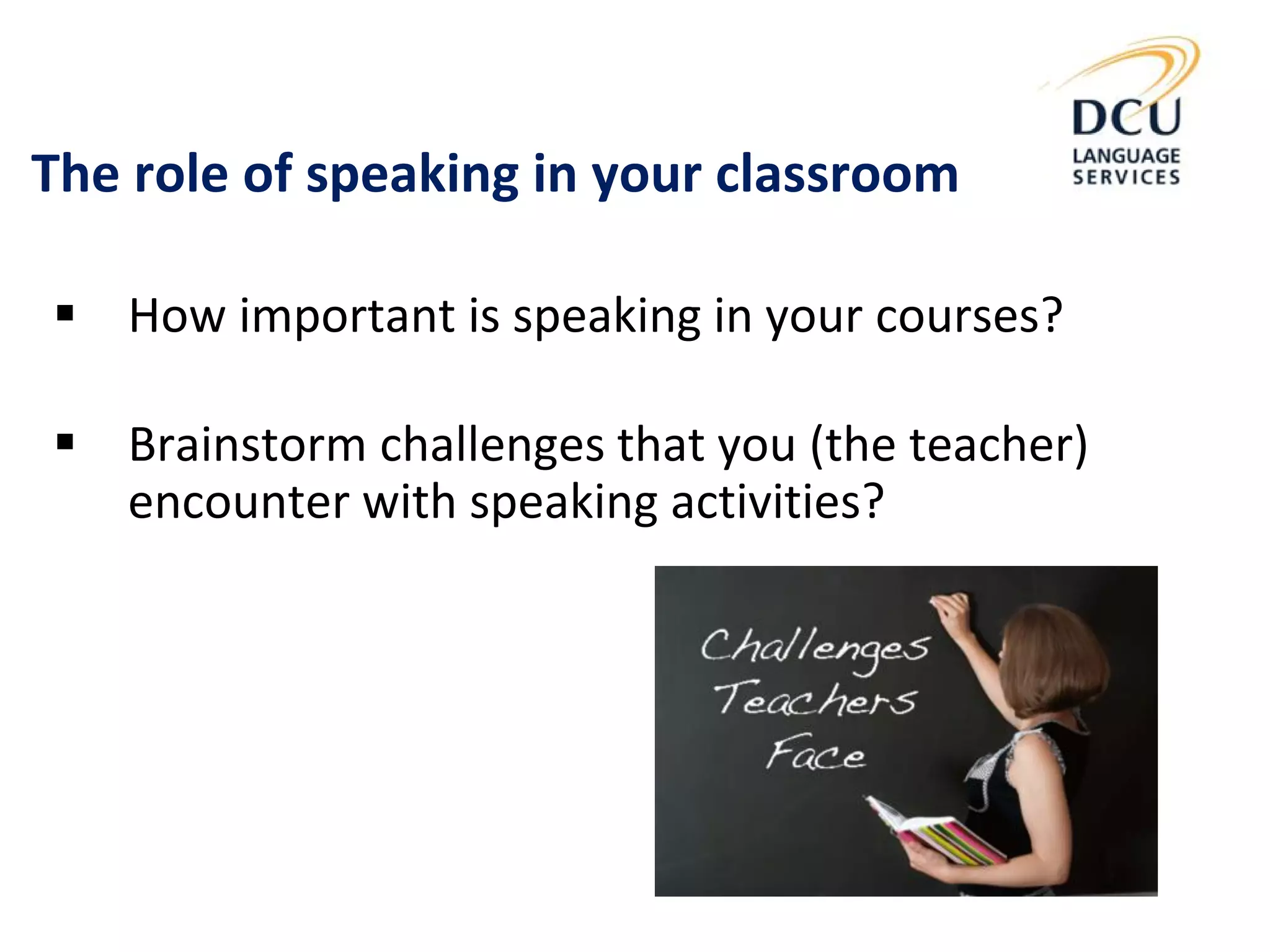
The role of speaking in your classroom
 How important is speaking in your courses?
 Brainstorm challenges that you (the teacher)
encounter with speaking activities?
 Students won’t talk
 Students talk in their own language
 Students don’t engage with the activity
 Noise levels can be disruptive to other neighbouring classes
 Devising relevant support materials
 Knowing when and how to correct errors
 Dividing students into pairs and groups
 Don’t feel confident in my own level of English
Speaking: Challenges for CLIL Teachers
What should we do to overcome these difficulties?
From the learner’s perspective…
 Brainstorm challenges learners face during speaking
activities?
 They feel silly speaking a language in which they know they are making
mistakes.
 It can feel artificial to communicate with classmates in a foreign language.
 When they want to say something important to each other, they do so
spontaneously in their mother tongue.
 They do not have the English to express the concepts that the teacher
wants them to express.
 They do not understand the point of speaking English all the time in class.
 It is very tiring to concentrate on producing a foreign language especially
when your level is low.
 The topic / activity that they are supposed to be talking about in English is
boring, so they talk about something else in their mother tongue.
 Speaking English is difficult.
 Speaking English is not fun.
Speaking: Challenges for CLIL learners
Now let’s look at solutions!
What can we do to overcome these challenges?
We practise speaking skills to improve 2 broad
functions. What are they?
 Fluency Accuracy
What is the main difference between both?
What is the teacher’s/students’ role?
Brainstorm different type of activities used to
encourage fluency
In pairs or groups:
 Information gap fills
 Reaching a consensus
 Problem solving
 Interpersonal exchange
 Role play
 Story construction
 Research and project work
 Presentations
 Surveys
 Debates/Discussions
 Show and Tell
 Did you hear about
Fluency Activities
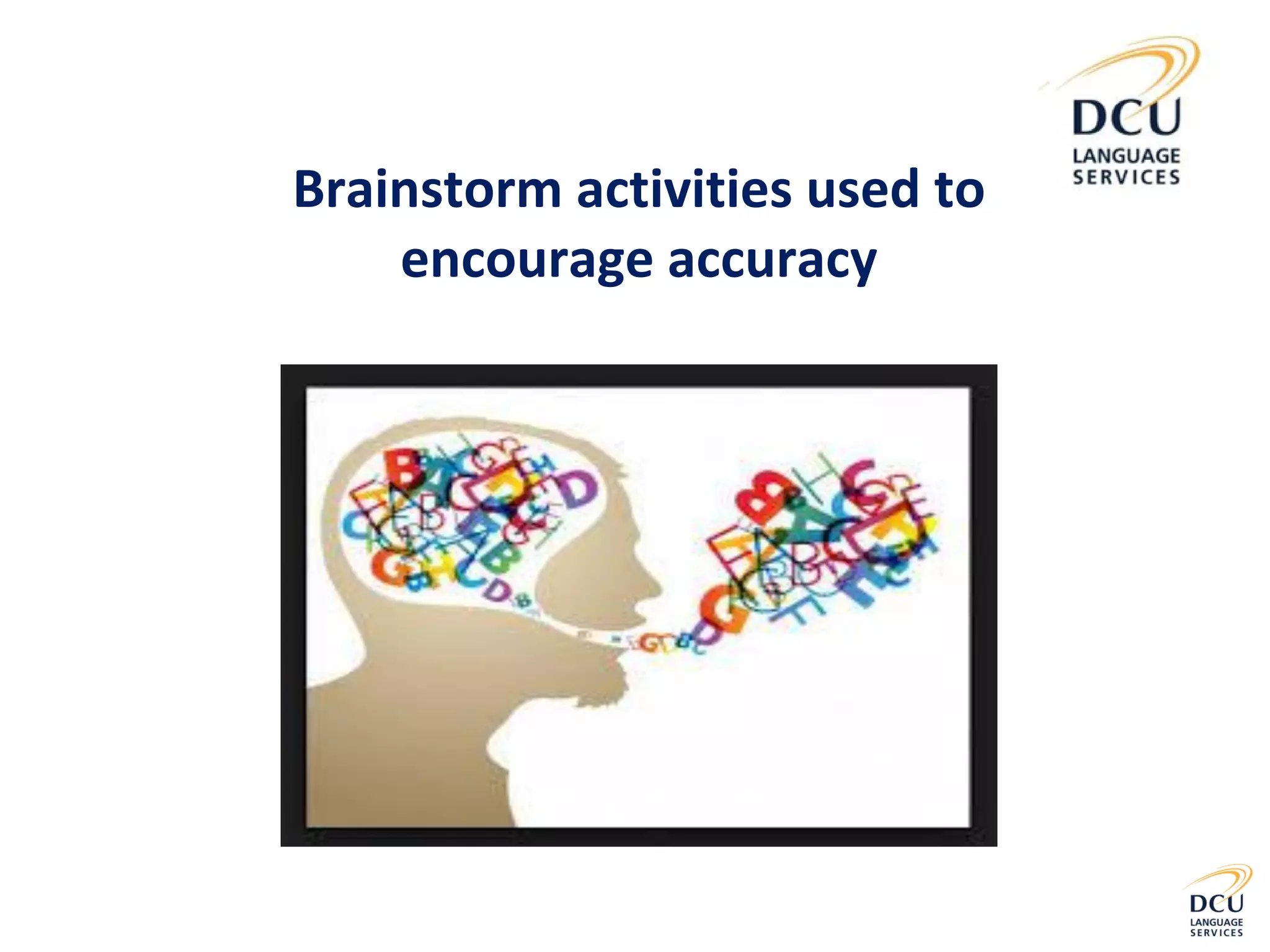
Brainstorm activities used to
encourage accuracy
Controlled Practice: strict to freer activities
 Drilling
 Mix Drill
 Spot the Difference (Picture A/B).
 Jigsaw Activity: Four pictures of an event are
flashed before students in random order, and
they have to reconstruct the event.
 ‘Get up and find out’ surveys: Find out about
classmates’ preferences. Students create
questions, ask them, and collate the answers.
 Guessing games: e.g.‘What’s my line?’/’Who am
I?’ /’Animal, vegetable or mineral’/ 20 Questions.’
.
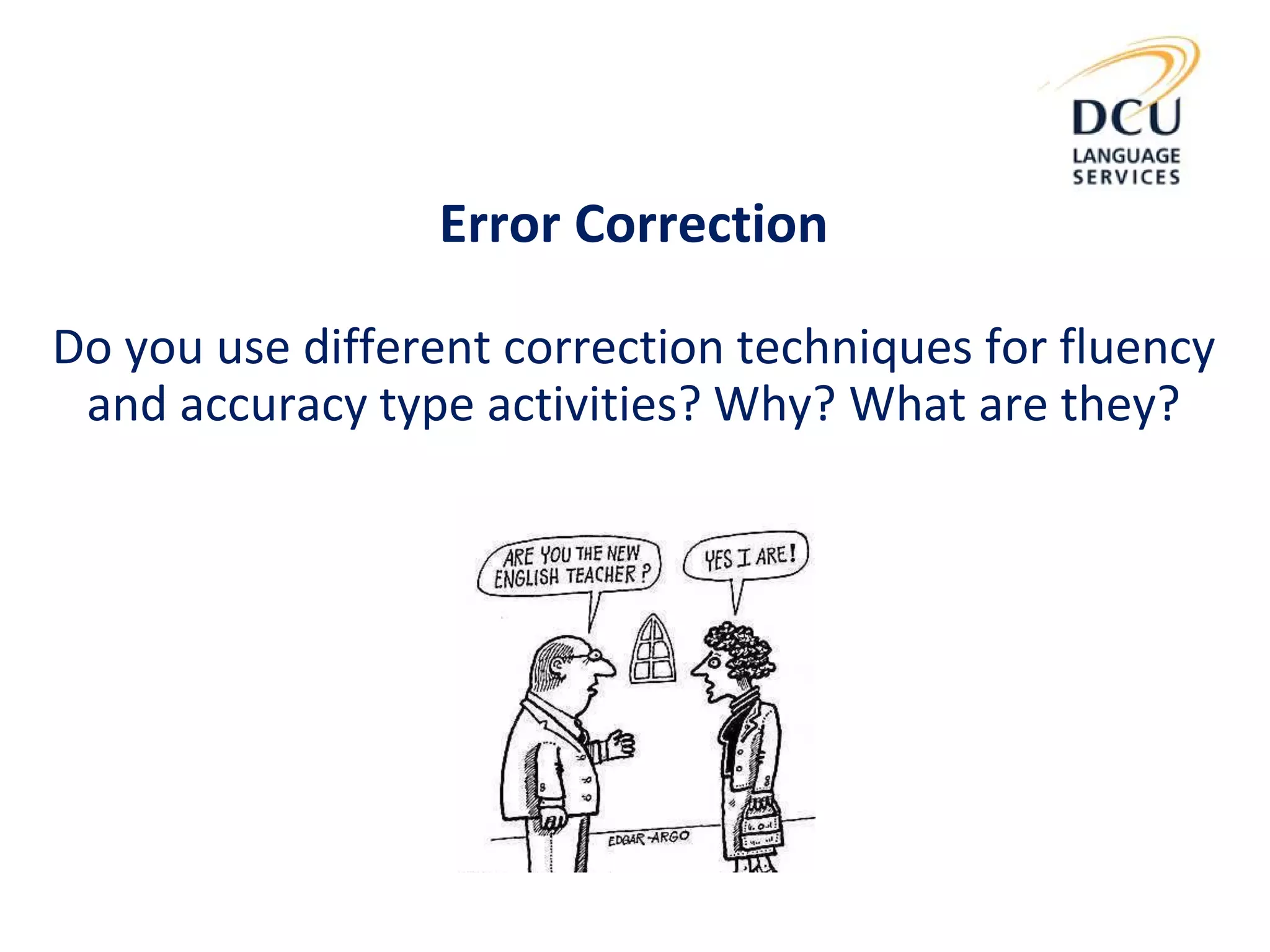
Error Correction
Do you use different correction techniques for fluency
and accuracy type activities? Why? What are they?
When faced with a student’s error, the teacher
must think on her/his feet:
 Is there an error here?
 What kind of error is it?
 What caused it?
 Does it matter?
 What, if anything, should I do about it?
(Thornbury, S. (1999). How to Teach Grammar. p. 113)
 Direct correction
“That’s wrong”; “No”; “That’s not right”
 Indirect correction:
Facial expression
Gesture + expression
Finger correction (count out the words in the phrase)
Repetition, with rising intonation
Paraphrase or Reformulation Asking a question
Expansion and elaboration
Sentence completion
Drawing on the board, e.g. a time line
Pointing to the correct version e.g. on a chart or in a book
Error correction
Watch: What kinds of error correction
techniques does this teacher use?
 http://www.youtube.com/watch?v=qdlaj4xSPjo
 As you watch this clip, take note of all the different
methods that the teacher uses to correct her learners as
they learn the primary colours (German).
 How do you think the teacher dealt with them?
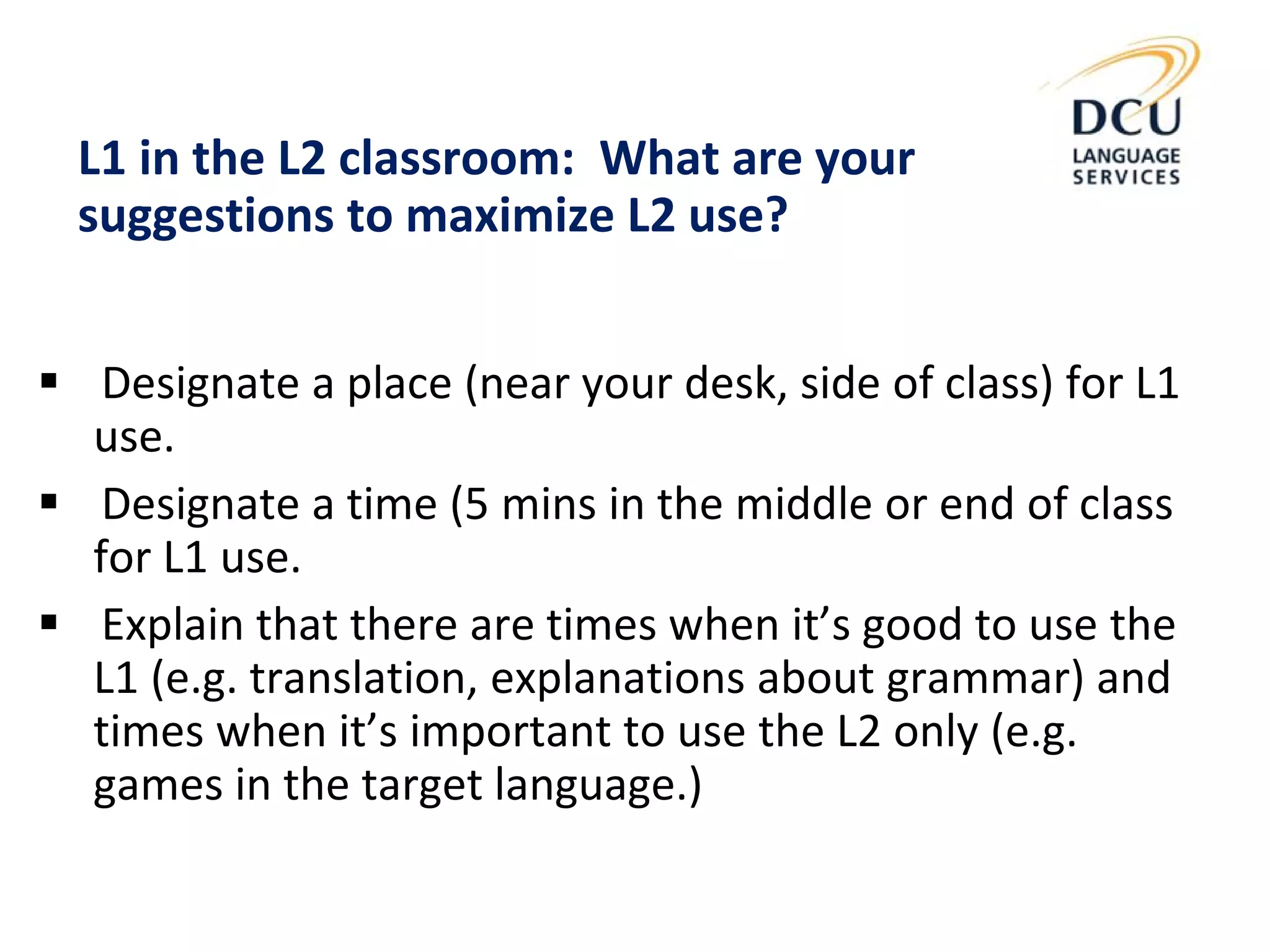
L1 in the L2 classroom: What are your
suggestions to maximize L2 use?
 Designate a place (near your desk, side of class) for L1
use.
 Designate a time (5 mins in the middle or end of class
for L1 use.
 Explain that there are times when it’s good to use the
L1 (e.g. translation, explanations about grammar) and
times when it’s important to use the L2 only (e.g.
games in the target language.)
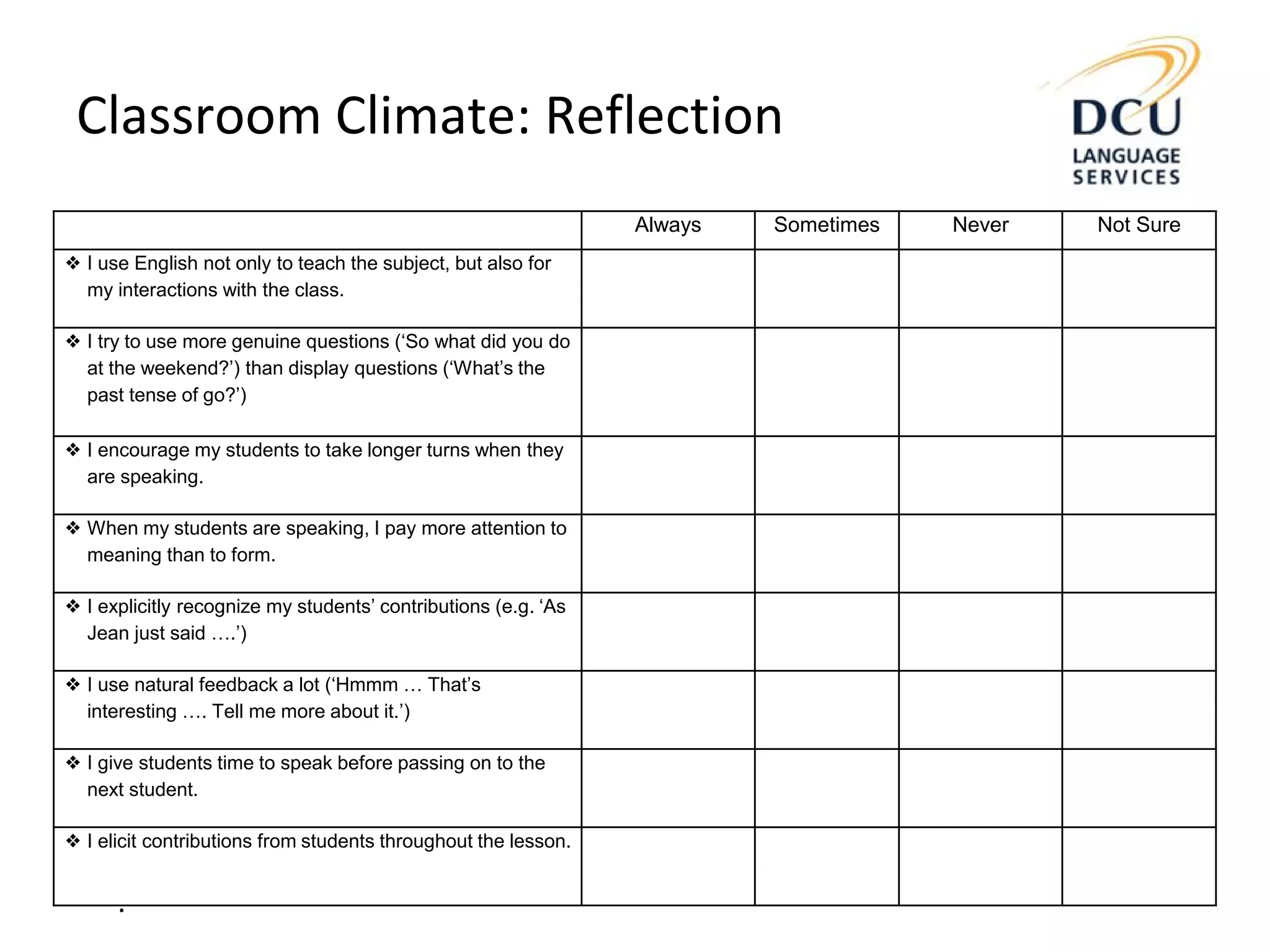
Classroom Climate: Reflection
Always Sometimes Never Not Sure
❖ I use English not only to teach the subject, but also for
my interactions with the class.
❖ I try to use more genuine questions (‘So what did you do
at the weekend?’) than display questions (‘What’s the
past tense of go?’)
❖ I encourage my students to take longer turns when they
are speaking.
❖ When my students are speaking, I pay more attention to
meaning than to form.
❖ I explicitly recognize my students’ contributions (e.g. ‘As
Jean just said ….’)
❖ I use natural feedback a lot (‘Hmmm … That’s
interesting …. Tell me more about it.’)
❖ I give students time to speak before passing on to the
next student.
❖ I elicit contributions from students throughout the lesson.
.

Speaking activities for clil

  • 1.
  • 2.
    Warmer...  What wasthe purpose of this task?  Have you ever done anything similar with your class?  How could you adapt / scaffold these tasks for different subjects?
  • 3.
    Warmers to use: http://busyteacher.org/teaching_ideas_and_techniques/warmers/  http://eslgames.com/no-prep-warm-up-activities/  http://www.onestopenglish.com/teenagers/skills/warmers/  https://teachertrove.wikispaces.com/Warmers+and+Fillers  https://www.englishclub.com/english-clubs/warmups.htm  https://www.britishcouncil.es/sites/default/files/warmers_and_fille rs_booklet.pdf
  • 4.
    The role ofspeaking in your classroom  How important is speaking in your courses?  Brainstorm challenges that you (the teacher) encounter with speaking activities?
  • 5.
     Students won’ttalk  Students talk in their own language  Students don’t engage with the activity  Noise levels can be disruptive to other neighbouring classes  Devising relevant support materials  Knowing when and how to correct errors  Dividing students into pairs and groups  Don’t feel confident in my own level of English Speaking: Challenges for CLIL Teachers
  • 6.
    What should wedo to overcome these difficulties?
  • 7.
    From the learner’sperspective…  Brainstorm challenges learners face during speaking activities?
  • 8.
     They feelsilly speaking a language in which they know they are making mistakes.  It can feel artificial to communicate with classmates in a foreign language.  When they want to say something important to each other, they do so spontaneously in their mother tongue.  They do not have the English to express the concepts that the teacher wants them to express.  They do not understand the point of speaking English all the time in class.  It is very tiring to concentrate on producing a foreign language especially when your level is low.  The topic / activity that they are supposed to be talking about in English is boring, so they talk about something else in their mother tongue.  Speaking English is difficult.  Speaking English is not fun. Speaking: Challenges for CLIL learners
  • 9.
    Now let’s lookat solutions! What can we do to overcome these challenges?
  • 10.
    We practise speakingskills to improve 2 broad functions. What are they?  Fluency Accuracy What is the main difference between both? What is the teacher’s/students’ role?
  • 11.
    Brainstorm different typeof activities used to encourage fluency
  • 12.
    In pairs orgroups:  Information gap fills  Reaching a consensus  Problem solving  Interpersonal exchange  Role play  Story construction  Research and project work  Presentations  Surveys  Debates/Discussions  Show and Tell  Did you hear about Fluency Activities
  • 13.
    Brainstorm activities usedto encourage accuracy
  • 14.
    Controlled Practice: strictto freer activities  Drilling  Mix Drill  Spot the Difference (Picture A/B).  Jigsaw Activity: Four pictures of an event are flashed before students in random order, and they have to reconstruct the event.  ‘Get up and find out’ surveys: Find out about classmates’ preferences. Students create questions, ask them, and collate the answers.  Guessing games: e.g.‘What’s my line?’/’Who am I?’ /’Animal, vegetable or mineral’/ 20 Questions.’ .
  • 15.
    Error Correction Do youuse different correction techniques for fluency and accuracy type activities? Why? What are they?
  • 16.
    When faced witha student’s error, the teacher must think on her/his feet:  Is there an error here?  What kind of error is it?  What caused it?  Does it matter?  What, if anything, should I do about it? (Thornbury, S. (1999). How to Teach Grammar. p. 113)
  • 17.
     Direct correction “That’swrong”; “No”; “That’s not right”  Indirect correction: Facial expression Gesture + expression Finger correction (count out the words in the phrase) Repetition, with rising intonation Paraphrase or Reformulation Asking a question Expansion and elaboration Sentence completion Drawing on the board, e.g. a time line Pointing to the correct version e.g. on a chart or in a book Error correction
  • 18.
    Watch: What kindsof error correction techniques does this teacher use?  http://www.youtube.com/watch?v=qdlaj4xSPjo  As you watch this clip, take note of all the different methods that the teacher uses to correct her learners as they learn the primary colours (German).  How do you think the teacher dealt with them?
  • 19.
    L1 in theL2 classroom: What are your suggestions to maximize L2 use?  Designate a place (near your desk, side of class) for L1 use.  Designate a time (5 mins in the middle or end of class for L1 use.  Explain that there are times when it’s good to use the L1 (e.g. translation, explanations about grammar) and times when it’s important to use the L2 only (e.g. games in the target language.)
  • 20.
    Classroom Climate: Reflection AlwaysSometimes Never Not Sure ❖ I use English not only to teach the subject, but also for my interactions with the class. ❖ I try to use more genuine questions (‘So what did you do at the weekend?’) than display questions (‘What’s the past tense of go?’) ❖ I encourage my students to take longer turns when they are speaking. ❖ When my students are speaking, I pay more attention to meaning than to form. ❖ I explicitly recognize my students’ contributions (e.g. ‘As Jean just said ….’) ❖ I use natural feedback a lot (‘Hmmm … That’s interesting …. Tell me more about it.’) ❖ I give students time to speak before passing on to the next student. ❖ I elicit contributions from students throughout the lesson. .