Carcinogenesis
Mohammed Fathy Bayomy, MSc, MD
Lecturer
Clinical Oncology & Nuclear Medicine
Faculty of Medicine
Zagazig University
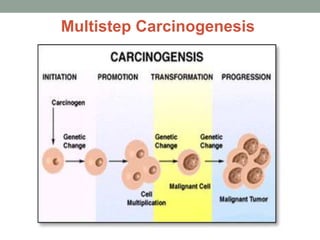
Multistep Carcinogenesis
 Stages
1) Initiation
* Caused by mutation following application of initiating agent
* Once mutation is fixed by mitosis, it is irreversible
* Cells histologically appear normal inspite of genetic damage
* Initiated cells are also diploid, with normal DNA content
* Initiator
- Chemical e.g. smoking & alcohol) or
- Radiation (e.g. solar ultraviolet irradiation)
2) Promotion
* Characterized by cell proliferation (clonal expansion), &
reversible after cassation of promoting agent
* Promoting agents act through increase in growth factor which
stimulate cell proliferation through epigenetic mechanism
* Histologically, pre-neoplastic lesion in form of dysplasia or
benign tumor
* Promoted cells are usually diploid
* Promotor
- Experimental (croton oil ‘‘phorbol ester’’ saccharine, plastic)
- Human promoting agents (bile acids, hormones, oncogenic
viruses growth factors)
3) Progression
* Results from multiple, mutations in proliferating cellular
subclones which results in intratumor molecular heterogeneity
* Irreversible process
* Histologically: cellular anaplasia, other malignant biological
feature, cells are aneuploid
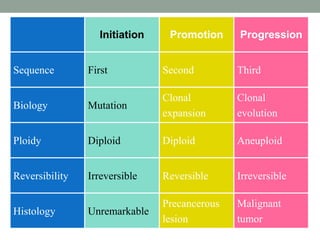
Initiation Promotion Progression
Sequence First Second Third
Biology Mutation
Clonal
expansion
Clonal
evolution
Ploidy Diploid Diploid Aneuploid
Reversibility Irreversible Reversible Irreversible
Histology Unremarkable
Precancerous
lesion
Malignant
tumor
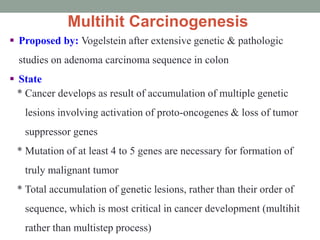
Multihit Carcinogenesis
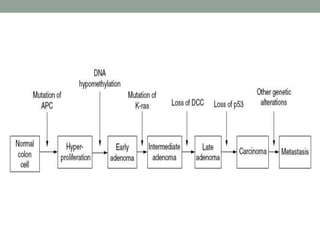
 Proposed by: Vogelstein after extensive genetic & pathologic
studies on adenoma carcinoma sequence in colon
 State
* Cancer develops as result of accumulation of multiple genetic
lesions involving activation of proto-oncogenes & loss of tumor
suppressor genes
* Mutation of at least 4 to 5 genes are necessary for formation of
truly malignant tumor
* Total accumulation of genetic lesions, rather than their order of
sequence, which is most critical in cancer development (multihit
rather than multistep process)
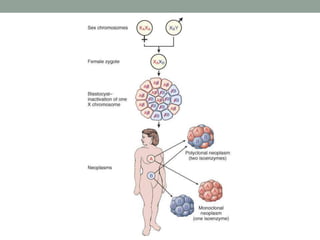
Monoclonality of Cancer
 Cancer arises through multistep accumulation of somatic gene
mutations in progeny of single cell of origin (monoclonal)
 Accumulation of mutations in different subclones will ultimately
lead to molecular intratumour heterogeneity
 Tumour cell subclones, compete with each other on basis of growth
rate, with ultimate survival & predominance of more aggressive
subclones (clonal evolution)
 Two driving forces of malignancy are mutagenesis & mitogenesis
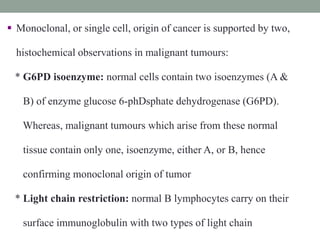
 Monoclonal, or single cell, origin of cancer is supported by two,
histochemical observations in malignant tumours:
* G6PD isoenzyme: normal cells contain two isoenzymes (A &
B) of enzyme glucose 6-phDsphate dehydrogenase (G6PD).
Whereas, malignant tumours which arise from these normal
tissue contain only one, isoenzyme, either A, or B, hence
confirming monoclonal origin of tumor
* Light chain restriction: normal B lymphocytes carry on their
surface immunoglobulin with two types of light chain
Carcinogenesis

Carcinogenesis

  • 1.
    Carcinogenesis Mohammed Fathy Bayomy,MSc, MD Lecturer Clinical Oncology & Nuclear Medicine Faculty of Medicine Zagazig University
  • 2.
  • 3.
     Stages 1) Initiation *Caused by mutation following application of initiating agent * Once mutation is fixed by mitosis, it is irreversible * Cells histologically appear normal inspite of genetic damage * Initiated cells are also diploid, with normal DNA content * Initiator - Chemical e.g. smoking & alcohol) or - Radiation (e.g. solar ultraviolet irradiation)
  • 4.
    2) Promotion * Characterizedby cell proliferation (clonal expansion), & reversible after cassation of promoting agent * Promoting agents act through increase in growth factor which stimulate cell proliferation through epigenetic mechanism * Histologically, pre-neoplastic lesion in form of dysplasia or benign tumor * Promoted cells are usually diploid
  • 5.
    * Promotor - Experimental(croton oil ‘‘phorbol ester’’ saccharine, plastic) - Human promoting agents (bile acids, hormones, oncogenic viruses growth factors)
  • 6.
    3) Progression * Resultsfrom multiple, mutations in proliferating cellular subclones which results in intratumor molecular heterogeneity * Irreversible process * Histologically: cellular anaplasia, other malignant biological feature, cells are aneuploid
  • 7.
    Initiation Promotion Progression SequenceFirst Second Third Biology Mutation Clonal expansion Clonal evolution Ploidy Diploid Diploid Aneuploid Reversibility Irreversible Reversible Irreversible Histology Unremarkable Precancerous lesion Malignant tumor
  • 8.
    Multihit Carcinogenesis  Proposedby: Vogelstein after extensive genetic & pathologic studies on adenoma carcinoma sequence in colon  State * Cancer develops as result of accumulation of multiple genetic lesions involving activation of proto-oncogenes & loss of tumor suppressor genes * Mutation of at least 4 to 5 genes are necessary for formation of truly malignant tumor * Total accumulation of genetic lesions, rather than their order of sequence, which is most critical in cancer development (multihit rather than multistep process)
  • 10.
    Monoclonality of Cancer Cancer arises through multistep accumulation of somatic gene mutations in progeny of single cell of origin (monoclonal)  Accumulation of mutations in different subclones will ultimately lead to molecular intratumour heterogeneity  Tumour cell subclones, compete with each other on basis of growth rate, with ultimate survival & predominance of more aggressive subclones (clonal evolution)  Two driving forces of malignancy are mutagenesis & mitogenesis
  • 11.
     Monoclonal, orsingle cell, origin of cancer is supported by two, histochemical observations in malignant tumours: * G6PD isoenzyme: normal cells contain two isoenzymes (A & B) of enzyme glucose 6-phDsphate dehydrogenase (G6PD). Whereas, malignant tumours which arise from these normal tissue contain only one, isoenzyme, either A, or B, hence confirming monoclonal origin of tumor * Light chain restriction: normal B lymphocytes carry on their surface immunoglobulin with two types of light chain