WHAT IS PROBABILITY?
Probability is a way of measuring how likely something is to
happen.
● It tells us the chance of an event occurring.
● The idea of probability is based on observation.
● Values range from 0 (impossible) to 1 (certain).
● For example, flipping a fair coin:
○ Probability of heads = 0.5
3.
BASIC TERMINOLOGIES OFPROBABILITY
● Experiment :
A process or action that leads to one or more outcomes.
Example: Tossing a coin.
● Sample Space (S) :
The set of all possible outcomes of an experiment.
Example: S = {Heads, Tails}
● Event (E) :
A subset of the sample space – one or more outcomes.
Example: Getting a Head (E = {Heads})
● Outcome :
A single result from the experiment.
Example: "Tails" is an outcome of a coin toss.
● Probability (P) :
A number between 0 and 1 that shows the chance of an event happening.
Example: P(Head) = 0.5
4.
TYPES OF PROBABILITY:
● CLASSICAL PROBABILITY
● EXPERIMENTAL PROBABILITY
● SUBJECTIVE PROBABILITY
5.
CLASSICAL PROBABILITY :
ClassicalProbability is the chance of an event happening when all outcomes are
equally likely.
● It is based on logic and reasoning, not experiments.
● Formula:
(P/E) = NUMBER OF FAVOURABLE OUTCOMES/ TOTAL NUMBER OF OUTCOMES
● EXAMPLE : Probability of getting a 3 on a dice = 1/6
●
6.
EXPERIMENTAL PROBABILITY :
ExperimentalProbability is the chance of an event happening based on
the results of actual experiments or trials.
● It is calculated by doing the experiment and observing the outcomes
● FORMULA : (P/E) = NUMBER OF TIMES EVENT OCCURS/TOTAL
NUMBER OF TRIALS
● EXAMPLE : Probability of rain based on weather records.
* If you toss a coin 100 times and get heads 55 times :
P(Heads) = 55 / 100 = 0.55
7.
SUBJECTIVE PROBABILITY :
SubjectiveProbability is the chance of an event happening based on a
person's opinion, intuition, or experience, not on exact data or experiments.
● It reflects personal belief about how likely something is.
● Often used when there is no historical data available.
● Example:
A doctor estimating the success rate of a new treatment.
A business owner predicting market growth.
8.
BAYES THEOREM :
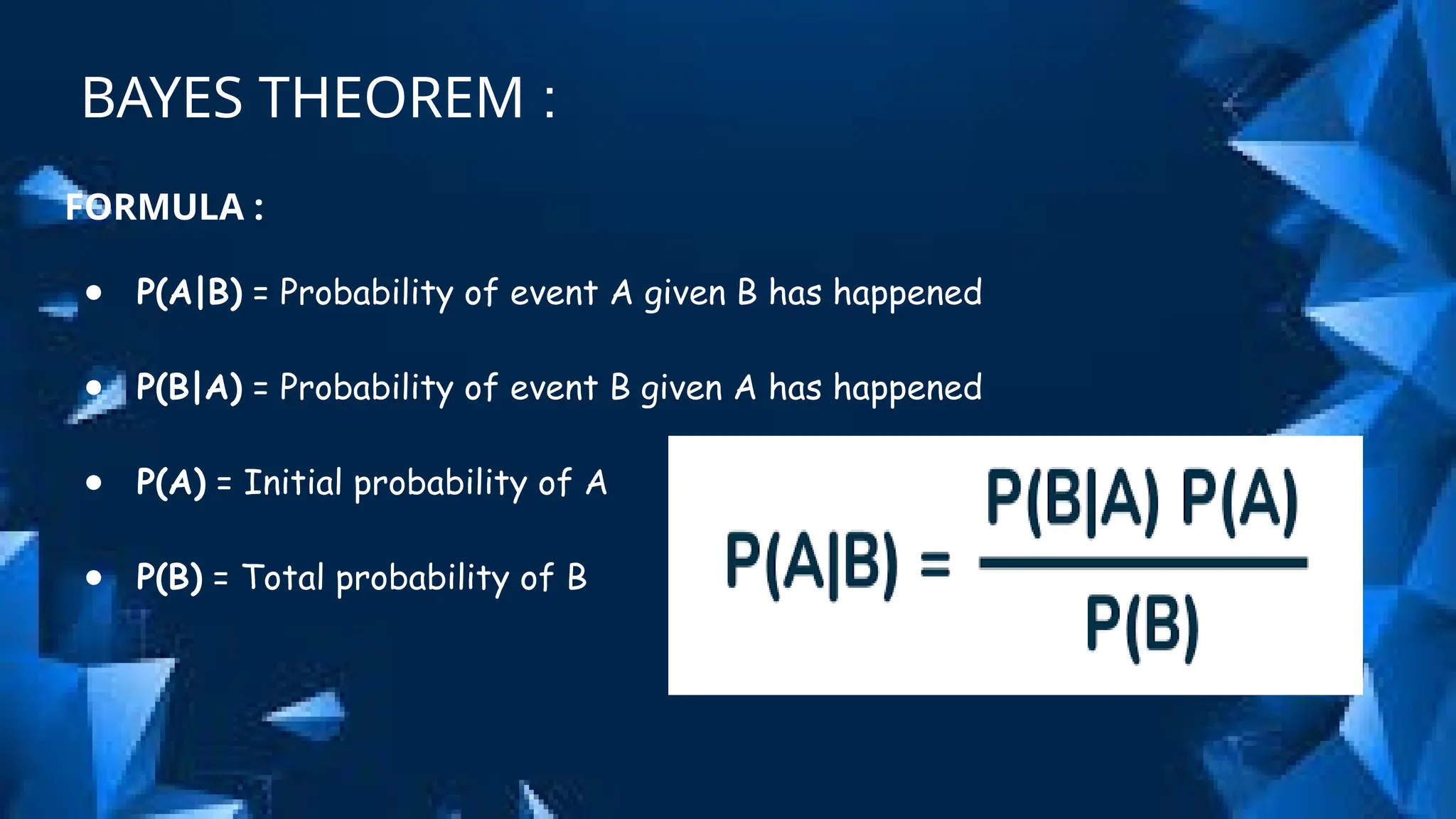
FORMULA:
● P(A|B) = Probability of event A given B has happened
● P(B|A) = Probability of event B given A has happened
● P(A) = Initial probability of A
● P(B) = Total probability of B
9.
APPLICATIONS OF PROBABILITY
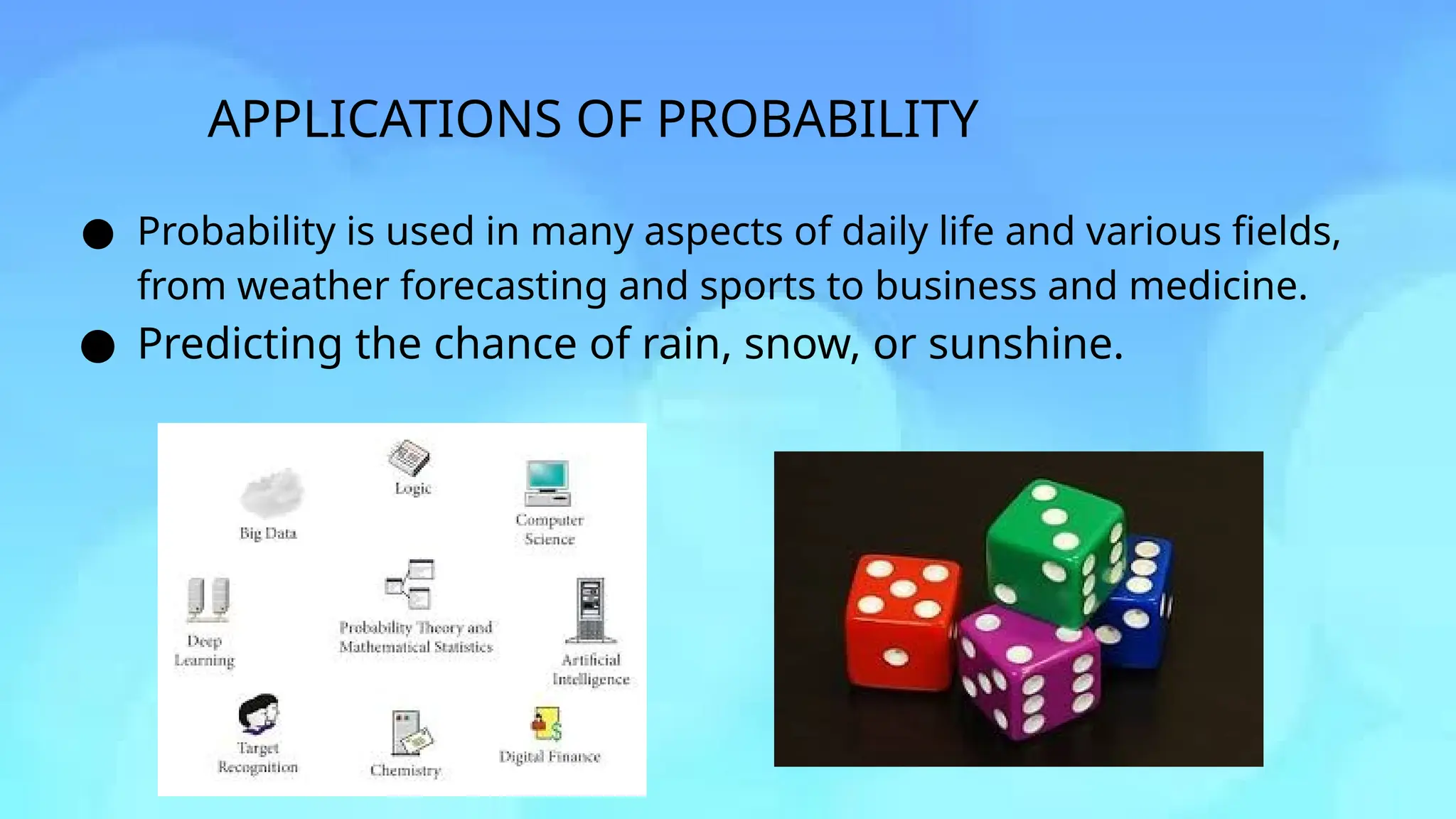
●Probability is used in many aspects of daily life and various fields,
from weather forecasting and sports to business and medicine.
● Predicting the chance of rain, snow, or sunshine.
10.
CONCLUSION
● Probability isa powerful tool for analyzing uncertainty in real-world and
engineering problems.
● It provides a mathematical foundation for decision-making, prediction, and risk
analysis.
● Understanding basic concepts like events, outcomes, and probability rules is
essential.
● It plays a key role in engineering, data science, AI, finance, and quality control.
● A solid grasp of probability leads to smarter solutions and better designs in
various fields.