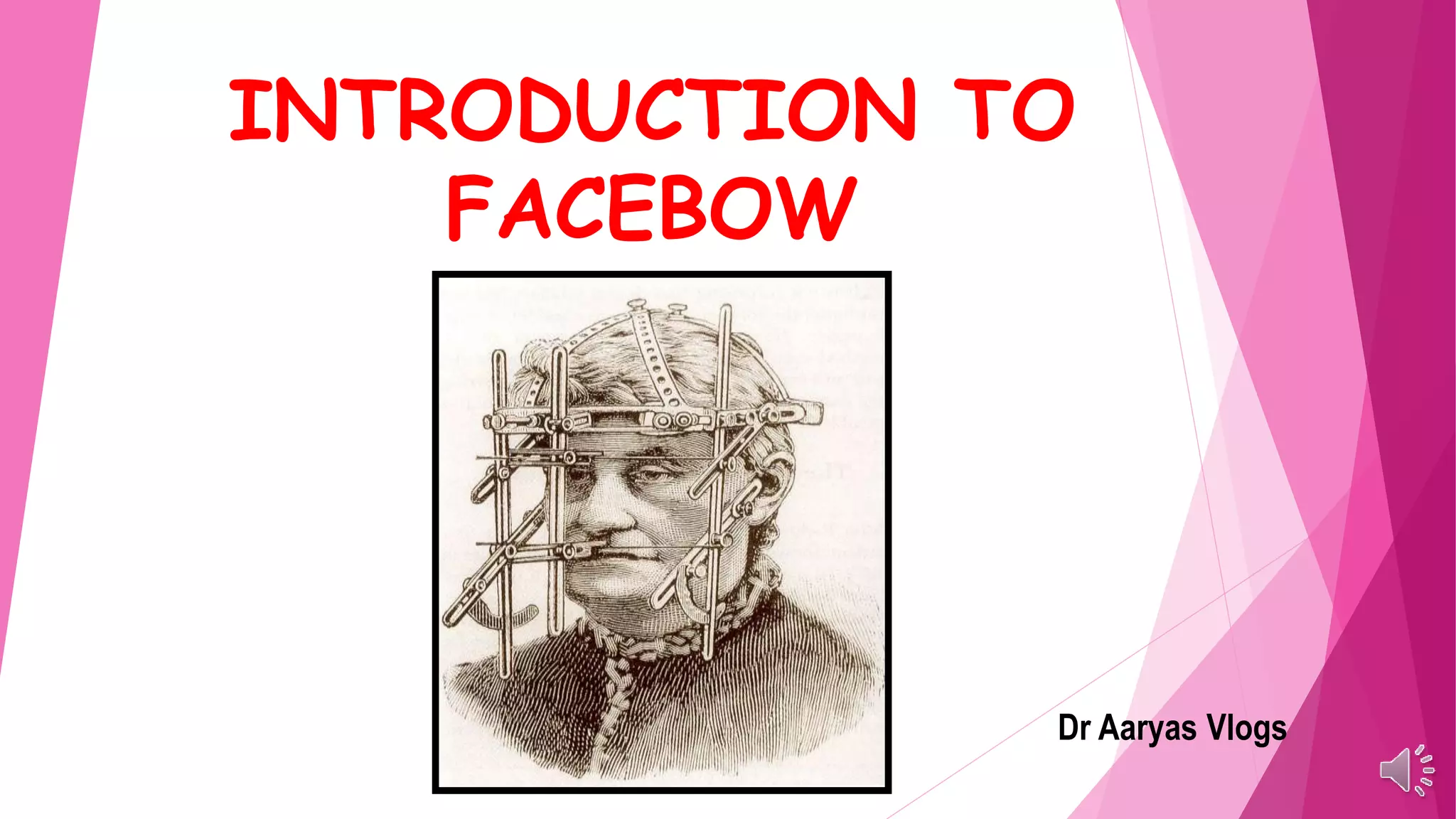
INTRODUCTION TO
FACEBOW
Dr Aaryas Vlogs
INTRODUCTION
 The upper jaw in the human skull is positioned uniquely to
the lower jaw. This position is different for every person.
 The opening movement to bring the jaw from occlusal to
rest position is almost a pure hinge movement.
 The relation of maxilla to the opening and closing axis has
to be determined.
HISTORY
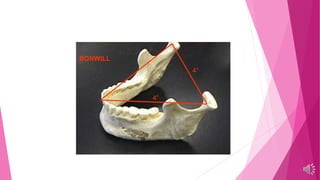
BONWILL 1860 the distance from the center of each
condyle to the median incisal point
and the lower teeth -10cm
BALKWILL 1866 apparatus to measure the angle
formed by the occlusal plane of the
teeth and a plane passing through the
lines extending from the condyles to
the incisal line of the lower teeth
HAYES 1880 functional face bow like device
intended for locating the position of
the casts correctly in the articulator
- articulating caliper
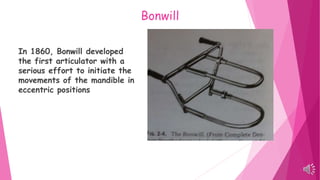
Bonwill
In 1860, Bonwill developed
the first articulator with a
serious effort to initiate the
movements of the mandible in
eccentric positions
5
6
4”
4”
BONWILL
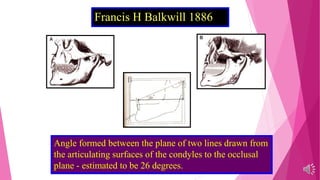
Francis H Balkwill 1886
Angle formed between the plane of two lines drawn from
the articulating surfaces of the condyles to the occlusal
plane - estimated to be 26 degrees.
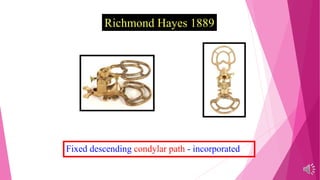
Richmond Hayes 1889
Fixed descending condylar path - incorporated
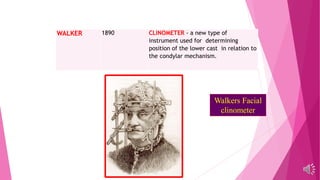
WALKER 1890 CLINOMETER - a new type of
instrument used for determining
position of the lower cast in relation to
the condylar mechanism.
Walkers Facial
clinometer
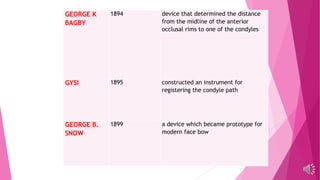
GEORGE K
BAGBY
1894 device that determined the distance
from the midline of the anterior
occlusal rims to one of the condyles
GYSI 1895 constructed an instrument for
registering the condyle path
GEORGE B.
SNOW
1899 a device which became prototype for
modern face bow
PURPOSE
To record the relationship of the maxillary arch
to the horizontal axis of the mandibular condyles
USES
 The face bow is used when cusp form teeth are used
 Balanced occlusion in the eccentric position is desired
 Inter-occlusal check records are used for verification of
jaw positions
 When the vertical dimension of occlusion is subject to
change
 Balanced occlusion in CD
 Class I & II cases
Uses of face bow
 Open anterior bite or end to end relationship
 Single restoration on II molar not for premolar
and I molar
 Segmental restoration
 Anterior restoration – primary guidance
 Factor in excursive movement
 Restoration of entire quadrant
 Diagnostic purposes and treatment planning
The face bow is not necessary under the following
conditions
 Monoplane teeth
 No alterations of the occluding surfaces of the teeth
 No inter-occlusal check records
 Articulators that are not designed to accept a face bow
transfer
FACEBOW RECORD
• Accurate mounting - three points
• Criteria for selection of points
– Ease of location
– Convenience
– Reproducibility
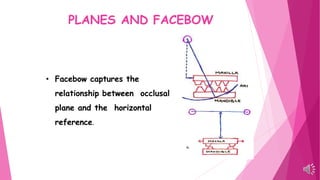
PLANES AND FACEBOW
• Facebow captures the
relationship between occlusal
plane and the horizontal
reference.
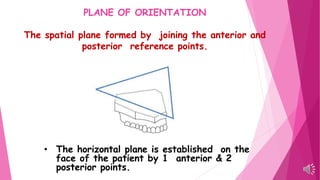
PLANE OF ORIENTATION
The spatial plane formed by joining the anterior and
posterior reference points.
• The horizontal plane is established on the
face of the patient by 1 anterior & 2
posterior points.
Thanks for watching……………………….

Introduction to Facebow

  • 1.
  • 2.
    INTRODUCTION  The upperjaw in the human skull is positioned uniquely to the lower jaw. This position is different for every person.  The opening movement to bring the jaw from occlusal to rest position is almost a pure hinge movement.  The relation of maxilla to the opening and closing axis has to be determined.
  • 3.
  • 4.
    BONWILL 1860 thedistance from the center of each condyle to the median incisal point and the lower teeth -10cm BALKWILL 1866 apparatus to measure the angle formed by the occlusal plane of the teeth and a plane passing through the lines extending from the condyles to the incisal line of the lower teeth HAYES 1880 functional face bow like device intended for locating the position of the casts correctly in the articulator - articulating caliper
  • 5.
    Bonwill In 1860, Bonwilldeveloped the first articulator with a serious effort to initiate the movements of the mandible in eccentric positions 5
  • 6.
  • 7.
    Francis H Balkwill1886 Angle formed between the plane of two lines drawn from the articulating surfaces of the condyles to the occlusal plane - estimated to be 26 degrees.
  • 8.
    Richmond Hayes 1889 Fixeddescending condylar path - incorporated
  • 9.
    WALKER 1890 CLINOMETER- a new type of instrument used for determining position of the lower cast in relation to the condylar mechanism. Walkers Facial clinometer
  • 10.
    GEORGE K BAGBY 1894 devicethat determined the distance from the midline of the anterior occlusal rims to one of the condyles GYSI 1895 constructed an instrument for registering the condyle path GEORGE B. SNOW 1899 a device which became prototype for modern face bow
  • 11.
    PURPOSE To record therelationship of the maxillary arch to the horizontal axis of the mandibular condyles
  • 12.
    USES  The facebow is used when cusp form teeth are used  Balanced occlusion in the eccentric position is desired  Inter-occlusal check records are used for verification of jaw positions  When the vertical dimension of occlusion is subject to change  Balanced occlusion in CD  Class I & II cases
  • 13.
    Uses of facebow  Open anterior bite or end to end relationship  Single restoration on II molar not for premolar and I molar  Segmental restoration  Anterior restoration – primary guidance  Factor in excursive movement  Restoration of entire quadrant  Diagnostic purposes and treatment planning
  • 14.
    The face bowis not necessary under the following conditions  Monoplane teeth  No alterations of the occluding surfaces of the teeth  No inter-occlusal check records  Articulators that are not designed to accept a face bow transfer
  • 15.
    FACEBOW RECORD • Accuratemounting - three points • Criteria for selection of points – Ease of location – Convenience – Reproducibility
  • 16.
    PLANES AND FACEBOW •Facebow captures the relationship between occlusal plane and the horizontal reference.
  • 17.
    PLANE OF ORIENTATION Thespatial plane formed by joining the anterior and posterior reference points. • The horizontal plane is established on the face of the patient by 1 anterior & 2 posterior points.
  • 19.