
Cognitive Domain

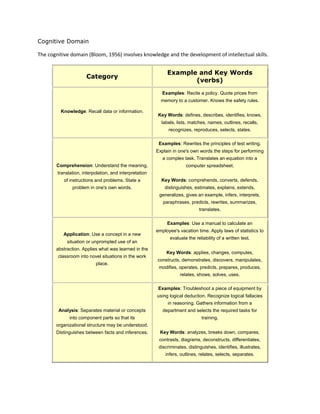
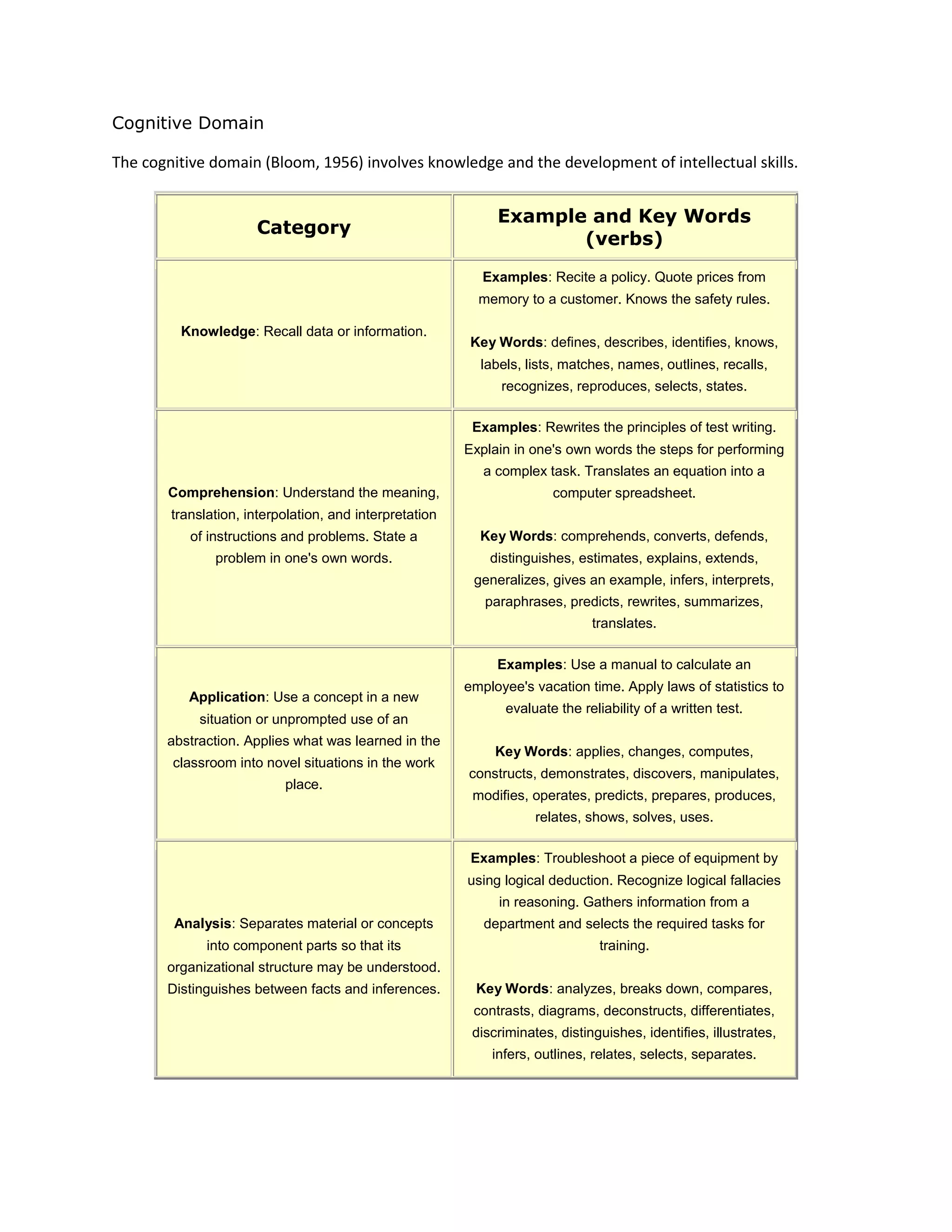
The cognitive domain (Bloom, 1956) involves knowledge and the development of intellectual skills.


                                                              Example and Key Words
                      Category
                                                                     (verbs)
                                                            Examples: Recite a policy. Quote prices from
                                                           memory to a customer. Knows the safety rules.

         Knowledge: Recall data or information.
                                                          Key Words: defines, describes, identifies, knows,
                                                           labels, lists, matches, names, outlines, recalls,
                                                               recognizes, reproduces, selects, states.

                                                          Examples: Rewrites the principles of test writing.
                                                         Explain in one's own words the steps for performing
                                                            a complex task. Translates an equation into a
       Comprehension: Understand the meaning,                           computer spreadsheet.
        translation, interpolation, and interpretation
           of instructions and problems. State a           Key Words: comprehends, converts, defends,
               problem in one's own words.                   distinguishes, estimates, explains, extends,
                                                          generalizes, gives an example, infers, interprets,
                                                            paraphrases, predicts, rewrites, summarizes,
                                                                               translates.

                                                              Examples: Use a manual to calculate an
                                                         employee's vacation time. Apply laws of statistics to
           Application: Use a concept in a new
                                                               evaluate the reliability of a written test.
            situation or unprompted use of an
       abstraction. Applies what was learned in the
                                                              Key Words: applies, changes, computes,
        classroom into novel situations in the work
                                                         constructs, demonstrates, discovers, manipulates,
                           place.
                                                          modifies, operates, predicts, prepares, produces,
                                                                     relates, shows, solves, uses.

                                                          Examples: Troubleshoot a piece of equipment by
                                                         using logical deduction. Recognize logical fallacies
                                                              in reasoning. Gathers information from a
        Analysis: Separates material or concepts            department and selects the required tasks for
              into component parts so that its                                  training.
       organizational structure may be understood.
       Distinguishes between facts and inferences.        Key Words: analyzes, breaks down, compares,
                                                          contrasts, diagrams, deconstructs, differentiates,
                                                          discriminates, distinguishes, identifies, illustrates,
                                                             infers, outlines, relates, selects, separates.
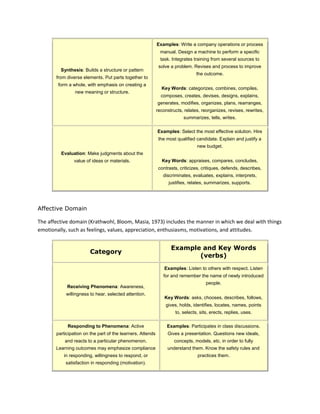
Examples: Write a company operations or process
                                                              manual. Design a machine to perform a specific
                                                              task. Integrates training from several sources to
                                                             solve a problem. Revises and process to improve
         Synthesis: Builds a structure or pattern
                                                                                the outcome.
       from diverse elements. Put parts together to
        form a whole, with emphasis on creating a
                                                              Key Words: categorizes, combines, compiles,
                new meaning or structure.
                                                              composes, creates, devises, designs, explains,
                                                            generates, modifies, organizes, plans, rearranges,
                                                            reconstructs, relates, reorganizes, revises, rewrites,
                                                                          summarizes, tells, writes.

                                                            Examples: Select the most effective solution. Hire
                                                             the most qualified candidate. Explain and justify a
                                                                                new budget.
         Evaluation: Make judgments about the
               value of ideas or materials.                   Key Words: appraises, compares, concludes,
                                                             contrasts, criticizes, critiques, defends, describes,
                                                               discriminates, evaluates, explains, interprets,
                                                                  justifies, relates, summarizes, supports.


Affective Domain

The affective domain (Krathwohl, Bloom, Masia, 1973) includes the manner in which we deal with things
emotionally, such as feelings, values, appreciation, enthusiasms, motivations, and attitudes.


                                                                   Example and Key Words
                        Category
                                                                          (verbs)
                                                                Examples: Listen to others with respect. Listen
                                                               for and remember the name of newly introduced
                                                                                     people.
            Receiving Phenomena: Awareness,
           willingness to hear, selected attention.
                                                                Key Words: asks, chooses, describes, follows,
                                                                gives, holds, identifies, locates, names, points
                                                                     to, selects, sits, erects, replies, uses.

            Responding to Phenomena: Active                      Examples: Participates in class discussions.
       participation on the part of the learners. Attends        Gives a presentation. Questions new ideals,
           and reacts to a particular phenomenon.                    concepts, models, etc. in order to fully
       Learning outcomes may emphasize compliance                understand them. Know the safety rules and
          in responding, willingness to respond, or                              practices them.
           satisfaction in responding (motivation).
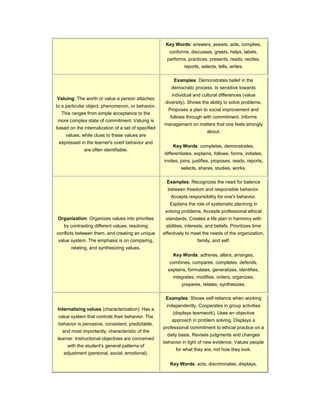
Key Words: answers, assists, aids, complies,
                                                        conforms, discusses, greets, helps, labels,
                                                       performs, practices, presents, reads, recites,
                                                               reports, selects, tells, writes.

                                                          Examples: Demonstrates belief in the
                                                         democratic process. Is sensitive towards
                                                         individual and cultural differences (value
Valuing: The worth or value a person attaches
                                                      diversity). Shows the ability to solve problems.
to a particular object, phenomenon, or behavior.
                                                       Proposes a plan to social improvement and
  This ranges from simple acceptance to the
                                                        follows through with commitment. Informs
more complex state of commitment. Valuing is
                                                     management on matters that one feels strongly
based on the internalization of a set of specified
                                                                            about.
    values, while clues to these values are
 expressed in the learner's overt behavior and
                                                         Key Words: completes, demonstrates,
              are often identifiable.
                                                     differentiates, explains, follows, forms, initiates,
                                                     invites, joins, justifies, proposes, reads, reports,
                                                              selects, shares, studies, works.

                                                      Examples: Recognizes the need for balance
                                                       between freedom and responsible behavior.
                                                        Accepts responsibility for one's behavior.
                                                        Explains the role of systematic planning in
                                                      solving problems. Accepts professional ethical
Organization: Organizes values into priorities        standards. Creates a life plan in harmony with
   by contrasting different values, resolving         abilities, interests, and beliefs. Prioritizes time
conflicts between them, and creating an unique       effectively to meet the needs of the organization,
 value system. The emphasis is on comparing,                          family, and self.
       relating, and synthesizing values.
                                                          Key Words: adheres, alters, arranges,
                                                        combines, compares, completes, defends,
                                                       explains, formulates, generalizes, identifies,
                                                         integrates, modifies, orders, organizes,
                                                              prepares, relates, synthesizes.

                                                      Examples: Shows self-reliance when working
                                                      independently. Cooperates in group activities
Internalizing values (characterization): Has a
                                                         (displays teamwork). Uses an objective
 value system that controls their behavior. The
                                                         approach in problem solving. Displays a
 behavior is pervasive, consistent, predictable,
                                                     professional commitment to ethical practice on a
   and most importantly, characteristic of the
                                                       daily basis. Revises judgments and changes
learner. Instructional objectives are concerned
                                                     behavior in light of new evidence. Values people
     with the student's general patterns of
                                                           for what they are, not how they look.
   adjustment (personal, social, emotional).

                                                        Key Words: acts, discriminates, displays,
influences, listens, modifies, performs, practices,
                                                               proposes, qualifies, questions, revises, serves,
                                                                                solves, verifies.


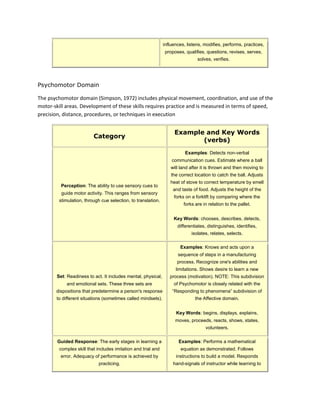
Psychomotor Domain

The psychomotor domain (Simpson, 1972) includes physical movement, coordination, and use of the
motor-skill areas. Development of these skills requires practice and is measured in terms of speed,
precision, distance, procedures, or techniques in execution


                                                                    Example and Key Words
                          Category
                                                                           (verbs)
                                                                          Examples: Detects non-verbal
                                                                   communication cues. Estimate where a ball
                                                                  will land after it is thrown and then moving to
                                                                   the correct location to catch the ball. Adjusts
                                                                  heat of stove to correct temperature by smell
          Perception: The ability to use sensory cues to
                                                                    and taste of food. Adjusts the height of the
          guide motor activity. This ranges from sensory
                                                                    forks on a forklift by comparing where the
         stimulation, through cue selection, to translation.
                                                                         forks are in relation to the pallet.


                                                                    Key Words: chooses, describes, detects,
                                                                      differentiates, distinguishes, identifies,
                                                                             isolates, relates, selects.

                                                                       Examples: Knows and acts upon a
                                                                      sequence of steps in a manufacturing
                                                                      process. Recognize one's abilities and
                                                                     limitations. Shows desire to learn a new
        Set: Readiness to act. It includes mental, physical,      process (motivation). NOTE: This subdivision
            and emotional sets. These three sets are                of Psychomotor is closely related with the
       dispositions that predetermine a person's response          “Responding to phenomena” subdivision of
       to different situations (sometimes called mindsets).                    the Affective domain.


                                                                     Key Words: begins, displays, explains,
                                                                     moves, proceeds, reacts, shows, states,
                                                                                    volunteers.

        Guided Response: The early stages in learning a               Examples: Performs a mathematical
         complex skill that includes imitation and trial and           equation as demonstrated. Follows
         error. Adequacy of performance is achieved by               instructions to build a model. Responds
                             practicing.                            hand-signals of instructor while learning to
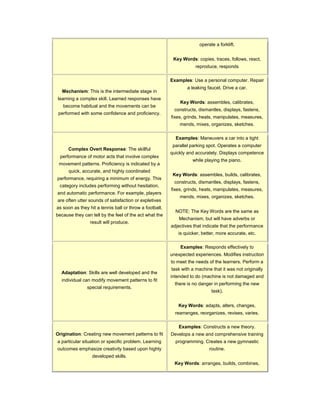
operate a forklift.


                                                          Key Words: copies, traces, follows, react,
                                                                     reproduce, responds

                                                         Examples: Use a personal computer. Repair
                                                                 a leaking faucet. Drive a car.
   Mechanism: This is the intermediate stage in
learning a complex skill. Learned responses have
                                                             Key Words: assembles, calibrates,
   become habitual and the movements can be
                                                           constructs, dismantles, displays, fastens,
 performed with some confidence and proficiency.
                                                         fixes, grinds, heats, manipulates, measures,
                                                             mends, mixes, organizes, sketches.

                                                           Examples: Maneuvers a car into a tight
                                                          parallel parking spot. Operates a computer
      Complex Overt Response: The skillful
                                                         quickly and accurately. Displays competence
  performance of motor acts that involve complex
                                                                   while playing the piano.
 movement patterns. Proficiency is indicated by a
      quick, accurate, and highly coordinated
                                                          Key Words: assembles, builds, calibrates,
performance, requiring a minimum of energy. This
                                                           constructs, dismantles, displays, fastens,
 category includes performing without hesitation,
                                                         fixes, grinds, heats, manipulates, measures,
and automatic performance. For example, players
                                                             mends, mixes, organizes, sketches.
are often utter sounds of satisfaction or expletives
as soon as they hit a tennis ball or throw a football,
                                                           NOTE: The Key Words are the same as
because they can tell by the feel of the act what the
                                                             Mechanism, but will have adverbs or
                 result will produce.
                                                         adjectives that indicate that the performance
                                                            is quicker, better, more accurate, etc.

                                                             Examples: Responds effectively to
                                                         unexpected experiences. Modifies instruction
                                                         to meet the needs of the learners. Perform a
                                                         task with a machine that it was not originally
  Adaptation: Skills are well developed and the
                                                         intended to do (machine is not damaged and
  individual can modify movement patterns to fit
                                                           there is no danger in performing the new
               special requirements.
                                                                             task).


                                                             Key Words: adapts, alters, changes,
                                                           rearranges, reorganizes, revises, varies.

                                                             Examples: Constructs a new theory.
Origination: Creating new movement patterns to fit       Develops a new and comprehensive training
a particular situation or specific problem. Learning       programming. Creates a new gymnastic
outcomes emphasize creativity based upon highly                             routine.
                  developed skills.
                                                           Key Words: arranges, builds, combines,
composes, constructs, creates, designs,
      initiate, makes, originates.

Principles of teaching

  • 1.
    Cognitive Domain The cognitivedomain (Bloom, 1956) involves knowledge and the development of intellectual skills. Example and Key Words Category (verbs) Examples: Recite a policy. Quote prices from memory to a customer. Knows the safety rules. Knowledge: Recall data or information. Key Words: defines, describes, identifies, knows, labels, lists, matches, names, outlines, recalls, recognizes, reproduces, selects, states. Examples: Rewrites the principles of test writing. Explain in one's own words the steps for performing a complex task. Translates an equation into a Comprehension: Understand the meaning, computer spreadsheet. translation, interpolation, and interpretation of instructions and problems. State a Key Words: comprehends, converts, defends, problem in one's own words. distinguishes, estimates, explains, extends, generalizes, gives an example, infers, interprets, paraphrases, predicts, rewrites, summarizes, translates. Examples: Use a manual to calculate an employee's vacation time. Apply laws of statistics to Application: Use a concept in a new evaluate the reliability of a written test. situation or unprompted use of an abstraction. Applies what was learned in the Key Words: applies, changes, computes, classroom into novel situations in the work constructs, demonstrates, discovers, manipulates, place. modifies, operates, predicts, prepares, produces, relates, shows, solves, uses. Examples: Troubleshoot a piece of equipment by using logical deduction. Recognize logical fallacies in reasoning. Gathers information from a Analysis: Separates material or concepts department and selects the required tasks for into component parts so that its training. organizational structure may be understood. Distinguishes between facts and inferences. Key Words: analyzes, breaks down, compares, contrasts, diagrams, deconstructs, differentiates, discriminates, distinguishes, identifies, illustrates, infers, outlines, relates, selects, separates.
  • 2.
    Examples: Write acompany operations or process manual. Design a machine to perform a specific task. Integrates training from several sources to solve a problem. Revises and process to improve Synthesis: Builds a structure or pattern the outcome. from diverse elements. Put parts together to form a whole, with emphasis on creating a Key Words: categorizes, combines, compiles, new meaning or structure. composes, creates, devises, designs, explains, generates, modifies, organizes, plans, rearranges, reconstructs, relates, reorganizes, revises, rewrites, summarizes, tells, writes. Examples: Select the most effective solution. Hire the most qualified candidate. Explain and justify a new budget. Evaluation: Make judgments about the value of ideas or materials. Key Words: appraises, compares, concludes, contrasts, criticizes, critiques, defends, describes, discriminates, evaluates, explains, interprets, justifies, relates, summarizes, supports. Affective Domain The affective domain (Krathwohl, Bloom, Masia, 1973) includes the manner in which we deal with things emotionally, such as feelings, values, appreciation, enthusiasms, motivations, and attitudes. Example and Key Words Category (verbs) Examples: Listen to others with respect. Listen for and remember the name of newly introduced people. Receiving Phenomena: Awareness, willingness to hear, selected attention. Key Words: asks, chooses, describes, follows, gives, holds, identifies, locates, names, points to, selects, sits, erects, replies, uses. Responding to Phenomena: Active Examples: Participates in class discussions. participation on the part of the learners. Attends Gives a presentation. Questions new ideals, and reacts to a particular phenomenon. concepts, models, etc. in order to fully Learning outcomes may emphasize compliance understand them. Know the safety rules and in responding, willingness to respond, or practices them. satisfaction in responding (motivation).
  • 3.
    Key Words: answers,assists, aids, complies, conforms, discusses, greets, helps, labels, performs, practices, presents, reads, recites, reports, selects, tells, writes. Examples: Demonstrates belief in the democratic process. Is sensitive towards individual and cultural differences (value Valuing: The worth or value a person attaches diversity). Shows the ability to solve problems. to a particular object, phenomenon, or behavior. Proposes a plan to social improvement and This ranges from simple acceptance to the follows through with commitment. Informs more complex state of commitment. Valuing is management on matters that one feels strongly based on the internalization of a set of specified about. values, while clues to these values are expressed in the learner's overt behavior and Key Words: completes, demonstrates, are often identifiable. differentiates, explains, follows, forms, initiates, invites, joins, justifies, proposes, reads, reports, selects, shares, studies, works. Examples: Recognizes the need for balance between freedom and responsible behavior. Accepts responsibility for one's behavior. Explains the role of systematic planning in solving problems. Accepts professional ethical Organization: Organizes values into priorities standards. Creates a life plan in harmony with by contrasting different values, resolving abilities, interests, and beliefs. Prioritizes time conflicts between them, and creating an unique effectively to meet the needs of the organization, value system. The emphasis is on comparing, family, and self. relating, and synthesizing values. Key Words: adheres, alters, arranges, combines, compares, completes, defends, explains, formulates, generalizes, identifies, integrates, modifies, orders, organizes, prepares, relates, synthesizes. Examples: Shows self-reliance when working independently. Cooperates in group activities Internalizing values (characterization): Has a (displays teamwork). Uses an objective value system that controls their behavior. The approach in problem solving. Displays a behavior is pervasive, consistent, predictable, professional commitment to ethical practice on a and most importantly, characteristic of the daily basis. Revises judgments and changes learner. Instructional objectives are concerned behavior in light of new evidence. Values people with the student's general patterns of for what they are, not how they look. adjustment (personal, social, emotional). Key Words: acts, discriminates, displays,
  • 4.
    influences, listens, modifies,performs, practices, proposes, qualifies, questions, revises, serves, solves, verifies. Psychomotor Domain The psychomotor domain (Simpson, 1972) includes physical movement, coordination, and use of the motor-skill areas. Development of these skills requires practice and is measured in terms of speed, precision, distance, procedures, or techniques in execution Example and Key Words Category (verbs) Examples: Detects non-verbal communication cues. Estimate where a ball will land after it is thrown and then moving to the correct location to catch the ball. Adjusts heat of stove to correct temperature by smell Perception: The ability to use sensory cues to and taste of food. Adjusts the height of the guide motor activity. This ranges from sensory forks on a forklift by comparing where the stimulation, through cue selection, to translation. forks are in relation to the pallet. Key Words: chooses, describes, detects, differentiates, distinguishes, identifies, isolates, relates, selects. Examples: Knows and acts upon a sequence of steps in a manufacturing process. Recognize one's abilities and limitations. Shows desire to learn a new Set: Readiness to act. It includes mental, physical, process (motivation). NOTE: This subdivision and emotional sets. These three sets are of Psychomotor is closely related with the dispositions that predetermine a person's response “Responding to phenomena” subdivision of to different situations (sometimes called mindsets). the Affective domain. Key Words: begins, displays, explains, moves, proceeds, reacts, shows, states, volunteers. Guided Response: The early stages in learning a Examples: Performs a mathematical complex skill that includes imitation and trial and equation as demonstrated. Follows error. Adequacy of performance is achieved by instructions to build a model. Responds practicing. hand-signals of instructor while learning to
  • 5.
    operate a forklift. Key Words: copies, traces, follows, react, reproduce, responds Examples: Use a personal computer. Repair a leaking faucet. Drive a car. Mechanism: This is the intermediate stage in learning a complex skill. Learned responses have Key Words: assembles, calibrates, become habitual and the movements can be constructs, dismantles, displays, fastens, performed with some confidence and proficiency. fixes, grinds, heats, manipulates, measures, mends, mixes, organizes, sketches. Examples: Maneuvers a car into a tight parallel parking spot. Operates a computer Complex Overt Response: The skillful quickly and accurately. Displays competence performance of motor acts that involve complex while playing the piano. movement patterns. Proficiency is indicated by a quick, accurate, and highly coordinated Key Words: assembles, builds, calibrates, performance, requiring a minimum of energy. This constructs, dismantles, displays, fastens, category includes performing without hesitation, fixes, grinds, heats, manipulates, measures, and automatic performance. For example, players mends, mixes, organizes, sketches. are often utter sounds of satisfaction or expletives as soon as they hit a tennis ball or throw a football, NOTE: The Key Words are the same as because they can tell by the feel of the act what the Mechanism, but will have adverbs or result will produce. adjectives that indicate that the performance is quicker, better, more accurate, etc. Examples: Responds effectively to unexpected experiences. Modifies instruction to meet the needs of the learners. Perform a task with a machine that it was not originally Adaptation: Skills are well developed and the intended to do (machine is not damaged and individual can modify movement patterns to fit there is no danger in performing the new special requirements. task). Key Words: adapts, alters, changes, rearranges, reorganizes, revises, varies. Examples: Constructs a new theory. Origination: Creating new movement patterns to fit Develops a new and comprehensive training a particular situation or specific problem. Learning programming. Creates a new gymnastic outcomes emphasize creativity based upon highly routine. developed skills. Key Words: arranges, builds, combines,
  • 6.
    composes, constructs, creates,designs, initiate, makes, originates.