Team “2”
Presented to:
Dr. Mohamed AbdEl-Monem Daha
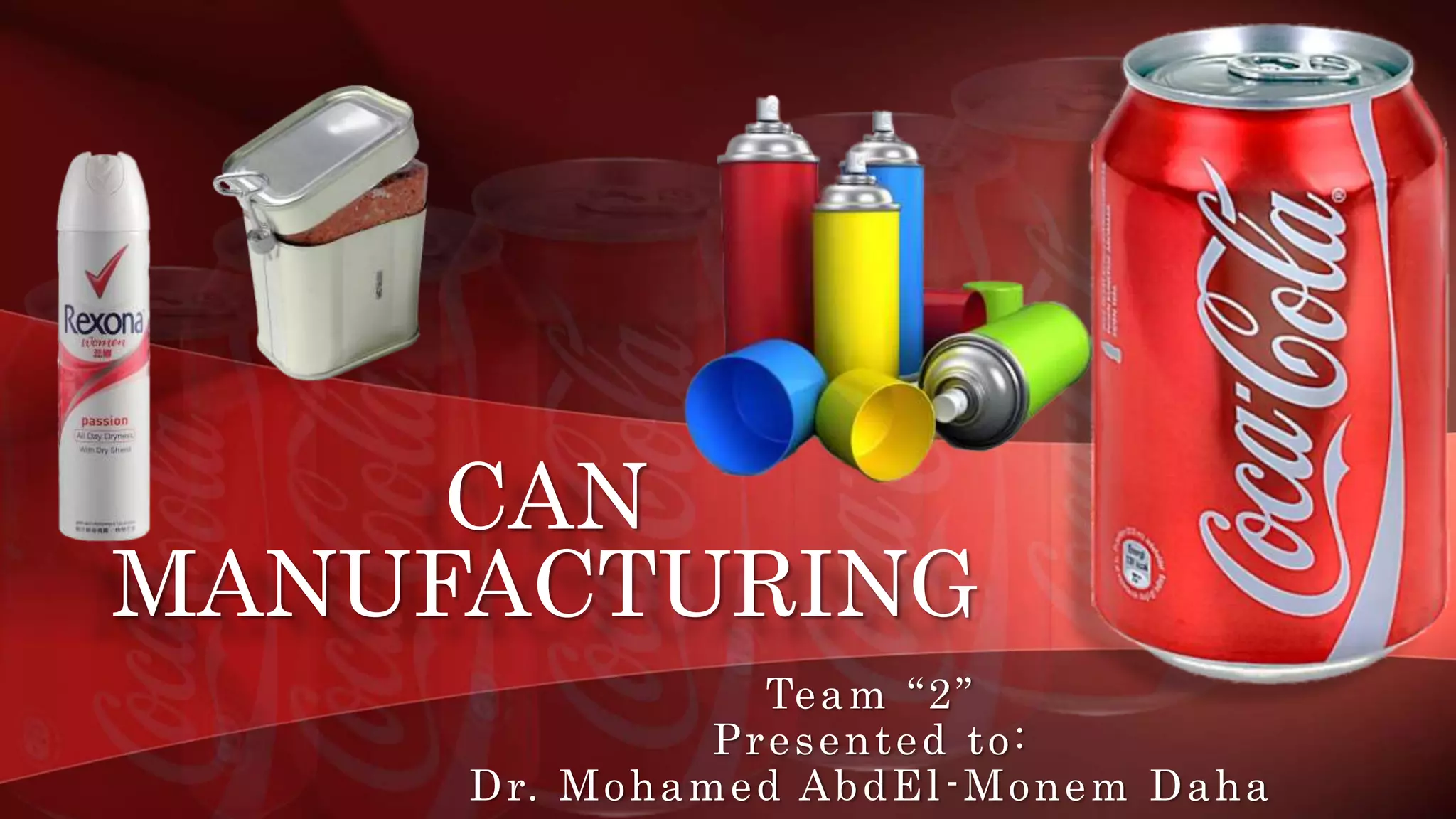
CAN
MANUFACTURING
Team "2" 2
• Introduction
• Types of Cans

• Materials
• Manufacturing Process
• Conclusion
OUTLINES
HISTORY OF CAN MANUFACTURING
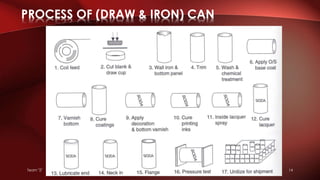
• Early tin cans were sealed by soldering with a
tin-lead alloy, which could lead to lead
poisoning.
• Use of aluminum in cans began after the (2nd
world war) in 1957.
Why Aluminum?
• Less in cost.
• Greater malleability.
• This gave rise to the two-piece can, where all
but the top of the can is simply stamped out of a
single piece of aluminum, rather than
constructed from two pieces of steel.
Team "2" 3
Team "2" 4
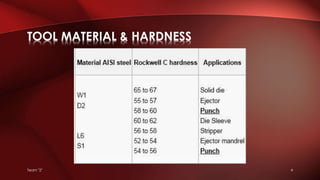
TOOL MATERIAL & HARDNESS
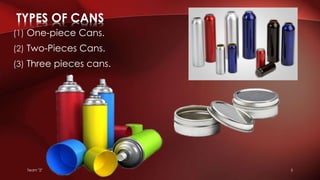
(1) One-piece Cans.
(2) Two-Pieces Cans.
(3) Three pieces cans.
TYPES OF CANS
Team "2" 5
Team "2" 6
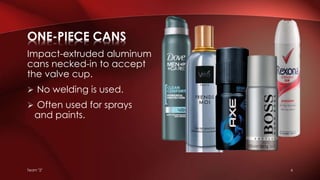
Impact-extruded aluminum
cans necked-in to accept
the valve cup.
 No welding is used.
 Often used for sprays
and paints.
ONE-PIECE CANS
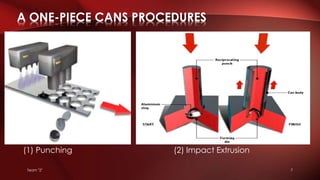
(1) Punching (2) Impact Extrusion
A ONE-PIECE CANS PROCEDURES
Team "2" 7
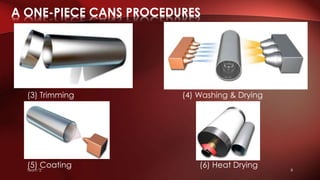
(3) Trimming (4) Washing & Drying
(5) Coating (6) Heat Drying
A ONE-PIECE CANS PROCEDURES
Team "2" 8
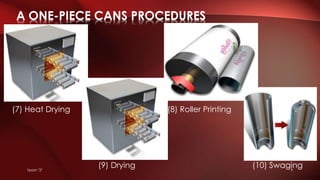
(7) Heat Drying (8) Roller Printing
(9) Drying (10) Swaging
A ONE-PIECE CANS PROCEDURES
Team "2" 9
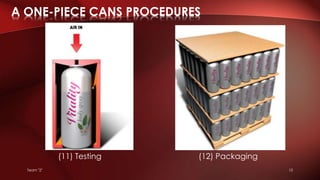
(11) Testing (12) Packaging
A ONE-PIECE CANS PROCEDURES
Team "2" 10
Team "2" 11
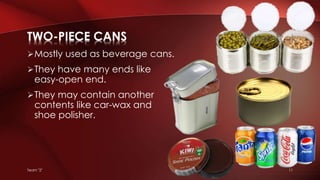
Mostly used as beverage cans.
They have many ends like
easy-open end.
They may contain another
contents like car-wax and
shoe polisher.
TWO-PIECE CANS
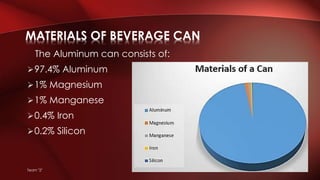
The Aluminum can consists of:
97.4% Aluminum
1% Magnesium
1% Manganese
0.4% Iron
0.2% Silicon
MATERIALS OF BEVERAGE CAN
Team "2" 12
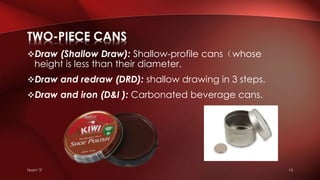
Draw (Shallow Draw): Shallow-profile cans(whose
height is less than their diameter.
Draw and redraw (DRD): shallow drawing in 3 steps.
Draw and iron (D&I ): Carbonated beverage cans.
TWO-PIECE CANS
Team "2" 13
PROCESS OF (DRAW & IRON) CAN
Team "2" 14
Team "2" 15
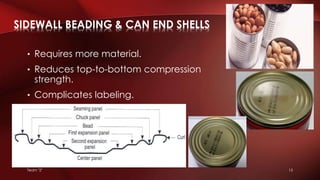
• Requires more material.
• Reduces top-to-bottom compression
strength.
• Complicates labeling.
SIDEWALL BEADING & CAN END SHELLS
Team "2" 16
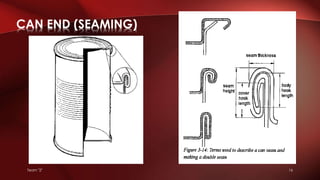
CAN END (SEAMING)
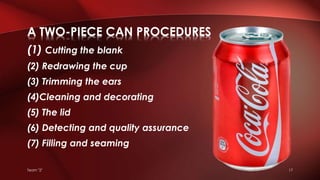
(1) Cutting the blank
(2) Redrawing the cup
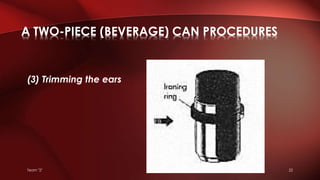
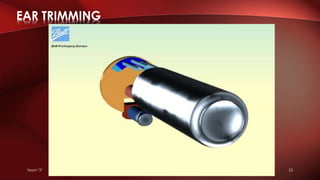
(3) Trimming the ears
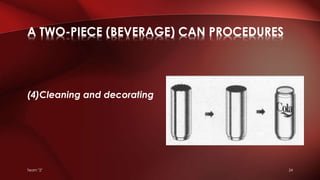
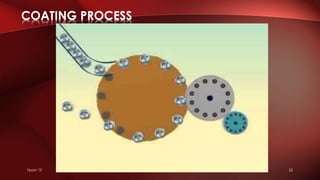
(4)Cleaning and decorating
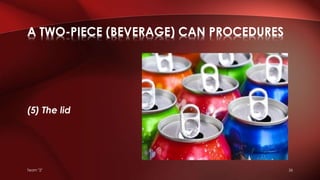
(5) The lid
(6) Detecting and quality assurance
(7) Filling and seaming
A TWO-PIECE CAN PROCEDURES
Team "2" 17
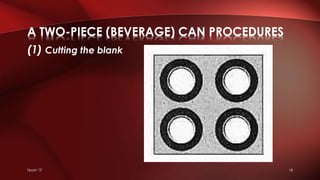
(1) Cutting the blank
A TWO-PIECE (BEVERAGE) CAN PROCEDURES
Team "2" 18
Team "2" 19
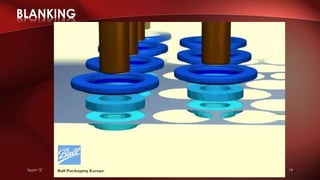
BLANKING
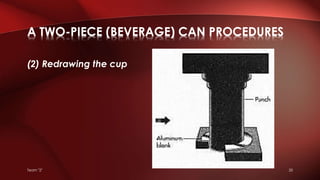
(2) Redrawing the cup
A TWO-PIECE (BEVERAGE) CAN PROCEDURES
Team "2" 20
Team "2" 21
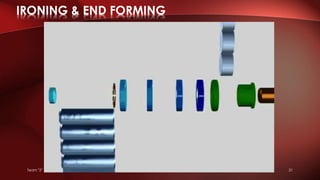
IRONING & END FORMING
(3) Trimming the ears
A TWO-PIECE (BEVERAGE) CAN PROCEDURES
Team "2" 22
Team "2" 23
EAR TRIMMING
(4)Cleaning and decorating
A TWO-PIECE (BEVERAGE) CAN PROCEDURES
Team "2" 24
Team "2" 25
COATING PROCESS
(5) The lid
A TWO-PIECE (BEVERAGE) CAN PROCEDURES
Team "2" 26
Team "2" 27
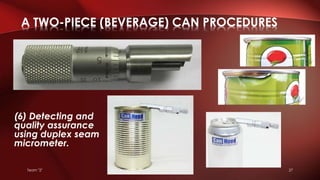
(6) Detecting and
quality assurance
using duplex seam
micrometer.
A TWO-PIECE (BEVERAGE) CAN PROCEDURES
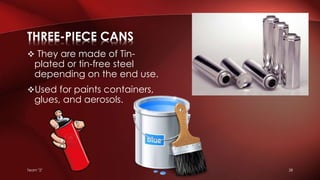
 They are made of Tin-
plated or tin-free steel
depending on the end use.
Used for paints containers,
glues, and aerosols.
THREE-PIECE CANS
Team "2" 28
Team "2" 29
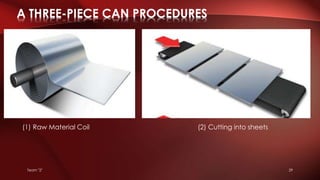
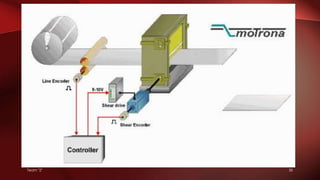
(1) Raw Material Coil (2) Cutting into sheets
A THREE-PIECE CAN PROCEDURES
Team "2" 30
Team "2" 31
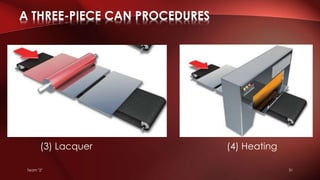
(3) Lacquer (4) Heating
A THREE-PIECE CAN PROCEDURES
Team "2" 32
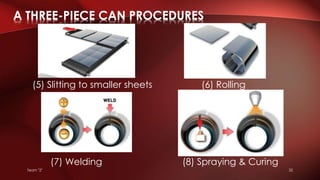
(5) Slitting to smaller sheets (6) Rolling
(7) Welding (8) Spraying & Curing
A THREE-PIECE CAN PROCEDURES
Team "2" 33
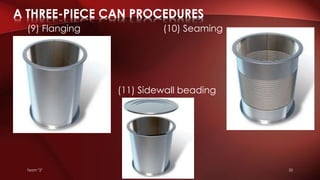
(9) Flanging (10) Seaming
(11) Sidewall beading
A THREE-PIECE CAN PROCEDURES
Team "2" 34
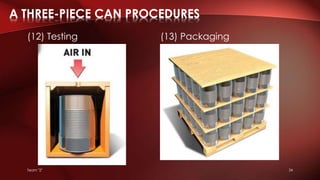
(12) Testing (13) Packaging
A THREE-PIECE CAN PROCEDURES
Team "2" 35
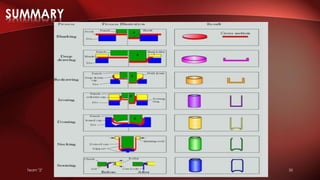
SUMMARY
Team "2" 36
• The manufacturing process for aluminum beverage cans
is already technologically very advanced, and therefore
it is useful to have the utmost information possible on
material and tooling, in order to optimize it
CONCLUSION
Team "2" 37
Team “2”
1- Ahmed Ayman 2- Esraa Tarek
3- Bassant Hamdi 4- Dalia Mahmoud
5- Sara Samy 6- Tarek Hossny
7- Abdel Rahman Atef

Can manufacturing

  • 1.
    Team “2” Presented to: Dr.Mohamed AbdEl-Monem Daha CAN MANUFACTURING
  • 2.
    Team "2" 2 •Introduction • Types of Cans • Materials • Manufacturing Process • Conclusion OUTLINES
  • 3.
    HISTORY OF CANMANUFACTURING • Early tin cans were sealed by soldering with a tin-lead alloy, which could lead to lead poisoning. • Use of aluminum in cans began after the (2nd world war) in 1957. Why Aluminum? • Less in cost. • Greater malleability. • This gave rise to the two-piece can, where all but the top of the can is simply stamped out of a single piece of aluminum, rather than constructed from two pieces of steel. Team "2" 3
  • 4.
    Team "2" 4 TOOLMATERIAL & HARDNESS
  • 5.
    (1) One-piece Cans. (2)Two-Pieces Cans. (3) Three pieces cans. TYPES OF CANS Team "2" 5
  • 6.
    Team "2" 6 Impact-extrudedaluminum cans necked-in to accept the valve cup.  No welding is used.  Often used for sprays and paints. ONE-PIECE CANS
  • 7.
    (1) Punching (2)Impact Extrusion A ONE-PIECE CANS PROCEDURES Team "2" 7
  • 8.
    (3) Trimming (4)Washing & Drying (5) Coating (6) Heat Drying A ONE-PIECE CANS PROCEDURES Team "2" 8
  • 9.
    (7) Heat Drying(8) Roller Printing (9) Drying (10) Swaging A ONE-PIECE CANS PROCEDURES Team "2" 9
  • 10.
    (11) Testing (12)Packaging A ONE-PIECE CANS PROCEDURES Team "2" 10
  • 11.
    Team "2" 11 Mostlyused as beverage cans. They have many ends like easy-open end. They may contain another contents like car-wax and shoe polisher. TWO-PIECE CANS
  • 12.
    The Aluminum canconsists of: 97.4% Aluminum 1% Magnesium 1% Manganese 0.4% Iron 0.2% Silicon MATERIALS OF BEVERAGE CAN Team "2" 12
  • 13.
    Draw (Shallow Draw):Shallow-profile cans(whose height is less than their diameter. Draw and redraw (DRD): shallow drawing in 3 steps. Draw and iron (D&I ): Carbonated beverage cans. TWO-PIECE CANS Team "2" 13
  • 14.
    PROCESS OF (DRAW& IRON) CAN Team "2" 14
  • 15.
    Team "2" 15 •Requires more material. • Reduces top-to-bottom compression strength. • Complicates labeling. SIDEWALL BEADING & CAN END SHELLS
  • 16.
    Team "2" 16 CANEND (SEAMING)
  • 17.
    (1) Cutting theblank (2) Redrawing the cup (3) Trimming the ears (4)Cleaning and decorating (5) The lid (6) Detecting and quality assurance (7) Filling and seaming A TWO-PIECE CAN PROCEDURES Team "2" 17
  • 18.
    (1) Cutting theblank A TWO-PIECE (BEVERAGE) CAN PROCEDURES Team "2" 18
  • 19.
  • 20.
    (2) Redrawing thecup A TWO-PIECE (BEVERAGE) CAN PROCEDURES Team "2" 20
  • 21.
    Team "2" 21 IRONING& END FORMING
  • 22.
    (3) Trimming theears A TWO-PIECE (BEVERAGE) CAN PROCEDURES Team "2" 22
  • 23.
  • 24.
    (4)Cleaning and decorating ATWO-PIECE (BEVERAGE) CAN PROCEDURES Team "2" 24
  • 25.
  • 26.
    (5) The lid ATWO-PIECE (BEVERAGE) CAN PROCEDURES Team "2" 26
  • 27.
    Team "2" 27 (6)Detecting and quality assurance using duplex seam micrometer. A TWO-PIECE (BEVERAGE) CAN PROCEDURES
  • 28.
     They aremade of Tin- plated or tin-free steel depending on the end use. Used for paints containers, glues, and aerosols. THREE-PIECE CANS Team "2" 28
  • 29.
    Team "2" 29 (1)Raw Material Coil (2) Cutting into sheets A THREE-PIECE CAN PROCEDURES
  • 30.
  • 31.
    Team "2" 31 (3)Lacquer (4) Heating A THREE-PIECE CAN PROCEDURES
  • 32.
    Team "2" 32 (5)Slitting to smaller sheets (6) Rolling (7) Welding (8) Spraying & Curing A THREE-PIECE CAN PROCEDURES
  • 33.
    Team "2" 33 (9)Flanging (10) Seaming (11) Sidewall beading A THREE-PIECE CAN PROCEDURES
  • 34.
    Team "2" 34 (12)Testing (13) Packaging A THREE-PIECE CAN PROCEDURES
  • 35.
  • 36.
    Team "2" 36 •The manufacturing process for aluminum beverage cans is already technologically very advanced, and therefore it is useful to have the utmost information possible on material and tooling, in order to optimize it CONCLUSION
  • 37.
    Team "2" 37 Team“2” 1- Ahmed Ayman 2- Esraa Tarek 3- Bassant Hamdi 4- Dalia Mahmoud 5- Sara Samy 6- Tarek Hossny 7- Abdel Rahman Atef