TRAINING ON THE
MATATAG CURRICULUM
1
GRADE 7
Resource Person: SALVACION B. FELICES
MATATAG Curriculum Training | 2024
Session 9/10
CLASSROOM PRACTICES TO PROMOTE
INCLUSION FOR LEARNERS WITH DISABILITIES
2
MATATAG Curriculum Training | 2024
Session Objectives: At the end of the session, participants will:
.
3
 discuss inclusion, inclusive education, and types of
disability and how they impact students’ learning
experiences;
 identify equitable learning opportunities through
classroom accommodations and modifications in an
inclusive classroom; and
 appreciate the application of appropriate
strategies/activities to promote inclusive education.
MATATAG Curriculum Training | 2024
Professional Standards Addressed:
4
3.3 Learners with disabilities,
giftedness and talents
3.3.2 Design, adapt, and implement teaching
strategies that are responsive to learners with
disabilities, giftedness, and talents.
MATATAG Curriculum Training | 2024
Session Flow
5
Inclusive Education (RA 11650; DO 44 s. 2021;
DO 21 s. 2019)
Universal Design for Learning
Classroom practices and strategies
Accommodation and modification
MATATAG Curriculum Training | 2024
Activity 1: Charge to Experience!
6
1. Walking while in a blindfold
Directions: The group with task 1 will put on the simulation
mask. You will be instructed by your leader on the directions to
walking while in a blindfold. (e.g. Walk straight, turn left, right,
and go back to your place). The leader will ensure that all of
you are seated after one minute.
2. Reading while using the simulation mask.
Direction: In the group with task 2 you will put on the
simulation masks. The leader will give them a selection found
in the envelope. With the simulation masks, each shall read
the selection without removing or touching the simulation
mask. Participants wearing eyeglasses shall remove this
device.
3. Talking without sound.
Direction: The group with task 3 the leader will distribute
paper and pencils to members. The leader will read the
selection found in the envelope, without sound. Participants
will write down the words they heard.
SITUATIONS:
MATATAG Curriculum Training | 2024
Activity 1: Charge to Experience!
7
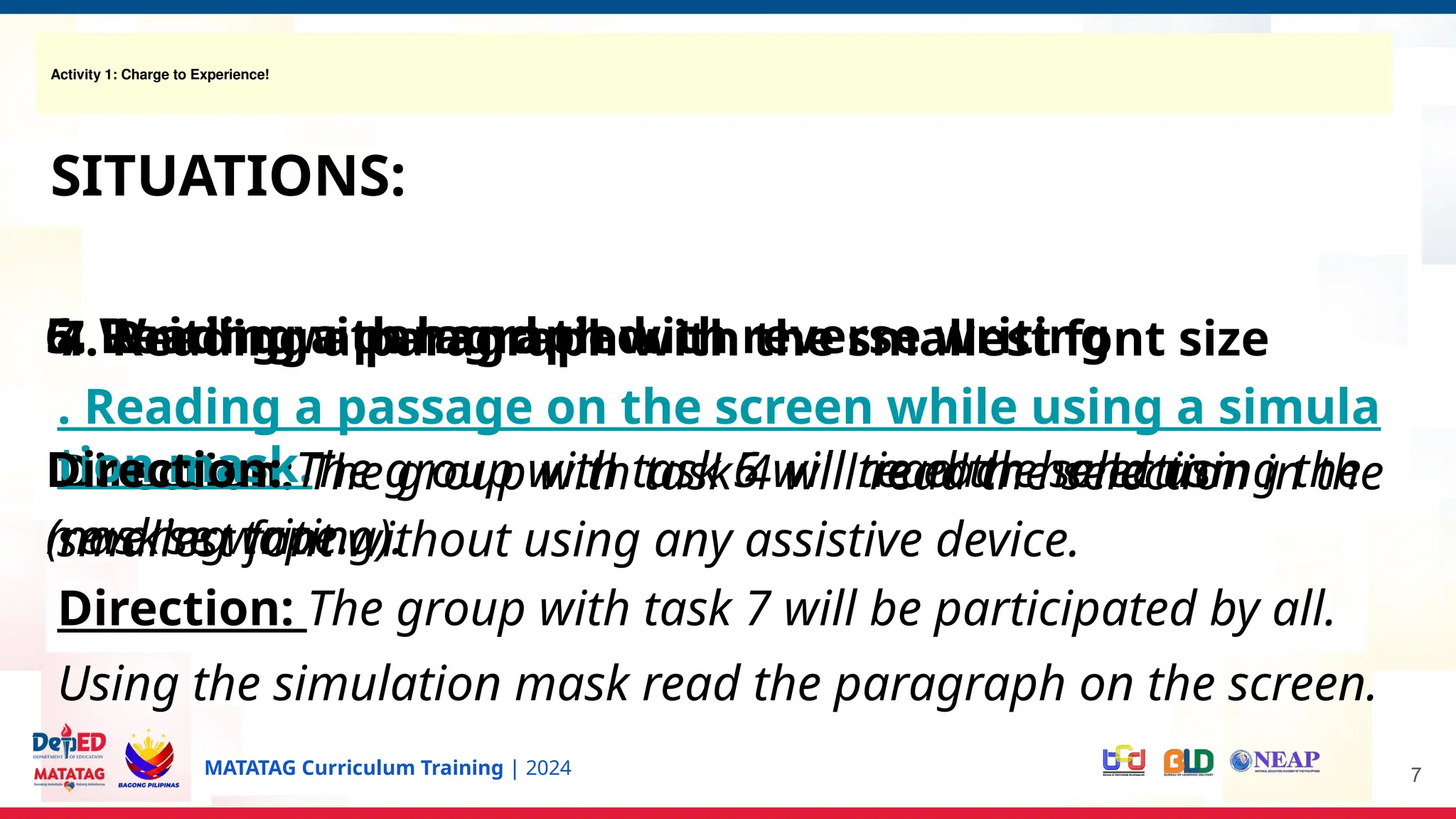
4. Reading a paragraph with the smallest font size
Direction: The group with task 4 will read the selection in the
smallest font without using any assistive device.
7
. Reading a passage on the screen while using a simula
tion mask.
Direction: The group with task 7 will be participated by all.
Using the simulation mask read the paragraph on the screen.
5. Reading a paragraph with reverse writing
Direction: The group with task 5 will read the selection
(reverse writing).
SITUATIONS:
6. Writing with hand tied.
Direction: The group with task 6 will tie each hand using the
masking tape.
MATATAG Curriculum Training | 2024
Reading while using the simulation mask
8
MATATAG Curriculum Training | 2024
Reading a paragraph with the smallest font size
9
The Story of the Pencil
By: Paulo Coelho
The Grandchild was looking at his grandma writing a letter. Suddenly he asked: are you writing a story about us?
Is it by chance a story about me?”
The grandma stopped writing, smiled and said to her grandchild. “Indeed I am writing about you, however more
important than the words is the pencil I am using. I hope you will be like this pencil when you grow up.”
The child looked at the pencil curiously, but could not see anything special. “But… it is exactly the same as every
other pencil I saw in my life.”
It is all in the way you look at things. There are five quali
ties in that pencil that, if you will be able to maintain, will
make you a man in peace with the whole world.
“First quality: you can make big things, but never forget that there is a hand guiding your steps. This hand we call
it God, and He will always have to address you towards His will.”
Second quality: sometimes I have to stop writing and use a sharpener. This makes the pencil suffer a little, but at
the end it will be sharper. So, learn to bear a little pain because it will make you a better man.”
Third quality: the penc il always allows us to use an eraser to cancel mistakes. U nderstand that correcting
something we did is not necessarily a bad thing, but something fundamental to keep us on the right path.”
Fourth quality: what is really important in the pencil is not the wood or the shape but the lead that is inside. So,
be always careful of what happens inside of yourself.”
“At the end, the fifth quality is: always leave a sign. In any case be aware that everythi ng you do in your life will
leave trails; try to be concious of every single action.”
MATATAG Curriculum Training | 2024
Reading a paragraph with reverse writing
10
Delsyixa is a lefilnog cnoiiotdn. An idvanudiil with dlsexiya nga alayws nga a
uiuqne brian when crpoamed with a non-dsxleyic iiuandidvl. Ainddaotilly,
reading nga awlays be a far more focus- and loabr-isvinntee avtiticy for a
dixyslec idiaduvnil when ceopamrd to a “tipycal” ngage. Sitll, a diisnogas of
dlsyexia deos not maen taht an iudivdanil nga be froeevr barerd form
epinreceinxg the joy of rniedag, or left out of onpipoeutirts that require one
to read well. When they are tgahut lgnauage slikls wtih a dfenirfet, more
trlieaod aorpacph taht wrkos to ngage all paawhtys in liaenrng, mnay
idiiauvdnls wtih delsiyxa can eipecnerxe ssccues with txet for the fisrt time.
Carrntoy to plaopur bielef, not erevy posren with dslexyia nga rveesre letters wlihe rndiaeg and
wtirnig. In fcat, scuh reavlrses are very ngage wlihe credilhn, btoh those with dxseilya and ngag
wuthoit, are frist lnanreig to wtire. After two yaers of eicxlipt htawnidnirg iitontusrcn, criehldn
sluohd no legonr sgrultge with rveelasrs. If tehy do, tihs may be a sgin of dlyiesxa. However,
the eerournos blieef taht all ngage wtih dseyxlia nga rsrveee lrttees and even words while
riandeg and wirting may in fact be daelnyig dnisgaois and ineitevontrn for many iudldvinias.
Dsptiee its ngag ngage on how many iianiddvlus with dlyisxea ecpnexiere vsauil itaomironfn,
like txet, delisyxa is not a vosiin prelobm. Taht is why dxseiyla cnonat be suscclufesly
rmaedteeid torghuh vsoiin tahrepy pgramors, no mteatr how ngageve. Ientasd, idldaivnuis
wtih dlxysiea, a lggnaaue-baesd droidesr, must be eixpilctly ittseruncd in all levels of lngagaue,
from pnehiomc aenwsaers to mhrpoloogy, in ngag to “baerk the cdoe” and slcuefcslusy leran
to read.
MATATAG Curriculum Training | 2024
Hand tied
11
MATATAG Curriculum Training | 2024
http://tinyurl.com/WhatsUPPadlet
12
MATATAG Curriculum Training | 2024 13
Analysis:
1. What can you say about your experience in the
activity in terms of access?
2. How do you feel after doing the activity?
3. Recall your classroom now. Is there anyone you
observed having any difficulties in learning?
4. What is your major takeaway from this activity?
MATATAG Curriculum Training | 2024 14
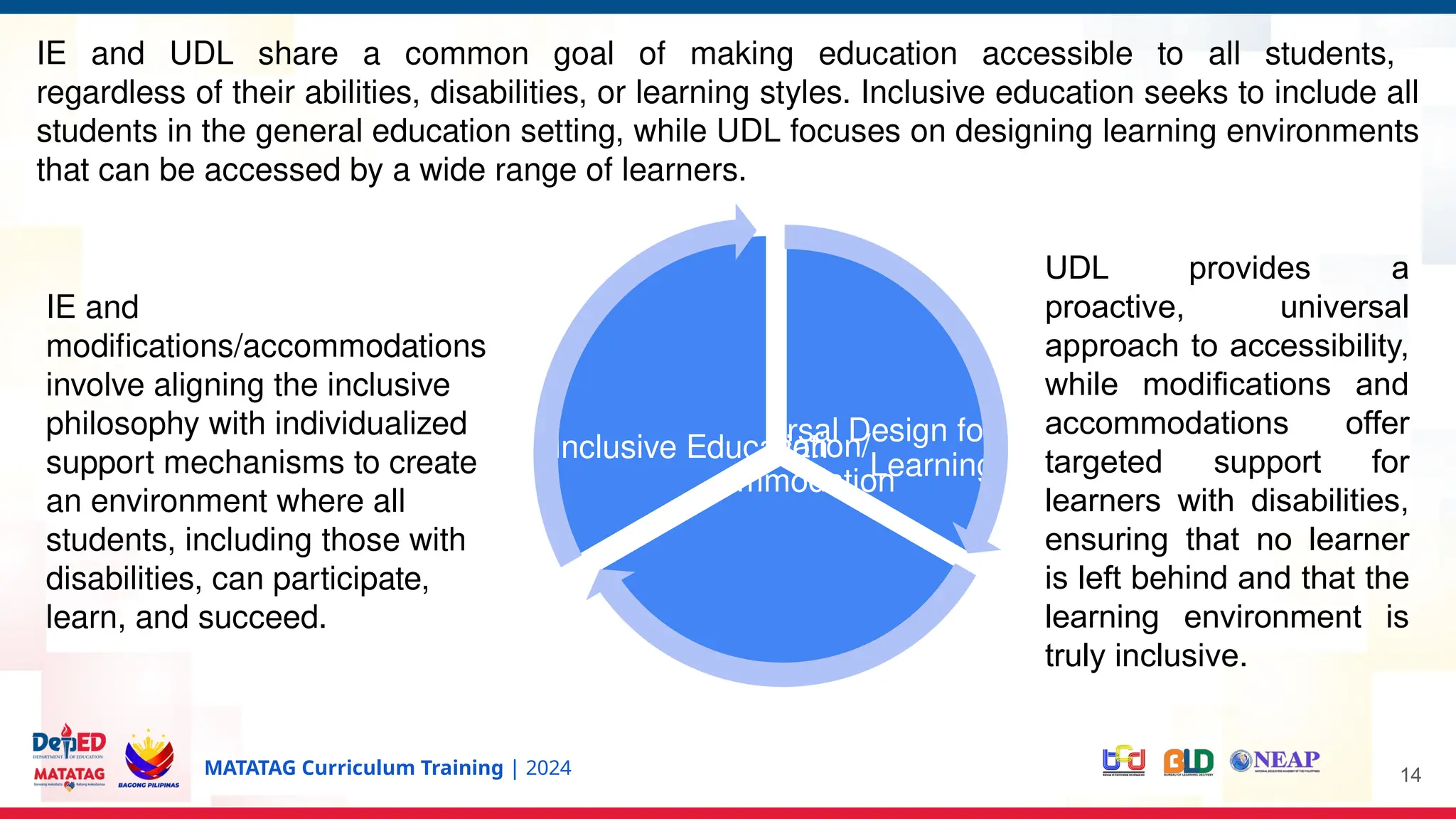
Universal Design for
Learning
Modification/
Accommodation
Inclusive Education
UDL provides a
proactive, universal
approach to accessibility,
while modifications and
accommodations offer
targeted support for
learners with disabilities,
ensuring that no learner
is left behind and that the
learning environment is
truly inclusive.
IE and UDL share a common goal of making education accessible to all students,
regardless of their abilities, disabilities, or learning styles. Inclusive education seeks to include all
students in the general education setting, while UDL focuses on designing learning environments
that can be accessed by a wide range of learners.
IE and
modifications/accommodations
involve aligning the inclusive
philosophy with individualized
support mechanisms to create
an environment where all
students, including those with
disabilities, can participate,
learn, and succeed.
MATATAG Curriculum Training | 2024 15
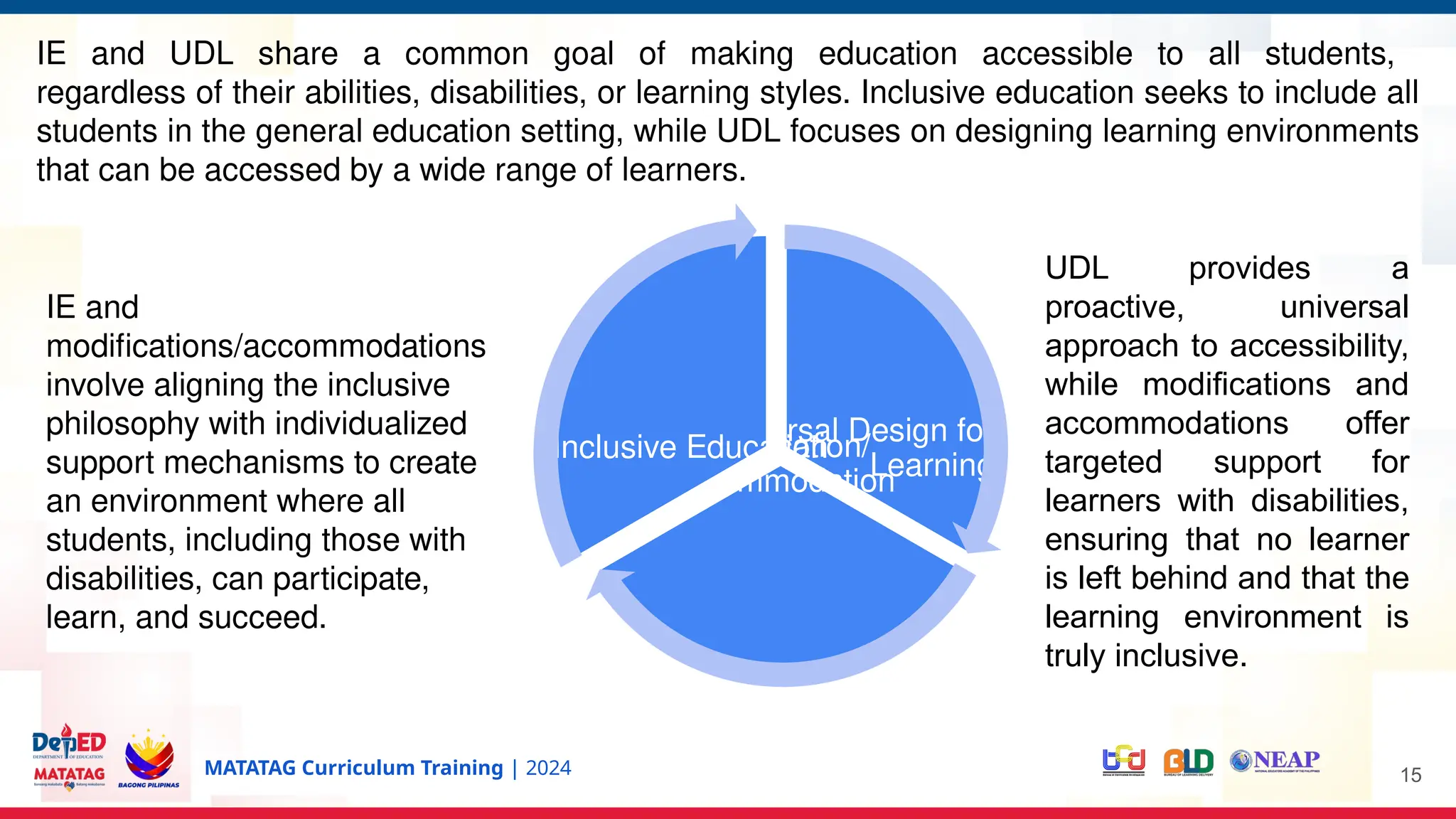
Universal Design for
Learning
Modification/
Accommodation
Inclusive Education
UDL provides a
proactive, universal
approach to accessibility,
while modifications and
accommodations offer
targeted support for
learners with disabilities,
ensuring that no learner
is left behind and that the
learning environment is
truly inclusive.
IE and UDL share a common goal of making education accessible to all students,
regardless of their abilities, disabilities, or learning styles. Inclusive education seeks to include all
students in the general education setting, while UDL focuses on designing learning environments
that can be accessed by a wide range of learners.
IE and
modifications/accommodations
involve aligning the inclusive
philosophy with individualized
support mechanisms to create
an environment where all
students, including those with
disabilities, can participate,
learn, and succeed.
MATATAG Curriculum Training | 2024 16
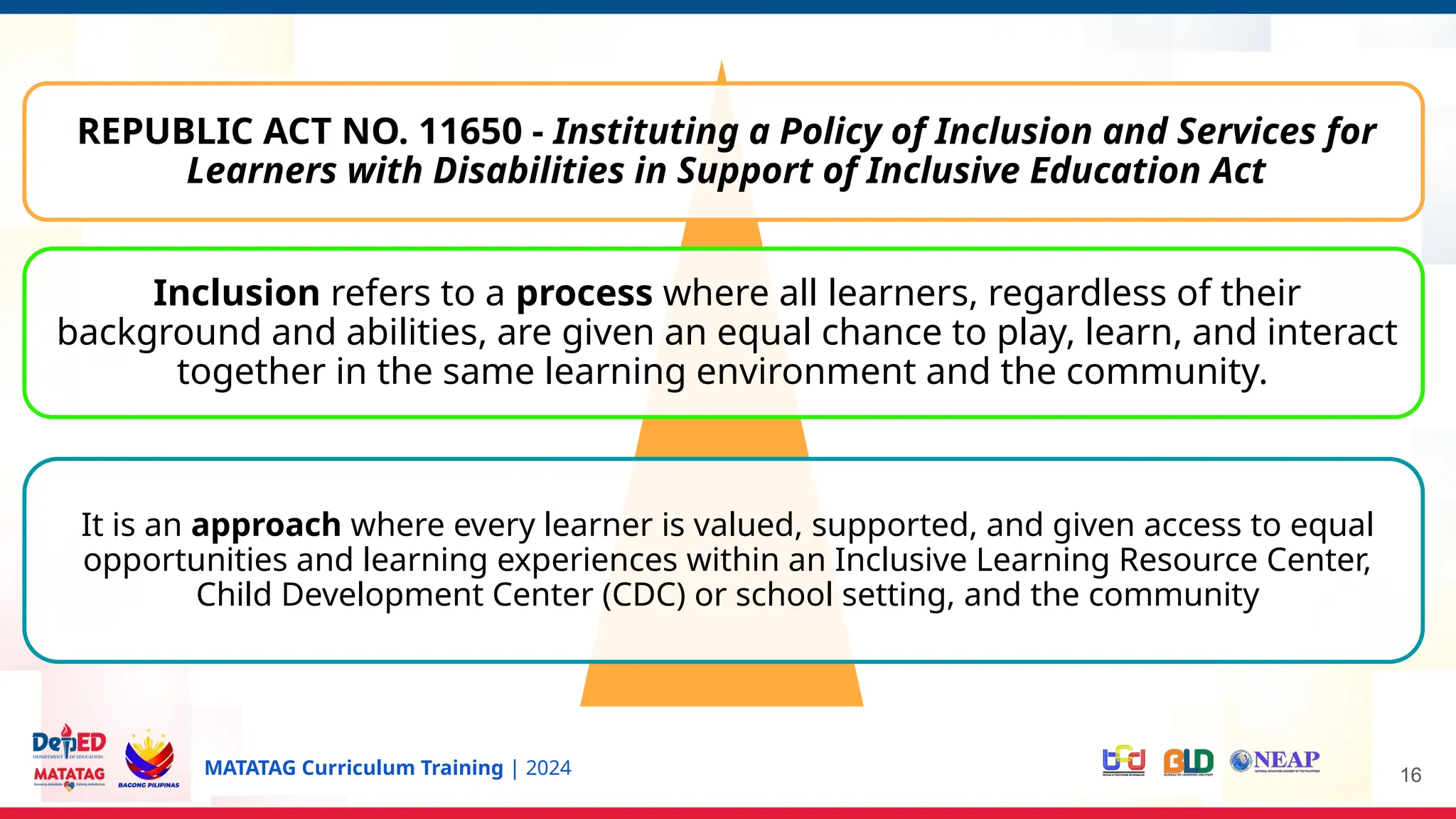
REPUBLIC ACT NO. 11650 - Instituting a Policy of Inclusion and Services for
Learners with Disabilities in Support of Inclusive Education Act
Inclusion refers to a process where all learners, regardless of their
background and abilities, are given an equal chance to play, learn, and interact
together in the same learning environment and the community.
It is an approach where every learner is valued, supported, and given access to equal
opportunities and learning experiences within an Inclusive Learning Resource Center,
Child Development Center (CDC) or school setting, and the community
MATATAG Curriculum Training | 2024 17
INCLUSIVE EDUCATION
⮚ refers to the process of addressing and responding to the diversity
of needs of all learners by moving towards the end-goal of full
participation, presence, and achievement in learning cultures and
communities which involves:
 accommodation;
 modification;
 adaptation;
 individualization in content;
 approaches; and
 structures and strategies.
MATATAG Curriculum Training | 2024 18
INCLUSIVE
EDUCATION
 it involves equitable opportunities for learners with
disabilities
 learners receive educational services, and the needed
support and related services
 learners should be with their age-appropriate peer
groups
 schools and ILRCs prepare them to live as fully
functional members of society.
MATATAG Curriculum Training | 2024 19
DISABILITY
Refers to a long-term physical, mental,
intellectual, behavioral, or sensory condition that
substantially limits one or more physiological or
anatomical function of an individual or activities of
such individual which results to limitation or
difficulty encountered in executing a task or action
(UNCRPD, 2OO6; Section 4 (c), RA 72771).
MATATAG Curriculum Training | 2024
LEARNERS WITH DISABILITIES
refer to learners in the general early and basic
education system who require additional support and
related services and adoptive pedagogic method due:
 to their long or short-term physical, mental, intellectual;
and
 sensory impairments in which interaction with various
barriers may hinder their full and effective participation in
society on an equal basis with others to develop them to
their maximum capability.
MATATAG Curriculum Training | 2024 21
1. Physical Disability
⮚ Refers to the musculoskeletal deformities,
difficulty in mobility, physical capacity,
stamina, or dexterity.
Lachica, I. (2023) Student with disability showcases talent in
drawing. https://cebudailynews.inquirer.net/506388/student-
with-disability-showcases-talent-in-drawing
⮚ Includes brain or spinal cord injuries,
multiple sclerosis, cerebral palsy,
respiratory disorders, epilepsy, hearing
and visual impairments, and more.
MATATAG Curriculum Training | 2024 22
22
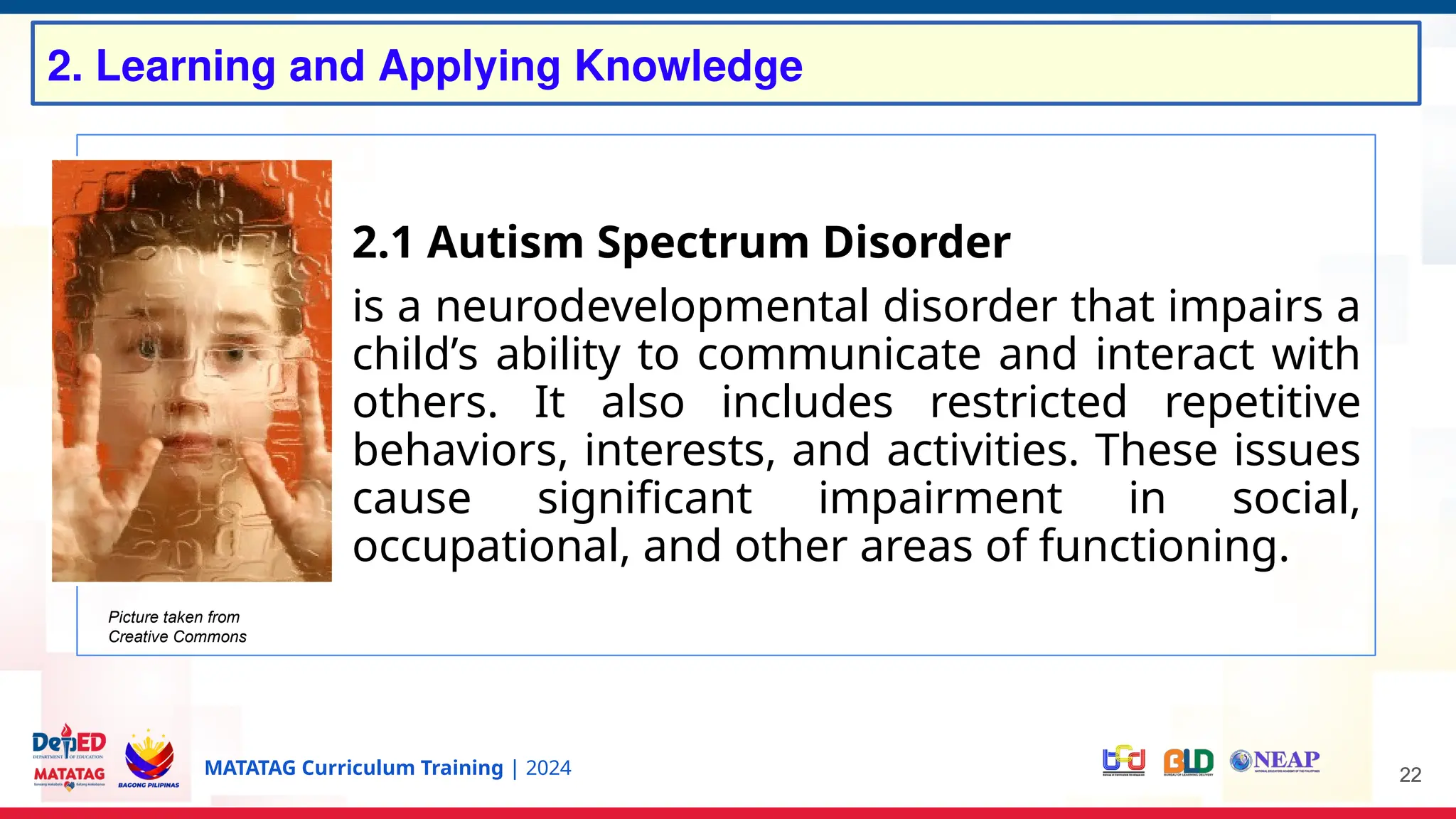
2. Learning and Applying Knowledge
2.1 Autism Spectrum Disorder
is a neurodevelopmental disorder that impairs a
child’s ability to communicate and interact with
others. It also includes restricted repetitive
behaviors, interests, and activities. These issues
cause significant impairment in social,
occupational, and other areas of functioning.
Picture taken from
Creative Commons
MATATAG Curriculum Training | 2024
A condition exhibiting one or more of the following
characteristics over a long period and to a marked degree
that adversely affects a child’s educational performance:
(a) An inability to learn that cannot be explained by intellectual,
sensory, or health factors;
(b) An inability to build or maintain satisfactory interpersonal
relationships with peers and teachers;
23
2.2. Emotional Behavioral Disturbance
MATATAG Curriculum Training | 2024 24
24
3.1. Intellectual Disability
Significantly sub-average general
intellectual functioning, existing
concurrently [at the same time] with deficits
in adaptive behavior and manifested during
the developmental period, adversely affects
a child’s educational performance.
Picture taken from
Creative Commons
3. Learners with Difficulty in Remembering and Concentrating
MATATAG Curriculum Training | 2024 25
25
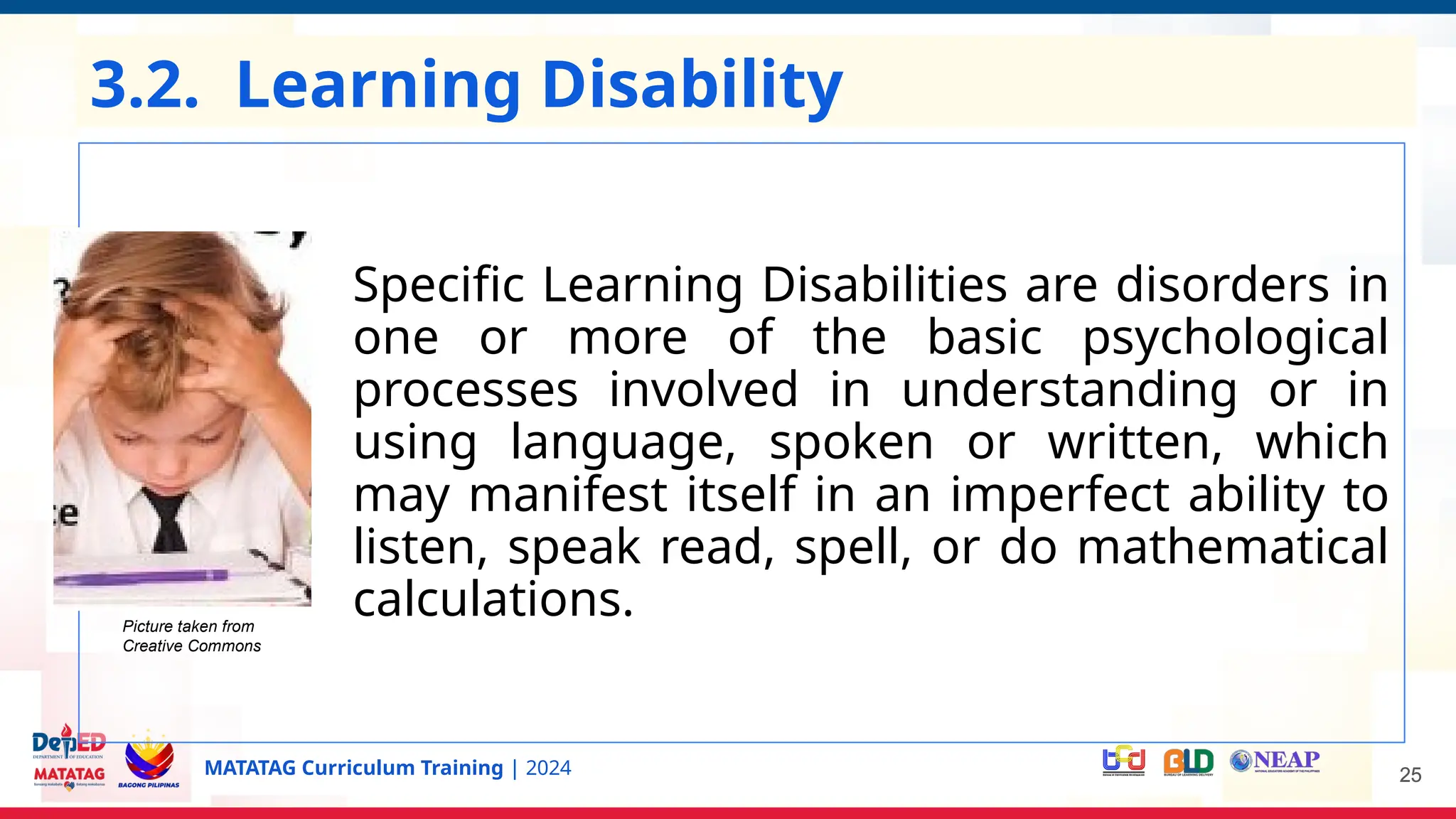
Specific Learning Disabilities are disorders in
one or more of the basic psychological
processes involved in understanding or in
using language, spoken or written, which
may manifest itself in an imperfect ability to
listen, speak read, spell, or do mathematical
calculations.
Picture taken from
Creative Commons
3.2. Learning Disability
MATATAG Curriculum Training | 2024 26
26
A person with ADHD has differences in brain
development and brain activity that affect
attention, the ability to sit still, and self-
control.
Picture taken from Creative
Commons
3.3. Attention Deficit Hyperactivity Disorder (ADHD)
MATATAG Curriculum Training | 2024
4.1 Visual Impairment refers to a significant functional
loss of vision that cannot be corrected by medication,
surgical operation, or the use of ordinary optical lenses
such as spectacles or eyeglasses.
27
4. Sensorial Impairment
MATATAG Curriculum Training | 2024 28
4. Sensorial Impairment
Degree of vision acuity
○Low Vision/Partially-Sighted those who are not
completely blind but cannot be corrected to normal
with regular eyeglasses or contact
lenses.
Degree of vision acuity
○Blindness is the lack of usable vision and the ability
to see anything; has no light perception; uses tactile
and auditory channels for learning functional tasks;
and uses the cane for mobility; learns via Braille and
other non-visual media.
MATATAG Curriculum Training | 2024
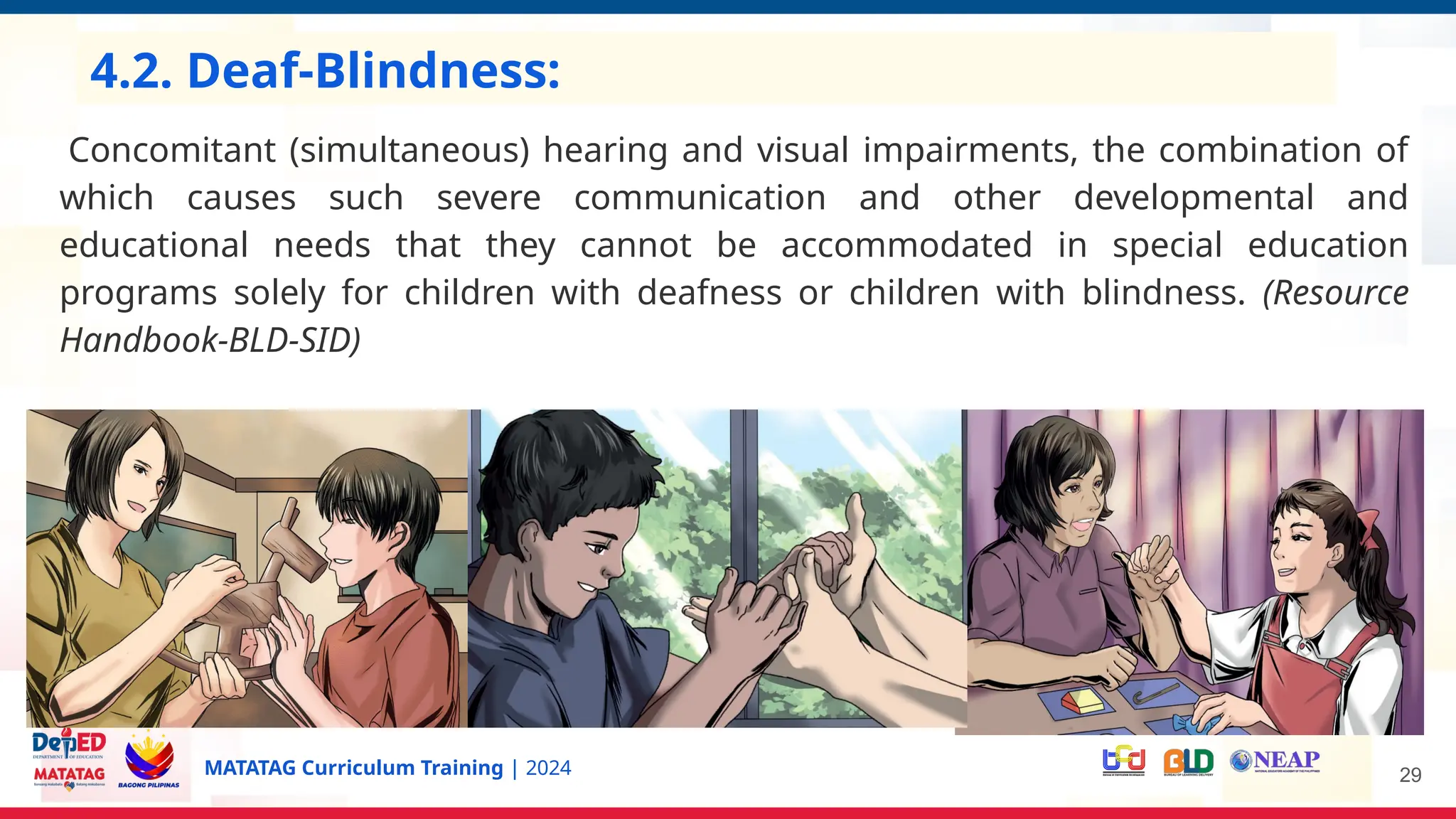
Concomitant (simultaneous) hearing and visual impairments, the combination of
which causes such severe communication and other developmental and
educational needs that they cannot be accommodated in special education
programs solely for children with deafness or children with blindness. (Resource
Handbook-BLD-SID)
29
4.2. Deaf-Blindness:
MATATAG Curriculum Training | 2024
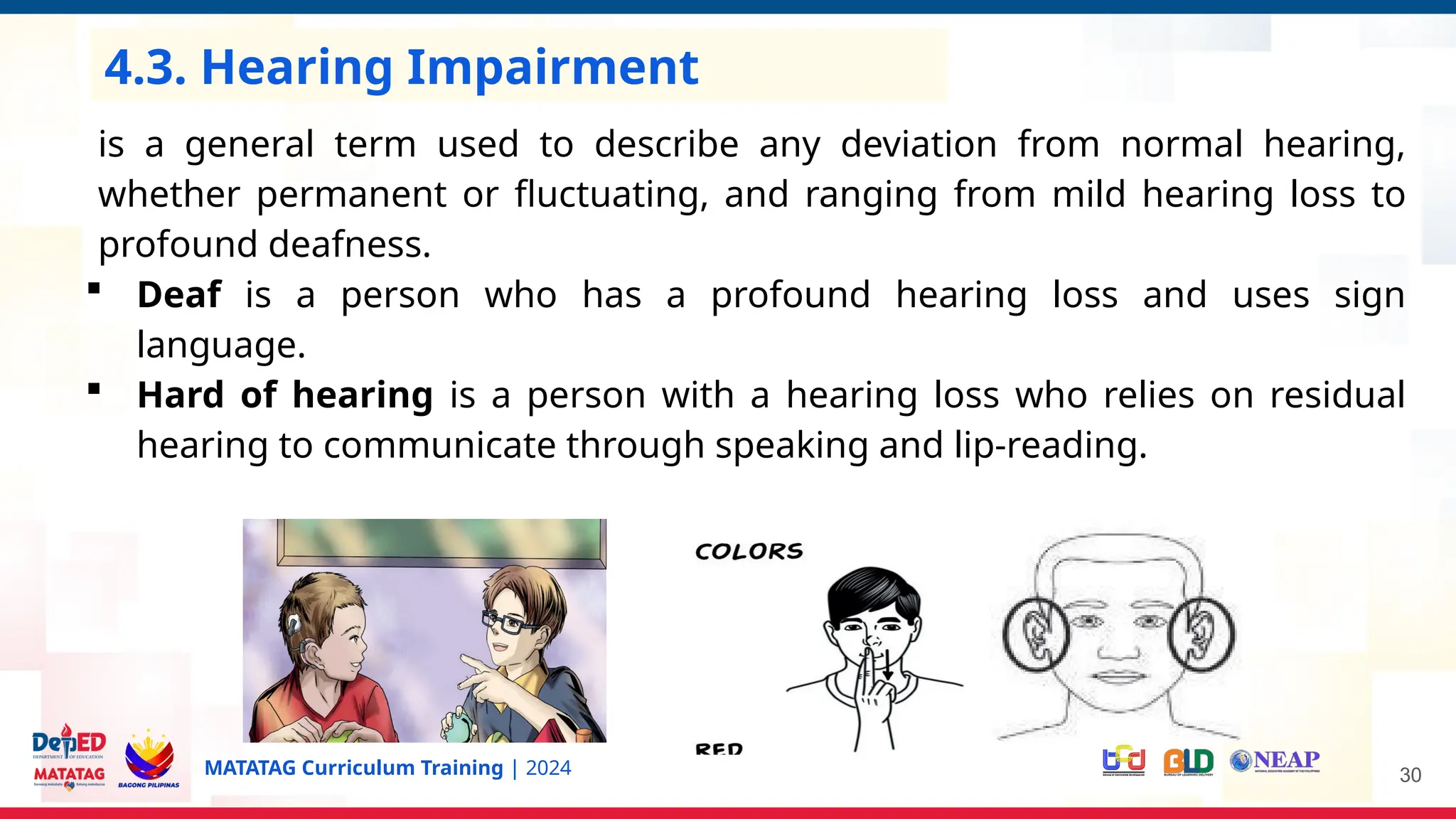
is a general term used to describe any deviation from normal hearing,
whether permanent or fluctuating, and ranging from mild hearing loss to
profound deafness.
 Deaf is a person who has a profound hearing loss and uses sign
language.
 Hard of hearing is a person with a hearing loss who relies on residual
hearing to communicate through speaking and lip-reading.
30
4.3. Hearing Impairment
MATATAG Curriculum Training | 2024
Disease due to chronic or acute health
problems such as asthma, diabetes, epilepsy, a
heart condition, hemophilia, lead poisoning,
leukemia, nephritis, rheumatic fever, sickle cell
anemia, and Tourette syndrome; and adversely
affects a child’s educational performance.
5. Learners with Health Concerns/Other Health Impairment
MATATAG Curriculum Training | 2024
Universal Design for Learning (UDL)
• Universal Design for Learning or UDL is a
framework developed by Center for Applied Special
Technology (CAST) that is grounded in research and
provides a set of three principles that guide how
educators can proactively design learning
environments that support the widest range of
learners (CAST, 2018).
MATATAG Curriculum Training | 2024 33
MATATAG Curriculum Training | 2024
•Provides flexibility in the way information is
presented, students respond or demonstrate
knowledge and skills, and their engagement; and
Based on RA 11650, UDL refers to a
scientifically valid framework for guiding
educational practice that:
• Reduces barriers in instruction, provides appropriate
accommodations, support mental and physical challenges,
and maintains high achievement expectations for all
students, including learners with disabilities.
MATATAG Curriculum Training | 2024
The three (3) principles of UDL are:
● Recognition – refers to multiple methods of representation
that give learners a variety of ways to acquire information
and build knowledge;
● Strategic Learning - refers to multiple means of learners’
action and expression that provide learners alternative
modes for demonstrating what they have learned; and
● Affective Learning- refers to multiple modes of learner
engagement that tap into learners interests, challenge
them appropriately, and motivate them to learn
35
MATATAG Curriculum Training | 2024
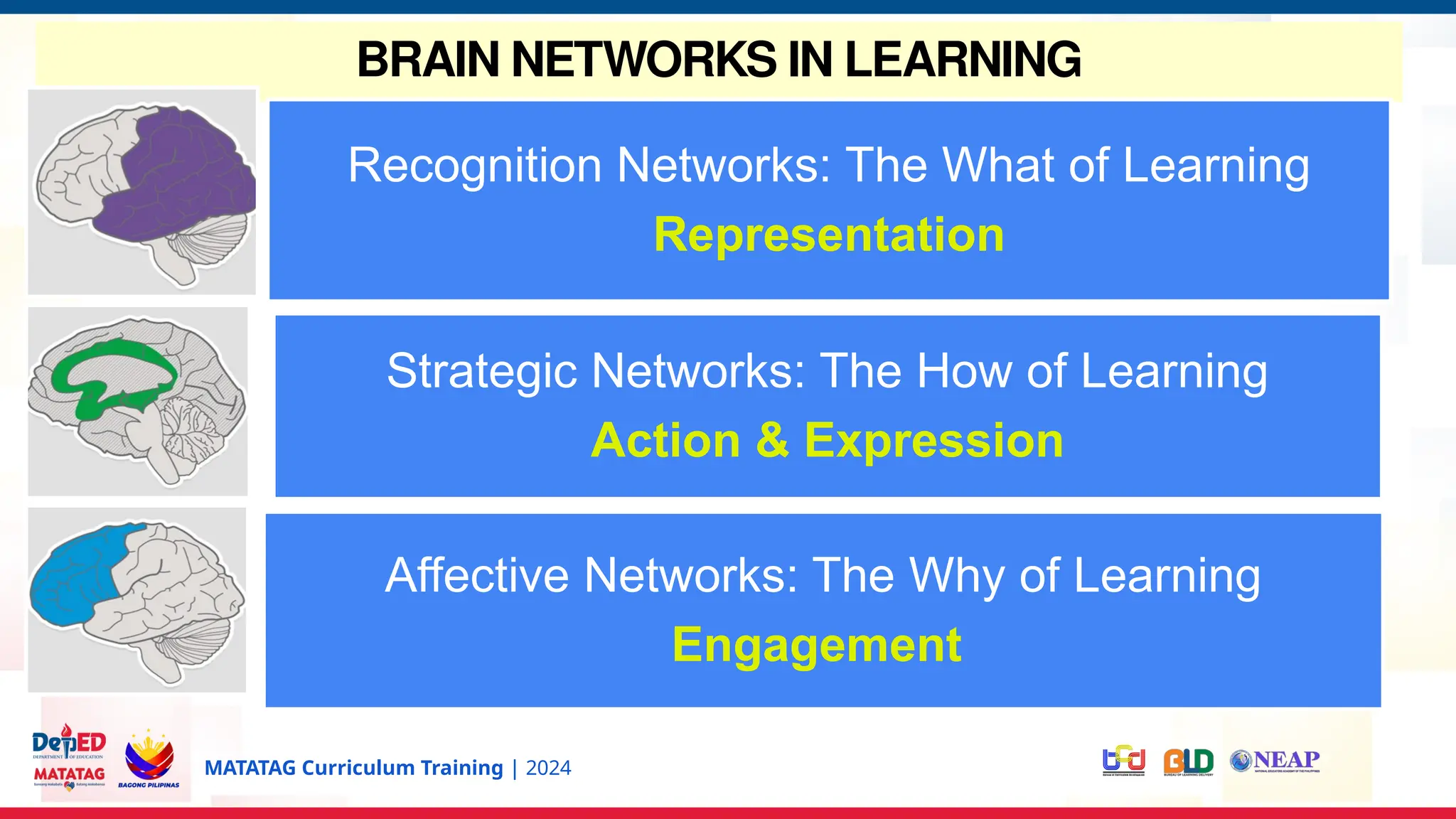
BRAIN NETWORKS IN LEARNING
Affective Networks: The Why of Learning
Engagement
Recognition Networks: The What of Learning
Representation
Strategic Networks: The How of Learning
Action & Expression
MATATAG Curriculum Training | 2024 37
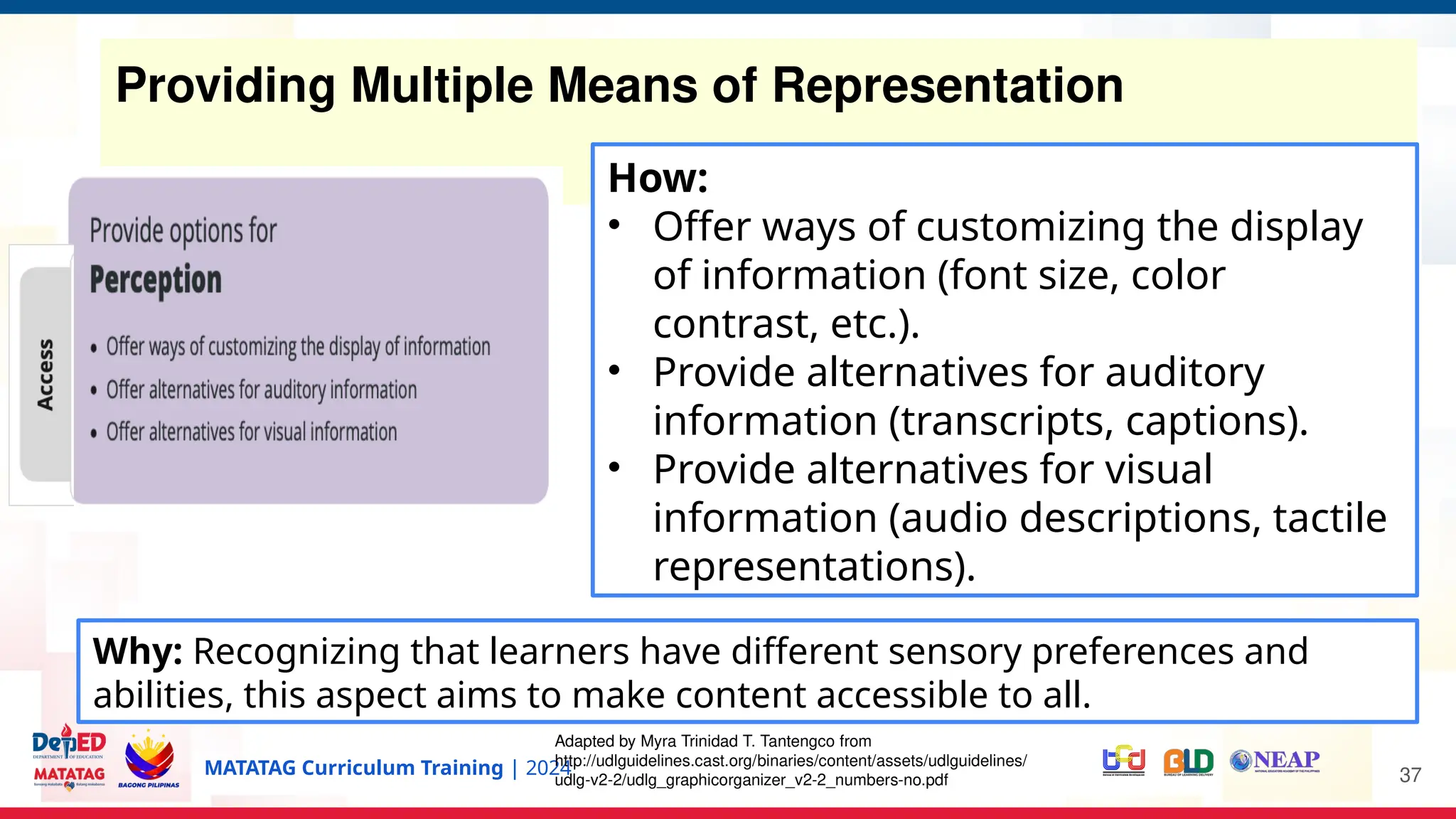
Providing Multiple Means of Representation
How:
• Offer ways of customizing the display
of information (font size, color
contrast, etc.).
• Provide alternatives for auditory
information (transcripts, captions).
• Provide alternatives for visual
information (audio descriptions, tactile
representations).
Why: Recognizing that learners have different sensory preferences and
abilities, this aspect aims to make content accessible to all.
Adapted by Myra Trinidad T. Tantengco from
http://udlguidelines.cast.org/binaries/content/assets/udlguidelines/
udlg-v2-2/udlg_graphicorganizer_v2-2_numbers-no.pdf
MATATAG Curriculum Training | 2024
Contrast between background and text or image.
MATATAG Curriculum Training | 2024
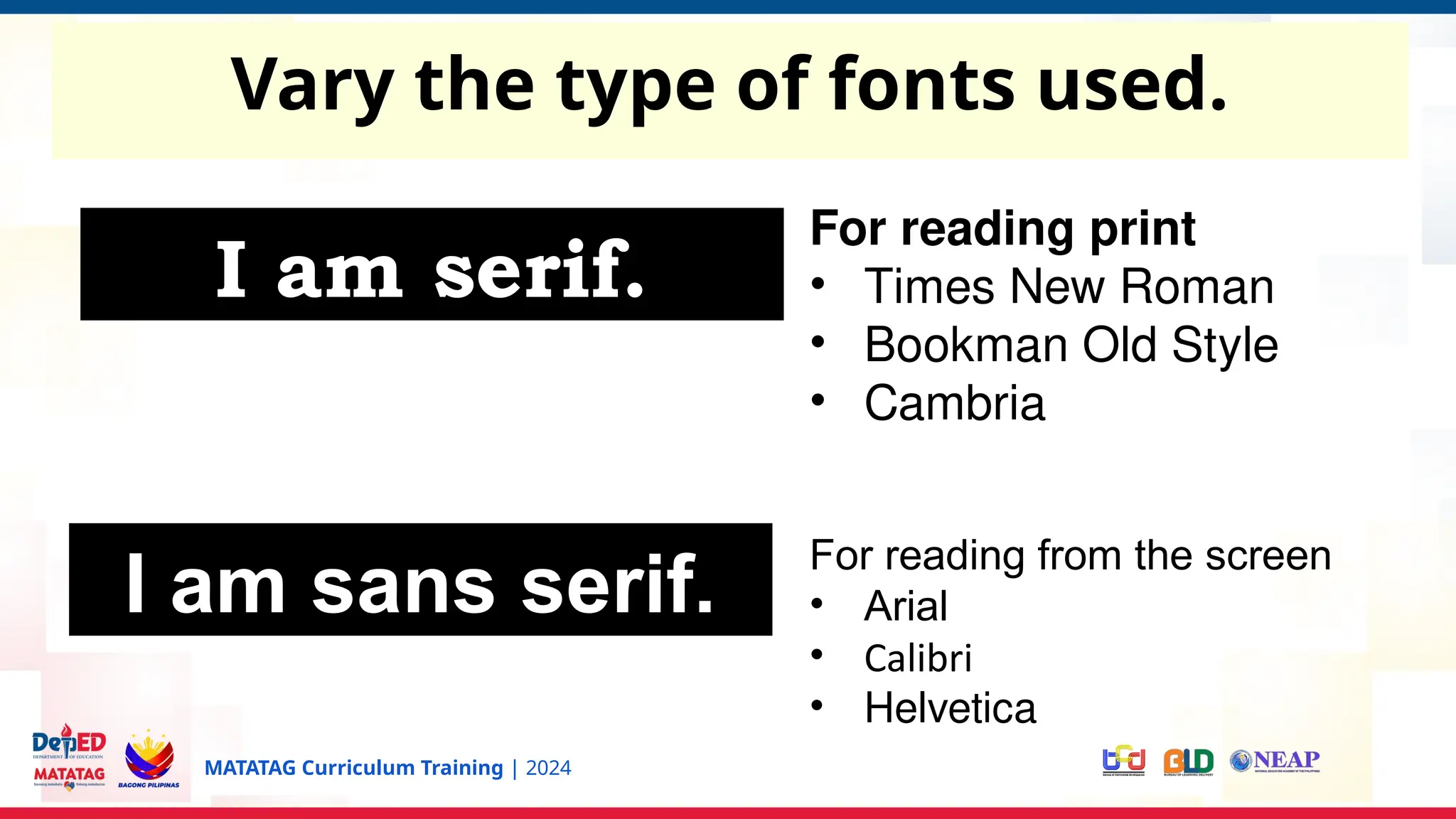
For reading from the screen
• Arial
• Calibri
• Helvetica
I am serif.
I am sans serif.
Vary the type of fonts used.
For reading print
• Times New Roman
• Bookman Old Style
• Cambria
MATATAG Curriculum Training | 2024 40
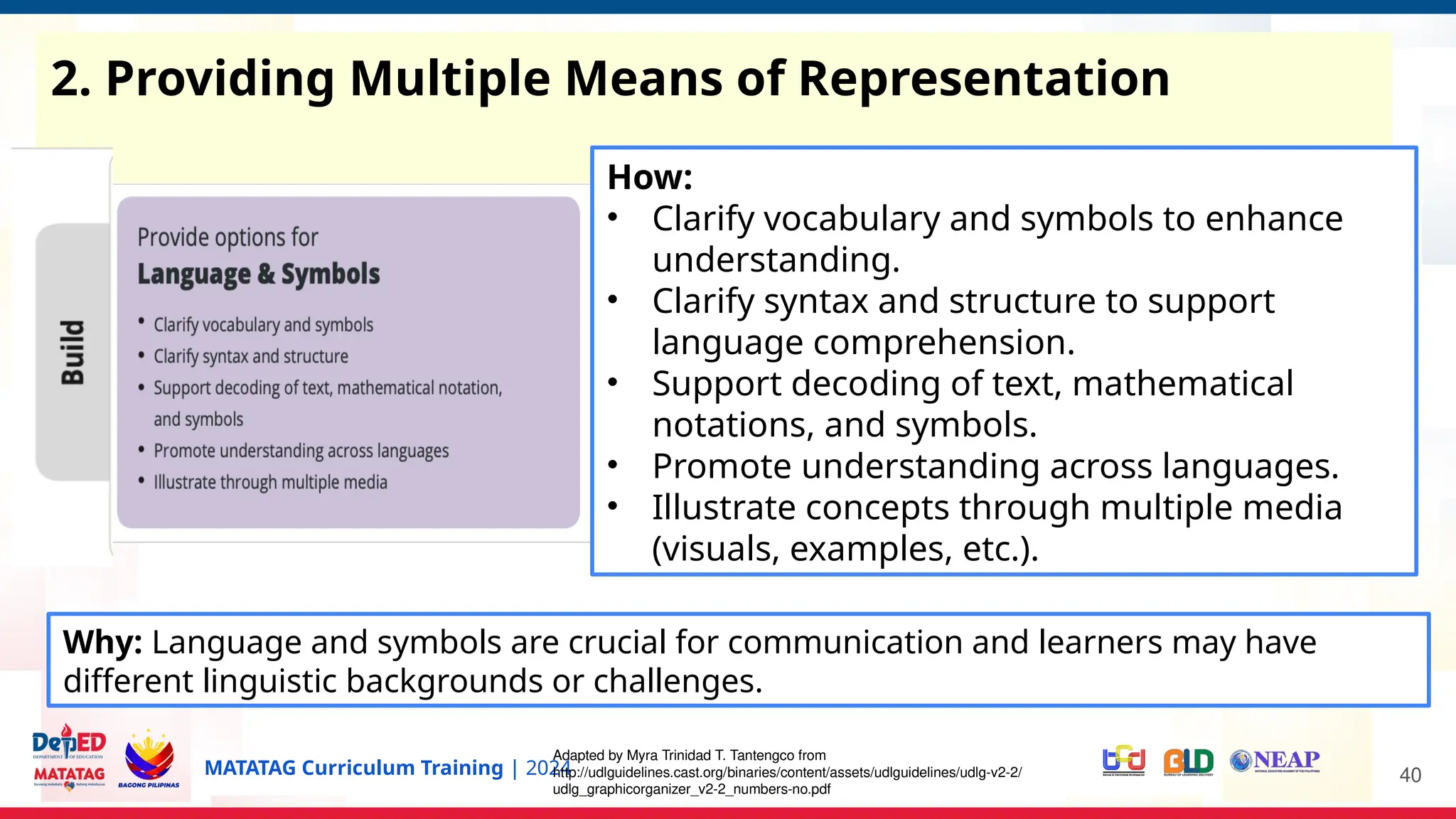
2. Providing Multiple Means of Representation
How:
• Clarify vocabulary and symbols to enhance
understanding.
• Clarify syntax and structure to support
language comprehension.
• Support decoding of text, mathematical
notations, and symbols.
• Promote understanding across languages.
• Illustrate concepts through multiple media
(visuals, examples, etc.).
Why: Language and symbols are crucial for communication and learners may have
different linguistic backgrounds or challenges.
Adapted by Myra Trinidad T. Tantengco from
http://udlguidelines.cast.org/binaries/content/assets/udlguidelines/udlg-v2-2/
udlg_graphicorganizer_v2-2_numbers-no.pdf
MATATAG Curriculum Training | 2024 41
Provide graphic symbols with alternative text descriptions
MATATAG Curriculum Training | 2024 42
Providing Multiple Means of Representation
How:
• Activate or supply background knowledge to connect
new information to what learners already know.
• Highlight patterns, critical features, big ideas, and
relationships to emphasize key concepts.
• Guide information processing and visualization
through scaffolding and cues.
• Maximize transfer and generalization by providing
opportunities to apply knowledge in different contexts.
Why: Different learners may require varying approaches to comprehend and
make meaning of information.
Adapted by Myra Trinidad T. Tantengco from
http://udlguidelines.cast.org/binaries/content/assets/udlguidelines/udlg-v2-2/
udlg_graphicorganizer_v2-2_numbers-no.pdf
MATATAG Curriculum Training | 2024 43
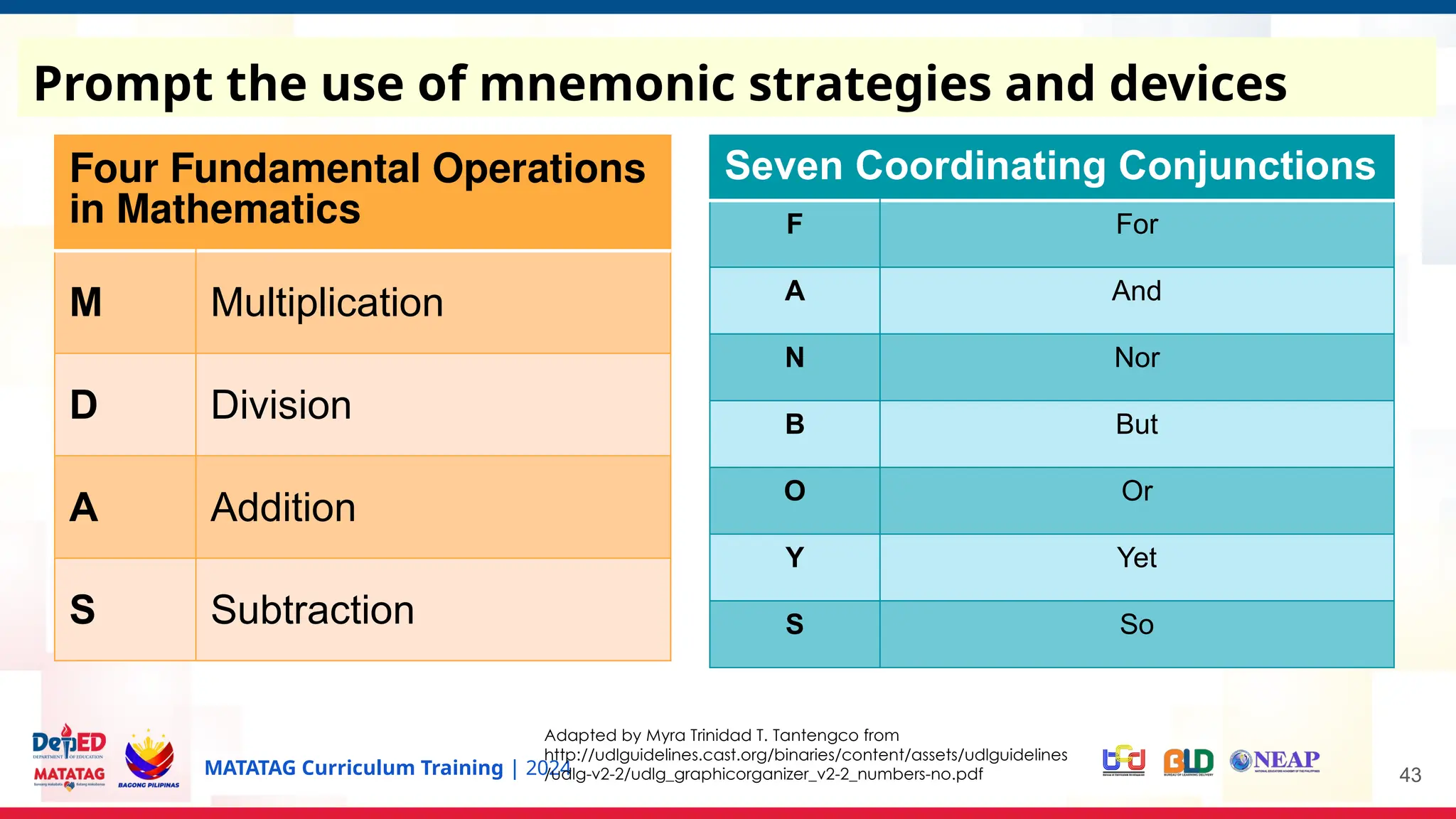
Prompt the use of mnemonic strategies and devices
Adapted by Myra Trinidad T. Tantengco from
http://udlguidelines.cast.org/binaries/content/assets/udlguidelines
/udlg-v2-2/udlg_graphicorganizer_v2-2_numbers-no.pdf
Four Fundamental Operations
in Mathematics
M Multiplication
D Division
A Addition
S Subtraction
Seven Coordinating Conjunctions
F For
A And
N Nor
B But
O Or
Y Yet
S So
MATATAG Curriculum Training | 2024
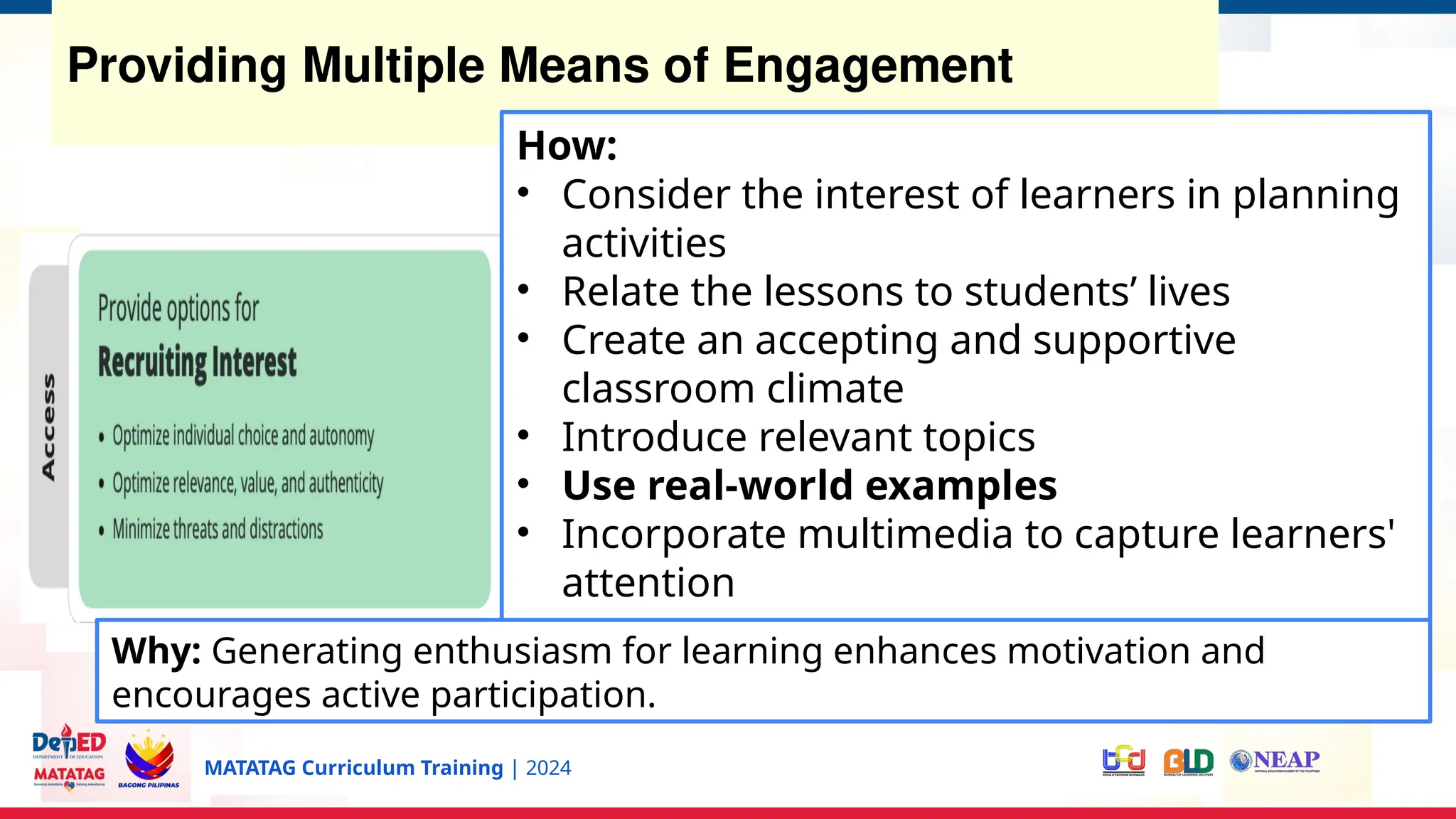
Providing Multiple Means of Engagement
How:
• Consider the interest of learners in planning
activities
• Relate the lessons to students’ lives
• Create an accepting and supportive
classroom climate
• Introduce relevant topics
• Use real-world examples
• Incorporate multimedia to capture learners'
attention
Why: Generating enthusiasm for learning enhances motivation and
encourages active participation.
MATATAG Curriculum Training | 2024 45
1. Providing Multiple Means of Engagement
How:
• Communicate clear learning objectives
• Set challenging but achievable tasks
• Create cooperative learning groups with clear goals,
appropriate roles, and fair responsibilities.
• Provide mastery-oriented feedback “You’ve made
improvements in ___. Now focus some time on the
areas that are a little more challenging for you to
build your strength in those areas, too.”
Why: Encouraging perseverance helps learners
overcome obstacles and achieve their goals.
MATATAG Curriculum Training | 2024 46
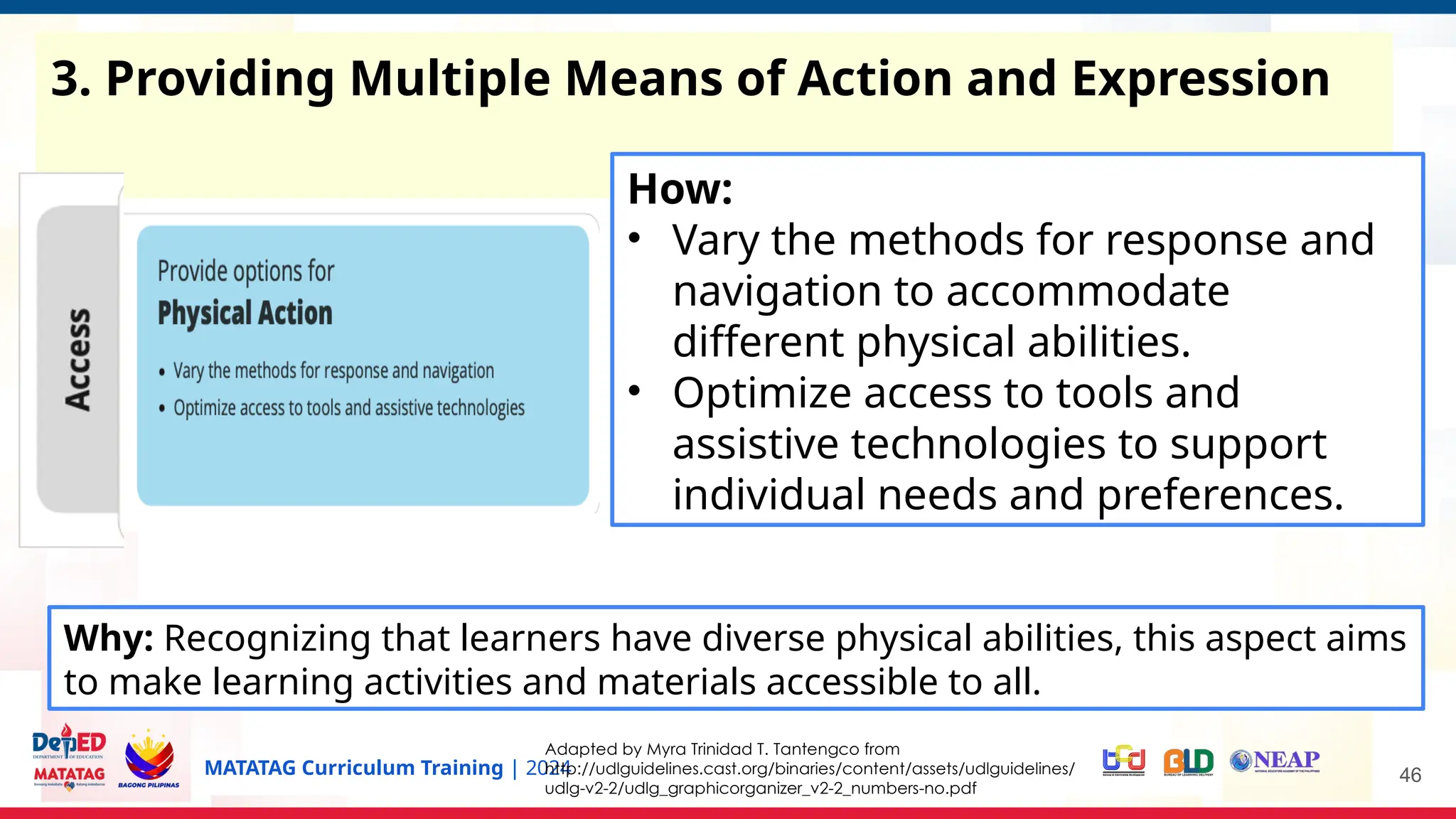
3. Providing Multiple Means of Action and Expression
How:
• Vary the methods for response and
navigation to accommodate
different physical abilities.
• Optimize access to tools and
assistive technologies to support
individual needs and preferences.
Why: Recognizing that learners have diverse physical abilities, this aspect aims
to make learning activities and materials accessible to all.
Adapted by Myra Trinidad T. Tantengco from
http://udlguidelines.cast.org/binaries/content/assets/udlguidelines/
udlg-v2-2/udlg_graphicorganizer_v2-2_numbers-no.pdf
MATATAG Curriculum Training | 2024
47
Providing Multiple Means of Action and Expression
How:
• Use multiple means of communication, such
as writing, speaking, drawing, or using
assistive technologies.
• Use a variety of tools for construction and
composition to cater to diverse preferences
and abilities.
• Build fluencies with graduated levels of
support for practice and performance to
accommodate varying skill levels.
Why: Different learners may have varied ways of expressing themselves and
communicating their understanding.
Adapted by Myra Trinidad T. Tantengco from
http://udlguidelines.cast.org/binaries/content/assets/udlguidelines/udlg-
v2-2/udlg_graphicorganizer_v2-2_numbers-no.pdf
MATATAG Curriculum Training | 2024 48
The way I descride a bumby ride is like wothgan mowtsarts
mowsek. eshe bumby rowd is like a song. Eshe bumb is the a note
eche uncon at the sam time ste is. that was the mewstere to
mowts mowsuk it was vare metereus and unperdekdable. So the
next time you drive down a bumby theak of mowtsart.
The way I describe a bumpy ride is like Wolfgang Mozart's music. Each
bumpy road is like a song. Each bump in the road is a note. Each
bump is uncontrolled; at the same time it still is controlled. That was
the magic to Mozart's music. It was very mysterious and
unpredictable. So, the next time you drive down a bumpy road, think
of Mozart.
MATATAG Curriculum Training | 2024 49
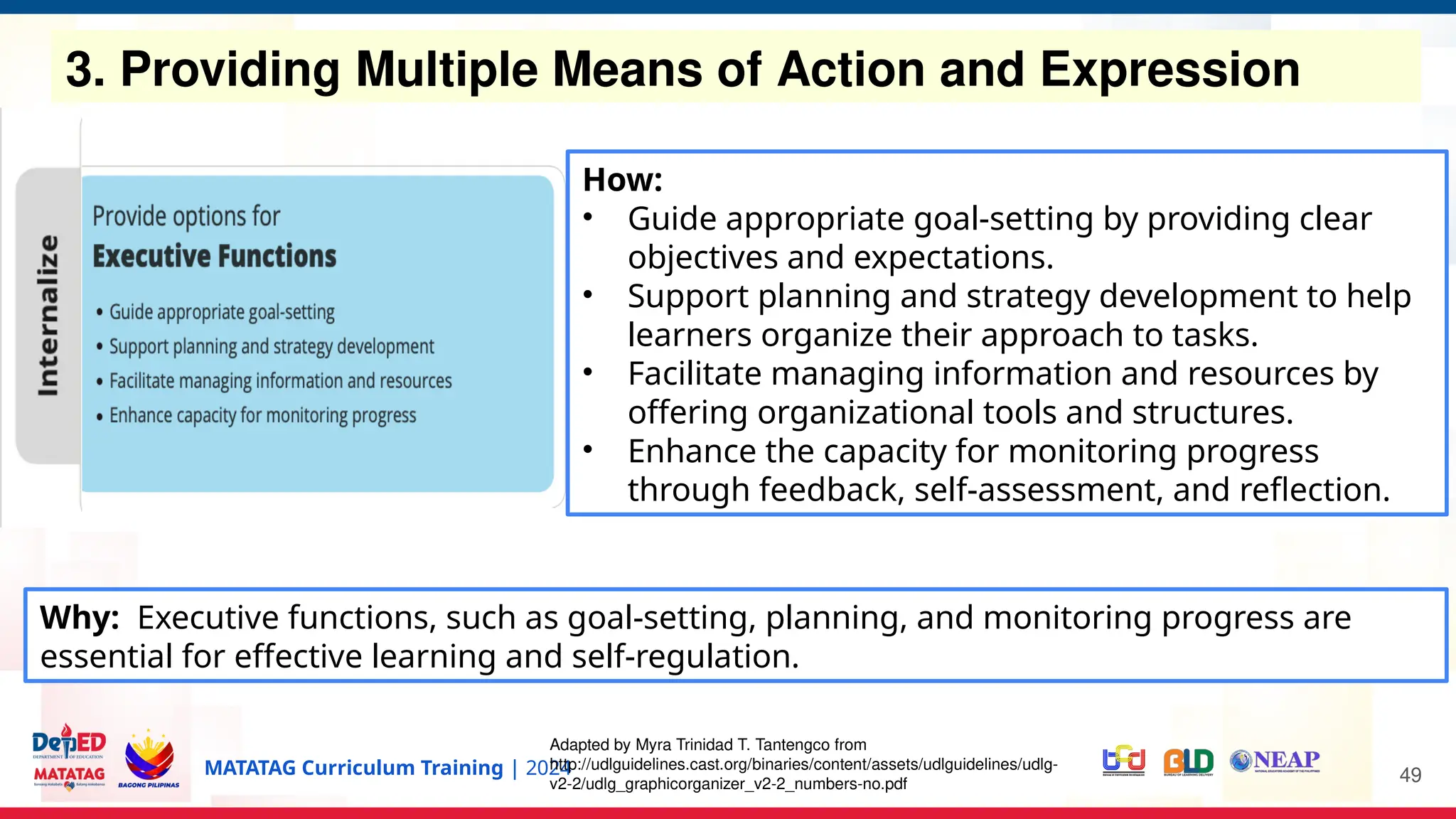
3. Providing Multiple Means of Action and Expression
How:
• Guide appropriate goal-setting by providing clear
objectives and expectations.
• Support planning and strategy development to help
learners organize their approach to tasks.
• Facilitate managing information and resources by
offering organizational tools and structures.
• Enhance the capacity for monitoring progress
through feedback, self-assessment, and reflection.
Why: Executive functions, such as goal-setting, planning, and monitoring progress are
essential for effective learning and self-regulation.
Adapted by Myra Trinidad T. Tantengco from
http://udlguidelines.cast.org/binaries/content/assets/udlguidelines/udlg-
v2-2/udlg_graphicorganizer_v2-2_numbers-no.pdf
MATATAG Curriculum Training | 2024 50
http://tinyurl.com/fzafsbcc
MATATAG Curriculum Training | 2024
Understanding Accommodations and Modifications for
Learners with Disabilities
• to allow learners with disabilities be able to learn
and develop understanding of the content and
competencies being taught or be able to complete
the task/activities given to them by their teachers.
Accommodations - are the appropriate
actions made regarding the learning
environment, learning materials, and other
resources, curriculum format, equipment,
and devices
MATATAG Curriculum Training | 2024
ACCOMMODATION STRATEGIES
The way information is
presented (e.g., text,
lecture) – PRESENTATION
ACCOMMODATIONS
The way the student is
required to respond (e.g.,
writing, speech) -
RESPONSE
ACCOMMODATIONS
The characteristics of the
setting (e.g., noise,
lighting) – SETTING
ACCOMMODATIONS
The timing and
scheduling of instruction
(e.g., time of day, length
of assignment) – TIMING
AND SCHEDULING
ACCOMMODATION
MARAMING SALAMAT!
PRESENTATION ACCOMMODATIONS
Instructional or test materials presented in a different manner than
standard print.
Examples:
o Alternative Recording: Allowing audio or video recording instead of
note-taking.
o Verbal Instruction: Reading directions or problems aloud to the
student.
o Font and Text Adaptations: Increasing font size or using
magnification tools.
o Enhanced Visuals: Improving contrast or differentiation in visual
materials, like using color for identification.
o Increased Space: Adding white space on assignments for clarity.
MARAMING SALAMAT!
PRESENTATION ACCOMMODATIONS
Instructional or test materials presented in a different manner
than standard print.
Examples:
o Reduced Density: Decreasing the number of items displayed per
page.
o Screen Reader Accessibility: Permitting the use of a screen reader.
o Tactile Support: Offering tactile prompts like physical guidance or
raised-line paper.
o Pre-lesson Materials: Providing notes or class presentations
before the lesson begins.
MATATAG Curriculum Training | 2024
RESPONSE ACCOMMODATIONS
An alternate method of responding from a typical pencil /
paper format.
Examples:
o Allowing students to use a visual/graphic organizer to
organize their thinking
o Letting students use concrete objects/manipulatives to
generate their answer
o Giving students the option to write their responses
directly on the assignment (as opposed to filling out an
answer sheet)
o Making an audio recording of lessons
o Letting students use a calculator or multiplication chart
on an assignment that does not assess computation
MATATAG Curriculum Training | 2024 56
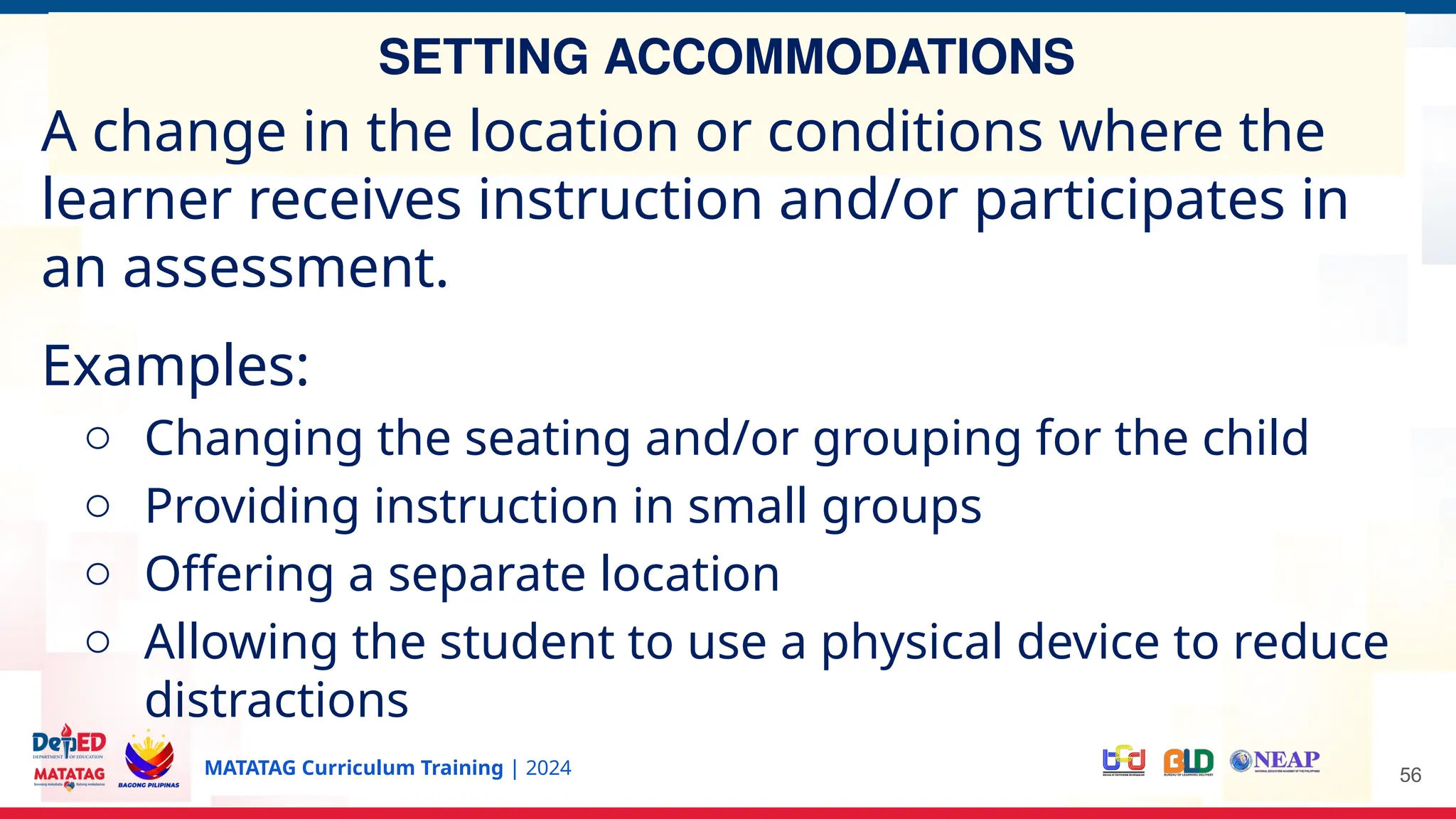
SETTING ACCOMMODATIONS
A change in the location or conditions where the
learner receives instruction and/or participates in
an assessment.
Examples:
o Changing the seating and/or grouping for the child
o Providing instruction in small groups
o Offering a separate location
o Allowing the student to use a physical device to reduce
distractions
MATATAG Curriculum Training | 2024 57
TIMING/SCHEDULING ACCOMMODATIONS
Additional time is allowed or provided to complete homeworks
and/or assessments
Examples:
o Extra time
o Frequent breaks
o Time of day
o Multiple test sessions
MATATAG Curriculum Training | 2024 58
• practices and procedures that provide equitable access
during instruction and assessments for learners with
disabilities;
• intended to reduce or even eliminate the effects of a student’s
disability;
• do not reduce learning expectations;
• must be consistent for classroom instruction, and classroom
assessments
POINTS TO REMEMBER ABOUT ACCOMMODATIONS
MATATAG Curriculum Training | 2024 59
Understanding Modification for Learners with
Disabilities
Modifications
• are used to describe changes in the curriculum.
• are made "for learners with disabilities who are unable to
comprehend all of the content an instructor is teaching"
(Disabilities, Opportunities, Internetworking, and
Technology, 2O2l, par. 21.
MATATAG Curriculum Training | 2024 60
GENERAL MODIFICATIONS:
• Allow outlining instead of
writing for an essay or
major project
• Use of alternative books
or materials on the topic
being studied
• Computerized spell-check
support
• Word bank of choices for
answers to test questions
• Provision of calculator
and/or number line for
math tests
• Film or video supplements
in place of reading text
MATATAG Curriculum Training | 2024 61
GENERAL MODIFICATIONS:
• Reworded questions in
simpler language
• Projects instead of written
reports
• Highlighting important
words or phrases in
reading assignments
• Modified workload or
length of
assignments/tests
• Modified time demands
MATATAG Curriculum Training | 2024 62
Behavior Modifications:
• Breaks between tasks
• Cue expected behavior
• Use positive reinforcement
• Use proximity/touch control
• Use peer support and mentoring
• Model expected behavior by adults
• Have parents sign homework and behavior chart
• Set and post class rules
MATATAG Curriculum Training | 2024 63
⮚ Accommodations – do NOT reduce learning
expectations. But rather provide the learners with
access to the curriculum and assessments.
⮚ Modifications – change, lower, or reduce learning
expectations; increase the gap between achievement
of learners with disabilities and expectations for
proficiency at grade-level.
ACCOMMODATIONS and MODIFICATIONS
MATATAG Curriculum Training | 2024 64
Application
Identify whether the given scenario:
Accommodation
Modification
MATATAG Curriculum Training | 2024 65
Case Scenario 1: Mark Joseph
Mark Joseph, a high school student, wasn't
identified as having learning difficulties. However,
in his Algebra I class, he tends to make mistakes
when multiplying or dividing large numbers with
decimals. Interestingly, when Mark Joseph uses a
calculator, he gets the right answer.
MATATAG Curriculum Training | 2024 66
Case Scenario 2: Emma
Emma struggles with reading due to a learning
disability. Long passages are tough for her since
she reads below her grade level. She's working on
grasping the main idea sand supporting details. To
help her out, the teacher gives Emma a story that
matches her reading level. While everyone else in
class has to find both the main idea and supporting
details, Emma only needs to focus on identifying
the main idea.
MARAMING SALAMAT!
Case Scenario 3: Rajani
Rajani's special education teacher, Miss Ferrer, is super
caring. She's concerned that Rajani might get too
stressed with the tasks her regular teacher gives. Every
evening, Miss Ferrer goes through the next day's
assignments and figures out how to make them easier
for Rajani. For instance, she found a set of simpler 1st-
grade spelling words for Rajani's 5th-grade class. Miss
Ferrer's trying to help Rajani handle the work without
feeling overwhelmed.
MARAMING SALAMAT!
Discuss an appropriate
accommodation for each
given classroom
situation.
Activity 2 :
MARAMING SALAMAT!
Classroom Example No. 4:
Jane, a fourth-grade student, benefits from
special education support due to challenges in
reading and math. Specifically, she faces
difficulty in various aspects of reading, including
decoding words, blends, and commonly used
sight words.
What are possible classroom accommodations for
Jonas?
MARAMING SALAMAT!
Classroom Example No. 5:
Nikka demonstrates a strong recall of basic
math facts but struggles with retaining the steps
for solving complex problems using algorithms,
often losing her place. Despite consistent after-
school tutoring, her classroom assignment and
test scores don't reflect improvement.
What classroom accommodations could support
Nikka's learning?
MATATAG Curriculum Training | 2024 71
Let us check if your
answers are
correct. 
MATATAG Curriculum Training | 2024 72
Case Scenario 1: Mark Joseph
Mark Joseph, a high school student, wasn't
identified as having learning difficulties. However,
in his Algebra I class, he tends to make mistakes
when multiplying or dividing large numbers with
decimals. Interestingly, when Mark Joseph uses a
calculator, he gets the right answer.
Accommodation
MARAMING SALAMAT!
Ways to Address Mark Joseph’s Needs
 Graph Paper
 Class notes with an example question available for
student
 Procedures numbered explaining the step by step
process
 Peer tutor
 Teacher monitors student and checks work with
teacher every 2-4 problems.
 Provide other ideas
MATATAG Curriculum Training | 2024 74
Case Scenario 2: Emma
Emma struggles with reading due to a learning disability.
Long passages are tough for her since she reads below
he grade level. She's working on grasping the main idea
and supporting details. To help her out, the teacher gives
Emma a story that matches her reading level. While
everyone else in class has to find both the main idea and
supporting details, Emma only needs to focus on
identifying the main idea.
Modification
MARAMING SALAMAT!
Ways to Accommodate Emma’s Needs
• She can identify main idea and details within a
paragraph provided while the class will identify
the main idea and details in the whole story.
• She can answer question cards: identify the
main idea and supporting details.
MARAMING SALAMAT!
Case Scenario 4: Rajani
Rajani's special education teacher, Miss Ferrer, is super caring.
She's concerned that Rajani might get too stressed with the
tasks her regular teacher gives. Every evening, Miss Ferrer
goes through the next day's assignments and figures out
how to make them easier for Rajani. For instance, she found
a set of simpler 1st-grade spelling words for Rajani's 5th-
grade class. Miss Ferrer's trying to help Rajani handle the
work without feeling overwhelmed.
Modification
MARAMING SALAMAT!
Ways to Accommodate Rajani’s Needs
• Focus on lesson objective: Will Rajani benefit by
completing work lower than grade level
standards?
• Break tasks into smaller more manageable parts,
frequently check for understanding.
• Be reminded that the objective is quality and not
quantity.
MATATAG Curriculum Training | 2024
In a Nutshell
78
http://tinyurl.com/4anvtcr5
MATATAG Curriculum Training | 2024 79
Concepts of the Inclusive Education, Universal Design for Learning and
Modifications/Accommodation
Elements Inclusive
Education (IE)
Universal Design
for Learning (UDL)
Modifications/
Accommodations
1. Equity and
Accessibility
Advocates for
removing
barriers to
learning and
providing equal
opportunities for
all students
Aims to proactively
design learning
environments that
are accessible to all
learners, minimizing
the need for
retrofits.
Modifications and
accommodations further
enhance equity by
providing targeted
support to students
with specific needs,
ensuring they can fully
participate in the
learning process.
MATATAG Curriculum Training | 2024 80
Elements Inclusive
Education (IE)
Universal Design
for Learning (UDL)
Modifications
Accommodations
2. Learning
Environment
Promotes the idea
that education
should cater to the
diverse needs,
abilities, and
backgrounds of all
learners.
Focuses on designing
flexible learning
environments that
accommodate diverse
learner needs through
multiple means of
representation,
engagement, and
expression
Modifications and
accommodations adapt the
learning environment to
accommodate the specific
needs of individual students,
creating an environment
where everyone can
participate and succeed.
Concepts of the Inclusive Education, Universal Design for Learning and
Modifications/Accommodation
MATATAG Curriculum Training | 2024 81
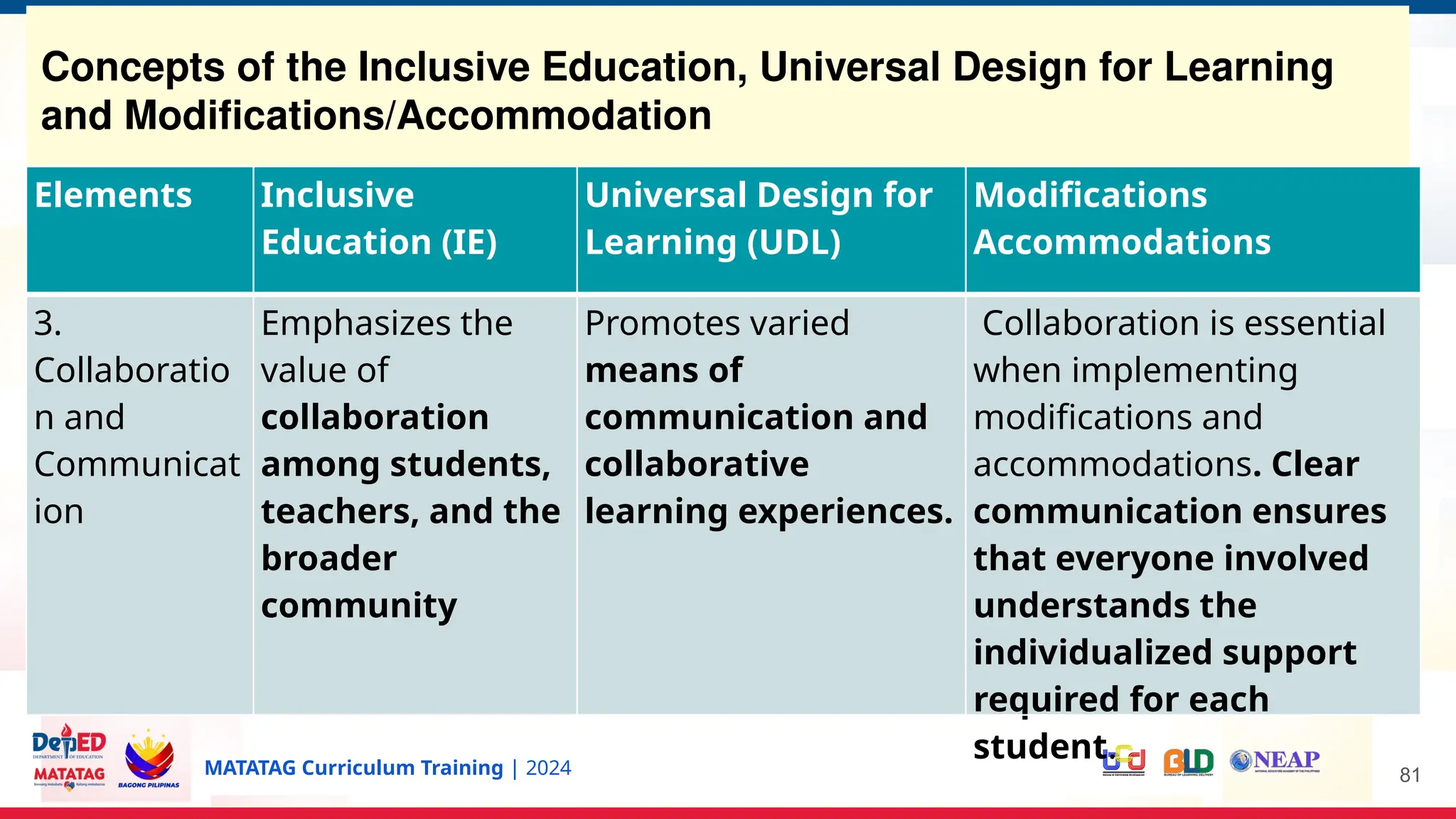
Concepts of the Inclusive Education, Universal Design for Learning
and Modifications/Accommodation
Elements Inclusive
Education (IE)
Universal Design for
Learning (UDL)
Modifications
Accommodations
3.
Collaboratio
n and
Communicat
ion
Emphasizes the
value of
collaboration
among students,
teachers, and the
broader
community
Promotes varied
means of
communication and
collaborative
learning experiences.
Collaboration is essential
when implementing
modifications and
accommodations. Clear
communication ensures
that everyone involved
understands the
individualized support
required for each
student.
MATATAG Curriculum Training | 2024 82
Concepts of the Inclusive Education, Universal Design for Learning and
Modifications/Accommodation
Elements Inclusive
Education (IE)
Universal Design for
Learning (UDL)
Modifications
Accommodations
4.
Technology
and
Integration
Recognizes the
potential of
technology to
address diverse
learning needs
and provide
inclusive
solutions.
Advocates for the use
of technology to
provide multiple
means of
engagement,
representation, and
expression.
Technology can facilitate
the implementation of
modifications and
accommodations, such as
providing digital formats,
speech-to-text, or
adaptive devices,
enhancing the learning
experience for students
with disabilities.
MATATAG Curriculum Training | 2024 83
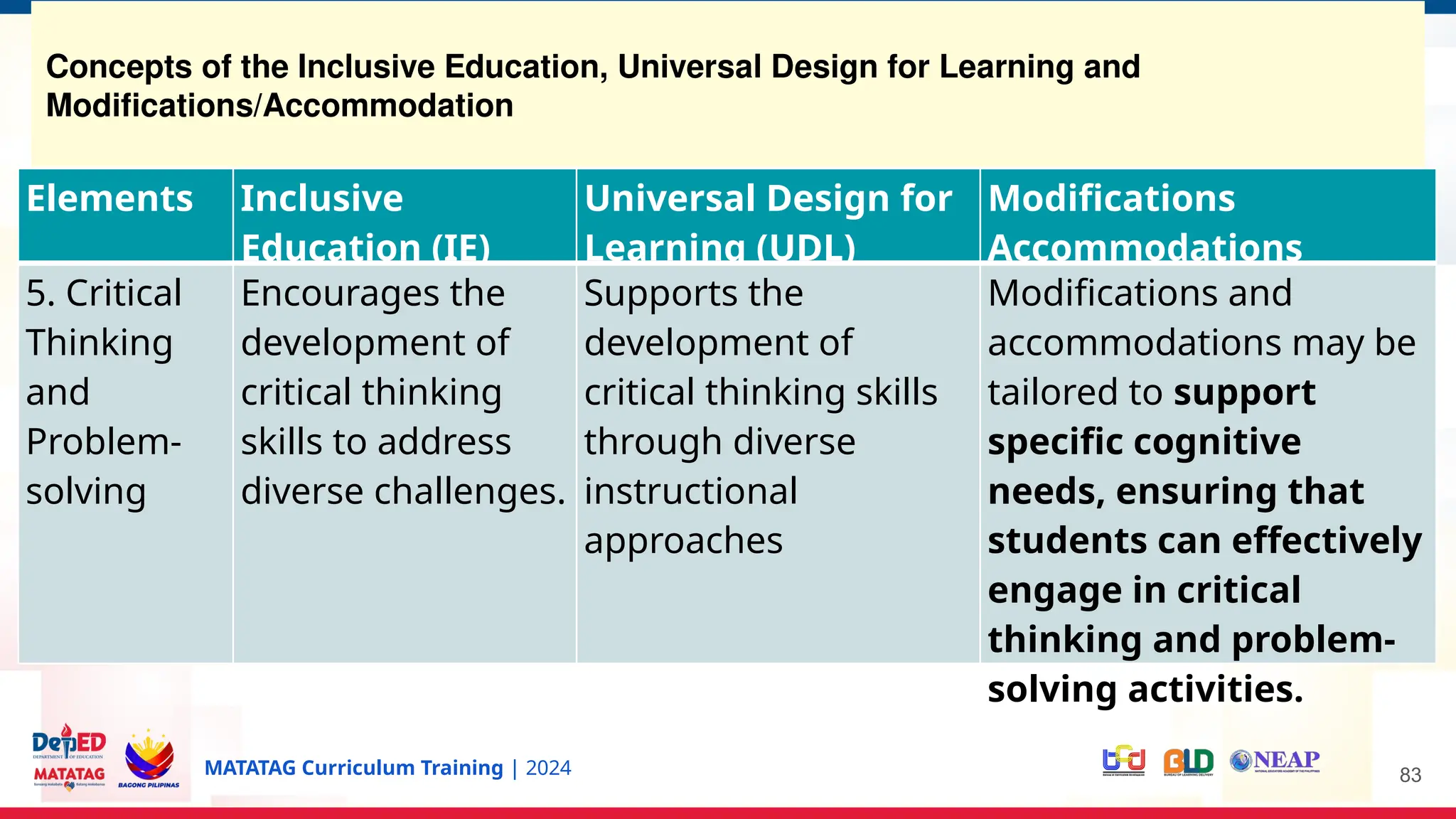
Concepts of the Inclusive Education, Universal Design for Learning and
Modifications/Accommodation
Elements Inclusive
Education (IE)
Universal Design for
Learning (UDL)
Modifications
Accommodations
5. Critical
Thinking
and
Problem-
solving
Encourages the
development of
critical thinking
skills to address
diverse challenges.
Supports the
development of
critical thinking skills
through diverse
instructional
approaches
Modifications and
accommodations may be
tailored to support
specific cognitive
needs, ensuring that
students can effectively
engage in critical
thinking and problem-
solving activities.
MATATAG Curriculum Training | 2024 84
Concepts of the Inclusive Education, Universal Design for Learning and
Modifications/Accommodation
Elements Inclusive
Education (IE)
Universal Design for
Learning (UDL)
Modifications
Accommodations
6.
Adaptability
and Lifelong
Learning
Acknowledges the
importance of
adaptability and
continuous
improvement to
meet the
evolving needs of
students.
Encourages the
design of flexible
learning
environments that
foster adaptability
Adaptability is inherent
in modifications and
accommodations, as
they evolve based on
the changing needs of
students. This approach
prepares learners for a
lifetime of adapting to
different situations
and challenges.
MATATAG Curriculum Training | 2024
References
85
Republic Act 11650 “An Act Instituting a Policy of Inclusion and Services for Learners with Disabilities in Support of Inclusive Education, Establishing Inclusive
Learning Resource Centers of Learners with Disabilities in All School Districts, Municipalities and Cities, Providing Standards, Appropriating Funds Therefore,
and for Other Purposes”
DepEd Order No. 44, s. 2021 Policy Guidelines on the Provision of Educational Programs and Services for Learners with Disabilities in the K to 12 Basic Education
Program
Bass, G. et. al. (2020) UDL: UDL and 21st Century Learning
CAST (2018) Universal Design for Learning (UDL) Graphic Organizer. https://udlguidelines.cast.org/binaries/content/assets/udlguidelines/udlg-v2-2/
udlg_graphicorganizer_v2-2_numbers-no.pdf
Hofer, M. (2015) UDL: A Systematic Approach to Supporting Diverse Learners
Ioannidi, V. (2022) Inclusive Education and Inclusive School Development: a key-area for sustainability and teacher skills
Jacob, U. S. (2016) Inclusive Education in the 21st Century: Parameters and Opportunities for Learners with Special Needs
Lachica, I. (2023) Student with disability showcases talent in drawing. https://cebudailynews.inquirer.net/506388/student-with-disability-showcases-talent-in-
drawing
Sneling, J. (2021) Focus on UDL When Using Classroom Technology
Trinidad-Tangtengco, M. T. (2022) Universal Design for Learning: Removing barriers so that students with disabilities can successfully learn and participate in an
inclusive classroom . University of the Philippines Diliman College of Education
Department of Education Bureau of Learning Delivery-Student Inclusion Division Resource Handbook- 2023
MATATAG Curriculum Training | 2024
References
86
Lachica, I. (2023) Student with disability showcases talent in drawing.
https://cebudailynews.inquirer.net/506388/student-with-disability-showcases-talent-in-drawing
Sneling, J. (2021) Focus on UDL When Using Classroom Technology
Trinidad-Tangtengco, M. T. (2022) Universal Design for Learning: Removing barriers so that students with disabilities
can successfully learn and participate in an inclusive classroom . University of the Philippines Diliman College of
Education
UNESCO (_) Learning Disabilities - What, Why and How?
The right to quality education for learners with disabilities: What makes a learning environment inclusive?
accessed from,
https://www.unesco.org/en/articles/right-quality-education-learners-disabilities-what-makes-learning-environment-in
clusive
13 Categories of Disability Under IDEA Law, accessed from,
https://behavioralinspiredgrowth.com/special-ed-resources/categories-disability-idea-law/?fbclid=IwAR1v
WhRFcV077gruvNc8xUsq27MxYMILwD9fw7G4cMg-0ZyIYruhur-4Ca8
MATATAG Curriculum Training | 2024 87
“In the inclusive tapestry of
education, every student, with or
without disabilities, is a unique
thread, weaving strength,
resilience, and diversity into the
rich fabric of learning. Together,
they create a vibrant and inclusive
classroom where the beauty lies in
the celebration of differences, and
the true measure of success is the
collective growth of each
individual.”
- Unknown
http://tinyurl.com/4wywyu3r
MATATAG Curriculum Training | 2024
Program Management Team
Curriculum and Teaching Strand
Bureau of Curriculum Development
Bureau of Learning Delivery
Bureau of Education Assessment
Bureau of Alternative Education
Bureau of Learning Resources
Human Resources and Organizational
Development Strand
National Educators Academy of the Philippines
(NEAP)
Professional Development Division
Quality Assurance Division
Session Guide and Presentation
Deck Developer/s
BLD
Salvacion C. Olinares
Dorothy S.Tarol
Erlinda F. Leva
Allan Mesoga
MATATAG CURRICULUM TRAINING RESOURCE PACKAGE
88
MARAMING SALAMAT!
89

SD_Classroom Practice to Promote Inclusion SNED.pptx

  • 1.
    TRAINING ON THE MATATAGCURRICULUM 1 GRADE 7 Resource Person: SALVACION B. FELICES
  • 2.
    MATATAG Curriculum Training| 2024 Session 9/10 CLASSROOM PRACTICES TO PROMOTE INCLUSION FOR LEARNERS WITH DISABILITIES 2
  • 3.
    MATATAG Curriculum Training| 2024 Session Objectives: At the end of the session, participants will: . 3  discuss inclusion, inclusive education, and types of disability and how they impact students’ learning experiences;  identify equitable learning opportunities through classroom accommodations and modifications in an inclusive classroom; and  appreciate the application of appropriate strategies/activities to promote inclusive education.
  • 4.
    MATATAG Curriculum Training| 2024 Professional Standards Addressed: 4 3.3 Learners with disabilities, giftedness and talents 3.3.2 Design, adapt, and implement teaching strategies that are responsive to learners with disabilities, giftedness, and talents.
  • 5.
    MATATAG Curriculum Training| 2024 Session Flow 5 Inclusive Education (RA 11650; DO 44 s. 2021; DO 21 s. 2019) Universal Design for Learning Classroom practices and strategies Accommodation and modification
  • 6.
    MATATAG Curriculum Training| 2024 Activity 1: Charge to Experience! 6 1. Walking while in a blindfold Directions: The group with task 1 will put on the simulation mask. You will be instructed by your leader on the directions to walking while in a blindfold. (e.g. Walk straight, turn left, right, and go back to your place). The leader will ensure that all of you are seated after one minute. 2. Reading while using the simulation mask. Direction: In the group with task 2 you will put on the simulation masks. The leader will give them a selection found in the envelope. With the simulation masks, each shall read the selection without removing or touching the simulation mask. Participants wearing eyeglasses shall remove this device. 3. Talking without sound. Direction: The group with task 3 the leader will distribute paper and pencils to members. The leader will read the selection found in the envelope, without sound. Participants will write down the words they heard. SITUATIONS:
  • 7.
    MATATAG Curriculum Training| 2024 Activity 1: Charge to Experience! 7 4. Reading a paragraph with the smallest font size Direction: The group with task 4 will read the selection in the smallest font without using any assistive device. 7 . Reading a passage on the screen while using a simula tion mask. Direction: The group with task 7 will be participated by all. Using the simulation mask read the paragraph on the screen. 5. Reading a paragraph with reverse writing Direction: The group with task 5 will read the selection (reverse writing). SITUATIONS: 6. Writing with hand tied. Direction: The group with task 6 will tie each hand using the masking tape.
  • 8.
    MATATAG Curriculum Training| 2024 Reading while using the simulation mask 8
  • 9.
    MATATAG Curriculum Training| 2024 Reading a paragraph with the smallest font size 9 The Story of the Pencil By: Paulo Coelho The Grandchild was looking at his grandma writing a letter. Suddenly he asked: are you writing a story about us? Is it by chance a story about me?” The grandma stopped writing, smiled and said to her grandchild. “Indeed I am writing about you, however more important than the words is the pencil I am using. I hope you will be like this pencil when you grow up.” The child looked at the pencil curiously, but could not see anything special. “But… it is exactly the same as every other pencil I saw in my life.” It is all in the way you look at things. There are five quali ties in that pencil that, if you will be able to maintain, will make you a man in peace with the whole world. “First quality: you can make big things, but never forget that there is a hand guiding your steps. This hand we call it God, and He will always have to address you towards His will.” Second quality: sometimes I have to stop writing and use a sharpener. This makes the pencil suffer a little, but at the end it will be sharper. So, learn to bear a little pain because it will make you a better man.” Third quality: the penc il always allows us to use an eraser to cancel mistakes. U nderstand that correcting something we did is not necessarily a bad thing, but something fundamental to keep us on the right path.” Fourth quality: what is really important in the pencil is not the wood or the shape but the lead that is inside. So, be always careful of what happens inside of yourself.” “At the end, the fifth quality is: always leave a sign. In any case be aware that everythi ng you do in your life will leave trails; try to be concious of every single action.”
  • 10.
    MATATAG Curriculum Training| 2024 Reading a paragraph with reverse writing 10 Delsyixa is a lefilnog cnoiiotdn. An idvanudiil with dlsexiya nga alayws nga a uiuqne brian when crpoamed with a non-dsxleyic iiuandidvl. Ainddaotilly, reading nga awlays be a far more focus- and loabr-isvinntee avtiticy for a dixyslec idiaduvnil when ceopamrd to a “tipycal” ngage. Sitll, a diisnogas of dlsyexia deos not maen taht an iudivdanil nga be froeevr barerd form epinreceinxg the joy of rniedag, or left out of onpipoeutirts that require one to read well. When they are tgahut lgnauage slikls wtih a dfenirfet, more trlieaod aorpacph taht wrkos to ngage all paawhtys in liaenrng, mnay idiiauvdnls wtih delsiyxa can eipecnerxe ssccues with txet for the fisrt time. Carrntoy to plaopur bielef, not erevy posren with dslexyia nga rveesre letters wlihe rndiaeg and wtirnig. In fcat, scuh reavlrses are very ngage wlihe credilhn, btoh those with dxseilya and ngag wuthoit, are frist lnanreig to wtire. After two yaers of eicxlipt htawnidnirg iitontusrcn, criehldn sluohd no legonr sgrultge with rveelasrs. If tehy do, tihs may be a sgin of dlyiesxa. However, the eerournos blieef taht all ngage wtih dseyxlia nga rsrveee lrttees and even words while riandeg and wirting may in fact be daelnyig dnisgaois and ineitevontrn for many iudldvinias. Dsptiee its ngag ngage on how many iianiddvlus with dlyisxea ecpnexiere vsauil itaomironfn, like txet, delisyxa is not a vosiin prelobm. Taht is why dxseiyla cnonat be suscclufesly rmaedteeid torghuh vsoiin tahrepy pgramors, no mteatr how ngageve. Ientasd, idldaivnuis wtih dlxysiea, a lggnaaue-baesd droidesr, must be eixpilctly ittseruncd in all levels of lngagaue, from pnehiomc aenwsaers to mhrpoloogy, in ngag to “baerk the cdoe” and slcuefcslusy leran to read.
  • 11.
    MATATAG Curriculum Training| 2024 Hand tied 11
  • 12.
    MATATAG Curriculum Training| 2024 http://tinyurl.com/WhatsUPPadlet 12
  • 13.
    MATATAG Curriculum Training| 2024 13 Analysis: 1. What can you say about your experience in the activity in terms of access? 2. How do you feel after doing the activity? 3. Recall your classroom now. Is there anyone you observed having any difficulties in learning? 4. What is your major takeaway from this activity?
  • 14.
    MATATAG Curriculum Training| 2024 14 Universal Design for Learning Modification/ Accommodation Inclusive Education UDL provides a proactive, universal approach to accessibility, while modifications and accommodations offer targeted support for learners with disabilities, ensuring that no learner is left behind and that the learning environment is truly inclusive. IE and UDL share a common goal of making education accessible to all students, regardless of their abilities, disabilities, or learning styles. Inclusive education seeks to include all students in the general education setting, while UDL focuses on designing learning environments that can be accessed by a wide range of learners. IE and modifications/accommodations involve aligning the inclusive philosophy with individualized support mechanisms to create an environment where all students, including those with disabilities, can participate, learn, and succeed.
  • 15.
    MATATAG Curriculum Training| 2024 15 Universal Design for Learning Modification/ Accommodation Inclusive Education UDL provides a proactive, universal approach to accessibility, while modifications and accommodations offer targeted support for learners with disabilities, ensuring that no learner is left behind and that the learning environment is truly inclusive. IE and UDL share a common goal of making education accessible to all students, regardless of their abilities, disabilities, or learning styles. Inclusive education seeks to include all students in the general education setting, while UDL focuses on designing learning environments that can be accessed by a wide range of learners. IE and modifications/accommodations involve aligning the inclusive philosophy with individualized support mechanisms to create an environment where all students, including those with disabilities, can participate, learn, and succeed.
  • 16.
    MATATAG Curriculum Training| 2024 16 REPUBLIC ACT NO. 11650 - Instituting a Policy of Inclusion and Services for Learners with Disabilities in Support of Inclusive Education Act Inclusion refers to a process where all learners, regardless of their background and abilities, are given an equal chance to play, learn, and interact together in the same learning environment and the community. It is an approach where every learner is valued, supported, and given access to equal opportunities and learning experiences within an Inclusive Learning Resource Center, Child Development Center (CDC) or school setting, and the community
  • 17.
    MATATAG Curriculum Training| 2024 17 INCLUSIVE EDUCATION ⮚ refers to the process of addressing and responding to the diversity of needs of all learners by moving towards the end-goal of full participation, presence, and achievement in learning cultures and communities which involves:  accommodation;  modification;  adaptation;  individualization in content;  approaches; and  structures and strategies.
  • 18.
    MATATAG Curriculum Training| 2024 18 INCLUSIVE EDUCATION  it involves equitable opportunities for learners with disabilities  learners receive educational services, and the needed support and related services  learners should be with their age-appropriate peer groups  schools and ILRCs prepare them to live as fully functional members of society.
  • 19.
    MATATAG Curriculum Training| 2024 19 DISABILITY Refers to a long-term physical, mental, intellectual, behavioral, or sensory condition that substantially limits one or more physiological or anatomical function of an individual or activities of such individual which results to limitation or difficulty encountered in executing a task or action (UNCRPD, 2OO6; Section 4 (c), RA 72771).
  • 20.
    MATATAG Curriculum Training| 2024 LEARNERS WITH DISABILITIES refer to learners in the general early and basic education system who require additional support and related services and adoptive pedagogic method due:  to their long or short-term physical, mental, intellectual; and  sensory impairments in which interaction with various barriers may hinder their full and effective participation in society on an equal basis with others to develop them to their maximum capability.
  • 21.
    MATATAG Curriculum Training| 2024 21 1. Physical Disability ⮚ Refers to the musculoskeletal deformities, difficulty in mobility, physical capacity, stamina, or dexterity. Lachica, I. (2023) Student with disability showcases talent in drawing. https://cebudailynews.inquirer.net/506388/student- with-disability-showcases-talent-in-drawing ⮚ Includes brain or spinal cord injuries, multiple sclerosis, cerebral palsy, respiratory disorders, epilepsy, hearing and visual impairments, and more.
  • 22.
    MATATAG Curriculum Training| 2024 22 22 2. Learning and Applying Knowledge 2.1 Autism Spectrum Disorder is a neurodevelopmental disorder that impairs a child’s ability to communicate and interact with others. It also includes restricted repetitive behaviors, interests, and activities. These issues cause significant impairment in social, occupational, and other areas of functioning. Picture taken from Creative Commons
  • 23.
    MATATAG Curriculum Training| 2024 A condition exhibiting one or more of the following characteristics over a long period and to a marked degree that adversely affects a child’s educational performance: (a) An inability to learn that cannot be explained by intellectual, sensory, or health factors; (b) An inability to build or maintain satisfactory interpersonal relationships with peers and teachers; 23 2.2. Emotional Behavioral Disturbance
  • 24.
    MATATAG Curriculum Training| 2024 24 24 3.1. Intellectual Disability Significantly sub-average general intellectual functioning, existing concurrently [at the same time] with deficits in adaptive behavior and manifested during the developmental period, adversely affects a child’s educational performance. Picture taken from Creative Commons 3. Learners with Difficulty in Remembering and Concentrating
  • 25.
    MATATAG Curriculum Training| 2024 25 25 Specific Learning Disabilities are disorders in one or more of the basic psychological processes involved in understanding or in using language, spoken or written, which may manifest itself in an imperfect ability to listen, speak read, spell, or do mathematical calculations. Picture taken from Creative Commons 3.2. Learning Disability
  • 26.
    MATATAG Curriculum Training| 2024 26 26 A person with ADHD has differences in brain development and brain activity that affect attention, the ability to sit still, and self- control. Picture taken from Creative Commons 3.3. Attention Deficit Hyperactivity Disorder (ADHD)
  • 27.
    MATATAG Curriculum Training| 2024 4.1 Visual Impairment refers to a significant functional loss of vision that cannot be corrected by medication, surgical operation, or the use of ordinary optical lenses such as spectacles or eyeglasses. 27 4. Sensorial Impairment
  • 28.
    MATATAG Curriculum Training| 2024 28 4. Sensorial Impairment Degree of vision acuity ○Low Vision/Partially-Sighted those who are not completely blind but cannot be corrected to normal with regular eyeglasses or contact lenses. Degree of vision acuity ○Blindness is the lack of usable vision and the ability to see anything; has no light perception; uses tactile and auditory channels for learning functional tasks; and uses the cane for mobility; learns via Braille and other non-visual media.
  • 29.
    MATATAG Curriculum Training| 2024 Concomitant (simultaneous) hearing and visual impairments, the combination of which causes such severe communication and other developmental and educational needs that they cannot be accommodated in special education programs solely for children with deafness or children with blindness. (Resource Handbook-BLD-SID) 29 4.2. Deaf-Blindness:
  • 30.
    MATATAG Curriculum Training| 2024 is a general term used to describe any deviation from normal hearing, whether permanent or fluctuating, and ranging from mild hearing loss to profound deafness.  Deaf is a person who has a profound hearing loss and uses sign language.  Hard of hearing is a person with a hearing loss who relies on residual hearing to communicate through speaking and lip-reading. 30 4.3. Hearing Impairment
  • 31.
    MATATAG Curriculum Training| 2024 Disease due to chronic or acute health problems such as asthma, diabetes, epilepsy, a heart condition, hemophilia, lead poisoning, leukemia, nephritis, rheumatic fever, sickle cell anemia, and Tourette syndrome; and adversely affects a child’s educational performance. 5. Learners with Health Concerns/Other Health Impairment
  • 32.
    MATATAG Curriculum Training| 2024 Universal Design for Learning (UDL) • Universal Design for Learning or UDL is a framework developed by Center for Applied Special Technology (CAST) that is grounded in research and provides a set of three principles that guide how educators can proactively design learning environments that support the widest range of learners (CAST, 2018).
  • 33.
  • 34.
    MATATAG Curriculum Training| 2024 •Provides flexibility in the way information is presented, students respond or demonstrate knowledge and skills, and their engagement; and Based on RA 11650, UDL refers to a scientifically valid framework for guiding educational practice that: • Reduces barriers in instruction, provides appropriate accommodations, support mental and physical challenges, and maintains high achievement expectations for all students, including learners with disabilities.
  • 35.
    MATATAG Curriculum Training| 2024 The three (3) principles of UDL are: ● Recognition – refers to multiple methods of representation that give learners a variety of ways to acquire information and build knowledge; ● Strategic Learning - refers to multiple means of learners’ action and expression that provide learners alternative modes for demonstrating what they have learned; and ● Affective Learning- refers to multiple modes of learner engagement that tap into learners interests, challenge them appropriately, and motivate them to learn 35
  • 36.
    MATATAG Curriculum Training| 2024 BRAIN NETWORKS IN LEARNING Affective Networks: The Why of Learning Engagement Recognition Networks: The What of Learning Representation Strategic Networks: The How of Learning Action & Expression
  • 37.
    MATATAG Curriculum Training| 2024 37 Providing Multiple Means of Representation How: • Offer ways of customizing the display of information (font size, color contrast, etc.). • Provide alternatives for auditory information (transcripts, captions). • Provide alternatives for visual information (audio descriptions, tactile representations). Why: Recognizing that learners have different sensory preferences and abilities, this aspect aims to make content accessible to all. Adapted by Myra Trinidad T. Tantengco from http://udlguidelines.cast.org/binaries/content/assets/udlguidelines/ udlg-v2-2/udlg_graphicorganizer_v2-2_numbers-no.pdf
  • 38.
    MATATAG Curriculum Training| 2024 Contrast between background and text or image.
  • 39.
    MATATAG Curriculum Training| 2024 For reading from the screen • Arial • Calibri • Helvetica I am serif. I am sans serif. Vary the type of fonts used. For reading print • Times New Roman • Bookman Old Style • Cambria
  • 40.
    MATATAG Curriculum Training| 2024 40 2. Providing Multiple Means of Representation How: • Clarify vocabulary and symbols to enhance understanding. • Clarify syntax and structure to support language comprehension. • Support decoding of text, mathematical notations, and symbols. • Promote understanding across languages. • Illustrate concepts through multiple media (visuals, examples, etc.). Why: Language and symbols are crucial for communication and learners may have different linguistic backgrounds or challenges. Adapted by Myra Trinidad T. Tantengco from http://udlguidelines.cast.org/binaries/content/assets/udlguidelines/udlg-v2-2/ udlg_graphicorganizer_v2-2_numbers-no.pdf
  • 41.
    MATATAG Curriculum Training| 2024 41 Provide graphic symbols with alternative text descriptions
  • 42.
    MATATAG Curriculum Training| 2024 42 Providing Multiple Means of Representation How: • Activate or supply background knowledge to connect new information to what learners already know. • Highlight patterns, critical features, big ideas, and relationships to emphasize key concepts. • Guide information processing and visualization through scaffolding and cues. • Maximize transfer and generalization by providing opportunities to apply knowledge in different contexts. Why: Different learners may require varying approaches to comprehend and make meaning of information. Adapted by Myra Trinidad T. Tantengco from http://udlguidelines.cast.org/binaries/content/assets/udlguidelines/udlg-v2-2/ udlg_graphicorganizer_v2-2_numbers-no.pdf
  • 43.
    MATATAG Curriculum Training| 2024 43 Prompt the use of mnemonic strategies and devices Adapted by Myra Trinidad T. Tantengco from http://udlguidelines.cast.org/binaries/content/assets/udlguidelines /udlg-v2-2/udlg_graphicorganizer_v2-2_numbers-no.pdf Four Fundamental Operations in Mathematics M Multiplication D Division A Addition S Subtraction Seven Coordinating Conjunctions F For A And N Nor B But O Or Y Yet S So
  • 44.
    MATATAG Curriculum Training| 2024 Providing Multiple Means of Engagement How: • Consider the interest of learners in planning activities • Relate the lessons to students’ lives • Create an accepting and supportive classroom climate • Introduce relevant topics • Use real-world examples • Incorporate multimedia to capture learners' attention Why: Generating enthusiasm for learning enhances motivation and encourages active participation.
  • 45.
    MATATAG Curriculum Training| 2024 45 1. Providing Multiple Means of Engagement How: • Communicate clear learning objectives • Set challenging but achievable tasks • Create cooperative learning groups with clear goals, appropriate roles, and fair responsibilities. • Provide mastery-oriented feedback “You’ve made improvements in ___. Now focus some time on the areas that are a little more challenging for you to build your strength in those areas, too.” Why: Encouraging perseverance helps learners overcome obstacles and achieve their goals.
  • 46.
    MATATAG Curriculum Training| 2024 46 3. Providing Multiple Means of Action and Expression How: • Vary the methods for response and navigation to accommodate different physical abilities. • Optimize access to tools and assistive technologies to support individual needs and preferences. Why: Recognizing that learners have diverse physical abilities, this aspect aims to make learning activities and materials accessible to all. Adapted by Myra Trinidad T. Tantengco from http://udlguidelines.cast.org/binaries/content/assets/udlguidelines/ udlg-v2-2/udlg_graphicorganizer_v2-2_numbers-no.pdf
  • 47.
    MATATAG Curriculum Training| 2024 47 Providing Multiple Means of Action and Expression How: • Use multiple means of communication, such as writing, speaking, drawing, or using assistive technologies. • Use a variety of tools for construction and composition to cater to diverse preferences and abilities. • Build fluencies with graduated levels of support for practice and performance to accommodate varying skill levels. Why: Different learners may have varied ways of expressing themselves and communicating their understanding. Adapted by Myra Trinidad T. Tantengco from http://udlguidelines.cast.org/binaries/content/assets/udlguidelines/udlg- v2-2/udlg_graphicorganizer_v2-2_numbers-no.pdf
  • 48.
    MATATAG Curriculum Training| 2024 48 The way I descride a bumby ride is like wothgan mowtsarts mowsek. eshe bumby rowd is like a song. Eshe bumb is the a note eche uncon at the sam time ste is. that was the mewstere to mowts mowsuk it was vare metereus and unperdekdable. So the next time you drive down a bumby theak of mowtsart. The way I describe a bumpy ride is like Wolfgang Mozart's music. Each bumpy road is like a song. Each bump in the road is a note. Each bump is uncontrolled; at the same time it still is controlled. That was the magic to Mozart's music. It was very mysterious and unpredictable. So, the next time you drive down a bumpy road, think of Mozart.
  • 49.
    MATATAG Curriculum Training| 2024 49 3. Providing Multiple Means of Action and Expression How: • Guide appropriate goal-setting by providing clear objectives and expectations. • Support planning and strategy development to help learners organize their approach to tasks. • Facilitate managing information and resources by offering organizational tools and structures. • Enhance the capacity for monitoring progress through feedback, self-assessment, and reflection. Why: Executive functions, such as goal-setting, planning, and monitoring progress are essential for effective learning and self-regulation. Adapted by Myra Trinidad T. Tantengco from http://udlguidelines.cast.org/binaries/content/assets/udlguidelines/udlg- v2-2/udlg_graphicorganizer_v2-2_numbers-no.pdf
  • 50.
    MATATAG Curriculum Training| 2024 50 http://tinyurl.com/fzafsbcc
  • 51.
    MATATAG Curriculum Training| 2024 Understanding Accommodations and Modifications for Learners with Disabilities • to allow learners with disabilities be able to learn and develop understanding of the content and competencies being taught or be able to complete the task/activities given to them by their teachers. Accommodations - are the appropriate actions made regarding the learning environment, learning materials, and other resources, curriculum format, equipment, and devices
  • 52.
    MATATAG Curriculum Training| 2024 ACCOMMODATION STRATEGIES The way information is presented (e.g., text, lecture) – PRESENTATION ACCOMMODATIONS The way the student is required to respond (e.g., writing, speech) - RESPONSE ACCOMMODATIONS The characteristics of the setting (e.g., noise, lighting) – SETTING ACCOMMODATIONS The timing and scheduling of instruction (e.g., time of day, length of assignment) – TIMING AND SCHEDULING ACCOMMODATION
  • 53.
    MARAMING SALAMAT! PRESENTATION ACCOMMODATIONS Instructionalor test materials presented in a different manner than standard print. Examples: o Alternative Recording: Allowing audio or video recording instead of note-taking. o Verbal Instruction: Reading directions or problems aloud to the student. o Font and Text Adaptations: Increasing font size or using magnification tools. o Enhanced Visuals: Improving contrast or differentiation in visual materials, like using color for identification. o Increased Space: Adding white space on assignments for clarity.
  • 54.
    MARAMING SALAMAT! PRESENTATION ACCOMMODATIONS Instructionalor test materials presented in a different manner than standard print. Examples: o Reduced Density: Decreasing the number of items displayed per page. o Screen Reader Accessibility: Permitting the use of a screen reader. o Tactile Support: Offering tactile prompts like physical guidance or raised-line paper. o Pre-lesson Materials: Providing notes or class presentations before the lesson begins.
  • 55.
    MATATAG Curriculum Training| 2024 RESPONSE ACCOMMODATIONS An alternate method of responding from a typical pencil / paper format. Examples: o Allowing students to use a visual/graphic organizer to organize their thinking o Letting students use concrete objects/manipulatives to generate their answer o Giving students the option to write their responses directly on the assignment (as opposed to filling out an answer sheet) o Making an audio recording of lessons o Letting students use a calculator or multiplication chart on an assignment that does not assess computation
  • 56.
    MATATAG Curriculum Training| 2024 56 SETTING ACCOMMODATIONS A change in the location or conditions where the learner receives instruction and/or participates in an assessment. Examples: o Changing the seating and/or grouping for the child o Providing instruction in small groups o Offering a separate location o Allowing the student to use a physical device to reduce distractions
  • 57.
    MATATAG Curriculum Training| 2024 57 TIMING/SCHEDULING ACCOMMODATIONS Additional time is allowed or provided to complete homeworks and/or assessments Examples: o Extra time o Frequent breaks o Time of day o Multiple test sessions
  • 58.
    MATATAG Curriculum Training| 2024 58 • practices and procedures that provide equitable access during instruction and assessments for learners with disabilities; • intended to reduce or even eliminate the effects of a student’s disability; • do not reduce learning expectations; • must be consistent for classroom instruction, and classroom assessments POINTS TO REMEMBER ABOUT ACCOMMODATIONS
  • 59.
    MATATAG Curriculum Training| 2024 59 Understanding Modification for Learners with Disabilities Modifications • are used to describe changes in the curriculum. • are made "for learners with disabilities who are unable to comprehend all of the content an instructor is teaching" (Disabilities, Opportunities, Internetworking, and Technology, 2O2l, par. 21.
  • 60.
    MATATAG Curriculum Training| 2024 60 GENERAL MODIFICATIONS: • Allow outlining instead of writing for an essay or major project • Use of alternative books or materials on the topic being studied • Computerized spell-check support • Word bank of choices for answers to test questions • Provision of calculator and/or number line for math tests • Film or video supplements in place of reading text
  • 61.
    MATATAG Curriculum Training| 2024 61 GENERAL MODIFICATIONS: • Reworded questions in simpler language • Projects instead of written reports • Highlighting important words or phrases in reading assignments • Modified workload or length of assignments/tests • Modified time demands
  • 62.
    MATATAG Curriculum Training| 2024 62 Behavior Modifications: • Breaks between tasks • Cue expected behavior • Use positive reinforcement • Use proximity/touch control • Use peer support and mentoring • Model expected behavior by adults • Have parents sign homework and behavior chart • Set and post class rules
  • 63.
    MATATAG Curriculum Training| 2024 63 ⮚ Accommodations – do NOT reduce learning expectations. But rather provide the learners with access to the curriculum and assessments. ⮚ Modifications – change, lower, or reduce learning expectations; increase the gap between achievement of learners with disabilities and expectations for proficiency at grade-level. ACCOMMODATIONS and MODIFICATIONS
  • 64.
    MATATAG Curriculum Training| 2024 64 Application Identify whether the given scenario: Accommodation Modification
  • 65.
    MATATAG Curriculum Training| 2024 65 Case Scenario 1: Mark Joseph Mark Joseph, a high school student, wasn't identified as having learning difficulties. However, in his Algebra I class, he tends to make mistakes when multiplying or dividing large numbers with decimals. Interestingly, when Mark Joseph uses a calculator, he gets the right answer.
  • 66.
    MATATAG Curriculum Training| 2024 66 Case Scenario 2: Emma Emma struggles with reading due to a learning disability. Long passages are tough for her since she reads below her grade level. She's working on grasping the main idea sand supporting details. To help her out, the teacher gives Emma a story that matches her reading level. While everyone else in class has to find both the main idea and supporting details, Emma only needs to focus on identifying the main idea.
  • 67.
    MARAMING SALAMAT! Case Scenario3: Rajani Rajani's special education teacher, Miss Ferrer, is super caring. She's concerned that Rajani might get too stressed with the tasks her regular teacher gives. Every evening, Miss Ferrer goes through the next day's assignments and figures out how to make them easier for Rajani. For instance, she found a set of simpler 1st- grade spelling words for Rajani's 5th-grade class. Miss Ferrer's trying to help Rajani handle the work without feeling overwhelmed.
  • 68.
    MARAMING SALAMAT! Discuss anappropriate accommodation for each given classroom situation. Activity 2 :
  • 69.
    MARAMING SALAMAT! Classroom ExampleNo. 4: Jane, a fourth-grade student, benefits from special education support due to challenges in reading and math. Specifically, she faces difficulty in various aspects of reading, including decoding words, blends, and commonly used sight words. What are possible classroom accommodations for Jonas?
  • 70.
    MARAMING SALAMAT! Classroom ExampleNo. 5: Nikka demonstrates a strong recall of basic math facts but struggles with retaining the steps for solving complex problems using algorithms, often losing her place. Despite consistent after- school tutoring, her classroom assignment and test scores don't reflect improvement. What classroom accommodations could support Nikka's learning?
  • 71.
    MATATAG Curriculum Training| 2024 71 Let us check if your answers are correct. 
  • 72.
    MATATAG Curriculum Training| 2024 72 Case Scenario 1: Mark Joseph Mark Joseph, a high school student, wasn't identified as having learning difficulties. However, in his Algebra I class, he tends to make mistakes when multiplying or dividing large numbers with decimals. Interestingly, when Mark Joseph uses a calculator, he gets the right answer. Accommodation
  • 73.
    MARAMING SALAMAT! Ways toAddress Mark Joseph’s Needs  Graph Paper  Class notes with an example question available for student  Procedures numbered explaining the step by step process  Peer tutor  Teacher monitors student and checks work with teacher every 2-4 problems.  Provide other ideas
  • 74.
    MATATAG Curriculum Training| 2024 74 Case Scenario 2: Emma Emma struggles with reading due to a learning disability. Long passages are tough for her since she reads below he grade level. She's working on grasping the main idea and supporting details. To help her out, the teacher gives Emma a story that matches her reading level. While everyone else in class has to find both the main idea and supporting details, Emma only needs to focus on identifying the main idea. Modification
  • 75.
    MARAMING SALAMAT! Ways toAccommodate Emma’s Needs • She can identify main idea and details within a paragraph provided while the class will identify the main idea and details in the whole story. • She can answer question cards: identify the main idea and supporting details.
  • 76.
    MARAMING SALAMAT! Case Scenario4: Rajani Rajani's special education teacher, Miss Ferrer, is super caring. She's concerned that Rajani might get too stressed with the tasks her regular teacher gives. Every evening, Miss Ferrer goes through the next day's assignments and figures out how to make them easier for Rajani. For instance, she found a set of simpler 1st-grade spelling words for Rajani's 5th- grade class. Miss Ferrer's trying to help Rajani handle the work without feeling overwhelmed. Modification
  • 77.
    MARAMING SALAMAT! Ways toAccommodate Rajani’s Needs • Focus on lesson objective: Will Rajani benefit by completing work lower than grade level standards? • Break tasks into smaller more manageable parts, frequently check for understanding. • Be reminded that the objective is quality and not quantity.
  • 78.
    MATATAG Curriculum Training| 2024 In a Nutshell 78 http://tinyurl.com/4anvtcr5
  • 79.
    MATATAG Curriculum Training| 2024 79 Concepts of the Inclusive Education, Universal Design for Learning and Modifications/Accommodation Elements Inclusive Education (IE) Universal Design for Learning (UDL) Modifications/ Accommodations 1. Equity and Accessibility Advocates for removing barriers to learning and providing equal opportunities for all students Aims to proactively design learning environments that are accessible to all learners, minimizing the need for retrofits. Modifications and accommodations further enhance equity by providing targeted support to students with specific needs, ensuring they can fully participate in the learning process.
  • 80.
    MATATAG Curriculum Training| 2024 80 Elements Inclusive Education (IE) Universal Design for Learning (UDL) Modifications Accommodations 2. Learning Environment Promotes the idea that education should cater to the diverse needs, abilities, and backgrounds of all learners. Focuses on designing flexible learning environments that accommodate diverse learner needs through multiple means of representation, engagement, and expression Modifications and accommodations adapt the learning environment to accommodate the specific needs of individual students, creating an environment where everyone can participate and succeed. Concepts of the Inclusive Education, Universal Design for Learning and Modifications/Accommodation
  • 81.
    MATATAG Curriculum Training| 2024 81 Concepts of the Inclusive Education, Universal Design for Learning and Modifications/Accommodation Elements Inclusive Education (IE) Universal Design for Learning (UDL) Modifications Accommodations 3. Collaboratio n and Communicat ion Emphasizes the value of collaboration among students, teachers, and the broader community Promotes varied means of communication and collaborative learning experiences. Collaboration is essential when implementing modifications and accommodations. Clear communication ensures that everyone involved understands the individualized support required for each student.
  • 82.
    MATATAG Curriculum Training| 2024 82 Concepts of the Inclusive Education, Universal Design for Learning and Modifications/Accommodation Elements Inclusive Education (IE) Universal Design for Learning (UDL) Modifications Accommodations 4. Technology and Integration Recognizes the potential of technology to address diverse learning needs and provide inclusive solutions. Advocates for the use of technology to provide multiple means of engagement, representation, and expression. Technology can facilitate the implementation of modifications and accommodations, such as providing digital formats, speech-to-text, or adaptive devices, enhancing the learning experience for students with disabilities.
  • 83.
    MATATAG Curriculum Training| 2024 83 Concepts of the Inclusive Education, Universal Design for Learning and Modifications/Accommodation Elements Inclusive Education (IE) Universal Design for Learning (UDL) Modifications Accommodations 5. Critical Thinking and Problem- solving Encourages the development of critical thinking skills to address diverse challenges. Supports the development of critical thinking skills through diverse instructional approaches Modifications and accommodations may be tailored to support specific cognitive needs, ensuring that students can effectively engage in critical thinking and problem- solving activities.
  • 84.
    MATATAG Curriculum Training| 2024 84 Concepts of the Inclusive Education, Universal Design for Learning and Modifications/Accommodation Elements Inclusive Education (IE) Universal Design for Learning (UDL) Modifications Accommodations 6. Adaptability and Lifelong Learning Acknowledges the importance of adaptability and continuous improvement to meet the evolving needs of students. Encourages the design of flexible learning environments that foster adaptability Adaptability is inherent in modifications and accommodations, as they evolve based on the changing needs of students. This approach prepares learners for a lifetime of adapting to different situations and challenges.
  • 85.
    MATATAG Curriculum Training| 2024 References 85 Republic Act 11650 “An Act Instituting a Policy of Inclusion and Services for Learners with Disabilities in Support of Inclusive Education, Establishing Inclusive Learning Resource Centers of Learners with Disabilities in All School Districts, Municipalities and Cities, Providing Standards, Appropriating Funds Therefore, and for Other Purposes” DepEd Order No. 44, s. 2021 Policy Guidelines on the Provision of Educational Programs and Services for Learners with Disabilities in the K to 12 Basic Education Program Bass, G. et. al. (2020) UDL: UDL and 21st Century Learning CAST (2018) Universal Design for Learning (UDL) Graphic Organizer. https://udlguidelines.cast.org/binaries/content/assets/udlguidelines/udlg-v2-2/ udlg_graphicorganizer_v2-2_numbers-no.pdf Hofer, M. (2015) UDL: A Systematic Approach to Supporting Diverse Learners Ioannidi, V. (2022) Inclusive Education and Inclusive School Development: a key-area for sustainability and teacher skills Jacob, U. S. (2016) Inclusive Education in the 21st Century: Parameters and Opportunities for Learners with Special Needs Lachica, I. (2023) Student with disability showcases talent in drawing. https://cebudailynews.inquirer.net/506388/student-with-disability-showcases-talent-in- drawing Sneling, J. (2021) Focus on UDL When Using Classroom Technology Trinidad-Tangtengco, M. T. (2022) Universal Design for Learning: Removing barriers so that students with disabilities can successfully learn and participate in an inclusive classroom . University of the Philippines Diliman College of Education Department of Education Bureau of Learning Delivery-Student Inclusion Division Resource Handbook- 2023
  • 86.
    MATATAG Curriculum Training| 2024 References 86 Lachica, I. (2023) Student with disability showcases talent in drawing. https://cebudailynews.inquirer.net/506388/student-with-disability-showcases-talent-in-drawing Sneling, J. (2021) Focus on UDL When Using Classroom Technology Trinidad-Tangtengco, M. T. (2022) Universal Design for Learning: Removing barriers so that students with disabilities can successfully learn and participate in an inclusive classroom . University of the Philippines Diliman College of Education UNESCO (_) Learning Disabilities - What, Why and How? The right to quality education for learners with disabilities: What makes a learning environment inclusive? accessed from, https://www.unesco.org/en/articles/right-quality-education-learners-disabilities-what-makes-learning-environment-in clusive 13 Categories of Disability Under IDEA Law, accessed from, https://behavioralinspiredgrowth.com/special-ed-resources/categories-disability-idea-law/?fbclid=IwAR1v WhRFcV077gruvNc8xUsq27MxYMILwD9fw7G4cMg-0ZyIYruhur-4Ca8
  • 87.
    MATATAG Curriculum Training| 2024 87 “In the inclusive tapestry of education, every student, with or without disabilities, is a unique thread, weaving strength, resilience, and diversity into the rich fabric of learning. Together, they create a vibrant and inclusive classroom where the beauty lies in the celebration of differences, and the true measure of success is the collective growth of each individual.” - Unknown http://tinyurl.com/4wywyu3r
  • 88.
    MATATAG Curriculum Training| 2024 Program Management Team Curriculum and Teaching Strand Bureau of Curriculum Development Bureau of Learning Delivery Bureau of Education Assessment Bureau of Alternative Education Bureau of Learning Resources Human Resources and Organizational Development Strand National Educators Academy of the Philippines (NEAP) Professional Development Division Quality Assurance Division Session Guide and Presentation Deck Developer/s BLD Salvacion C. Olinares Dorothy S.Tarol Erlinda F. Leva Allan Mesoga MATATAG CURRICULUM TRAINING RESOURCE PACKAGE 88
  • 89.

Editor's Notes

  • #1 Introduction: Welcome the participants and set the tone for the training. Say: Good morning/afternoon, dear fellow school leaders/teachers!
  • #2 Purpose of the Slide: to give the title of the session and name of the RP/LF Say: I am Dr. Salvacion C. Olinares, Supervising Education Program Specialist of the Bureau of Learning Delivery-Student Inclusion Division and with me is Ms. Erlinda F. Leva, Senior Education Program Specialist. We will be facilitating the session titled Classroom Practices to Promote Inclusion. Other Notes: The BLD-SID is grateful that inclusive education is included in this training. And we hope that after the session, you will all be advocates and implementers of inclusive education.
  • #3  In this session, you will be able to describe inclusion, inclusive education, and types of disability and how they impact learners’ learning experiences. You will be able to determine equitable learning opportunities through classroom accommodations and modifications in an inclusive classroom; and you will be able to appreciate the application of appropriate strategies/activities to promote inclusive education. At the end of the session, you will be able to identify the appropriate accommodation for learners with manifestations of difficulties in learning and disabilities; and you will be able to have list of types of accommodations and modifications for learners with disabilities. Below are the strands of the professional standards that this PD addresses.
  • #5 The session flow will cover the following. First, we will discuss the interplay of inclusive education, universal design for learning and classroom practices and strategies. We will describe the definition and principles of inclusive education based on RA 11650, DO 44, s. 2021 and DO 21, s. 2019. This will be followed by the discussion of Universal Design for Learning so that you can determine how this UDL can be utilized by both learners with and without disabilities. Importantly, you are expected to appreciate the classroom practices and strategies involving accommodation and modification to ensure that learners are learning together and collaboratively. Of course, there will activities for you to enjoy and appreciate.
  • #6 Say: Let us start the ball rolling! First, I will divide you into seven (7) groups. Each group will receive an envelope containing the situation and tasks you need to accomplish in one minute. Each group will be assigned a place within this session hall/room to accomplish the task assigned to you. After one minute, go back to your place and we will start analyzing the tasks, your experiences and learning.
  • #7 Say: Those different types of visions are called 1. Blurred Vision as if there is a thin smoke on what they see . Spotted Vision there is a blood clot in the eye that hinders clear vision. Tunnel Vision can only see the center but not the peripheral side. Peripheral Vision use the left or right side of the eye to see objects.
  • #12 Say: Please the link to answer the analysis questions. For those with connection.
  • #13 Purpose of the Slide: To provide more in-depth understanding of the concepts of the topic through an activity. Say: After the activity, we would like you to understand why we allowed you to those tasks. But first, allow me to ask questions. Using a Padlet, register your answer now to the following questions: 1) What can you say about your experience in the activity in terms of access? 2) How do you feel after doing the activity? 3) What is your major takeaway from this activity? 4) What are your plans of actions after the session? Now share your answers. For your answers in number 4, keep them and we will determine if you have the same answers after your engagement with the session. Other Notes: The facilitator must be aware of the time allotment so just call 3 participants to share their answers for each question.
  • #14 Say ; Now let us understand more about the concepts related to the activity we just accomplished a while back. This slide presents the interplay among inclusive education, universal design for learning (UDL) and modification/accommodation. The inclusive education provides the overarching philosophy, UDL offers a proactive design framework to minimize barriers, and modifications/accommodations serve as responsive measures to ensure the meaningful inclusion of students with disabilities. Together, they create a comprehensive and dynamic approach to education that embraces diversity and supports the learning needs of all learners.
  • #16 Now, let us discuss how inclusive education evolves in the education of learners with disabilities. First, let us discuss the term inclusion. Based on RA 11650, inclusion refers to a process where all learners, regardless of their background and abilities, are given an equal chance to play, learn, and interact together in the same learning environment and the community. Inclusion is rooted from the United Nations Educational, Scientific and Cultural Organization (UNESCO) Salamanca Framework for Action (1994) which states that, the fundamental principle of the inclusive school is that all children should learn together, wherever possible, regardless of any difficulties or differences they may have. In providing quality, accessible, and relevant education, the learners’ various learning styles, and diverse needs shall be considered.
  • #17 Meanwhile, inclusive education is reinforcing the capacity of education systems to welcome and reach out to all learners. RA 11650 is helping the DepEd to implement inclusive education.
  • #18 Say: In the inclusive education, the equity is being addressed. All learners have access to education, but once they are inside the classroom, or any mode of learning delivery, some of them have additional needs to learn even not with the same phase with their peers but to allow them to learn and enjoy learning with them.
  • #19 Say: Now let us understand disability. Based on the World Report on Disability, disability is now the umbrella term for impairments, activity limitations and participation restrictions which may result to difficulty in learning and self regulation.
  • #20 Say: Based on RA 11650, the term learners with disabilities is defined this way. (Read the complete definition as it is entirely taken from a law.) The law is now mandating the DepEd to ensure that learners with disabilities are included in the class whether it is in-person or face to face; homeschooling; distance education or in blended learning. The law also mention the establishment of Inclusive Learning Resource Center (ILRC) in every city to address the support services needed by the learners with disabilities.
  • #21 A physical disability in students refers to a condition that affects their physical function, mobility, or dexterity. This may result from congenital conditions, injuries, or illnesses. Students with physical disabilities may face challenges in activities such as walking, standing, or using their hands.
  • #22 Say : A student with a neuro-developmental disability has challenges related to the development and functioning of the nervous system. This type of disability often originates during the early stages of development and can impact various aspects of cognitive, motor, and social functioning. Neuro-developmental disabilities include conditions such as autism spectrum disorder (ASD), attention-deficit/hyperactivity disorder (ADHD), intellectual disability, and specific learning disabilities. Students with neuro-developmental disabilities may experience difficulties in areas such as communication, social interaction, attention, and academic performance. They often benefit from individualized approaches to learning, tailored interventions, and support systems that address their unique needs. Support services like therapies, and accommodations are frequently employed to create an inclusive and supportive learning environment for students with neuro-developmental disabilities. The goal is to help these students achieve their full potential and actively participate in educational experiences.
  • #24 A student with a neuro-developmental disability has challenges related to the development and functioning of the nervous system. This type of disability often originates during the early stages of development and can impact various aspects of cognitive, motor, and social functioning. Neuro-developmental disabilities include conditions such as attention-deficit/hyperactivity disorder (ADHD), intellectual disability, and specific learning disabilities. Students with neuro-developmental disabilities may experience difficulties in areas such as communication, social interaction, attention, and academic performance. They often benefit from individualized approaches to learning, tailored interventions, and support systems that address their unique needs. Support services like therapies, and accommodations are frequently employed to create an inclusive and supportive learning environment for students with neuro-developmental disabilities. The goal is to help these students achieve their full potential and actively participate in educational experiences.
  • #31 Say: What disability are familiar with ? Please mention some of the disability that struck your attention? Why?
  • #32 Now let us proceed with the use of Universal Design for Learning (UDL) which is also included in the RA 11650. Basically, UDL is a framework developed by Center for Applied Special Technology (CAST) that is grounded in research and provides a set of three principles that guide how educators can proactively design learning environments that support the widest range of learners.
  • #34 RA 11650 emphasized the use of UDL as basis in designing learning strategies and materials for learners with disabilities.
  • #36 The three different brain networks are: affective network which manages motivation and engagement; recognition network that collects information and puts it into meaningful categories; and strategic network which involves planning and performing tasks.
  • #37 2. Providing multiple means of representation. The principle of "Providing Multiple Means of Representation" in the Universal Design for Learning (UDL) framework focuses on addressing the "what" of learning by ensuring that instructional materials and content are accessible and comprehensible to all learners, regardless of their diverse abilities and learning styles.
  • #38 This is an example of offering ways of customizing the display of information in font size and in color contrast.
  • #39 This is an example of how to use appropriate fonts for learning materials. We don’t have a problem here in DepEd because we have DO 30, s. 2019 The Department of Education Manual Style.
  • #40 2. Providing multiple means of representation. Language and Symbols – Communicate Through Languages that Create Shared Understanding.
  • #41 This is an example of support decoding of text, mathematical notations, and symbols by providing graphic symbols with alternative text descriptions.
  • #42 2. Providing multiple means of representation. Comprehension – Construct Meaning and Generate New Understanding
  • #43 This is an example of guide information and visualization through scaffolding and cues, like the use of mnemonic strategies and devices.
  • #44 Recruiting Interest – Spark Excitement and Curiosity of Learning: The concept of "Providing Multiple Means of Engagement" in the Universal Design for Learning (UDL) framework focuses on addressing the "why" of learning by ensuring that learners are motivated, interested, and able to sustain their effort throughout the learning process.
  • #45 Recruiting Interest – Spark Excitement and Curiosity of Learning:
  • #46 The principle of "Provide multiple means of Action and Expression" in the Universal Design for Learning (UDL) framework addresses the "how" of learning by ensuring that learners have various options for demonstrating their understanding and engaging with the learning process
  • #47 Expression and Communication – Compose and Share Ideas Using Tools that Help Attain Learning Goals
  • #48 This is an example of use of multiple means of communication. If you have a writing activity and the output is like this. Don’t just mark the output poor and fill it with crazy comments. Let the learner read his/her work and you will understand the sense of his/her output.
  • #49 At the highest level of the human capacity to act skillfully are called “executive functions.” The learners with intellectual disability, learning disability, and difficulty in remembering and concentrating may have problems with executive functions. The UDL framework involves efforts to expand executive capacity in two ways: 1) by scaffolding lower-level skills so that they require less executive processing; and 2) by scaffolding higher level executive skills and strategies so that they are more effective and developed.
  • #50 In summary, providing multiple means of action and expression involves offering a range of options for learners to engage with and demonstrate their understanding of the learning materials. This approach acknowledges the diversity in physical abilities, communication styles, and executive functions among learners. By doing so, it promotes a more inclusive and personalized learning environment, allowing each student to express themselves and participate in the learning process in ways that align with their strengths and preferences.
  • #51 Now let us proceed with the third concept of this presentation: Accommodations and modifications. Let us try to understand the term, accommodations. Accommodations for students with disabilities are adjustments made to the learning environment or educational processes to ensure that students with disabilities have equal access to education. These accommodations are intended to level the playing field, allowing students with disabilities to demonstrate their knowledge and skills without being hindered by their disability.
  • #52 The slide contains the different accommodation strategies. Accommodation strategies are adjustments made in the way information is presented, how students respond, the characteristics of the setting, and the timing and scheduling of instruction. These accommodations aim to ensure that students with disabilities can access and participate in the learning environment effectively. Let's break down each category: 1. Presentation Accommodations (The way information is presented): Why: Some students may require information to be presented in ways that align with their learning needs. Examples: Providing written instructions along with verbal instructions. Using visual aids, charts, or diagrams to support understanding. Offering materials in alternative formats, such as large print, audio, or digital formats. 2. Response Accommodations (The way the student is required to respond): Why: Different students may have varied ways of demonstrating their understanding or completing assignments. Examples: Allowing verbal responses instead of written ones for students with difficulty writing. Permitting the use of assistive technology for written assignments. Offering alternative methods for demonstrating knowledge, such as presentations or projects. 3. Setting Accommodations (The characteristics of the setting): Why: The learning environment can impact students differently, and adjustments may be needed. Examples: Providing a quiet space or a separate room for exams for students sensitive to noise. Adjusting lighting or seating arrangements to accommodate visual or sensory needs. Ensuring physical accessibility for students with mobility challenges. 4. Timing and Scheduling Accommodations (The timing and scheduling of instruction): Why: Some students may need more time or specific scheduling arrangements to succeed. Examples: Allowing extended time for assignments or exams for students with processing speed challenges. Breaking down tasks into smaller, manageable segments to support attention and focus. Adjusting the timing or pacing of instruction based on individual needs. These accommodation strategies are part of a broader effort to create an inclusive and supportive learning environment. By recognizing and addressing the diverse needs of students, educators can ensure that everyone has an equitable opportunity to access and participate in the educational experience. Accommodations are often individualized based on students' specific requirements, as outlined in their Individualized Education Programs (IEPs)
  • #55 The slide contains general accommodations which can help you manage the learning of learners with disabilities and learners with difficulty in learning and self-regulation.
  • #59 Modifications for students with disabilities involve changes made to the curriculum, instruction, or assessment to meet the individualized needs of the student. Unlike accommodations, which aim to provide equal access, modifications alter the content or requirements to align with the student's abilities. Modifications are typically considered when students require more substantial adjustments to participate in the educational setting. These changes are documented in Individualized Education Plans (IEPs) and may include adjustments to the curriculum, grading criteria, or instructional methods to ensure meaningful and achievable learning outcomes for the student.
  • #60 These are examples of general modifications.
  • #61 Also, examples of modifications.
  • #62 These are general modifications for self regulation. Learners with disabilities have short patience, so be patient with them because eventually they will learn the value of patience with if they are properly trained and instructed. Behavior modification refers to a systematic approach that uses principles of learning theory to bring about desired changes in an individual's behavior. It involves identifying and reinforcing positive behaviors while minimizing or addressing negative ones. Behavior modification techniques may include setting clear expectations, providing positive reinforcement for desired behaviors, implementing consequences for undesired behaviors, and using consistent and structured strategies to promote behavior change. This approach is often applied in various settings, including education, therapy, and parenting, to encourage positive behaviors and reduce challenging or unwanted behaviors.
  • #63 These are general modifications for self regulation. Learners with disabilities have short patience, so be patient with them because eventually they will learn the value of patience with if they are properly trained and instructed. Behavior modification refers to a systematic approach that uses principles of learning theory to bring about desired changes in an individual's behavior. It involves identifying and reinforcing positive behaviors while minimizing or addressing negative ones. Behavior modification techniques may include setting clear expectations, providing positive reinforcement for desired behaviors, implementing consequences for undesired behaviors, and using consistent and structured strategies to promote behavior change. This approach is often applied in various settings, including education, therapy, and parenting, to encourage positive behaviors and reduce challenging or unwanted behaviors.
  • #64 Now, our time to apply what we have learned from the presentations and activities. You will be given three scenarios. Write down in your paper, whether the answer is modification or accommodation. I will read the scenario twice.
  • #65 Do: Read the scenario twice
  • #66 Do: Read the scenario twice
  • #68 In this task, you will be provided a scenario and asked to identify whether the scenario provided is a modification or an accommodation. After you have identified the modification or accommodation in the scenario, please identify other ways the teacher might accommodate this student’s needs.
  • #69 Classroom Accommodations: Additional support personnel Books provided on student’s instructional level Peer tutoring / one-on-one support from teacher Flashcards or frequently used sight words A buddy learner can record reading for him
  • #70 Classroom Accommodations: Look at test results in the specific area he is struggling. Provide step-by-step exa,ple of math problem. Open notes Teacher notes Peer tutoring Use colored pencils for each step Check problem and answer with tecahers after completion of two problems.
  • #71 Now let us check your answers.
  • #72 Do: Click to see the answer.
  • #74 Do: Click to see the answer.
  • #78 We are done with the session, but we would like to leave you with these words “In a Nutshell.”
  • #79 After reading studies and researches of different authors, we conducted a thematic approach for us to understand the connections of the concepts of inclusive education, universal design for learning (UDL) and modifications/accommodations. Six theme or elements were identified. Now let us take a look how each concept contributes to each theme/element. Note: The facilitator may call participant to read each element with the concepts of IE, UDL and Modifications/Accommodation for slides 11 and 12. For each element, say: In terms of equity and accessibility, learners with disabilities are included, provided with appropriate design for learning and support to maximize learning. For learning environment, appropriate learning resources and support to different types of learners are provided. The BP 344 is very important here as we realize that there are learners who need to be comfortable in their learning environment to feel that they are included and learning along their peers. In terms of collaboration and communication, learners have trust to everyone involved in their education because expressing themselves is very important in learning especially to learners with disabilities who may have additional needs, and some may need support services.
  • #80 After reading studies and researches of different authors, we conducted a thematic approach for us to understand the connections of the concepts of inclusive education, universal design for learning (UDL) and modifications/accommodations. Six theme or elements were identified. Now let us take a look how each concept contributes to each theme/element. Note: The facilitator may call participant to read each element with the concepts of IE, UDL and Modifications/Accommodation for slides 11 and 12. For each element, say: In terms of equity and accessibility, learners with disabilities are included, provided with appropriate design for learning and support to maximize learning. For learning environment, appropriate learning resources and support to different types of learners are provided. The BP 344 is very important here as we realize that there are learners who need to be comfortable in their learning environment to feel that they are included and learning along their peers. In terms of collaboration and communication, learners have trust to everyone involved in their education because expressing themselves is very important in learning especially to learners with disabilities who may have additional needs, and some may need support services.
  • #81 After reading studies and researches of different authors, we conducted a thematic approach for us to understand the connections of the concepts of inclusive education, universal design for learning (UDL) and modifications/accommodations. Six theme or elements were identified. Now let us take a look how each concept contributes to each theme/element. Note: The facilitator may call participant to read each element with the concepts of IE, UDL and Modifications/Accommodation for slides 11 and 12. For each element, say: In terms of equity and accessibility, learners with disabilities are included, provided with appropriate design for learning and support to maximize learning. For learning environment, appropriate learning resources and support to different types of learners are provided. The BP 344 is very important here as we realize that there are learners who need to be comfortable in their learning environment to feel that they are included and learning along their peers. In terms of collaboration and communication, learners have trust to everyone involved in their education because expressing themselves is very important in learning especially to learners with disabilities who may have additional needs, and some may need support services.
  • #82 After reading studies and researches of different authors, we conducted a thematic approach for us to understand the connections of the concepts of inclusive education, universal design for learning (UDL) and modifications/accommodations. Six theme or elements were identified. Now let us take a look how each concept contributes to each theme/element. Note: The facilitator may call participant to read each element with the concepts of IE, UDL and Modifications/Accommodation for slides 11 and 12. For each element, say: In terms of equity and accessibility, learners with disabilities are included, provided with appropriate design for learning and support to maximize learning. For learning environment, appropriate learning resources and support to different types of learners are provided. The BP 344 is very important here as we realize that there are learners who need to be comfortable in their learning environment to feel that they are included and learning along their peers. In terms of collaboration and communication, learners have trust to everyone involved in their education because expressing themselves is very important in learning especially to learners with disabilities who may have additional needs, and some may need support services.
  • #83 Note: The facilitator may call participant to read each element with the concepts of IE, UDL and Modifications/Accommodation for slides 11 and 12. For each element, say: 4) For technology and integration, technology for learners with disabilities help them keep up with their peers to the extent possible and enjoy learning. 5) On critical thinking and problem-solving, the appropriate learning design, modifications and accommodations, the cognitive needs of the learners with disabilities will be addressed in an inclusive setting. 6) In terms of adaptability and lifelong learners, the practice of inclusion, provision of appropriate learning design and teaching strategies would achieve the goal for the education of learners with disabilities is to make them self-reliant and productive members of the society.
  • #84 Note: The facilitator may call participant to read each element with the concepts of IE, UDL and Modifications/Accommodation for slides 11 and 12. For each element, say: 4) For technology and integration, technology for learners with disabilities help them keep up with their peers to the extent possible and enjoy learning. 5) On critical thinking and problem-solving, the appropriate learning design, modifications and accommodations, the cognitive needs of the learners with disabilities will be addressed in an inclusive setting. 6) In terms of adaptability and lifelong learners, the practice of inclusion, provision of appropriate learning design and teaching strategies would achieve the goal for the education of learners with disabilities is to make them self-reliant and productive members of the society.
  • #85 Our references for this presentation.
  • #86 Our references for this presentation.
  • #87 Call one participant to read the quotation
  • #89 Maraming Salamat po.