World University of Bangladesh
Program : B.Sc. in Civil Engineering
Irrigation and Flood Control
Course Code : CE1005
Lectures Notes
Assoc Prof. Engr. Rabindra Ranjan Saha, PEng
EX. Head
Department of Civil Engineering.
1
9-05-2019
2
World University of Bangladesh
Vision of World University of Bangladesh
To create leadership who will make his/he brains as well as the tiniest factory
capable of making enormous contributions to economic emancipation and social
well being of Bangladesh.
Mission of World University f Bangladesh
To become a university of quality and distinction enabling students to
flourish academically, personally, and socially through utilitarian education
at an affordable cost. The academic programs of this university are
continually being updated and improved to reflect the latest development
in Engineering education.
Vision of Civil Engineering Department
To be an internationally renowned Civil Engineering Department for producing
leader of the leaders who will contribute to economic emancipation as well as
national development in the field of Civil Engineering
Mission of Civil Engineering Department
To advance engineering knowledge and learning through utilitarian
education and research in the pursuit of fulfilling aspiration of the
University and Nation
World University of Bangladesh
3
Course Profile
Table-1
Course Title : Irrigation and flood control Course ID: CE 1005
Rationale The study of this course is to understand basic concepts of irrigation and
water requirement for plants growth. To know the different methods of
irrigation and irrigation structures. To understand the concepts of design
canal, irrigation structures and hydraulic structures for flood protection.
And also to gather knowledge about the flood and its control.
Outcomes At the end of this course, the students will be able to:
1. Explain different types of irrigation, classification, methods of
irrigation, identification of quality irrigation water and its sources
2. Explain water requirements for crops, consumptive use
3. Design of irrigation canal, irrigation structures, irrigation pumps,
flood and flood control and hydraulic structures for flood
protection
Unit Learning
Outcomes
Course content Teaching Learning
strategy
Assessment strategy
Define irrigation.
Classify irrigation.
Describe sprinkler and
trickle irrigation
method.
Introduction, irrigation,
importance and demerits of
irrigation and its
classification. Methods of
irrigation, quality irrigation
water and sources.
Lectures, power
point presentation,
and feedback.
Assignment,
Examination and
class presentation
4
Course Profile (Continued)
List the tools for the
determination of water
requirements for crops.
Define consumptive use and
solve problems on
estimation of consumptive
use
Water requirements for
plants growth, consumptive
use and estimate, different
methods for estimation of
consumptive use.
Lectures, power
point presentation,
and feedback.
Assignment,
Examination and class
presentation
 Describe irrigation
channel net work system;
define irrigation
structures with examples,
methods for flood control.
 Design branch canal
Irrigation structures,
Examples on irrigation
structures, canal irrigation
network system, design of
irrigation canal. Irrigation
pumps and flood control.
Lectures, power
point presentation,
and feedback.
Assignment,
Examination and class
presentation
Main References
(1).Santosh Kumar Garg, Irrigation Engineering and Hydraulic structures-2nd
revised edition-Oct,2008
(2) Vaughn E. Hanson, Orson W. Israelsen And Glen E. Stringham Irrigation
Principles practices.
(3) P Novak, AIB, Moffat, C Nalluri and R Narayan Hydraulic Structures-4th
Edition
Table 2: Course Outcome (CO) and Program Outcome (PO) relationship
Course
Code
PO
CO
PO 1 PO 2 PO 3 PO 4 PO 5 PO 6 PO 7 PO 8 PO 9 PO10 PO11 PO12
CE1005 1 √ √
2
3 √
5
Lecture Plan
Course Title: Irrigation and Flood Control
Course ID: CE 1005
Rationale
Water is natural gift and the greatest resource of humanity. The largest use of water in the world is made for
irrigating lands for increasing food production. The study of this course with aim to know the requirement of
water for the plant growth, different methods of irrigation and irrigation structures, design and also to gather
knowledge about the flood and its control.
Outcomes
At the end of this course, students will be able to understand and gather knowledge about:
1. Irrigation, classification, methods of irrigation, identification of quality irrigation water and its sources
2. Water requirements for crops, consumptive use
3. Design of irrigation canal, irrigation structures, irrigation pumps, Flood and flood control
Week Unit Learning
Outcome
Course content Teaching Learning
Strategy
Assessment
Strategy
1. Program Outcome
(PO), Vision,
Mission, Objectives,
CO-PO relationship
Introduction,
Description, Conclusion
List the merits and
demerits of irrigation
Irrigation, advantages and
disadvantages of irrigation,
classification irrigation
Lectures, power point
presentation, and
feedback.
Assignment,
Examination and
Quiz.
6
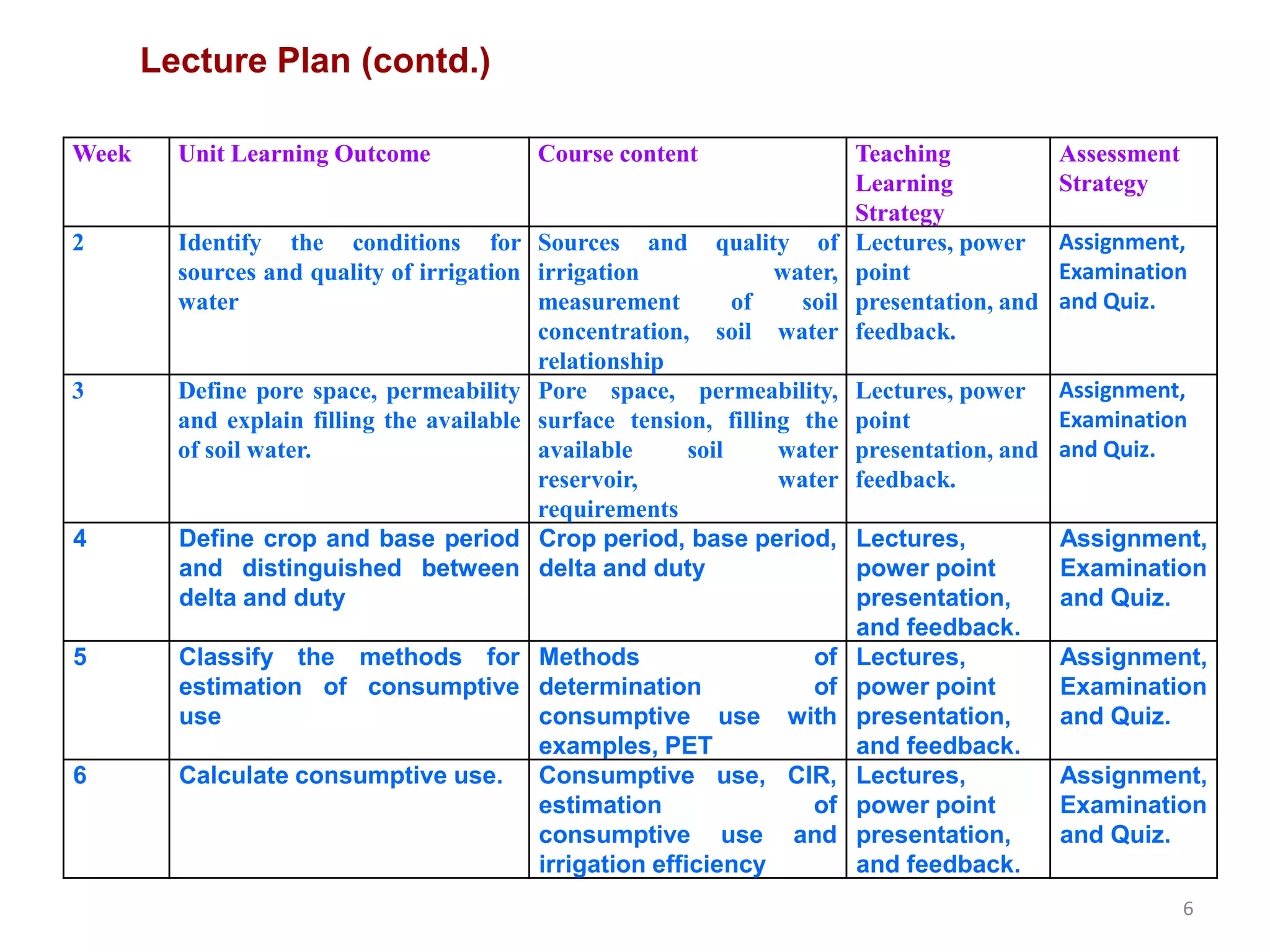
Lecture Plan (contd.)
Week Unit Learning Outcome Course content Teaching
Learning
Strategy
Assessment
Strategy
2 Identify the conditions for
sources and quality of irrigation
water
Sources and quality of
irrigation water,
measurement of soil
concentration, soil water
relationship
Lectures, power
point
presentation, and
feedback.
Assignment,
Examination
and Quiz.
3 Define pore space, permeability
and explain filling the available
of soil water.
Pore space, permeability,
surface tension, filling the
available soil water
reservoir, water
requirements
Lectures, power
point
presentation, and
feedback.
Assignment,
Examination
and Quiz.
4 Define crop and base period
and distinguished between
delta and duty
Crop period, base period,
delta and duty
Lectures,
power point
presentation,
and feedback.
Assignment,
Examination
and Quiz.
5 Classify the methods for
estimation of consumptive
use
Methods of
determination of
consumptive use with
examples, PET
Lectures,
power point
presentation,
and feedback.
Assignment,
Examination
and Quiz.
6 Calculate consumptive use. Consumptive use, CIR,
estimation of
consumptive use and
irrigation efficiency
Lectures,
power point
presentation,
and feedback.
Assignment,
Examination
and Quiz.
7
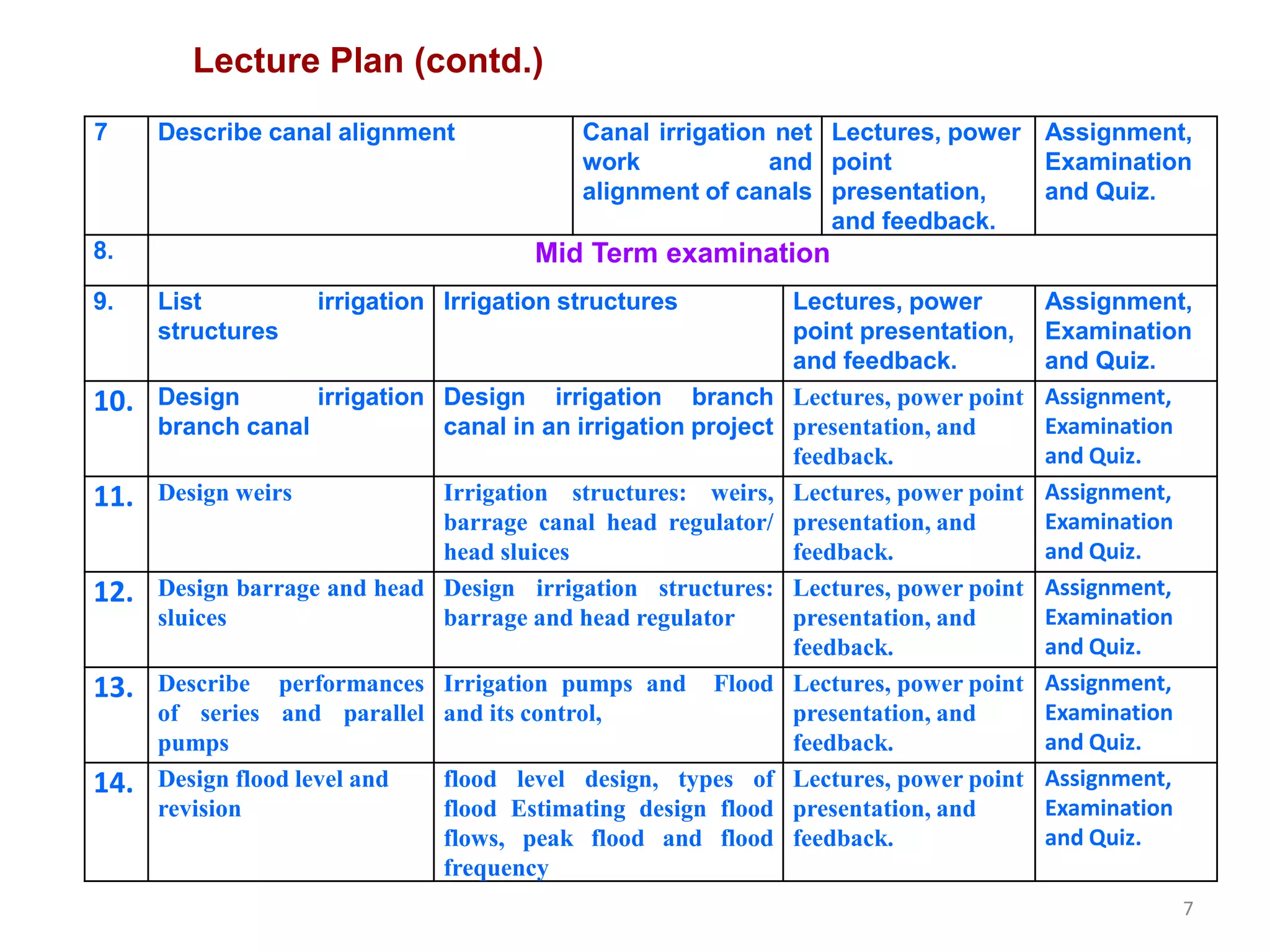
7 Describe canal alignment Canal irrigation net
work and
alignment of canals
Lectures, power
point
presentation,
and feedback.
Assignment,
Examination
and Quiz.
8. Mid Term examination
9. List irrigation
structures
Irrigation structures Lectures, power
point presentation,
and feedback.
Assignment,
Examination
and Quiz.
10. Design irrigation
branch canal
Design irrigation branch
canal in an irrigation project
Lectures, power point
presentation, and
feedback.
Assignment,
Examination
and Quiz.
11. Design weirs Irrigation structures: weirs,
barrage canal head regulator/
head sluices
Lectures, power point
presentation, and
feedback.
Assignment,
Examination
and Quiz.
12. Design barrage and head
sluices
Design irrigation structures:
barrage and head regulator
Lectures, power point
presentation, and
feedback.
Assignment,
Examination
and Quiz.
13. Describe performances
of series and parallel
pumps
Irrigation pumps and Flood
and its control,
Lectures, power point
presentation, and
feedback.
Assignment,
Examination
and Quiz.
14. Design flood level and
revision
flood level design, types of
flood Estimating design flood
flows, peak flood and flood
frequency
Lectures, power point
presentation, and
feedback.
Assignment,
Examination
and Quiz.
Lecture Plan (contd.)
8
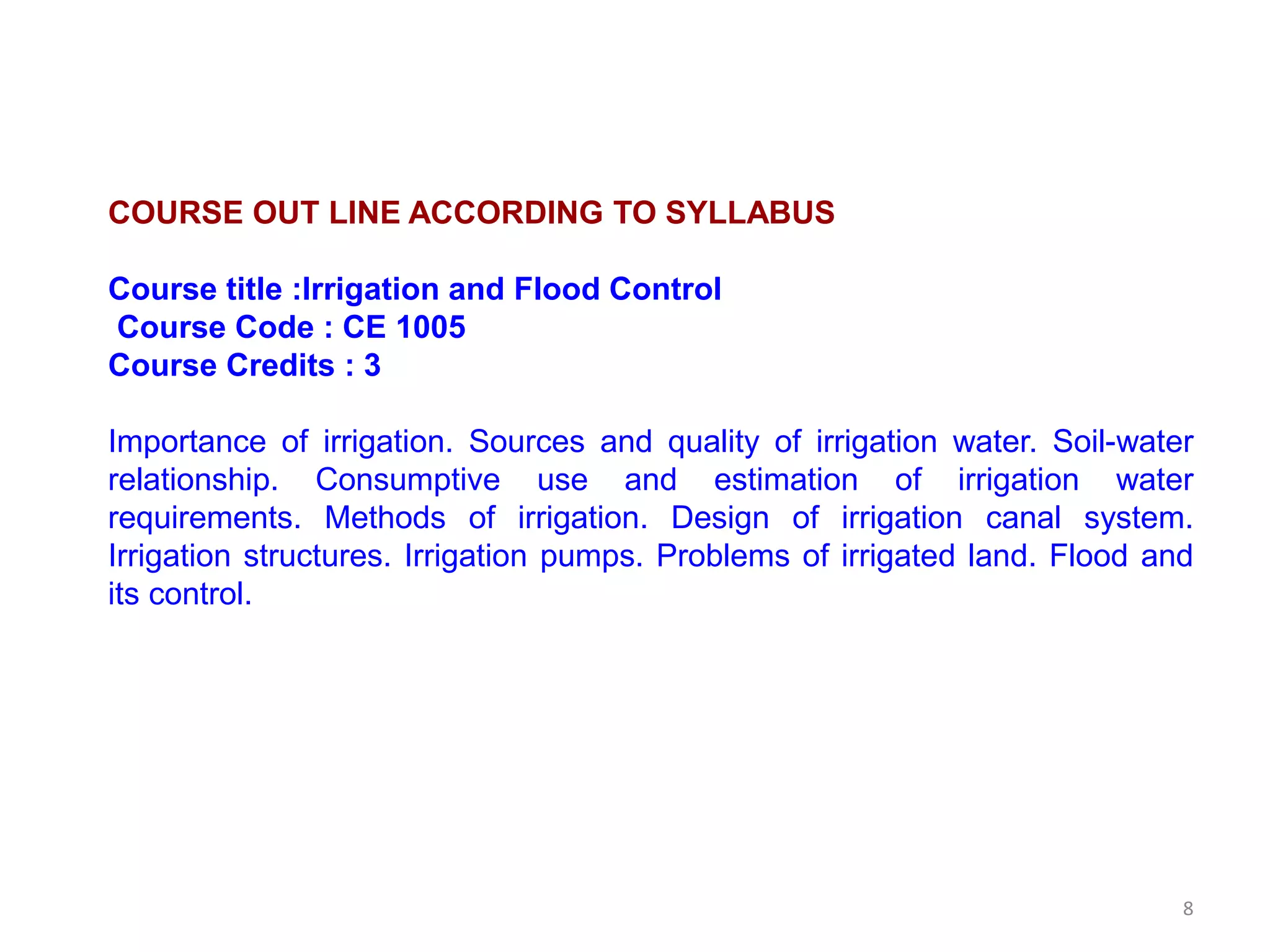
COURSE OUT LINE ACCORDING TO SYLLABUS
Course title :Irrigation and Flood Control
Course Code : CE 1005
Course Credits : 3
Importance of irrigation. Sources and quality of irrigation water. Soil-water
relationship. Consumptive use and estimation of irrigation water
requirements. Methods of irrigation. Design of irrigation canal system.
Irrigation structures. Irrigation pumps. Problems of irrigated land. Flood and
its control.
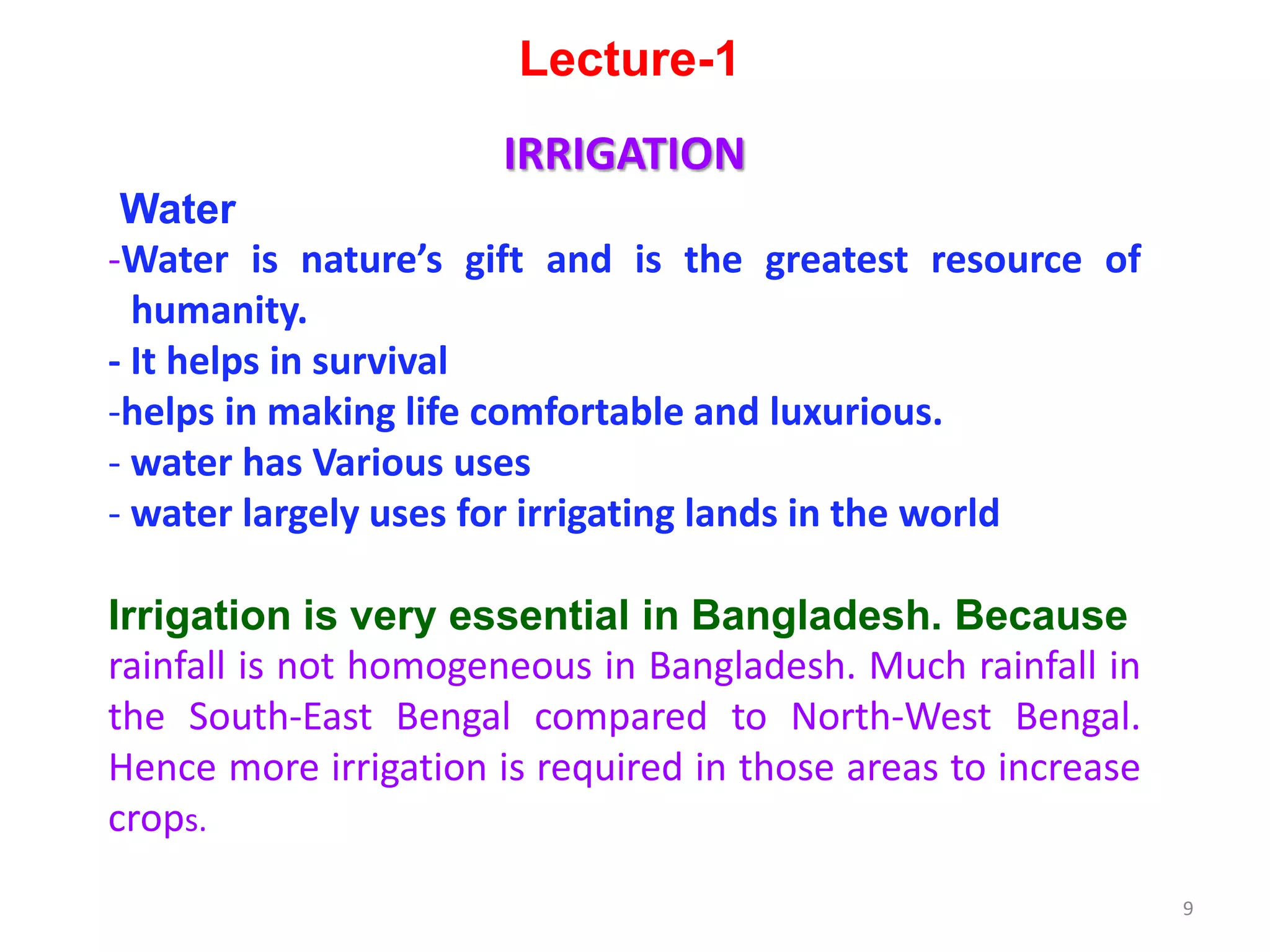
Lecture-1
IRRIGATION
Water
-Water is nature’s gift and is the greatest resource of
humanity.
- It helps in survival
-helps in making life comfortable and luxurious.
- water has Various uses
- water largely uses for irrigating lands in the world
Irrigation is very essential in Bangladesh. Because
rainfall is not homogeneous in Bangladesh. Much rainfall in
the South-East Bengal compared to North-West Bengal.
Hence more irrigation is required in those areas to increase
crops.
9
10
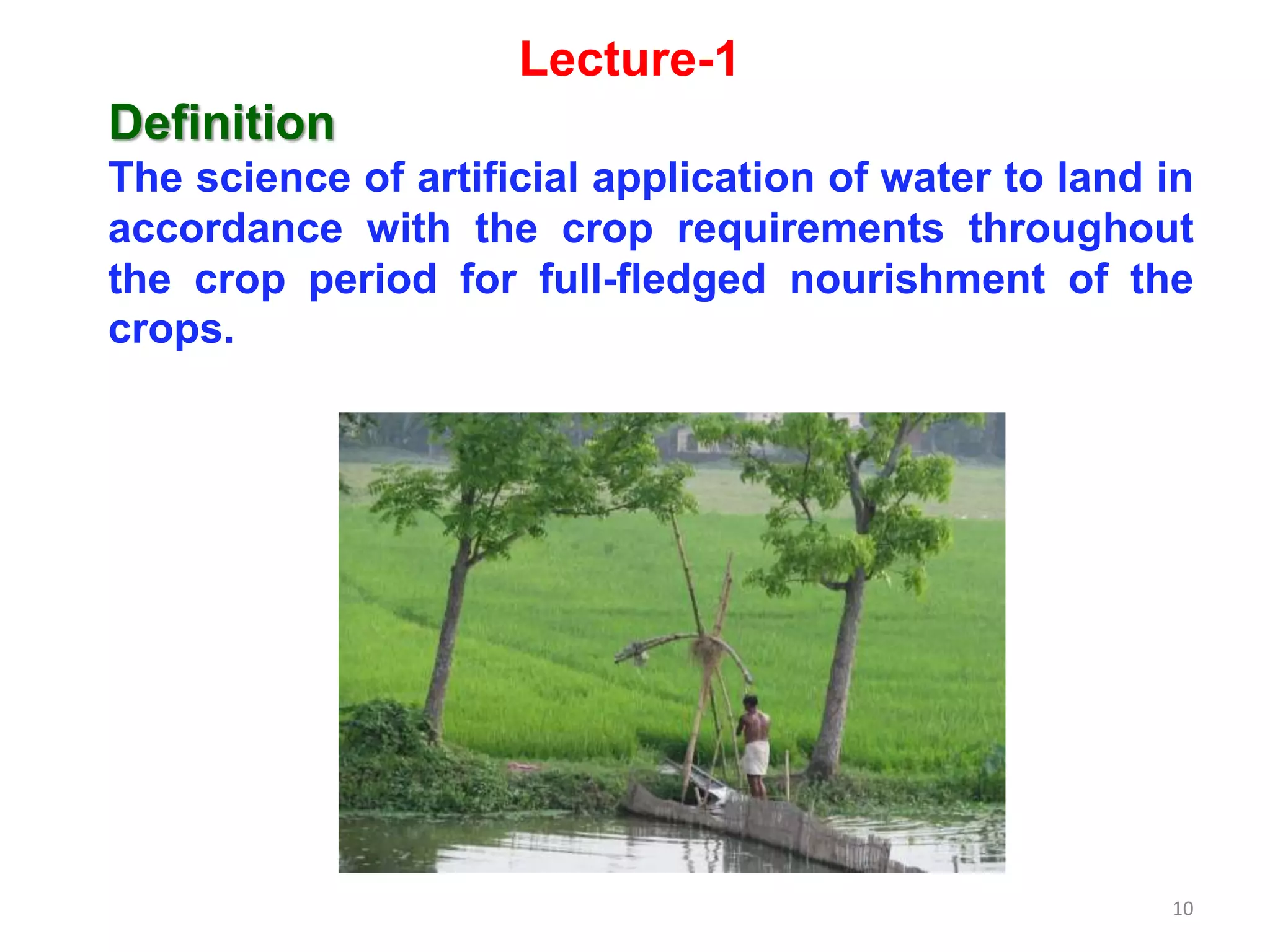
Definition
The science of artificial application of water to land in
accordance with the crop requirements throughout
the crop period for full-fledged nourishment of the
crops.
Lecture-1
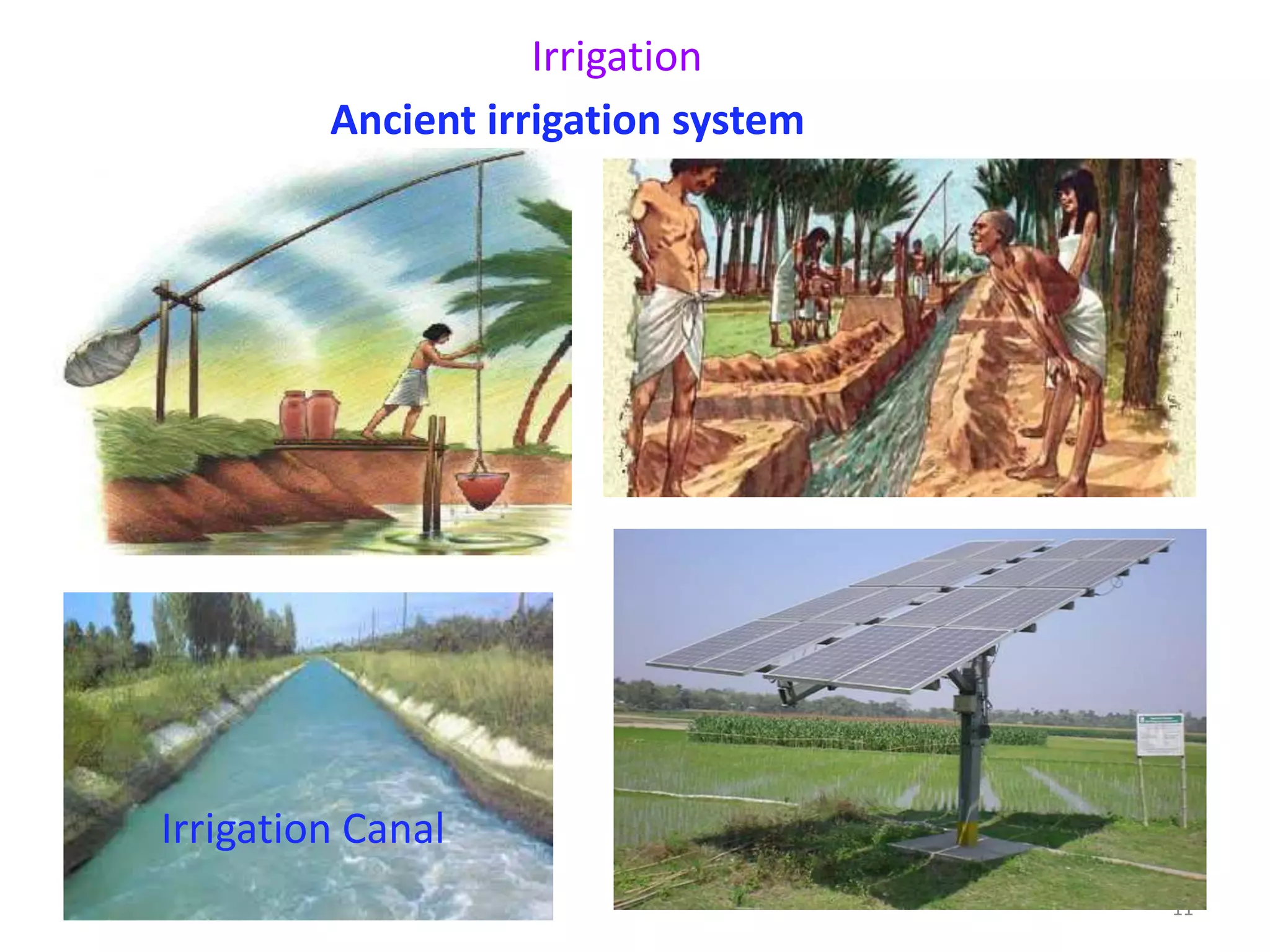
Ancient irrigation system
Irrigation Canal
11
Irrigation
12
Lecture-1(contd.)
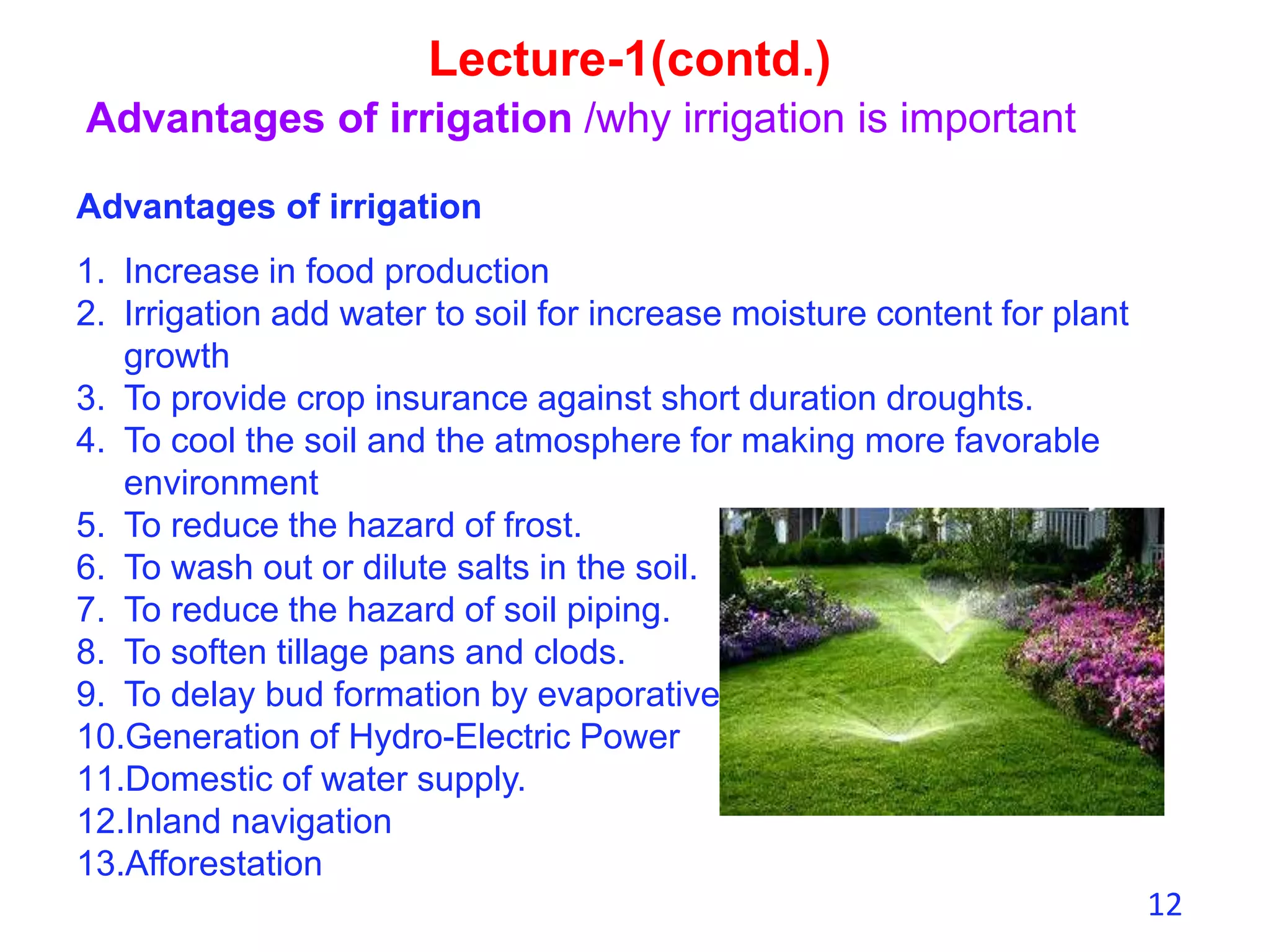
Advantages of irrigation /why irrigation is important
Advantages of irrigation
1. Increase in food production
2. Irrigation add water to soil for increase moisture content for plant
growth
3. To provide crop insurance against short duration droughts.
4. To cool the soil and the atmosphere for making more favorable
environment
5. To reduce the hazard of frost.
6. To wash out or dilute salts in the soil.
7. To reduce the hazard of soil piping.
8. To soften tillage pans and clods.
9. To delay bud formation by evaporative cooling
10.Generation of Hydro-Electric Power
11.Domestic of water supply.
12.Inland navigation
13.Afforestation
13
Lecture-1(contd.)
Disadvantages of irrigation-
1. Water pollution.
2. Irrigation creates colder and damper climate.
3. It is also the causes of marshy lands and breeding of mosquitoes, As
a result, outbreak of diseases like malaria and dengue.
4. Over irrigation may lead to water logging and may reduce crop yields.
5. Procuring and supplying irrigation water is complex and expensive
14
Lecture-1(contd.)
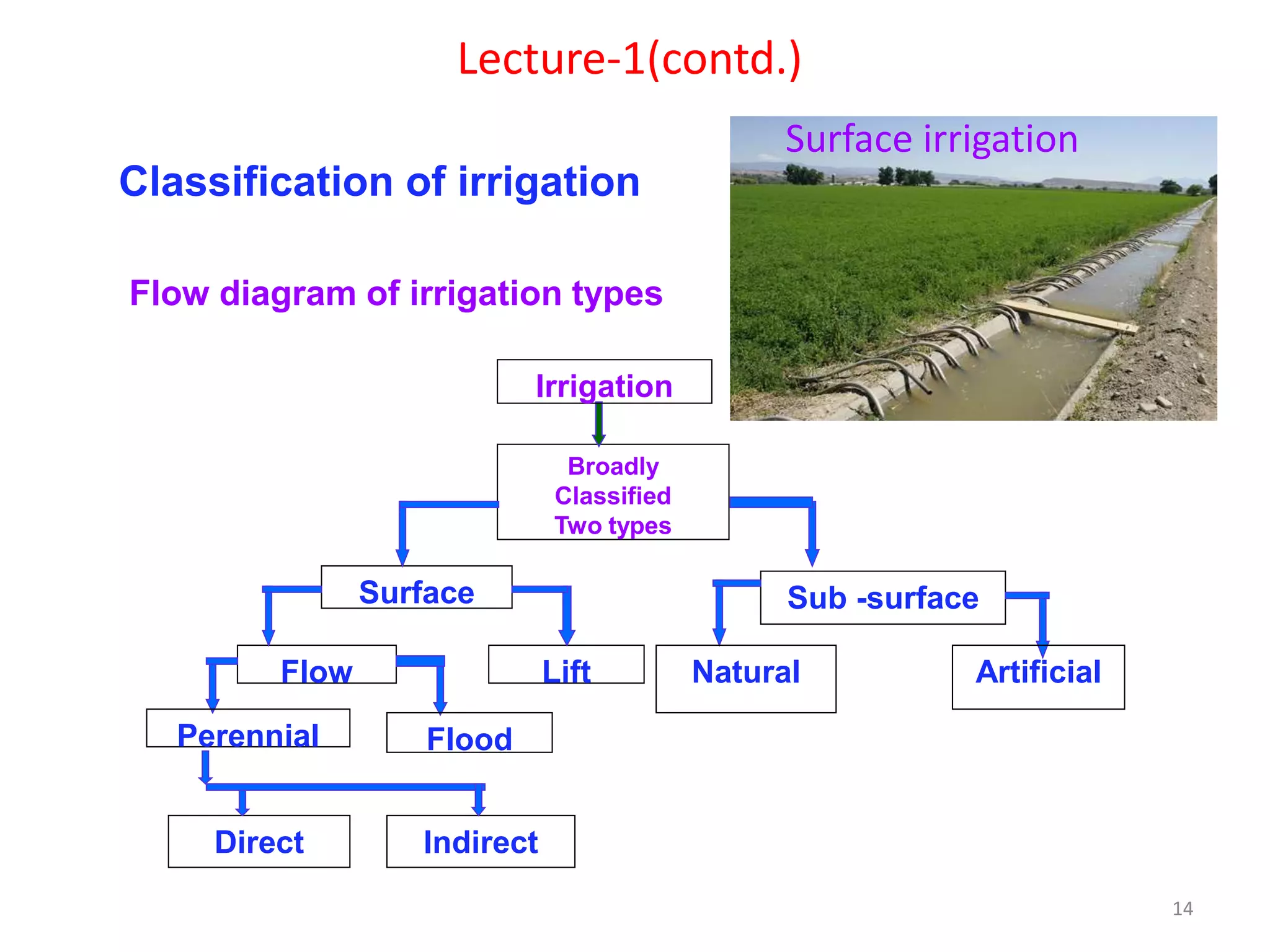
Classification of irrigation
Broadly
Classified
Two types
Sub -surfaceSurface
LiftFlow
Flood
ArtificialNatural
Perennial
Direct Indirect
Irrigation
Flow diagram of irrigation types
Surface irrigation
15
Lecture-1(contd.)
Description of irrigation classification
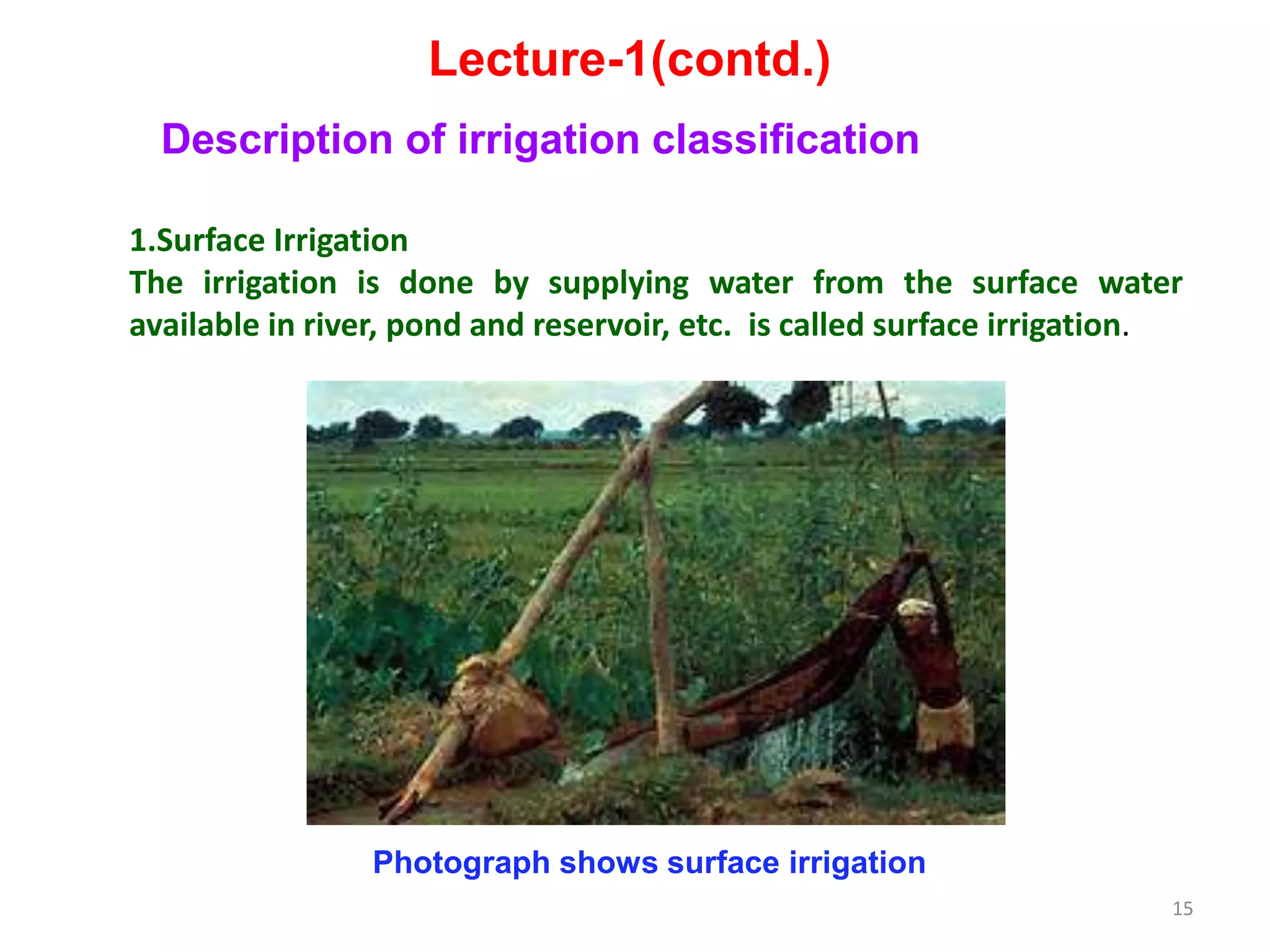
1.Surface Irrigation
The irrigation is done by supplying water from the surface water
available in river, pond and reservoir, etc. is called surface irrigation.
Photograph shows surface irrigation
16
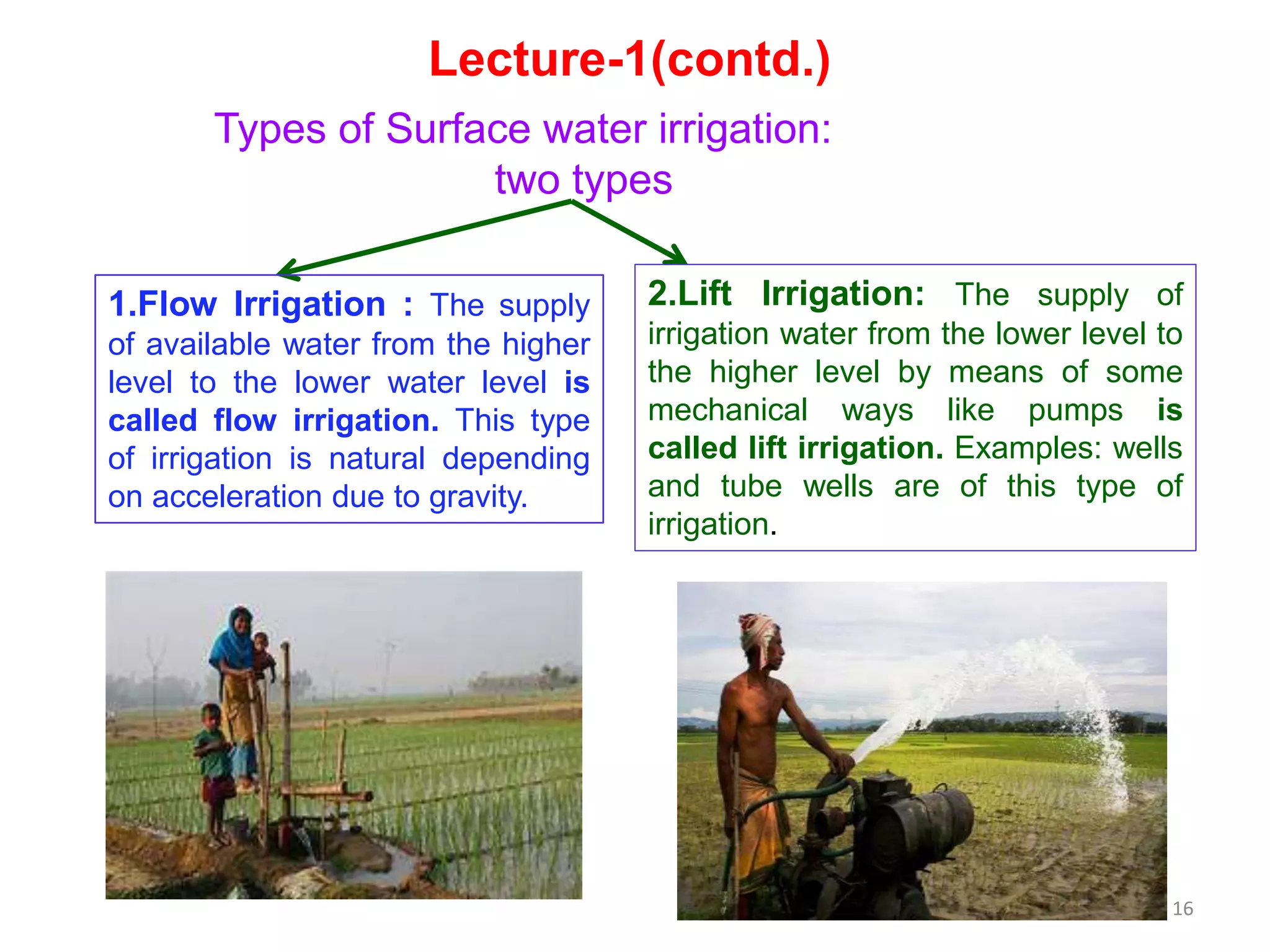
Types of Surface water irrigation:
two types
1.Flow Irrigation : The supply
of available water from the higher
level to the lower water level is
called flow irrigation. This type
of irrigation is natural depending
on acceleration due to gravity.
2.Lift Irrigation: The supply of
irrigation water from the lower level to
the higher level by means of some
mechanical ways like pumps is
called lift irrigation. Examples: wells
and tube wells are of this type of
irrigation.
Lecture-1(contd.)
17
Lecture-1(contd.)
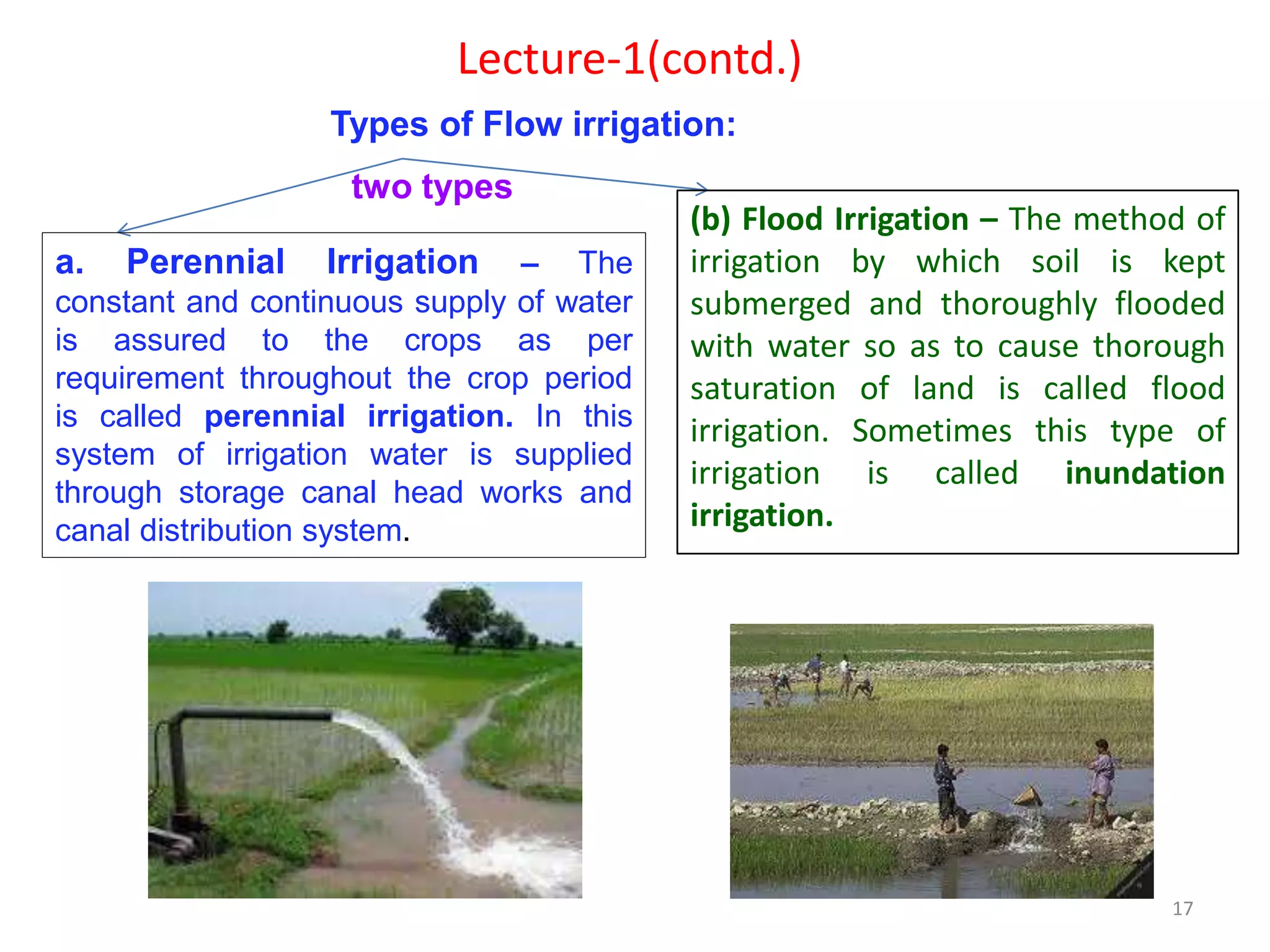
Types of Flow irrigation:
a. Perennial Irrigation – The
constant and continuous supply of water
is assured to the crops as per
requirement throughout the crop period
is called perennial irrigation. In this
system of irrigation water is supplied
through storage canal head works and
canal distribution system.
(b) Flood Irrigation – The method of
irrigation by which soil is kept
submerged and thoroughly flooded
with water so as to cause thorough
saturation of land is called flood
irrigation. Sometimes this type of
irrigation is called inundation
irrigation.
two types
18
Lecture-1(contd.)
Types of (a) Perennial Irrigation :
Two types
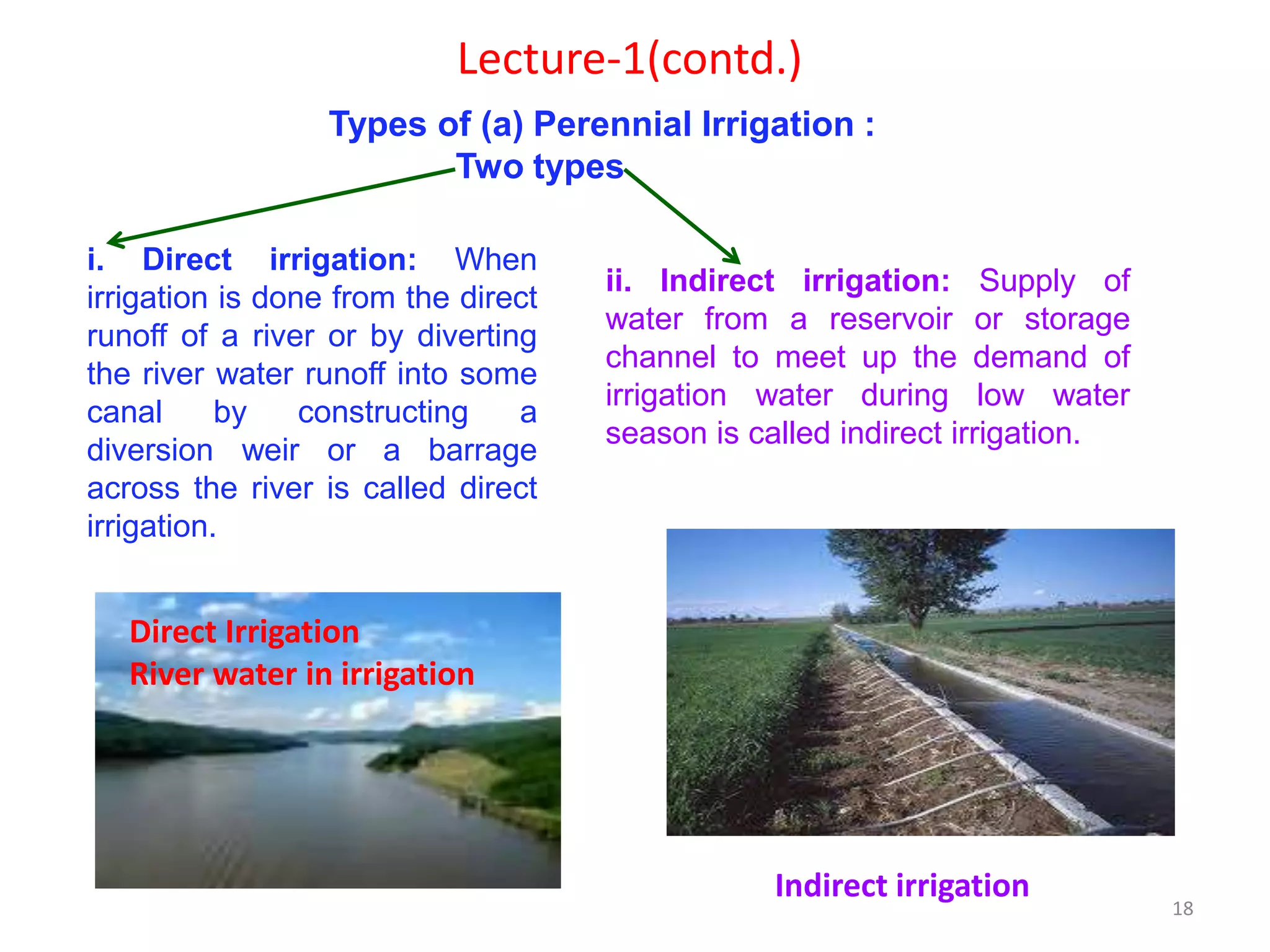
i. Direct irrigation: When
irrigation is done from the direct
runoff of a river or by diverting
the river water runoff into some
canal by constructing a
diversion weir or a barrage
across the river is called direct
irrigation.
ii. Indirect irrigation: Supply of
water from a reservoir or storage
channel to meet up the demand of
irrigation water during low water
season is called indirect irrigation.
Indirect irrigation
Direct Irrigation
River water in irrigation
19
Lecture-1(contd.)
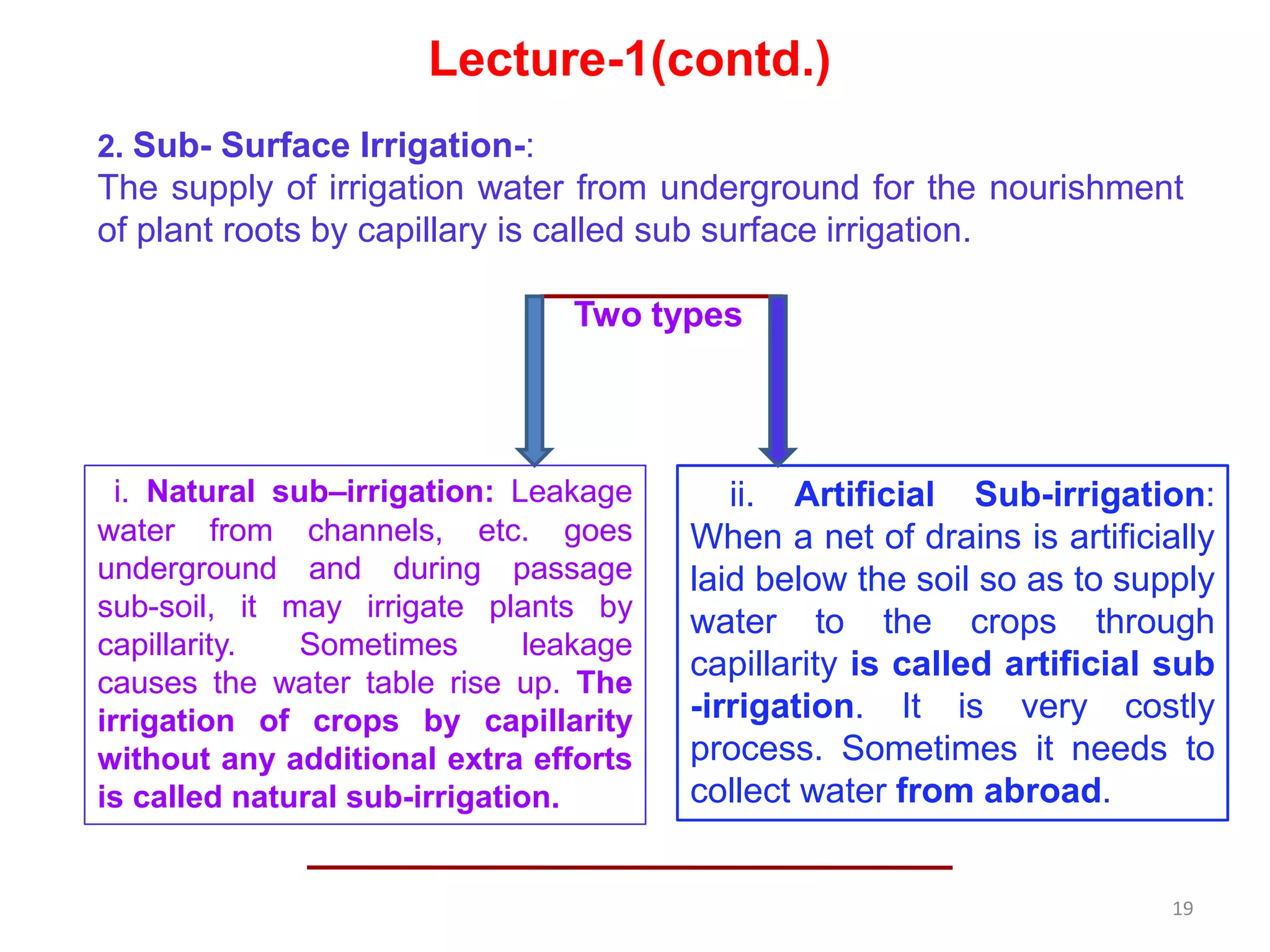
2. Sub- Surface Irrigation-:
The supply of irrigation water from underground for the nourishment
of plant roots by capillary is called sub surface irrigation.
i. Natural sub–irrigation: Leakage
water from channels, etc. goes
underground and during passage
sub-soil, it may irrigate plants by
capillarity. Sometimes leakage
causes the water table rise up. The
irrigation of crops by capillarity
without any additional extra efforts
is called natural sub-irrigation.
ii. Artificial Sub-irrigation:
When a net of drains is artificially
laid below the soil so as to supply
water to the crops through
capillarity is called artificial sub
-irrigation. It is very costly
process. Sometimes it needs to
collect water from abroad.
Two types

Class lectures on Irrigation Presentation-1 by Rabindra Ranjan saha,PEng, Assoc.Professor WUB Presentation1 ce1005

  • 1.
    World University ofBangladesh Program : B.Sc. in Civil Engineering Irrigation and Flood Control Course Code : CE1005 Lectures Notes Assoc Prof. Engr. Rabindra Ranjan Saha, PEng EX. Head Department of Civil Engineering. 1 9-05-2019
  • 2.
    2 World University ofBangladesh Vision of World University of Bangladesh To create leadership who will make his/he brains as well as the tiniest factory capable of making enormous contributions to economic emancipation and social well being of Bangladesh. Mission of World University f Bangladesh To become a university of quality and distinction enabling students to flourish academically, personally, and socially through utilitarian education at an affordable cost. The academic programs of this university are continually being updated and improved to reflect the latest development in Engineering education. Vision of Civil Engineering Department To be an internationally renowned Civil Engineering Department for producing leader of the leaders who will contribute to economic emancipation as well as national development in the field of Civil Engineering Mission of Civil Engineering Department To advance engineering knowledge and learning through utilitarian education and research in the pursuit of fulfilling aspiration of the University and Nation World University of Bangladesh
  • 3.
    3 Course Profile Table-1 Course Title: Irrigation and flood control Course ID: CE 1005 Rationale The study of this course is to understand basic concepts of irrigation and water requirement for plants growth. To know the different methods of irrigation and irrigation structures. To understand the concepts of design canal, irrigation structures and hydraulic structures for flood protection. And also to gather knowledge about the flood and its control. Outcomes At the end of this course, the students will be able to: 1. Explain different types of irrigation, classification, methods of irrigation, identification of quality irrigation water and its sources 2. Explain water requirements for crops, consumptive use 3. Design of irrigation canal, irrigation structures, irrigation pumps, flood and flood control and hydraulic structures for flood protection Unit Learning Outcomes Course content Teaching Learning strategy Assessment strategy Define irrigation. Classify irrigation. Describe sprinkler and trickle irrigation method. Introduction, irrigation, importance and demerits of irrigation and its classification. Methods of irrigation, quality irrigation water and sources. Lectures, power point presentation, and feedback. Assignment, Examination and class presentation
  • 4.
    4 Course Profile (Continued) Listthe tools for the determination of water requirements for crops. Define consumptive use and solve problems on estimation of consumptive use Water requirements for plants growth, consumptive use and estimate, different methods for estimation of consumptive use. Lectures, power point presentation, and feedback. Assignment, Examination and class presentation  Describe irrigation channel net work system; define irrigation structures with examples, methods for flood control.  Design branch canal Irrigation structures, Examples on irrigation structures, canal irrigation network system, design of irrigation canal. Irrigation pumps and flood control. Lectures, power point presentation, and feedback. Assignment, Examination and class presentation Main References (1).Santosh Kumar Garg, Irrigation Engineering and Hydraulic structures-2nd revised edition-Oct,2008 (2) Vaughn E. Hanson, Orson W. Israelsen And Glen E. Stringham Irrigation Principles practices. (3) P Novak, AIB, Moffat, C Nalluri and R Narayan Hydraulic Structures-4th Edition Table 2: Course Outcome (CO) and Program Outcome (PO) relationship Course Code PO CO PO 1 PO 2 PO 3 PO 4 PO 5 PO 6 PO 7 PO 8 PO 9 PO10 PO11 PO12 CE1005 1 √ √ 2 3 √
  • 5.
    5 Lecture Plan Course Title:Irrigation and Flood Control Course ID: CE 1005 Rationale Water is natural gift and the greatest resource of humanity. The largest use of water in the world is made for irrigating lands for increasing food production. The study of this course with aim to know the requirement of water for the plant growth, different methods of irrigation and irrigation structures, design and also to gather knowledge about the flood and its control. Outcomes At the end of this course, students will be able to understand and gather knowledge about: 1. Irrigation, classification, methods of irrigation, identification of quality irrigation water and its sources 2. Water requirements for crops, consumptive use 3. Design of irrigation canal, irrigation structures, irrigation pumps, Flood and flood control Week Unit Learning Outcome Course content Teaching Learning Strategy Assessment Strategy 1. Program Outcome (PO), Vision, Mission, Objectives, CO-PO relationship Introduction, Description, Conclusion List the merits and demerits of irrigation Irrigation, advantages and disadvantages of irrigation, classification irrigation Lectures, power point presentation, and feedback. Assignment, Examination and Quiz.
  • 6.
    6 Lecture Plan (contd.) WeekUnit Learning Outcome Course content Teaching Learning Strategy Assessment Strategy 2 Identify the conditions for sources and quality of irrigation water Sources and quality of irrigation water, measurement of soil concentration, soil water relationship Lectures, power point presentation, and feedback. Assignment, Examination and Quiz. 3 Define pore space, permeability and explain filling the available of soil water. Pore space, permeability, surface tension, filling the available soil water reservoir, water requirements Lectures, power point presentation, and feedback. Assignment, Examination and Quiz. 4 Define crop and base period and distinguished between delta and duty Crop period, base period, delta and duty Lectures, power point presentation, and feedback. Assignment, Examination and Quiz. 5 Classify the methods for estimation of consumptive use Methods of determination of consumptive use with examples, PET Lectures, power point presentation, and feedback. Assignment, Examination and Quiz. 6 Calculate consumptive use. Consumptive use, CIR, estimation of consumptive use and irrigation efficiency Lectures, power point presentation, and feedback. Assignment, Examination and Quiz.
  • 7.
    7 7 Describe canalalignment Canal irrigation net work and alignment of canals Lectures, power point presentation, and feedback. Assignment, Examination and Quiz. 8. Mid Term examination 9. List irrigation structures Irrigation structures Lectures, power point presentation, and feedback. Assignment, Examination and Quiz. 10. Design irrigation branch canal Design irrigation branch canal in an irrigation project Lectures, power point presentation, and feedback. Assignment, Examination and Quiz. 11. Design weirs Irrigation structures: weirs, barrage canal head regulator/ head sluices Lectures, power point presentation, and feedback. Assignment, Examination and Quiz. 12. Design barrage and head sluices Design irrigation structures: barrage and head regulator Lectures, power point presentation, and feedback. Assignment, Examination and Quiz. 13. Describe performances of series and parallel pumps Irrigation pumps and Flood and its control, Lectures, power point presentation, and feedback. Assignment, Examination and Quiz. 14. Design flood level and revision flood level design, types of flood Estimating design flood flows, peak flood and flood frequency Lectures, power point presentation, and feedback. Assignment, Examination and Quiz. Lecture Plan (contd.)
  • 8.
    8 COURSE OUT LINEACCORDING TO SYLLABUS Course title :Irrigation and Flood Control Course Code : CE 1005 Course Credits : 3 Importance of irrigation. Sources and quality of irrigation water. Soil-water relationship. Consumptive use and estimation of irrigation water requirements. Methods of irrigation. Design of irrigation canal system. Irrigation structures. Irrigation pumps. Problems of irrigated land. Flood and its control.
  • 9.
    Lecture-1 IRRIGATION Water -Water is nature’sgift and is the greatest resource of humanity. - It helps in survival -helps in making life comfortable and luxurious. - water has Various uses - water largely uses for irrigating lands in the world Irrigation is very essential in Bangladesh. Because rainfall is not homogeneous in Bangladesh. Much rainfall in the South-East Bengal compared to North-West Bengal. Hence more irrigation is required in those areas to increase crops. 9
  • 10.
    10 Definition The science ofartificial application of water to land in accordance with the crop requirements throughout the crop period for full-fledged nourishment of the crops. Lecture-1
  • 11.
  • 12.
    12 Lecture-1(contd.) Advantages of irrigation/why irrigation is important Advantages of irrigation 1. Increase in food production 2. Irrigation add water to soil for increase moisture content for plant growth 3. To provide crop insurance against short duration droughts. 4. To cool the soil and the atmosphere for making more favorable environment 5. To reduce the hazard of frost. 6. To wash out or dilute salts in the soil. 7. To reduce the hazard of soil piping. 8. To soften tillage pans and clods. 9. To delay bud formation by evaporative cooling 10.Generation of Hydro-Electric Power 11.Domestic of water supply. 12.Inland navigation 13.Afforestation
  • 13.
    13 Lecture-1(contd.) Disadvantages of irrigation- 1.Water pollution. 2. Irrigation creates colder and damper climate. 3. It is also the causes of marshy lands and breeding of mosquitoes, As a result, outbreak of diseases like malaria and dengue. 4. Over irrigation may lead to water logging and may reduce crop yields. 5. Procuring and supplying irrigation water is complex and expensive
  • 14.
    14 Lecture-1(contd.) Classification of irrigation Broadly Classified Twotypes Sub -surfaceSurface LiftFlow Flood ArtificialNatural Perennial Direct Indirect Irrigation Flow diagram of irrigation types Surface irrigation
  • 15.
    15 Lecture-1(contd.) Description of irrigationclassification 1.Surface Irrigation The irrigation is done by supplying water from the surface water available in river, pond and reservoir, etc. is called surface irrigation. Photograph shows surface irrigation
  • 16.
    16 Types of Surfacewater irrigation: two types 1.Flow Irrigation : The supply of available water from the higher level to the lower water level is called flow irrigation. This type of irrigation is natural depending on acceleration due to gravity. 2.Lift Irrigation: The supply of irrigation water from the lower level to the higher level by means of some mechanical ways like pumps is called lift irrigation. Examples: wells and tube wells are of this type of irrigation. Lecture-1(contd.)
  • 17.
    17 Lecture-1(contd.) Types of Flowirrigation: a. Perennial Irrigation – The constant and continuous supply of water is assured to the crops as per requirement throughout the crop period is called perennial irrigation. In this system of irrigation water is supplied through storage canal head works and canal distribution system. (b) Flood Irrigation – The method of irrigation by which soil is kept submerged and thoroughly flooded with water so as to cause thorough saturation of land is called flood irrigation. Sometimes this type of irrigation is called inundation irrigation. two types
  • 18.
    18 Lecture-1(contd.) Types of (a)Perennial Irrigation : Two types i. Direct irrigation: When irrigation is done from the direct runoff of a river or by diverting the river water runoff into some canal by constructing a diversion weir or a barrage across the river is called direct irrigation. ii. Indirect irrigation: Supply of water from a reservoir or storage channel to meet up the demand of irrigation water during low water season is called indirect irrigation. Indirect irrigation Direct Irrigation River water in irrigation
  • 19.
    19 Lecture-1(contd.) 2. Sub- SurfaceIrrigation-: The supply of irrigation water from underground for the nourishment of plant roots by capillary is called sub surface irrigation. i. Natural sub–irrigation: Leakage water from channels, etc. goes underground and during passage sub-soil, it may irrigate plants by capillarity. Sometimes leakage causes the water table rise up. The irrigation of crops by capillarity without any additional extra efforts is called natural sub-irrigation. ii. Artificial Sub-irrigation: When a net of drains is artificially laid below the soil so as to supply water to the crops through capillarity is called artificial sub -irrigation. It is very costly process. Sometimes it needs to collect water from abroad. Two types