Downloaded 186 times




![Logic
• Entailment in Wumpus
World
• Situation after detecting
nothing in [1,1], moving
right, breeze in [2,1]
• Consider possible models
for ? assuming only pits
• 3 Boolean choices => 8
possible models
February 20, 2006 AI: Chapter 7: Logical Agents 23](https://image.slidesharecdn.com/chapter077sldes-141210114438-conversion-gate01/75/Logical-Agents-23-2048.jpg)

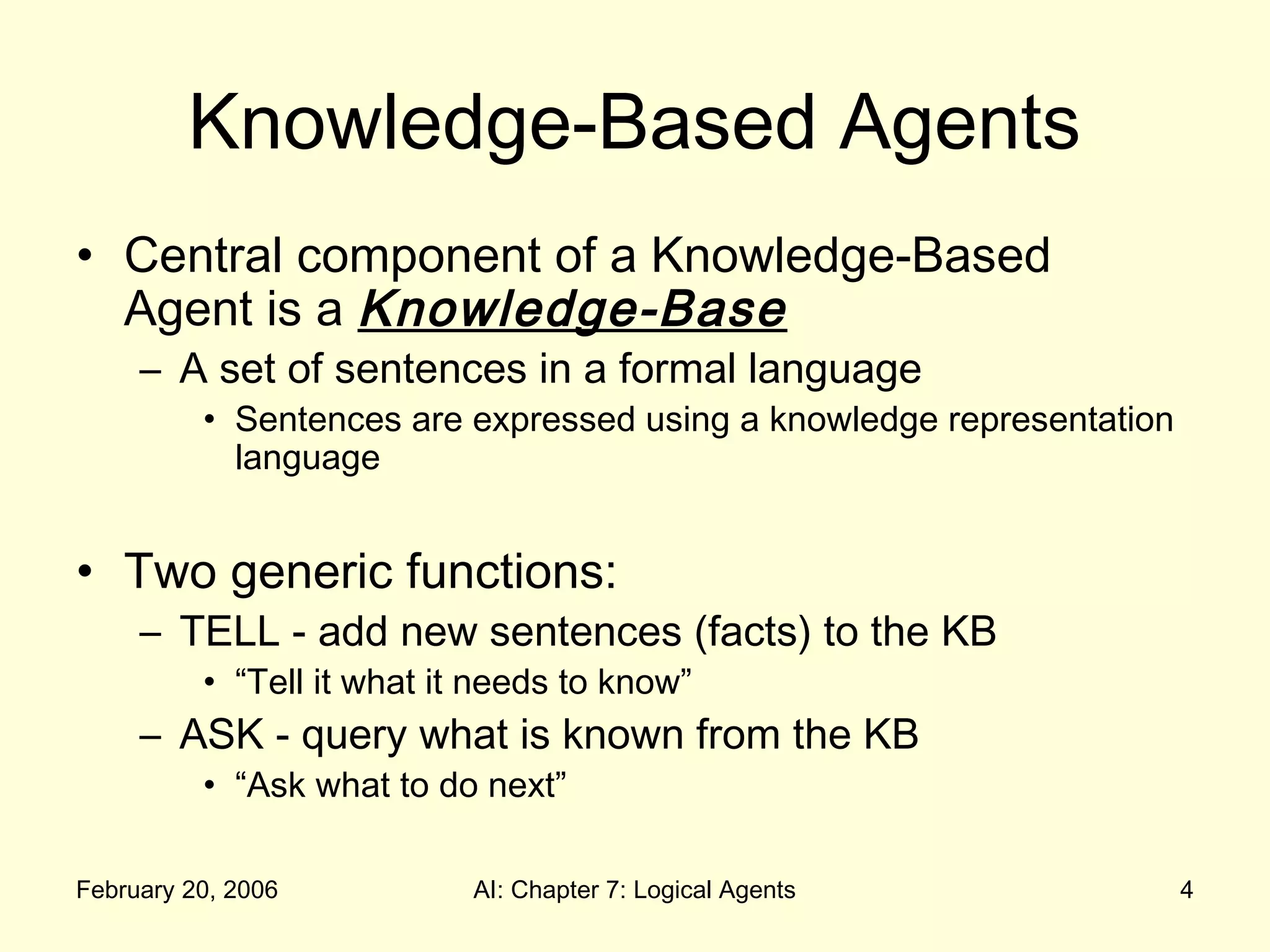
![Logic
• KB = wumpus world rules + observations
• a1 = “[1,2] is safe”, KB |= a1, proved by model checking
February 20, 2006 AI: Chapter 7: Logical Agents 25](https://image.slidesharecdn.com/chapter077sldes-141210114438-conversion-gate01/75/Logical-Agents-25-2048.jpg)
![Logic
• KB = wumpus world rules + observations
• a2 = “[2,2] is safe”, KB ¬|= a2 proved by model checking
February 20, 2006 AI: Chapter 7: Logical Agents 26](https://image.slidesharecdn.com/chapter077sldes-141210114438-conversion-gate01/75/Logical-Agents-26-2048.jpg)


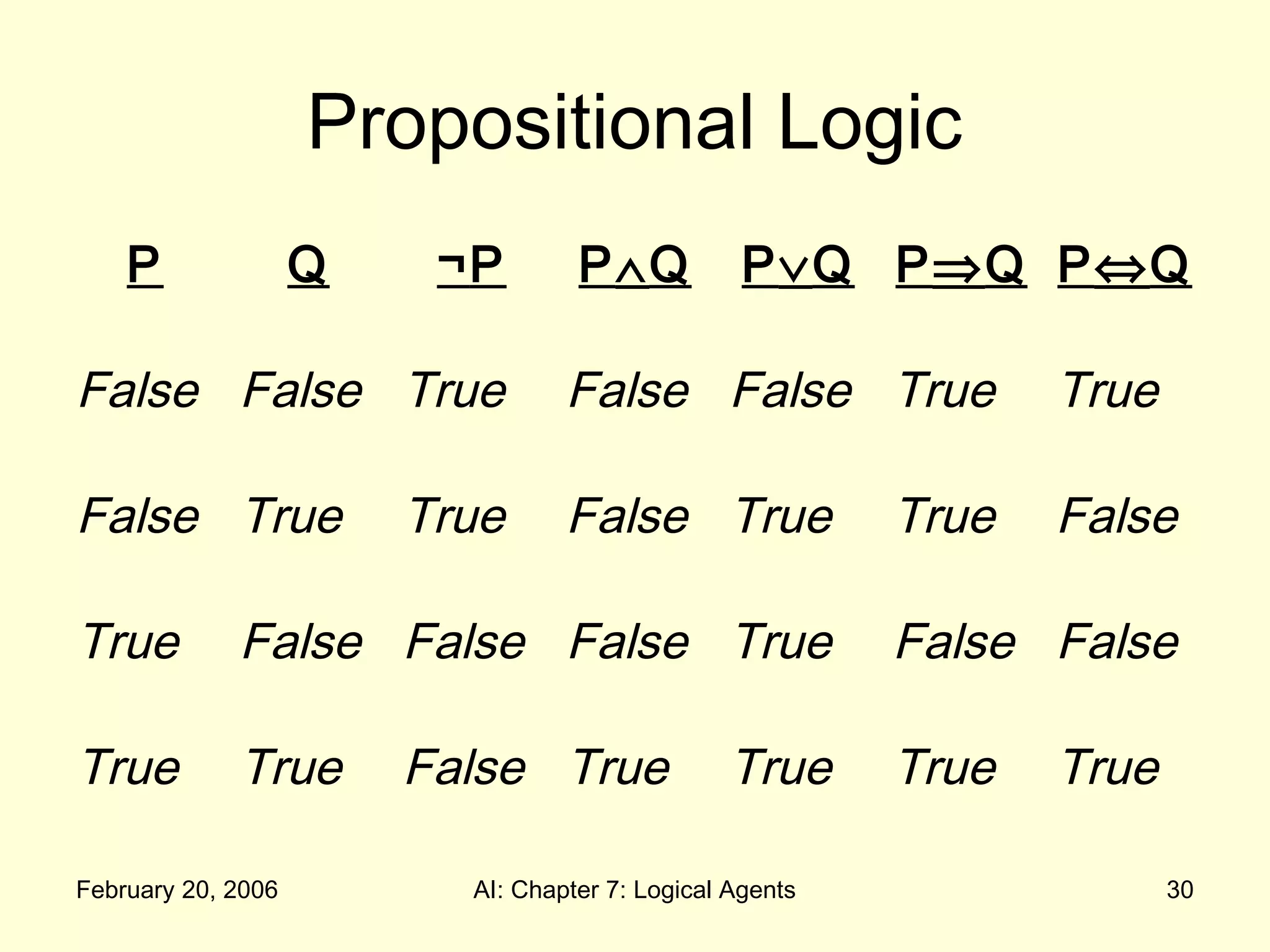
![Wumpus World Sentences
• Let Pi,j be True if there
is a pit in [i,j]
• Let Bi,j be True if there
is a breeze in [i,j]
• ¬P1,1
• ¬ B1,1
• B2,1
• “Pits cause breezes in
adjacent squares”
B1,1 Û (P1,2 Ú P2,1)
B2,1 Û (P1,1 Ú P2,1 Ú P3,1)
• A square is breezy if
and only if there is an
adjacent pit
February 20, 2006 AI: Chapter 7: Logical Agents 31](https://image.slidesharecdn.com/chapter077sldes-141210114438-conversion-gate01/75/Logical-Agents-31-2048.jpg)


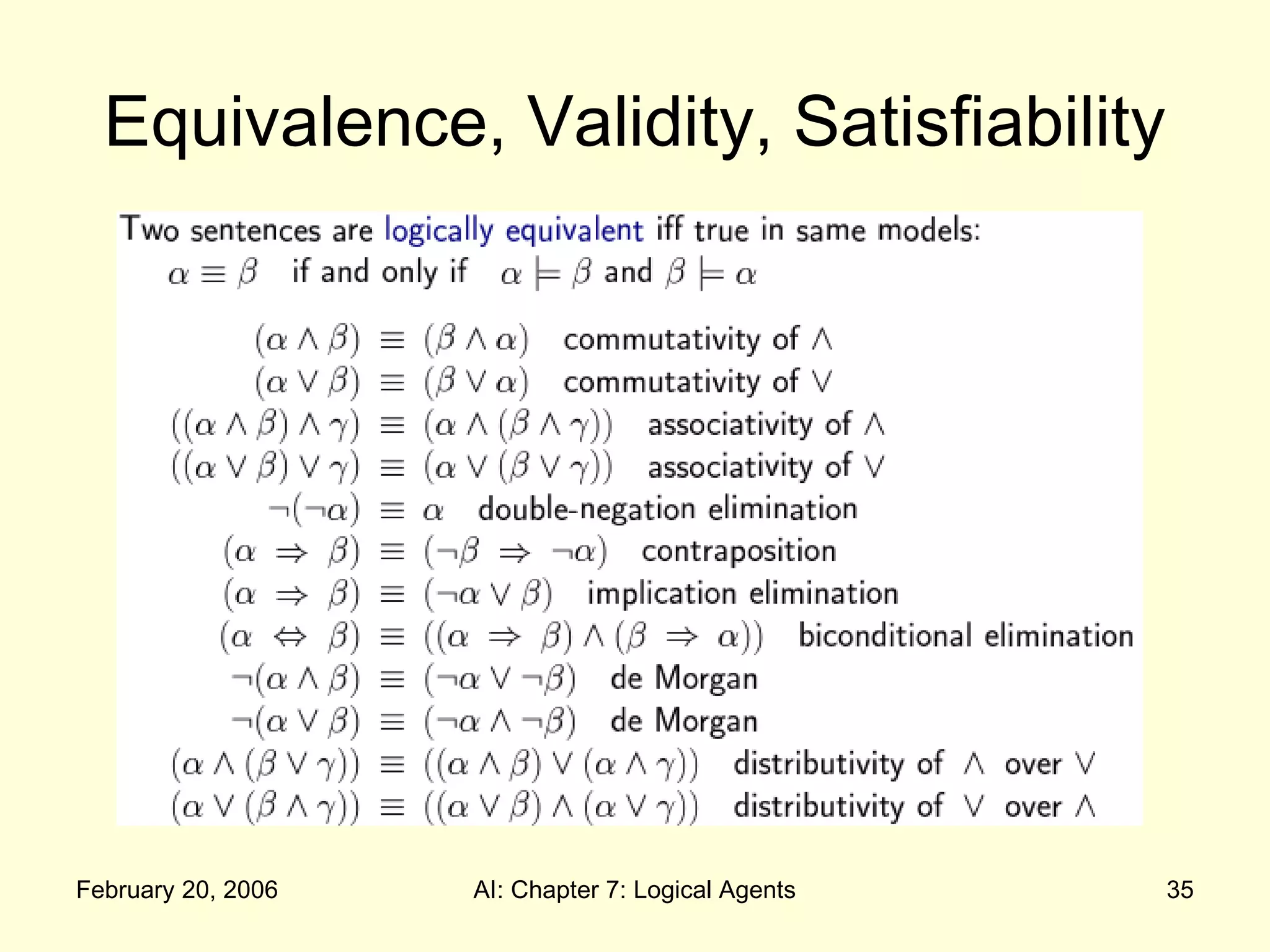


![Example Proof By Deduction
• Knowledge
S1: B22 Û ( P21 Ú P23 Ú P12 Ú P32 ) rule
S2: ØB22 observation
• Inferences
S3: (B22 Þ (P21 Ú P23 Ú P12 Ú P32 ))Ù
((P21 Ú P23 Ú P12 Ú P32 ) Þ B22) [S1,bi elim]
S4: ((P21 Ú P23 Ú P12 Ú P32 ) Þ B22) [S3, and elim]
S5: (ØB22 Þ Ø( P21 Ú P23 Ú P12 Ú P32 )) [contrapos]
S6: Ø(P21 Ú P23 Ú P12 Ú P32 ) [S2,S6, MP]
S7: ØP21 Ù ØP23 Ù ØP12 Ù ØP32 [S6, DeMorg]
February 20, 2006 AI: Chapter 7: Logical Agents 39](https://image.slidesharecdn.com/chapter077sldes-141210114438-conversion-gate01/75/Logical-Agents-39-2048.jpg)


![Resolution Example
• Given B22 and ØP21 and ØP23 and ØP32 ,
prove P12
• (ØB22 Ú P21 Ú P23 Ú P12 Ú P32 ) ; ØP12
• (ØB22 Ú P21 Ú P23 Ú P32 ) ; ØP21
• (ØB22 Ú P23 Ú P32 ) ; ØP23
• (ØB22 Ú P32 ) ; ØP32
• (ØB22) ; B22
• [empty clause]
February 20, 2006 AI: Chapter 7: Logical Agents 45](https://image.slidesharecdn.com/chapter077sldes-141210114438-conversion-gate01/75/Logical-Agents-45-2048.jpg)


This document summarizes a chapter about logical agents from an artificial intelligence textbook. It discusses how logical agents can represent knowledge and reason using that knowledge. Key points include: logical agents use a knowledge base to store facts and make inferences; propositional logic and inference rules like modus ponens allow agents to derive new knowledge; the Wumpus World example demonstrates logical reasoning to solve problems based on partial observations.


